
Quick Answer
Choose a small business lawyer for cross-border freelance work by testing whether they can map where you live, work, sign, invoice, and where clients are established before giving conclusions. The right fit helps before you sign, clarifies entity and contract boundaries, flags PE and treaty issues as fact-driven, and puts scope, ownership, fees, and ongoing support in writing.
Why a Solo Business Needs Legal Support Before Commitments Lock In#
If you run a business-of-one, reactive legal help often catches problems after key decisions are already made. A general-counsel-style partner helps before commitments lock in and gives you ongoing oversight of contracts, structure, compliance, payment terms, and ownership language.
| Reactive Lawyer | General Counsel Partner |
|---|---|
| Timing of support | After a problem appears |
| Scope of advice | One document or one dispute |
| Risk posture | Fix the immediate issue |
| Business impact | Resolves one issue |
Pillar 1: Prevent compliance surprises during onboarding. Before you invoice a cross-border client, confirm the onboarding packet, invoicing party, governing law, and tax documentation requirements for that engagement. For example, a U.S. client may request Form W-8BEN from a foreign individual to establish foreign status and, where applicable, claim treaty withholding relief. The practical rule is simple: align paperwork and contract terms before work starts, not when payment is already delayed.
Pillar 2: Protect personal assets through deliberate structure. Your legal structure affects operations, taxes, and personal asset exposure. A sole proprietorship does not create a separate legal entity. Treat structure as a legal decision with counsel, not an admin task you keep pushing off. Choosing early, then reviewing as your work changes, can reduce preventable risk.
Pillar 3: Support higher-trust client relationships with cleaner legal operations. Use contract review before signature to lock down payment timing, acceptance language, termination rights, and IP ownership terms. Do not skim past ownership clauses or "work made for hire" language without confirming what is actually being transferred. Clear terms make your business easier to evaluate and easier to trust.
Before you go deeper into Pillar 1, check four basics: your jurisdiction exposure, your contract model, your entity fit, and your advisory cadence.
For a step-by-step walkthrough, see How to Perform a Business Valuation for a Small Agency.
Pillar 1: Building Your Cross-Border Compliance Shield#
Cross-border compliance is often the first filter when you choose counsel. If a lawyer cannot quickly map where you live, work, contract, and invoice, they may be a domestic generalist rather than a strong fit for international work. Keep the core terms simple in the consultation:
- Business structure (business entity): the legal form in which a business is established or maintained.
- Permanent Establishment (PE) risk: whether your in-country activity could be treated as a taxable business presence; this depends on activities.
- Representative office: an office used for marketing or other non-transactional operations that may or may not create PE depending on activities.
Bring the core facts up front: where you live, where you physically perform services, where clients are based, and your current business structure. That structure matters because it can affect tax and legal liability, recurring filings, fundraising options, and personal asset exposure.
Step 1. Stress-test jurisdiction thinking#
Start with a question that forces clear reasoning: "I live in Country A, work part of the year in Country B, and invoice clients in Country C through my current entity. What do you review first?" Then listen to how they sort the facts.
A credible answer should separate the facts clearly: where work is performed, where clients are established, who signs, who invoices, and how your entity changes risk. It should also note that some entities require ongoing filings, such as annual reports, and that many jurisdictions default to sole proprietorship if no structure was selected.
Step 2. Probe PE awareness#
This is where vague advice gets expensive. Ask, "How would you review my work pattern and contract flow for PE risk?" A credible answer should explain that PE depends on activities, not labels alone.
| Activity or setup | PE note |
|---|---|
| Representative office used for non-transactional functions, for example marketing | May stay outside PE treatment when activity is not core business activity |
| Advertising and public relations | Generally described as non-core unless connected to sales |
| In-country activity combined with contract-concluding activity | Risk rises |
The pattern is practical: a representative office used for non-transactional functions, for example marketing, may stay outside PE treatment when activity is not core business activity. Advertising and public relations are generally described as non-core unless connected to sales. Risk rises when in-country activity is combined with contract-concluding activity.
Do not accept a universal day-count rule. A fact pattern with about 100 days is not a universal threshold.
Step 3. Test treaty framing without letting them bluff#
If treaty language comes up, the analysis should get more specific, not more confident, once your facts are on the table. Ask, "When would treaty treatment matter in my case, and what would you need before giving an answer?"
A credible answer should request your country set, entity details, and contract and invoicing chain before giving conclusions. Treat treaty analysis as fact-driven, not a blanket promise.
| Generalist Response | Cross-Border Specialist Response |
|---|---|
| Jurisdiction screening | "We can review your contract." |
| Entity view | "Set up a company and you're covered." |
| PE framing | "There's a standard day limit." |
| Treaty framing | "Treaties always fix it." |
Before You Hire#
Prepare this checklist before your next consultation:
- Map your countries of residence, physical work, and client location.
- List your current entity context, including any default sole-proprietor position.
- Prepare your contract flow: who signs, who invoices, where acceptance happens, and your current MSA and SOW set.
If you want a deeper dive, read Germany Freelance Visa: A Step-by-Step Application Guide.
Pillar 2: Forging a Liability & Asset Moat#
Once you understand the cross-border picture, get the signing entity and contract boundaries right. Before you sign any client agreement, decide in writing which entity signs and confirm key IP and scope-change terms with counsel. In practice, that is what legal readiness looks like. The goal is fewer surprises and less disruption, not zero risk.
Step 1. Choose the entity that will actually sign the contract#
Choose the signing entity based on liability exposure first, then on the admin and tax coordination you can realistically maintain. Structure affects liability, taxes, decision-making, and your ability to add partners or investors.
| Structure | Liability separation | Admin complexity | Tax coordination needs | Banking friction | Usually fits |
|---|---|---|---|---|---|
| Sole proprietorship | No personal liability shield; personal assets may be exposed to business debts/lawsuits | Low | Often simpler, but still fact-specific | Varies by bank and jurisdiction; verify current requirements | One owner only; simplest setup, highest personal exposure |
| LLC | Can provide liability protection with flexible tax treatment | Moderate | Fact-specific, especially cross-border | Varies by bank and jurisdiction; verify current requirements | Many small businesses and solo owners seeking separation with fewer formalities than a corporation |
| Corporation | Liability separation with more formalities | Higher | Can suit some tax and investment strategies, with more coordination | Varies by bank and jurisdiction; verify current requirements | Growth-oriented businesses and teams planning for outside investment |
| General partnership | Broad personal liability across partners, including for other partners' acts | Moderate operationally, but risk-heavy | Can become very complex, especially when ownership changes | Varies by bank and jurisdiction; verify current requirements | Two or more owners; sometimes used in trusted, lower-risk setups, but many advisers strongly discourage due to liability exposure |
Use concrete checkpoints with counsel:
- Confirm required formation documents were filed with the appropriate state agency.
- If you operate with a partner, confirm whether your setup creates general-partnership exposure and what that means for personal liability.
- If you are in a partnership, confirm recurring IRS information return and Schedule K-1 handling.
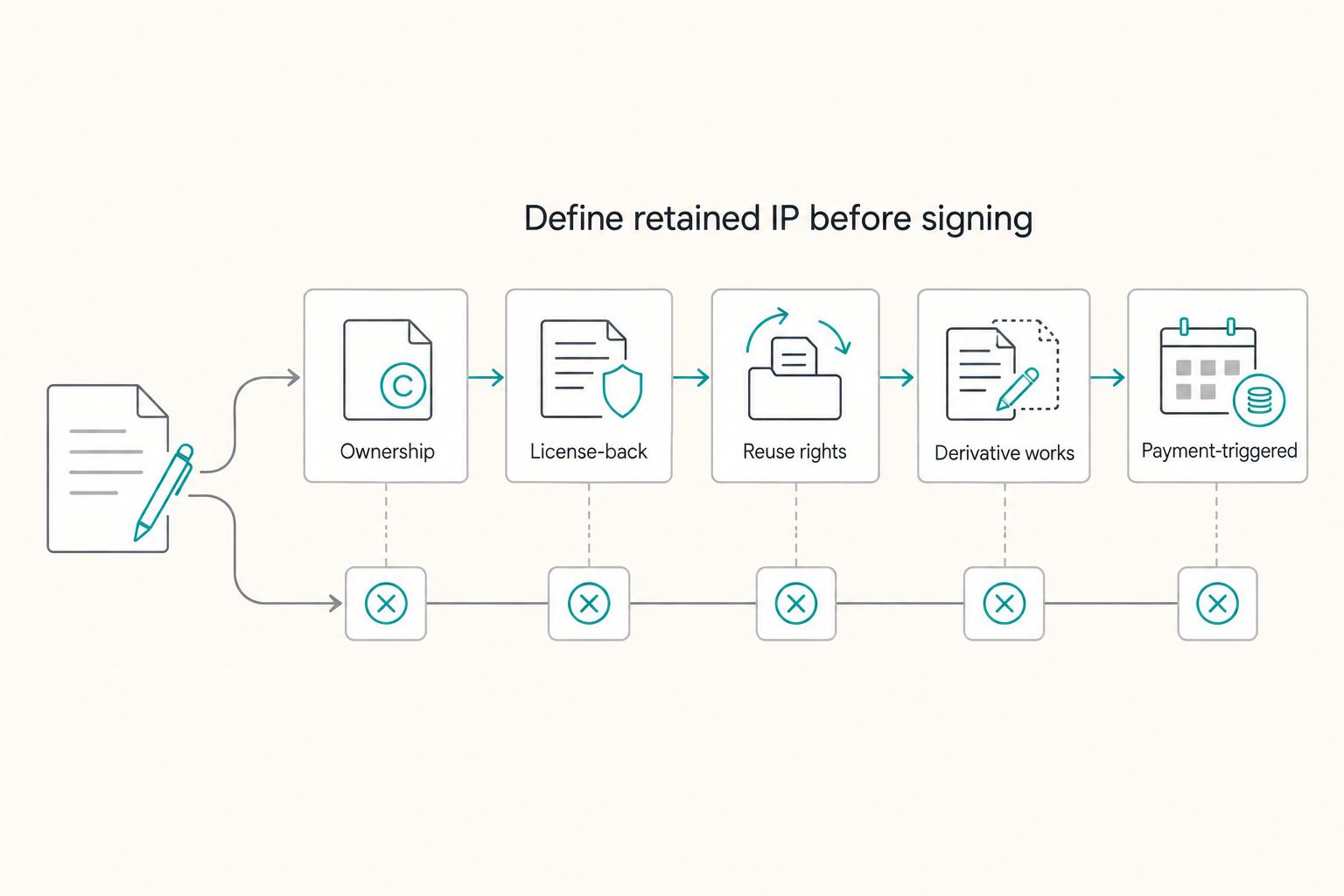
Step 2. Define what IP you keep before the contract defines it for you#
Do not rely on assumed default ownership rules for Background IP and Foreground IP here. Treat this as a contract-review checklist with counsel, and require the agreement to define the terms clearly:
| IP term | What to define |
|---|---|
| Ownership | Who owns the final deliverable |
| License-back | What rights you retain to operate or showcase work |
| Reuse rights | What pre-existing materials and know-how you can reuse |
| Derivative works | How modifications and adaptations are treated |
| Payment-triggered transfer | When ownership transfers in relation to payment |
Step 3. Lock scope-creep controls into the MSA and SOWs#
Do not treat any MSA/SOW clause set as universal protection across jurisdictions. Use this as a drafting checklist with counsel:
- Scope definition: in each SOW, state what is included, excluded, and what counts as acceptance.
- Change-order approval path: name who can approve added work, how approval is documented, and when timeline updates apply.
- Out-of-scope pricing method: pre-define hourly, fixed add-on, or new SOW.
- Dispute-handling language: draft terms that help protect delivery timelines and cash flow where your local rules and leverage allow.
Before your next counsel call, bring:
- A one-page business model summary, including offer, delivery model, and subcontractor use.
- The jurisdictions involved, including where you live, work, contract, and invoice.
- A reusable IP inventory that should remain Background IP.
- Three common scope-change scenarios you want documented in MSA and SOW terms.
Related: How to Choose a Niche for Your Freelance Business.
Pillar 3: Finding Your Value-Based Partner#
Once the legal foundation is clear, the next decision is who will help you keep it that way. Choose counsel based on how they work with you in real time, not how polished the pitch sounds. If you're working through how to choose a small business lawyer, use the consultation to test clarity, ownership, incentives, and whether ongoing support is explicitly part of the relationship.
Step 1. Test communication, ownership, and success metrics in the consultation#
A good consultation should leave you clearer on decisions, responsibilities, next steps, and how success will be evaluated. You are not looking for broad promises. You are looking for specific signs that someone will own the work, communicate clearly when facts get messy, and define performance indicators beyond cost alone.
| Question | Listen for |
|---|---|
| If I have a routine question, who is my contact and who replies? | A named person and a clear communication chain |
| If a matter needs input from multiple specialists, who owns coordination and major decisions? | One accountable owner and a clear decision path |
| How will we define success for this engagement besides spend? | Explicit performance indicators, not only financial outcomes |
| What behaviors does this engagement model reward? | Alignment between the behavior you need and the behavior being rewarded |
| What support is included between major transactions? | What is included in writing versus what requires a separate engagement |
Use those questions in the consultation, then listen for practical answers. Before you move forward, ask for a short written scope summary with responsibilities, decision ownership, and success indicators. If the conversation keeps steering toward opening new billable matters without clear ownership or metrics, treat that as an early incentive-misalignment signal.
Step 2. Match the fee model to the behavior you want#
No fee model is always right. The better question is whether the engagement terms give you predictable planning and reward the behavior you actually need.
| Fee model | What to clarify in writing | Behavior-reward check |
|---|---|---|
| Hourly | Scope boundaries, estimate update cadence, and who approves expansion | Does the model reward the behavior you need, or just more billable tasks? |
| Flat Fee | Deliverables, exclusions, and change-handling rules | Are clear scope and clear outputs rewarded? |
| Retainer | Included access, exclusions, and escalation process | Are continuity and shared context supported in practice? |
| Hybrid | Which matters are scoped vs ongoing, plus handoff triggers | Are flexibility and predictability balanced by explicit terms? |
If you need forward visibility, ask what budget and workload visibility they can reasonably provide and how often that view is refreshed. Treat explicit scope, ownership, and change-handling as practical prerequisites for predictability.
Step 3. Use a weighted scorecard with visible red flags#
Score each candidate right after the consultation while details are still fresh. Keep the weights and scores as placeholders so you can tune them to your business.
| Criterion | Weight (you set) | Score (you set) | Red flag |
|---|---|---|---|
| Communication clarity | __ | __ | Jargon-heavy answers; no direct response to practical questions |
| Ownership and decision structure | __ | __ | No single owner for coordination or major decisions |
| Performance indicators | __ | __ | Success discussed only in financial terms |
| Alignment on shared objectives | __ | __ | Treats every issue as a one-off task with no shared goals |
| Billing fit and scope clarity | __ | __ | Vague exclusions, unclear change handling, or unclear ownership |
| Ongoing advisory fit | __ | __ | Verbal promises of support but no written commitment |
Final filter: if they cannot state responsibilities, decision ownership, and success indicators clearly in writing, keep looking. Alignment can shift over time, so revisit shared objectives and incentives as the relationship evolves.
Treat Legal Support as an Ongoing Operating Decision#
Treat legal support as an operating decision, not a one-time document purchase. The right fit can give you steadier support on business structure, contracts, taxation issues, and related legal questions.
Step 1. Choose the relationship you actually need#
Choose the relationship based on how often your needs change. Use reactive legal help for narrow, stable issues. If your business model, client mix, or contract types change often, use an ongoing partner who can spot issues earlier. They should also tell you when your accountant should be involved for tax-related matters.
| Reactive legal help | Ongoing legal partner |
|---|---|
| Timing of engagement | After a dispute, filing issue, or urgent contract |
| Scope of work | One task or one document |
| Decision support | Answers the question you asked |
| Likely business impact | More after-the-fact fixes |
Step 2. Verify fit with your actual business#
Do not stop at credentials. Ask direct questions and confirm they have helped businesses like yours. Then test that against your real materials: the contracts and other core business documents they need to review.
Before you proceed, get a written scope summary that separates confirmed advice from assumptions, open items, and facts that still need tax review. For tax-related matters, confirm they will consult with your accountant. If confidence is high but answers stay vague once your facts are specific, treat that as a warning sign.
Step 3. Confirm operating terms, then review them regularly#
Before engaging counsel, confirm in writing:
- what they will review or produce, and what is excluded
- how new matters are opened and billed
- who coordinates if a specialist is needed
Then review those terms whenever your business model, client mix, or contract templates change. Also track legal spend predictability. A Dec 17, 2025 market analysis reported mean partner rate increases at top 25 firms fell to 6.3% in 2025 from 10.4% the prior year, while broader predictability weakened. That is not a direct pricing benchmark for your lawyer, but it is a practical reason to ask how rate changes are handled before invoices change.
If responsiveness drops or billing expands beyond scope without warning, switch advisors. If you need to make that move, How to Fire Your Accountant or Lawyer can help you do it cleanly.
You might also find this useful: How to Choose the Right Business Structure for Your Freelance Business.
When you are ready to pair legal structure with cleaner cross-border payment operations, review Gruv for freelancers.
Frequently Asked Questions
What should you ask about tax reporting?
Ask for a clear map of possible reporting and filing obligations based on your actual facts. A reliable answer should separate what is confirmed from what depends on your entity setup, where you live and work, client locations, and payment flows. Broad assurances before those facts are reviewed are a risk signal.
What should you ask about residency compliance?
Ask how your current living and operating setup affects registrations, filings, and business formalities you must maintain. Good advice should separate what can be handled now from what still needs local confirmation. If they skip where you actually live and operate, the advice is not decision-ready.
What should you ask about contract jurisdiction?
Ask which law should govern the contract, where disputes would be handled, and whether local mandatory rules could affect that choice. Then have counsel mark up your real MSA or SOW clauses for governing law, venue, dispute process, payment, and termination. Look for terms that are clear and enforceable in writing.
What should you ask about IP ownership?
Ask counsel to define in writing who owns pre-existing materials, who owns project deliverables, and what reuse rights you keep for methods, templates, and know-how. The contract should clearly separate background IP from project deliverables and state any ownership transfer terms. If the wording is vague, revise it before work starts.
Do you need home-country counsel, residence-country counsel, or a coordinated team?
Choose home-country counsel for matters tied to that jurisdiction, residence-country counsel for local requirements where you live or work, and a coordinated team when material activity spans more than one jurisdiction. Plan handoffs early. Confirm scope and coordination in writing instead of assuming one advisor covers everything.
When is a business lawyer enough, when is a tax lawyer enough, and when do you need both?
A business lawyer is commonly used for entity documents, contracts, drafting and review, negotiations, and governance practices that support liability protection through proper filings, contracts, and records. Add tax counsel when your main question is reporting exposure or tax treatment, or when entity and contract decisions may affect tax outcomes. Share one facts memo so both advisors work from the same assumptions.
What fee structure works best for a project-based business?
The best fee structure depends on your scope and uncertainty. Use fixed scope for clearly defined tasks and deliverables, phased scope when facts are still unfolding, and ongoing advisory when you need regular review and coordination. Before signing, lock in scope, deliverables, exclusions, point of contact, communication expectations, and what opens a new billable matter.
Can you use limited-scope legal help instead of full representation?
Yes, limited-scope legal help can work for targeted tasks such as clause review or advice on a narrow issue. It only works when the boundary is explicit in writing. Confirm whether counsel is only reviewing documents or also revising drafts, contacting the other side, or handling filings.
What is the biggest mistake to avoid?
The biggest mistake is hiring counsel without relevant business experience or without clear communication expectations. That can lead to costly mistakes and unclear handoffs. Prevent it by listing every jurisdiction involved, gathering core documents, getting a written scope summary, and confirming who owns coordination across tax, compliance, contracts, and IP before signing.
Try a related tool
Researched and edited by the Gruv editorial team. Gruv builds cross-border billing, payouts, and finance-operations software for global businesses.
Sources
- acquisition.gov/far/52.242-5trusted
- cbp.gov/trade/programs-administration/customs-brokerstrusted
- clp.law.harvard.edu/article/defining-the-perfect-partnertrusted
- copyright.gov/register/se-hire.htmltrusted
- copyright.gov/circs/circ30.pdftrusted
- dau.edu/sites/default/files/Migrated/CopDocuments/20...trusted
- federalreserve.gov/publications/files/cbem.pdftrusted
- gao.gov/assets/gao-16-89g.pdftrusted
Educational content only. Not legal, tax, or financial advice.
Related Posts

Germany Freelance Visa Application Path for Freiberufler and Gewerbe
Choose your track before you collect documents. That first decision determines what your file needs to prove and which label should appear everywhere: `Freiberufler` for liberal-profession services, or `Selbständiger/Gewerbetreibender` for business and trade activity.

How to Fire Your Accountant or Lawyer
Ending an accountant relationship is mostly an execution problem. If you're working through this, the safest path is to protect continuity first, then close the engagement in writing with clear records.

The Freelance Payment Penalty: A Modeled Audit of Platform Fees, FX Spreads, and Payout Delays
The money rarely disappears through a single, easy-to-spot fee. The real loss is stacked. A marketplace takes its commission, a processor adds a charge for international cards, a bank or payment company converts the currency at a spread, a platform holds the funds before release, and a wire sheds a little to intermediaries on the way in. Each layer looks defensible on its own, but the worker feels the combined result as a smaller deposit and a later payday.