
Quick Answer
Start with a control-first operating design for channel sales for saas: set legal and financial guardrails, activate partners through a lean handoff process, and run ongoing performance reviews. The article’s three-phase approach centers on rules of engagement, role-based onboarding, and leading indicators such as partner-sourced pipeline so you can grow distribution without drifting into pricing conflicts, messy attribution, or support chaos.
Treat the Channel as an Operating Decision You Can Inspect#
Channel sales for SaaS works when you treat the channel as an operating decision, not just a sales idea. The tradeoff is simple. You want more reach and efficiency, but you also need a centralized process with visibility, clear metrics, and controls that reduce avoidable compliance risk.
That matters even more in a lean B2B SaaS business, where recurring subscription revenue supports ongoing operations and mistakes are expensive. One cited survey says bootstrapped B2B SaaS companies operate with median total spend at 95% of revenue. It is a useful reminder that you probably do not have room for a partner motion that burns time and introduces avoidable risk. This framework is built for solo operators, small founding teams, and practical leaders who need a controlled partner program, not a sprawling channel org.
The rule up front is simple: do not recruit partners into a process you cannot inspect. If core workflow steps still live in spreadsheets and email threads, fix that first. A manual setup increases human error and leaves no audit trail, which raises legal and financial risk. A basic checkpoint is whether every step is documented, the right people can see what is happening, and the process supports internal policy and external obligations such as GDPR.
The rest of this guide follows a three-phase path. First, you set guardrails around legal, financial, and operating control. Second, you activate partners with enough structure to get traction without overbuilding. Third, you run performance control with clear metrics so strategy stays tied to tactics and execution instead of drifting.
You might also find this useful: How to Create a Sales Playbook for Your SaaS Team.
Phase 1: Architecting Your Legal & Financial Guardrails#
Before you recruit a single partner, lock four decisions: how each partner motion makes money, who approves pricing exceptions, how conflicts are resolved, and how tax/revenue treatment is reviewed. The goal in this phase is control you can inspect, not partner volume.
Start with a separate profitability model for each motion you plan to allow. Do not combine referral, affiliate, and reseller activity into one model. Each one can change margin pressure, support load, and compliance overhead in different ways. Include, at minimum: contract value, retention assumption, payout type, onboarding time, co-selling time, partner support time, customer success load, tooling/admin cost, and expected discounting.
If these inputs are missing, volume can rise while pipeline quality declines. That drift is common when teams optimize channels in isolation.
Document ownership next. Name who approves standard pricing, discounts, and non-standard terms. Use specific roles, not generic labels. If a partner requests special pricing, free onboarding, or custom clauses, final approvers should already be clear across sales, finance, product, and legal.
Pick the motion before you pick the payout#
Choose the partner motion first, then match payout design to it.
| Partner motion | Your control of contract/pricing | Margin pressure risk | Compliance/ops overhead |
|---|---|---|---|
| Referral | Higher (you keep the customer contract path) | Lower to medium (depends on payout design) | Lower to medium |
| Affiliate | Medium (message and promotion controls must be explicit) | Medium (depends on payout and channel quality) | Medium |
| Reseller / VAR / indirect resale | Lower to medium (more shared control points) | Medium to high (discounting and deal structure matter) | Higher |
Then choose a payout structure that fits cash flow and retention incentives.
| Payout structure | Best fit | Cash flow impact | Retention alignment | Admin burden |
|---|---|---|---|---|
| One-time payout | Referral or affiliate motion with simple handoff | Highest upfront cost at close | Low after deal handoff | Low |
| Recurring revenue share | Motions where partner influences adoption or renewal | Spread over customer life | Stronger | Medium to high |
| Hybrid payout | Motions needing early incentive plus ongoing involvement | Mixed upfront and ongoing cost | Medium to strong | High |
Until finance validates final values, keep unresolved payout terms explicit and confirm each with your finance team before you publish them: the one-time fee, the recurring-share range, and the hybrid payout split.
Put rules of engagement into the agreement#
Your agreement should prevent channel conflict before it starts. Define lead registration, evidence required for ownership, overlap review with direct sales, and final dispute authority. Without this, internal channel competition is likely.
Set practical boundaries for brand/IP usage: which logos, screenshots, claims, case studies, and demo assets are allowed; when pre-approval is required; and who can publish co-branded material. Define customer-data responsibilities operationally: what partners may collect, where data is stored, how it is transferred, and how deletion/security incidents are handled. If AI features are part of your motion, apply a stricter privacy/security review path up front.
Make termination workflows operational, not abstract: trigger events, who revokes portal/asset access, open-deal handling, customer handoff ownership, and treatment of confidential information and unpaid commissions. Keep an evidence pack per partner: signed agreement, approved pricing sheet, tax form (or local equivalent), brand approvals, and data-handling notes.
Run a weekly decision loop with sales and support feedback to catch message drift, pricing friction, and handoff issues early.
Before launch, review this checklist with legal and accounting:
- Finalize partner motion type by tier (referral, affiliate, reseller, or other indirect model).
- Approve payout structure and exact formulas, and confirm the final formula with your commercial team.
- Confirm pricing authority, discount authority, and exception ownership.
- Validate agreement terms for channel conflict, IP use, data responsibilities, and termination workflow.
- Confirm tax treatment, invoicing flow, and revenue treatment by partner type and jurisdiction with your finance and legal advisors.
Related: How to Build a Referral Program for Your Freelance Business.
Phase 2: A Lean System for High-Trust Activation#
Once your guardrails are set, keep activation lean: screen partners tightly, onboard by role, and push toward one shared deal first. Focus on a small, repeatable system you can run every time. If you add too much process too early, channel risk shows up fast through message drift, inconsistent execution, and slower end-customer feedback.
Tighten the partner profile before you recruit#
Use your Ideal Partner Profile as a filter, not a wish list. Start from your ICP and segmentation model, then confirm the partner already reaches that audience in a trusted way and can sell with their existing service motion.
Screen each candidate on four points:
- Audience overlap: They already serve the same buyer, use case, or segment you want.
- Service motion fit: Your product fits what they already deliver, without forcing a brand-new sales motion.
- Enablement readiness: They can name a sales contact, delivery contact, and customer success/account contact.
- Channel-fit risk signals: Ownership is vague, customer access is weak, custom pricing requests are constant, or they position themselves as "everything for everyone."
If a partner likes the idea but cannot show where your offer fits into current customer conversations, treat that as a high-risk signal.
Onboard by role and gate the handoff#
Do not enable "the partner" as a single unit. Enable the people who touch the deal.
- Sales contact: ICP summary, core message, top objections, demo path, lead registration step, and clear rules for when to involve you.
- Delivery contact: Implementation scope, handoff notes, customer prerequisites, escalation path, and out-of-scope boundaries.
- Customer success contact: Adoption milestones, renewal signals, support boundaries, and where product feedback goes.
Before you mark a partner as ready to sell, run one handoff gate:
- Confirm named contacts for sales, delivery, and customer success.
- Test lead routing once.
- Confirm access to the current asset folder or portal.
- Verify completion of required training items against the sales-ops training checklist.
- Verify completion of the final acknowledgement/certification step with sales ops.
| Lightweight stack option | Setup effort | Process control | Reporting visibility | Integration limits |
|---|---|---|---|---|
| Shared folder + form + inbox | Low | Low to medium | Low | Mostly manual handoffs |
| CRM + form + automation | Medium | Medium to high | Medium to high | Depends on your CRM and automation connections |
| Dedicated portal or PRM layer | Medium to high | High | High | More dependency on vendor connectors and admin upkeep |
Aim for one clean joint win, then review the motion#
Your first target is not scale. Your first target is one clean joint win.
- Set a lead qualification path for partner-submitted deals.
- Create a one-page shared deal plan with owner names, next step, customer problem, and close risk.
- Run a weekly communication cadence until the deal is won or lost.
- Run a short post-win or post-loss retro to capture buyer confusion, handoff gaps, and missing assets or training.
Use ramp timing as directional review points, not guarantees: if there is no path to first revenue in about 60-90 days, or no sign of full productivity by 120 days, review the partner motion before you add more.
Keep activation governance light but consistent#
You can keep governance minimal and still stay in control:
- One source of truth for partner assets.
- One lead-routing method.
- One owner for partner communications.
- Version control for customer-facing assets.
That discipline helps you scale without losing consistency.
For a step-by-step walkthrough, see A Guide to International Expansion for SaaS Businesses.
Phase 3: The KPIs for Maintaining Control and Driving Growth#
After your first joint win, control comes from reading the right signals and acting quickly. Keep your KPI set small enough to support decisions, not reporting theater.
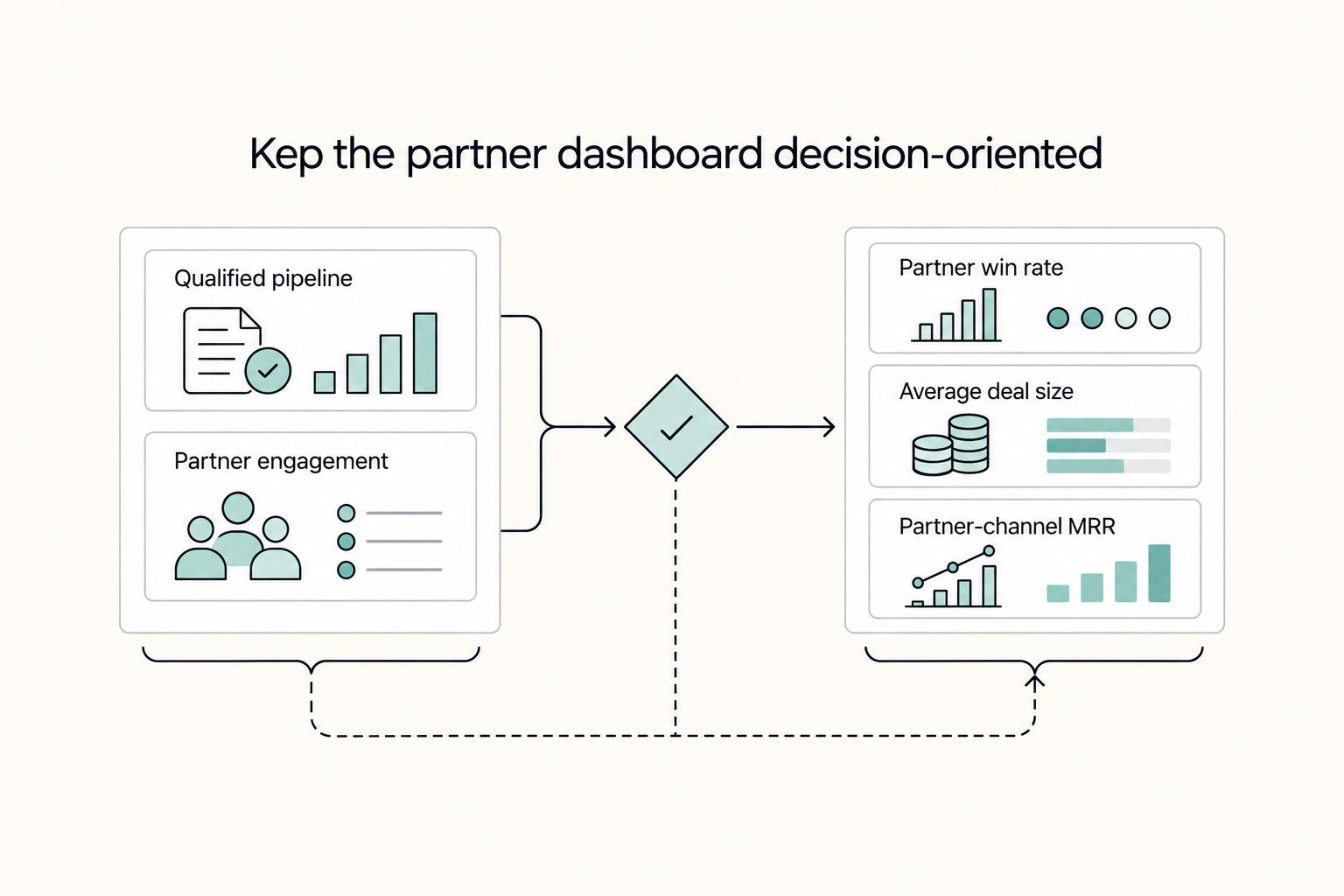
Keep your dashboard small and decision-oriented#
Use two buckets: short-cycle signals (are partners creating and advancing real opportunities now?) and longer-term outcome signals (is that motion turning into durable revenue and customer value?). Revenue alone is too slow to manage the channel well.
| KPI | What it tells you | Main data source | Owner | Review cadence | Action trigger and decision |
|---|---|---|---|---|---|
| Partner-sourced qualified pipeline | Whether partners are creating real opportunities, not just introductions | CRM opportunities + lead registration records | Channel owner or sales lead | Every recurring review | Confirm the current benchmark with sales ops; until then, if trend is flat/down vs recent baseline, review lead quality, joint prospecting, and partner profile fit |
| Partner win rate | Whether partner-submitted deals are converting | CRM stage history + close reasons | Sales lead | Every recurring review | Confirm the current benchmark with sales ops; until then, if conversion weakens vs your baseline, tighten qualification, objection handling, and seller support |
| Average deal size (partner vs direct) | Whether partners are selling full-value motions or only smaller deals | CRM closed-won data | RevOps, finance, or founder | Monthly or recurring review cycle | If partner deal size stays below direct trend, adjust packaging, pricing guidance, and demo support |
| Partner engagement | Whether enablement is being used in practice | Portal activity, training status, meeting participation | Channel owner | Every recurring review | If engagement is high but pipeline is weak, simplify enablement and require one concrete go-to-market motion |
| Partner-channel MRR | Monthly recurring revenue contribution from channel deals | Billing + finance reporting | Finance or founder | Monthly | If MRR rises while margin quality drops, review discounting, payout mechanics, and services load |
| Retention or LTV trend (partner customers) | Whether partner-originated customers sustain value over time | Billing, renewals, customer success records | Customer success lead | Monthly or trend review | If retention/LTV weakens after strong bookings, fix onboarding quality, customer fit, and handoff ownership |
Keep data hygiene strict: one partner-attribution source of truth per opportunity, one named internal owner, and a documented closed-lost reason when a deal dies.
Run one recurring review with a real paper trail#
Use one lightweight review rhythm across Sales, Marketing, and Customer Success so everyone is acting on the same facts. Quarterly can work, but during partner ramp you should review more frequently if signals are moving fast.
Pre-read (one page):
- KPI snapshot with trend notes
- Open deals by stage
- Wins/losses since last review
- One blocker that needs a decision
- Partner asks and your asks
Meeting agenda:
- Confirm KPI movement and focus on exceptions
- Decide one priority for the next cycle
- Assign owners and due dates before closing
Follow-up log (same template every time):
- Commitment
- Named owner
- Due date
- Status
- Evidence of completion
Handle disputes and early warnings before they spread#
When conflict appears, route it through a standard intake, not scattered email threads. Capture: account, contacts, opportunity summary, estimated value, first-contact timing, related registration reference, and supporting evidence you can verify.
Triage each case into:
- Ownership dispute
- Pricing/compensation question
- Delivery/support conflict
Resolve against your rules of engagement first. Escalate to the finance or legal owner named in your agreement when payout logic or contract interpretation is involved. Record the final outcome in both CRM and your partner records.
Use KPI patterns as early warnings:
- High engagement + weak pipeline: tighten enablement to one concrete use case and one joint motion.
- Strong pipeline + weak win rate: fix qualification and stage-entry discipline.
- Good bookings + weak retention/LTV: tighten onboarding and post-sale ownership.
- Uneven activity across partners: rebalance partner mix and prune inactive accounts.
- Rising revenue + falling margin quality: review discounts, compensation mechanics, and delivery load.
If you want a deeper dive, read Digital Nomad Health Insurance: A Comparison of Top Providers.
Conclusion: Define How Customers Pay, Then Build the One-Pager#
You do not make partner selling safer by waiting. You make it safer by deciding the structure before the first partner call, the first discount request, and the first argument over lead ownership.
If you are starting now, begin with guardrails. Ask the structure-first pricing question before you pick a number: how should customers pay you, and why? Your pricing model, whether seats, usage, outcomes, platform tiers, or a hybrid, affects how fast you sell, who buys first, how accounts expand, and how durable your revenue becomes. A common failure mode is jumping straight to price before you have defined that structure.
Then keep activation boring in the best way. Give partners one repeatable sales artifact instead of a pile of scattered docs. A sales one-pager should be 1 to 2 pages, easy to skim, easy to share, and easy to act on. If your team keeps rewriting it for every conversation, you are probably dealing with vague positioning, unclear scope, or both.
What good looks like is not flashy. The structure is clear before number debates start, and the one-pager stays usable by design.
So take the first step in order: define how customers pay, then create a one-pager your team can use repeatedly without constant rewrites. If your first motion is affiliate-led, How to Set Up an Affiliate Program for Your SaaS Product is the next practical step.
Frequently Asked Questions
How should you structure partner compensation?
Start from your financial model, not a copied market percentage. Keep the draft payout range marked as pending finance verification, then test whether the deal still works after discounts, onboarding effort, support load, and payment timing. Next step: price one recent closed-won deal and one closed-lost deal using the same assumptions before you publish terms.
How do you choose between referral, affiliate, reseller, and VAR models?
Use the lightest model that matches what the partner will actually do for you. Definitions vary across programs, so treat the labels below as internal scoping questions, not universal definitions. Next step: define the control point first, then name the model. | Model label | Control point to define first | Evidence or checkpoint | | --- | --- | --- | | Referral | Who owns the sale and when an introduction counts | Lead registration or qualified-intro record | | Affiliate | How attribution is tracked and what happens when tracking is incomplete | Tracking log, approved promotion method, payout proof | | Reseller | Who sells to the customer and who handles support | Order path, discount approval, handoff record | | VAR | What added services are included and who owns delivery risk | Service scope, implementation document, escalation path |
What clauses matter most in a partner agreement?
Keep it operational: rules of engagement, compensation terms, brand and IP use, confidentiality, data-handling responsibilities, and term and termination. This matters because partners in indirect sales may prospect, sell, and grow accounts, so unclear boundaries can turn into pricing fights, support confusion, or customer-data risk. Next step: get legal review before launch and name one owner for contract questions and one owner for payout questions.
How do you avoid channel conflict with your direct team?
Write the ownership rules before you recruit, not after the first overlap. Many companies run direct and channel motions at the same time, so use one source of truth for attribution, a named internal owner, and a dispute path that does not live in email threads. Next step: require deal registration evidence such as CRM notes, email threads, meeting invites, or call summaries.
How do you measure ROI without fooling yourself?
Keep it simple and auditable. Compare a small set of KPIs, such as partner-sourced pipeline, win rate, average deal size, partner channel MRR, and retention trend, against your recent baseline while you confirm the current benchmark with sales ops, and avoid overconfident conclusions when attribution data is incomplete. Next step: audit 10 recent opportunities for missing source fields, unnamed owners, and blank closed-lost reasons before you buy more reporting software.
What should you build first if you are starting from zero?
A practical starting sequence is four basics: a financial model, one partner profile, one agreement, and one recurring KPI review. This matters because SaaS sales can require substantial customer education, and early broad enablement can create noise before you know who can actually sell. Next step: pick one segment, one partner type, and one shared win condition for the first review cycle.
Who owns compliance, customer data, and dispute resolution?
Do not leave this to assumptions. Your agreement should state who can access customer data, who approves pricing exceptions, who receives disputes first, and when legal review is required. Next step: put those names in both the contract file and the CRM so your team can verify responsibility fast when something goes wrong.
Try a related tool
Researched and edited by the Gruv editorial team. Gruv builds cross-border billing, payouts, and finance-operations software for global businesses.
Sources
Includes 7 external sources outside the trusted-domain allowlist.
- knowledge.wharton.upenn.edu/where-ai-works-showtrusted
- baremetrics.com/academy/new-customersexternal
- channels-as-a-strategy.com/channel-sales-vs-direct-sales-saas-modelexternal
- disruptiveadvertising.com/blog/marketing/saas-marketing-trends-for-2026external
- dock.us/library/sales-one-pagersexternal
- ey.com/en_us/insights/tech-sector/saas-go-to-market...external
- gmass.co/blog/saas-salesexternal
- hubifi.com/blog/saas-key-performance-indicators-guideexternal
Educational content only. Not legal, tax, or financial advice.
Related Posts

Digital Nomad Health Insurance Comparison for Long-Stay Moves
Use focused time now to avoid expensive mistakes later. Start with a practical `digital nomad health insurance comparison`, then map your route in [Gruv's visa planner](/tools/visa-for-digital-nomads) so we anchor policy checks to your real plan before pricing pages pull you off course.

Build a Freelance Referral Program Without Payout Disputes
Your week one control set is a practical baseline: the offer, the Referral Program Terms and Conditions, and the decision log. If a payout decision cannot point to one clause in the terms and one dated record entry, you are not ready to launch.
How to Set Up an Affiliate Program for Your SaaS Product
This is not a small marketing experiment. You are taking on a sales channel that touches payouts, attribution, partner trust, and margin. If you run it solo, every vague rule and every edge case comes back to you.