
Quick Answer
UK freelancers should treat Capital Gains Tax as a verification and filing exercise first, not a guess. Confirm the issue is UK CGT, identify the legal owner and seller, separate personal and company actions, check your Self Assessment filing route and account status, and keep records such as bank statements and receipts. If residence, trading status, or relief eligibility is unclear, keep calculations provisional and get advice before filing.
Capital gains tax for UK freelancers without the guesswork#
Start with one basic control: if a source is not clearly about UK Capital Gains Tax and HMRC, do not use it to make filing decisions. For UK freelancers, that is the first risk to control here because the background material also includes Australian GST and ABN content, which is not UK CGT guidance.
Keep the jurisdiction straight from line one#
Check two labels before you trust any rule: country and tax type. Details about ABNs, BAS obligations, non-resident GST registration, and A$75,000 thresholds apply to Australia, not the UK. If your notes include ABN, BAS, ATO, A$75,000, or 10% GST, you are in the wrong lane for an HMRC capital gains decision.
| Marker in notes | Context | Tag |
|---|---|---|
| ABN | ATO GST/registration material | Australia + GST |
| BAS | ATO GST reporting material | Australia + GST |
| ATO | ATO source material | Australia + GST |
| A$75,000 | GST turnover threshold context | Australia + GST |
| 10% GST | GST rate context | Australia + GST |
This mix-up is easy to make for globally mobile freelancers because the business context can look similar across countries. Do not treat similar facts as portable tax guidance. A simple safeguard is to tag every working note before you calculate anything: UK + CGT or Australia + GST.
Who this guide is for#
This guide is for freelancers who need clear, low-drama decisions, including:
- globally mobile sole trader consultants
- members of a business partnership
- limited company contractors, including people who switch models over time
What you should expect from the rest of the guide#
This is not a tax-minimization playbook. It is a decision sequence designed to cut bad assumptions and rework. By the end, you should be able to:
- pin down the facts before any calculation
- build a filing checklist tied to source documents
- spot when to pause and get specialist advice instead of guessing
Keep one evidence pack together as you work through the later sections: ownership records, transaction documents, and the exact guidance pages you relied on. If your facts already span more than one country, keep this companion open too: Understanding the UK's Statutory Residence Test (SRT). If you want a deeper dive, read our guide to a defensible 2026 filing plan.
Start with the terms that change the outcome#
Before you calculate anything, write one clear sentence that states who the taxpayer is and what transaction you are checking. If you cannot do that cleanly, pause there.
Keep your notes in separate lanes: possible CGT, possible Income Tax, and the tax return route that may follow. Do not fill gaps from memory or forum advice. Confirm the exact event wording on GOV.UK first.
For filing purposes, "freelancer" is too vague. Use HMRC-relevant labels instead:
- sole trader
- limited company
- partnership
Business structure matters because it affects how you pay tax and your legal responsibilities. Most businesses register as either a sole trader or a limited company, so use the legal form, not the casual label. For Self Assessment, confirm status early:
- first-time filers must register before using the filing service
- tell HMRC by 5 October if you need to complete a return for the previous year
- reactivate an existing account before filing, or your return may be delayed
- the online service cannot be used to file a partnership return
Once those basics are clear, the next job is to identify the right tax lane from the legal owner and legal seller.
Pick the right tax lane from your business structure#
Begin with the legal owner and legal seller, not the tax result you expect. Only limited structure facts are available here, mainly sole trader points and Australian ABN/GST checkpoints, and they do not establish final UK CGT or Corporation Tax outcomes.
| Structure | What is grounded here | How to route this section safely |
|---|---|---|
| Sole Trader | A sole trader is the only owner of the business and is legally responsible for all aspects of the business, including debts and obligations. | Use this as ownership context only. If the activity is employee work, ABN entitlement does not apply for that activity; if carrying on an enterprise, confirm ABN status before any GST registration step. |
| Business Partnership | Confirm with the relevant authority. | Do not infer tax treatment from the trading name; verify ownership and legal seller from records. |
| Limited Company | Confirm with the relevant authority. | Keep company and personal records separate, then verify treatment using official UK guidance before calculating. |
Treat this as triage only. It helps you document ownership and seller identity, but it does not prove UK disposal treatment.
IR35 can distract you here#
If your IR35 status shifted, treat that as background context only. Using IR35 status to determine disposal treatment is not supported here.
Verification checkpoint before any UK tax logic#
Before you apply any UK disposal logic, confirm:
- who owned the asset immediately before disposal
- who is named as legal seller on the transaction document
- whether the activity is employee work or an enterprise activity (for ABN entitlement context)
If Australian GST is in scope, also confirm ABN status first, check the GST turnover threshold (A$75,000, or A$150,000 for non-profits), and note that penalties may apply if registration is required and not completed within 21 days.
Map the disposal events freelancers actually trigger#
Treat each filing-relevant item as its own checkpoint before you analyze tax treatment. The quickest way to blur the answer is to collapse structure, filing route, and records into one vague story.
The checkpoints to separate on your working sheet#
Use one line per checkpoint, even when several things happened in one period.
| Checkpoint to review | Who this applies to | Why it needs its own line | Records to pull now |
|---|---|---|---|
| Business structure for the period (sole trader, limited company, partnership) | You and, if relevant, your company | Your structure affects how tax and legal responsibilities apply | Bank statements, receipts, and your structure details |
| Separation of personal vs company actions (limited company cases) | You personally and the company | A limited company is legally separate from its owners, so personal and company actions must stay separate | Bank statements and receipts kept for the return |
| Online filing route constraints | Anyone filing Self Assessment online | The standard online service is not available for partnership returns or if you lived abroad as a non-resident | Filing and account details for the route you need |
| Self Assessment account status | Anyone previously registered | You may need to reactivate an existing account, and filing without reactivation can delay the return | Account access details plus core records (bank statements and receipts) |
The false comfort to avoid#
Do not assume one admin step covers everything. Confirm your structure, filing route, account status, and records as separate checks before you file.
Operator checklist for your records#
Use this as a practical minimum working log, not an official HMRC checklist:
- business structure for the relevant tax year
- whether actions were personal or company actions (if you operate through a limited company)
- whether the standard online filing service applies in your case
- whether you need to reactivate an existing Self Assessment account
- supporting records, such as bank statements and receipts
Keep this log as you go, because GOV.UK expects records such as bank statements and receipts so you can complete returns correctly.
Once these checkpoints are mapped, the next question is whether your UK residence position affects your filing route.
Run residency checks before you run the tax math#
If your filing position is unclear, keep your tax calculations provisional. For globally mobile freelancers, do that before the final tax math, not after it.
In cross-border situations, your circumstances can affect how you file, including whether the standard online route is available.
Why this matters before final calculations#
Some return details may be clear while the filing position is still unsettled. If you lived abroad as a non-resident, confirm your filing route before you lock the return worksheet.
GOV.UK also states that if you lived abroad as a non-resident, this online filing service is not available in that context. You may need commercial software or other forms. So this is an operational filing check, not just a label.
Pre-filing control points#
- check whether you need to send a tax return before registering or filing
- confirm your filing route if you lived abroad as a non-resident, and do not assume the standard online service applies
- confirm your filing status: first-time filers must register, and previously inactive accounts may need reactivation
- confirm your Unique Taxpayer Reference (UTR) is ready before deadline pressure
- keep the records you need to complete the return correctly, including bank statements or receipts
HMRC notes that filing without reactivating an existing account may delay your return. It also says you must tell HMRC by 5 October if you need to complete a return for the relevant year. Late notification can lead to a penalty.
Where to verify and when to pause#
Use a simple rule: if filing eligibility or route is uncertain, do not treat your tax math as final. Mark it provisional and verify the current position on GOV.UK before you submit.
If you need to refresh the residence side before filing decisions, start with Understanding the UK's Statutory Residence Test (SRT).
Calculate your gain line by line before selecting a rate#
Build the worksheet as an evidence file first, then deal with filing-access checks. Do not file while key numbers are still unsupported.
Use this sequence before you lock anything into your return:
| Step | What to do now | Records to keep |
|---|---|---|
| Define the return line items | List each number you plan to report and mark any item that is still provisional. | Keep the records you used to build each line, including bank statements or receipts. |
| Separate evidence-backed vs unsupported entries | Tag each line as document-backed or needs support so weak items are visible before filing. | Keep the underlying records together with your worksheet. |
| Keep assumptions explicit | If a figure comes from a document, label it clearly and keep that document with the working file. | The documents used for each line, together with related transaction records. |
| Finalize only after records are complete | Do not treat the worksheet as final while material lines are missing support. | A complete worksheet pack. |
| Move to filing access checks | Confirm you can use the online service: first-time filers must register, you need your UTR, previously inactive accounts may need reactivation, and partnership returns cannot use this service. | Account status, UTR, and final worksheet pack. |
For HMRC, record quality is operational, not optional. You need records, for example bank statements or receipts, so you can complete the return correctly.
Before deadline pressure builds, make sure filing access is ready too. HMRC says filing without reactivation may delay the return. If this applies to you, HMRC says you must tell them by 5 October 2025 for the previous tax year, and telling HMRC after that could lead to a penalty.
Apply the right rate logic without mixing tax bands#
Use a verification flow, not memory. The provided GOV.UK excerpts do not set out CGT rate percentages or band calculations, so confirm any rate treatment separately against current guidance.
Start with the filing mechanics you can actually verify in this return: whether you needed to tell HMRC by 5 October, whether your Self Assessment account is active, and whether you have your UTR ready before you file.
Keep the check in one place#
Before filing, reconcile these items together in your working papers:
- whether you needed to notify HMRC by 5 October for this return cycle
- whether your Self Assessment account is active (reactivate it if needed)
- your UTR and the records supporting your return, for example bank statements or receipts
Treat this as a consistency check before submission.
Keep filing route checks separate from rate assumptions#
Do not assume HMRC's online service fits every case. Confirm first whether your case can be filed online, then follow the required route if it cannot.
Do one current-year GOV.UK check before submission#
If wording or filing windows may have changed, confirm that you are using current GOV.UK guidance before you submit.
| What to verify | Why it matters | What to keep |
|---|---|---|
| HMRC notification timing (including 5 October where it applies) | Late notification can lead to penalties | Dated note of when and how you notified HMRC |
| Account status and login details (including UTR) | Filing can be delayed if an existing account is not reactivated | Sign-in confirmation and UTR record |
| Online-service eligibility and filing route | Partnerships and some non-resident cases must use another route | Copy of the route you used (software or other forms) |
If your case is outside HMRC's online service, use the required filing route. That includes partnerships and some non-resident cases. Use commercial software or other forms as needed, and keep this verification step explicit in your records.
Use exemptions and reliefs carefully where freelancers over-assume#
Assume an exemption or relief does not apply until you can verify it. A common error is treating any exemption or relief as automatic permission to ignore a gain.
The safe position is narrow: do not assume a blanket rule that gifts are always exempt, that freelancers get a unique Capital Gains Tax (CGT) exemption, or that one relief approach fits every setup. Confirm specific exemption or relief eligibility against current HMRC guidance before filing.
Treat relief use as a proof step in your file. Before relying on any exemption or relief, record:
- what you disposed of
- whether it was sold or gifted
- whether the disposal was personal or through a company
- which HM Revenue & Customs (HMRC) or GOV.UK guidance you relied on
Keep that note with the records HMRC expects for accurate filing, such as bank statements or receipts.
If eligibility is unclear, model the downside first, then confirm with HMRC guidance before submission. If that downside model indicates you may need to file for the previous tax year, HMRC says you must notify by 5 October. Late notification can lead to a penalty.
Build your filing evidence pack before Self Assessment opens#
Build the file before you open the return. HMRC's baseline is simple: keep records so you can complete your return correctly.
If you need to file for the previous tax year and you are new to Self Assessment, or returning after a gap, tell HMRC by 5 October. If you registered before, check whether your account needs reactivation, because filing can be delayed if you submit without reactivating it first.
Practical working checklist#
- keep the records that support each figure in your return, for example bank statements or receipts
- confirm you are registered if this is your first time filing
- confirm any existing account is reactivated before submission
- have your Unique Taxpayer Reference (UTR) ready before using the online filing service
- confirm your filing route early: the online service is not for partnership returns, so use commercial software or other forms where needed
You can file online on or after 6 April following the end of the tax year, so do this setup before that point rather than waiting for the deadline.
If you operate across borders, keep one traceable record set so entries are easy to reconcile and explain later. If you use Gruv, transaction exports and audit trails can help organize that reconciliation where supported, but they do not replace the underlying records you need to keep. If you operate through a limited company, remember the company is legally separate from its owners.
Before you file, keep your records organized in one place: Use the Tax Residency Tracker.
Escalation triggers when you should stop and call a professional#
Stop and get advice when you cannot clearly show who should file, which filing route applies, and whether your records support the return.
Bright-line cases to escalate#
| Escalation trigger | Why it needs a second look | What to pull together first |
|---|---|---|
| You are not sure whether the income or activity is trading | GOV.UK says to contact HMRC if you are not sure whether you are trading | Timeline of work, contracts, invoices, and payment records |
| You are unsure whether the position is personal or through a company | A limited company is legally separate from its owners, and business structure affects tax and legal responsibilities | Ownership records, company records, contracts, and bank flows showing who received funds |
| Your filing route is unclear | The standard online service does not cover all cases, including partnerships and some people who lived abroad as non-residents | UTR, residency details, registration status, and a note on whether you need commercial software or other forms |
| You previously had Self Assessment but account status is unclear | Filing without reactivating an existing account can delay your return | Account history, reactivation confirmation, and submission plan |
| Your records do not clearly support each figure | You need records, for example bank statements or receipts, to complete the return correctly | Bank statements, receipts, contracts, and a clean file per entry |
The one-page test#
Use a simple operator rule: if you cannot explain your filing position in one page with the supporting documents listed, pause and get specialist review before submission.
That page should state who is filing, what is being reported, when it happened, and why that filing route is correct. If your explanation depends on "maybe" or verbal context that is not in your records, you are not ready to file.
Practical checkpoint before submission#
Before you submit, verify three things against your evidence pack: filing person or entity, filing route, and account status. If any of the three is uncertain, pause.
If you lived abroad as a non-resident and are unsure about the filing route, pause and confirm your route first, since the standard online service does not cover that case and you may need commercial software or other forms.
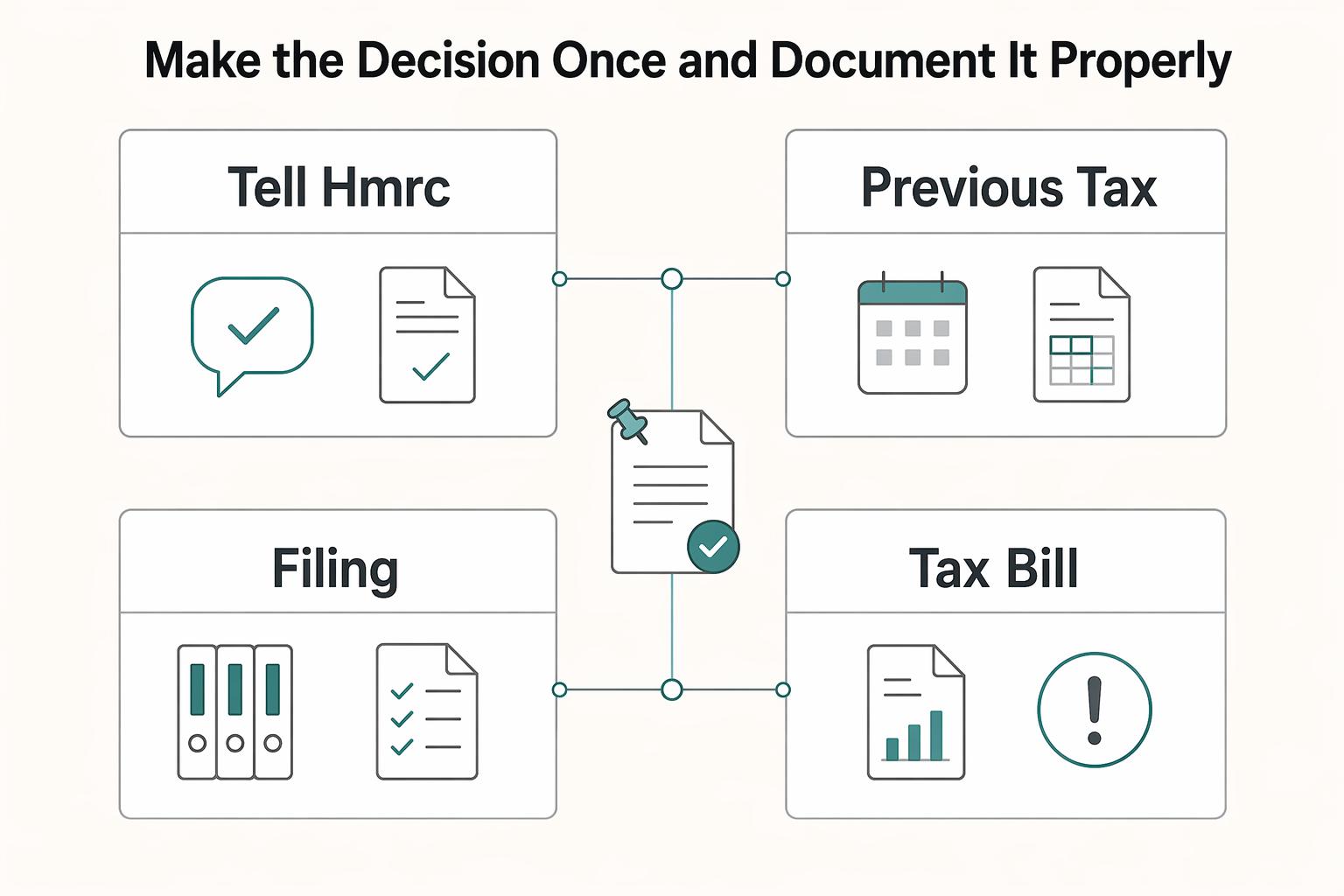
Make the decision once and document it properly#
The safest approach is to make one clear filing decision, document it, and keep your return aligned with that same story from start to finish.
| Item | Date or timing | Note |
|---|---|---|
| Tell HMRC you need to complete a return | 5 October 2025 | For the previous tax year |
| Previous tax year | 6 April 2024 to 5 April 2025 | Referenced in the guidance excerpt |
| Online filing opens | On or after 6 April | Following the end of the tax year |
| Tax bill due | 31 January | Use dates only after your filing position is clear |
Use the sequence in this order every time:
- Confirm whether you need to file a Self Assessment return and tell HMRC by registering when required.
- If you have filed before but did not file last year, check whether your Self Assessment account needs reactivation before filing.
- Confirm your filing route early, since some cases, including partnerships, cannot use HMRC's standard online filing service.
- Gather and keep the records you will rely on, for example bank statements or receipts.
- File on the right timeline with evidence ready.
If you are unsure whether activity is trading, contact HMRC before you file. Do not guess and try to fix the position later.
Keep your filing narrative and paperwork consistent. Your return should match the records you rely on, and HMRC guidance is explicit that records like bank statements or receipts are needed to complete a return correctly.
The avoidable errors are usually administrative, not exotic:
- first-time filers try online filing before registering, or returning filers skip account reactivation even though HMRC says filing without reactivating can delay the return
- some cases cannot use HMRC's standard online service, including partnerships, so confirm the filing route first
Use dates only after your filing position is clear. The guidance excerpt states 5 October 2025 to tell HMRC you need to complete a return for the previous tax year, 6 April 2024 to 5 April 2025. Filing online is on or after 6 April following the end of the tax year, and the tax bill is due by 31 January.
Next step: complete your checklist now, then escalate early on filing-route or eligibility edge cases instead of repairing errors after submission.
If you want cross-border payouts and documentation to stay traceable as your freelance business grows, review the workflow built for independents: See Gruv for freelancers.
Frequently Asked Questions
Do UK freelancers always pay Capital Gains Tax when they sell something?
No. Being a freelancer does not decide the tax outcome on its own. HMRC says you are likely to be trading if you sell regularly to make a profit, so not every sale should be treated the same way. If you are not sure whether your activity is trading, contact HMRC for advice.
Is selling shares in a Limited Company treated differently from a company selling its own assets?
Yes. A limited company is legally separate from its owners, so these are different legal situations. There is no full CGT rule spelled out here for each case, so confirm who the legal seller is and keep records that support what you report.
How do Income Tax bands affect the CGT rate I use?
There is not enough support here to set CGT rates from Income Tax bands. Do not guess from memory. If your filing position is not clearly supported, pause and get professional review before filing.
What information do I need before I can calculate a gain correctly?
You need records that let you complete your return correctly, including examples such as bank statements or receipts. You should also identify the taxpayer, the legal owner, and the legal seller before calculating anything. If your records are incomplete, pause and fix that first.
Does UK residence under the Statutory Residence Test change my CGT outcome?
There is not enough support here to state a definitive CGT outcome rule based on residence status. If your position is unclear, keep your calculation provisional and review your residence position before filing. Also confirm whether your filing route changes if you lived abroad as a non-resident.
When should I stop and get professional advice instead of filing on my own?
Stop when you cannot clearly show who should file, which filing route applies, and whether your records support each figure. Pause if you are unsure whether your activity is trading, whether your account needs reactivation, or whether you needed to register for Self Assessment. Also stop if you may have missed the 5 October notification point for the previous tax year.
What filing deadlines matter if I decide to handle it myself?
If you need to file for the previous tax year, HMRC says you must tell them by 5 October. You can file online on or after 6 April following the end of the tax year, and the Self Assessment bill is due by 31 January. Use those dates only after your filing position is clear.
Researched and edited by the Gruv editorial team. Gruv builds cross-border billing, payouts, and finance-operations software for global businesses.
Sources
Includes 2 external sources outside the trusted-domain allowlist.
Educational content only. Not legal, tax, or financial advice.
Related Posts

Digital Nomad Taxes in 2026 With a Defensible Filing Plan
With digital nomad taxes, the first move is not optimization. It is figuring out where you may be taxable, where filings may be required, and what proof supports that position.

Understanding the UK's Statutory Residence Test (SRT)
Treat SRT like ops, not folklore. You want a repeatable workflow you can run monthly so your tax-year answer is boring, documented, and easy to defend.

The Freelance Payment Penalty: A Modeled Audit of Platform Fees, FX Spreads, and Payout Delays
The money rarely disappears through a single, easy-to-spot fee. The real loss is stacked. A marketplace takes its commission, a processor adds a charge for international cards, a bank or payment company converts the currency at a spread, a platform holds the funds before release, and a wire sheds a little to intermediaries on the way in. Each layer looks defensible on its own, but the worker feels the combined result as a smaller deposit and a later payday.