
Quick Answer
Start by treating contractor status as something you must evidence, not assume. For california ab5 law engagements, shape the deal around the ABC test, then verify whether Labor Code §2776 or §2778 can apply. Use an MSA and SOW that state scope, payment amount or rate, and payment timing, and back that with business records you can send during onboarding.
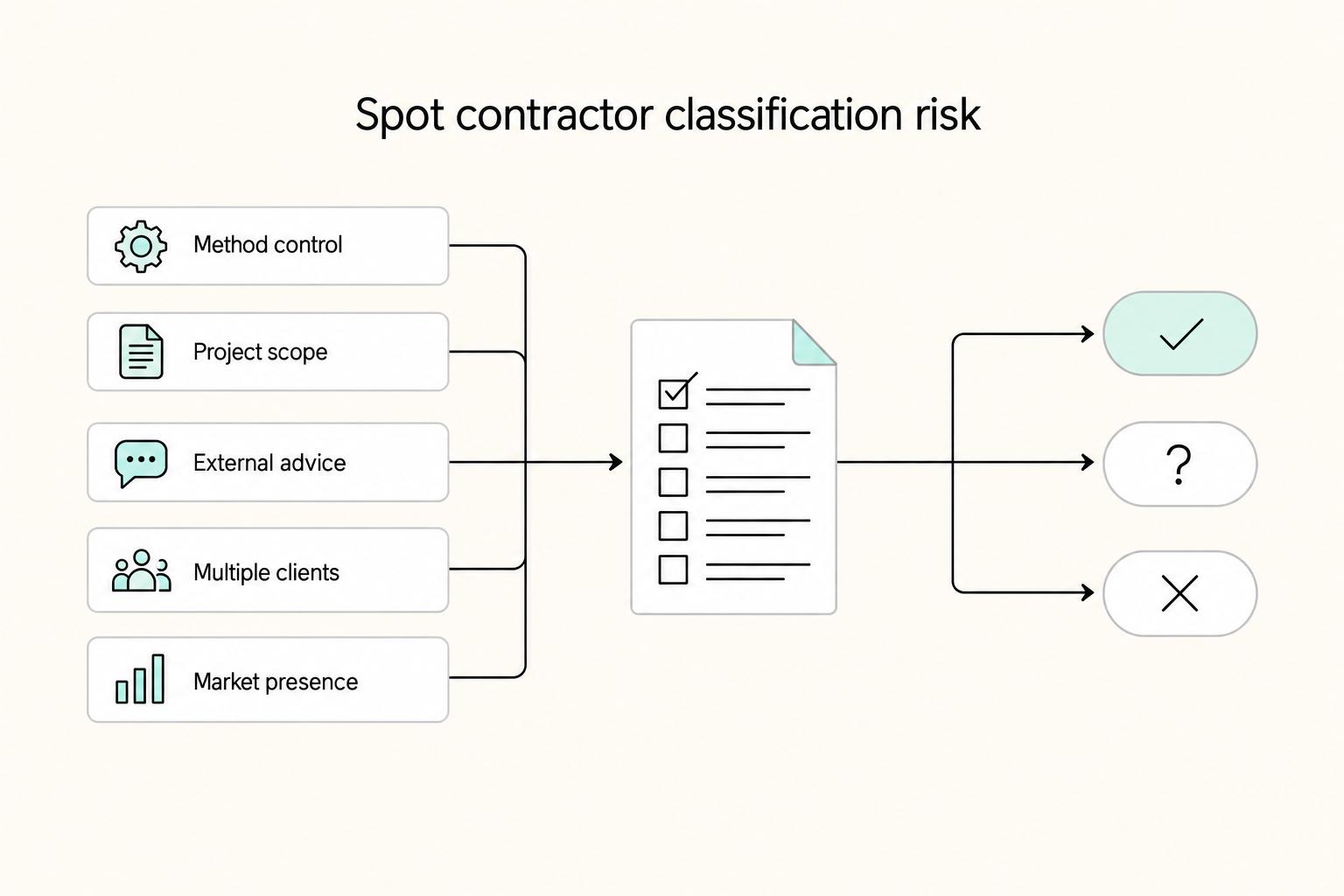
Spot the classification risk pattern before redlines start#
If you sell services to California clients, the real issue is often whether the client's legal and procurement teams can evaluate and document the classification decision before they send your contract for signature. Under AB5, that review happens inside a framework that has been in place since January 1, 2020. Misclassification exposure can include civil penalties of $5,000 to $25,000 per violation.
Your first job is to spot the risk pattern before redlines start. Trouble usually begins when an engagement looks less like an outside business relationship and more like a role inside the client's company. California's ABC test starts from a presumption of employee status unless all three conditions are met. That means the way you shape the deal and supporting evidence matters.
| Looks like independent business | Looks like employee-like arrangement |
|---|---|
| You control method and schedule | Client directs cadence, meetings, and day-to-day process |
| Scope is tied to defined deliverables or a project | Scope reads like ongoing duties or staff coverage |
| You advise from outside the org chart | You are embedded in a team like existing employees |
| You can serve multiple businesses as a separate provider | Engagement structure makes you function like a dedicated internal resource |
| You present as a separate business selling services | You present like an individual filling an internal function |
Use a simple checkpoint before you go any further. Read your statement of work and ask whether it specifies the payment amount, rate, services to be performed, and pay date. If it does not, expect questions. Another red flag is Prong B pressure. If you are being hired into a role that looks comparable to existing employees, it becomes much easier for the client to see you as working in its usual course of business.
Before you move on, do three things. Verify your operating model, map the engagement to Prong A, B, and C pressure points, and assemble evidence you can share with client legal early. In practice, that means your contract, scope, pricing terms, and proof that you operate as an independently established business.
Related: A Guide to India's Data Protection Law (DPDP Act) for Foreign Companies. If you want a quick next step, try the SOW generator.
The Ground Shift: From Flexible Rules to a Rigid Test#
AB5 changed your starting position: you are treated as an employee unless the hiring business can establish all three ABC elements. In practice, that means your deal has to be built and documented for contractor status from the outset, not argued after scope is drafted.
California passed AB5 in September 2019, and it took effect in January 2020. The older Borello framework is generally described as more flexible, while AB5 codified a stricter ABC structure.
| Issue | Older Borello framing | AB5 ABC framing |
|---|---|---|
| Control | More flexible overall assessment | Must be supported in the contract and in real-world practice |
| Business alignment | More context-driven analysis | The hiring entity must establish all required A, B, and C elements |
| Evidence expectations | Broader room for debate | Thin or inconsistent records are harder to defend because all elements must be established |
For you as a freelancer or consultant, this is why legal review is stricter before approval. If your SOW says you control the work, but the day-to-day model looks staff-like, that mismatch creates immediate classification risk.
What this means for your next deal is simple: design scope, operating model, and paperwork together so each ABC element is supportable from day one. The next section breaks down how to do that in the contract.
If you want a deeper dive, read How to Legally Avoid Double Taxation: A Freelancer's Guide to Tax Treaties.
Make each ABC prong easy to verify from your records#
Your contractor position is defensible only if all three ABC prongs hold up. California's worker-classification rules are now in Labor Code sections 2775-2787, and one weak prong can collapse the analysis.
Make each prong easy to verify from three places: your contract, your statement of work, and your operating record.
| ABC area | Stronger independent-contractor signal | Employee-like signal |
|---|---|---|
| Control and direction (Prong A) | Clear project outcomes, you control how work is performed, limited supervision, you use your own tools/materials where practical | Daily direction, required check-ins, client controls methods, employee-style oversight |
| Usual course of business (Prong B) | External specialty tied to a defined outcome outside the client's core service | Role comparable to existing employees or ongoing internal capacity coverage |
| Independently established business (Prong C) | Public business presence, ability to serve other clients, separate records/invoicing, clear commercial posture | Single-client dependence, restrictions on other clients, weak proof of a standalone business |
Prong A#
Prong A is about control in both contract language and real practice. The fastest way to support it is to define the scope by outcomes, timeline, and completion terms, then run the engagement that way day to day.
"Deliverables, not duties" is practical risk control here. AB5 does not require those exact words, but scopes built around project outcomes are usually easier to review than job-description language. Use specific outputs, clear acceptance criteria, and a change-order path for extra requests so boundaries stay visible.
What undermines you is mismatch: contract says you control the work, but the engagement runs on client-set hours, constant supervision, or manager-style approvals.
Prong B#
Prong B is often the pressure point for consultants. You need to show the work is outside the client's usual course of business, not that you are simply experienced enough to do it.
Position your service as an external specialty with a defined outcome, not staff augmentation or role coverage. If you look interchangeable with internal staff in day-to-day function, reporting shape, or responsibilities, Prong B risk rises quickly.
A stronger setup is a bounded engagement with a clear start, end, and output, instead of open-ended support inside the client's core function.
Prong C#
Prong C asks whether you are customarily engaged in an independently established business of the same nature as the work you provide. Give reviewers an evidence packet that shows you operate as a business apart from this client.
Useful evidence includes entity documents (if applicable), public market presence, invoices in your business name, client-facing terms, business records, and proof you can serve multiple clients without restriction. Insurance can support your business profile if you already carry it, but it is not a universal AB5 requirement.
If the engagement is being reviewed under the business-to-business exemption context in Labor Code section 2776, two checks often matter in the file: the written contract should specify payment amount/rate and payment due date, and you should have the required business license or business tax registration where applicable.
Your First Line of Defense: Fortifying Your Contracts#
Your contract should make your independent status easy to verify at a glance. Treat your Master Services Agreement and each SOW as evidence files, not boilerplate, and make sure they match how the work actually runs.
Four contract protections that actually help#
Use these four protections to support the ABC analysis. They do not fix a misaligned engagement by themselves, but they make your file easier for legal reviewers to clear.
| Protection | Contract point | Why it matters |
|---|---|---|
| Control of work | State that you control how services are performed, while the client evaluates agreed outcomes | Supports Prong A, which focuses on control in both contract language and real practice |
| Substitution rights | Reserve your business's right to use qualified support or subcontract part of the work | Helps show the client engaged your business, not an employee-like role, which supports the Prong A and Prong C narrative |
| Scoped project term | Define work by project, milestone, or stated term with a clear endpoint | Bounded scope is easier to defend than open-ended staffing-like arrangements, especially when Prong B is sensitive |
| Independent business relationship | State clearly that this is a business-to-business relationship and that your business remains operationally independent | Supports Prong C, but only if your day-to-day operations and records match the contract |
| Contract language that supports independence | Language that creates employee-like risk |
|---|---|
| Scope defined by deliverables, milestones, and acceptance criteria | Scope framed as ongoing duties or "support as needed" |
| Client reviews outcomes | Client directs methods, approvals, and daily activity |
| Contractor controls schedule needed to meet deadlines | Fixed daily hours or employee-style availability blocks |
| Contractor uses own tools where practical | Client-issued tools are the default setup |
| Payment tied to project, milestone, or deliverable | Payment tied mainly to time worked like regular wages |
Drafting details are where this either holds up or breaks. Add acceptance criteria so "done" is measurable. Add a change-order process so extra requests become new scope instead of quiet role creep. Keep communication boundaries clear: status updates are fine, but employee-style oversight language is not.
Align invoicing with the scope. If the SOW is deliverable-based but invoices read like ongoing general support, your evidence trail becomes inconsistent, and that risk is higher in long, embedded engagements.
Before signature, run this hygiene check:
- Confirm the MSA, SOW, proposal, and invoice structure describe the same relationship.
- Remove contradictory terms (for example, project language in one document and duty-based staffing language in another).
- Add any currently required California notice or disclosure language only after separate verification.
Need the full breakdown? Read A guide to the 'Common Law' vs. 'Civil Law' systems for international contracts.
Know Your Shield: Navigating AB5 Exemptions#
Before you accept a California engagement, decide whether an exemption truly fits your facts. When a valid exemption applies, analysis can move from the ABC test to Borello, but that is not automatic protection from misclassification risk.
AB 2257 recodified these rules into Labor Code sections 2775-2787. For most independent service providers, the two screening lanes are § 2776 (business-to-business) and § 2778 (professional services). If the exemption requirements are not fully met, ABC remains the controlling test. In the B2B lane, the hiring entity must prove all 12 criteria.
Start with the right lane#
Use this as a pre-signing screen, not a post-dispute argument.
| Screen result | Indicators | Article guidance |
|---|---|---|
| Likely fit | You are contracting business-to-business; the written contract states services, payment amount or rate, and due date; you hold any required business license or business tax registration; and you can serve other businesses without client restrictions. Or, for § 2778, your service is in a listed professional-services occupation and you can document all six required factors | Use this as a pre-signing screen, not a post-dispute argument |
| Needs legal review | Your role seems close to a listed professional service but is not clearly verified, or the client relationship includes exclusivity, heavy control, or a long embedded model that weakens independence | Treat it as a legal-review case before signature |
| Likely not a fit | You are effectively filling an internal role, restricted to one client, relying on contractor labels alone, outside listed § 2778 occupations, or already missing a required B2B criterion | If the exemption requirements are not fully met, ABC remains the controlling test |
If you cannot explain your exemption lane in plain terms and support it with documents, treat it as a legal-review case before signature.
What to verify before relying on an exemption#
For § 2778, all six specified factors must be met or the test reverts to ABC. For § 2776, missing even one required criterion means ABC controls.
| Requirement | What good evidence looks like | Common red flags |
|---|---|---|
| B2B written contract elements under § 2776 | Signed MSA/SOW identifying services, payment amount or rate, and payment due date | Vague scope, unsigned terms, missing pay date, or conflicting side communications |
| Required business license or business tax registration (where required) | Active registration/license in the correct business name, with matching records | Expired or mismatched records, or no check on local registration requirements |
| Ability to serve other businesses without hiring-entity restrictions | Non-exclusive terms and proof you maintain outside clientele | Exclusivity, approval gates for other clients, or practical dependence on one client |
| Professional-services lane under § 2778 | Verified occupation fit plus documentation that all six required factors are met | "Close enough" role matching, unverified occupation status, or missing factor evidence |
| Insert exact current statutory criteria wording after verification | Final legal-verified text pasted into your internal checklist before signature | Using summaries as a substitute for verified statutory language |
Do this before contract signature#
- Identify your likely lane: § 2776, § 2778, or neither.
- Collect your support file: signed contract terms, payment terms, registration records, and proof you can serve other clients; for § 2778, verify listed-occupation status and all six factors.
- Escalate borderline files for legal review before signing.
For more detail, read A deep dive into the 'governing law' clause for a contract between a US freelancer and an Asian client.
Send one package that shows you operate as an independent business#
Make client approval easier by sending one clear, consistent package that shows how you operate as an independent business. The goal is to reduce classification exposure and procurement friction, not to make legal guarantees.
Start with a short onboarding note. State that you contract through your business, the work is tied to a defined scope, and you can share supporting business records for review. If they ask for documents, send one complete bundle instead of scattered attachments.
Build a review-ready packet#
Use a reusable checklist and tailor it per client and jurisdiction. Keep files dated and searchable so reviewers can quickly confirm what they need.
| Packet item | Details | Qualifier |
|---|---|---|
| Signed contract documents (MSA/SOW) | Scope, pricing terms, and payment timing | Include |
| Business entity or registration documents | Business entity or registration documents | Where applicable |
| License or tax registration documents | Jurisdiction-specific license or tax registration documents | Where required |
| Insurance certificate | Insurance certificate | If requested |
| Tax forms | Tax forms relevant to the engagement | Include |
| Public-facing business proof | Site, profile, or equivalent | Include |
| One-page cover note | Listing attached files and the contracting entity | Include |
Keep the entity name, scope, and supporting documents consistent across the bundle.
| Client-facing item | Weak signal | Strong signal |
|---|---|---|
| Onboarding message | "I can jump in like part of the internal team." | "My business can provide scope, contract, and business records for review." |
| Packet contents | Mixed screenshots, incomplete files, inconsistent entity names | One organized bundle with current, readable documents and matching entity details |
| Invoice structure | Personal-name invoice, generic weekly hours, payroll-like wording | Business-identity invoice with project reference and scope-linked deliverable or milestone line items |
Invoice like a vendor, not payroll#
Your invoice should match your contract story. Use your business identity consistently, include invoice number and issue date, name the client legal entity, and reference the SOW, PO, or project identifier. Format line items around scoped deliverables or milestones; if you bill by time, tie that time to defined tasks in scope.
If you share legal references during onboarding, verify that the source is official before you rely on it. Some online Federal Register pages explicitly state they are not the official legal edition, XML versions do not provide legal notice, and pages can be unavailable.
For a step-by-step walkthrough, see CCPA for Freelancers Handling California Client Data.
Conclusion: Decide your classification path before the deal starts#
You do not need a loophole to work with California clients. You need facts, documents, and day-to-day practices that support independent business status under AB 5 and the current Labor Code sections 2775 to 2787.
The practical move is to decide your classification path before the deal starts. If you may fit a business-to-business contracting relationship under Labor Code §2776, verify that your written contract is not vague. It should specify the payment amount and payment due date. The rest of your evidence should match it: current license or business tax registration where required, public marketing, your own tools, negotiable rates, and a real business presence separate from the client. If your actual working relationship does not match those independent-business facts, do not assume an LLC, a 1099, or an independent-contractor label will fix it.
That discipline matters because California starts from employee status unless the hiring entity can prove otherwise, and willful misclassification is expressly unlawful. The civil penalties cited in Labor Code §226.8 are material.
Use this short pre-outreach check:
- Contract structure: define scope, deliverables, control, payment amount, and payment due date in writing.
- Exemption fit review: confirm whether you are relying on ABC by default or an exemption path such as §2776, and test the real facts, not just the title.
- Client-facing documentation: keep a clean packet ready with business license or tax registration where required, public marketing evidence, and proof of independent business operations.
- Invoice discipline: align invoices with the written contract terms and milestones so the paper trail stays consistent.
Rules change, and they have already been revised once, so recheck your assumptions against current California materials. If you want faster approvals and fewer legal slowdowns, prepare your compliance materials before outreach, not after a client flags the risk.
This pairs well with our guide on A Guide to California's Meal and Rest Break Laws.
Frequently Asked Questions
Who is exempt from the california ab5 law?
Do not assume you are exempt just because your work sounds professional or because a client says other contractors were approved. Start by checking whether your engagement fits a current exemption path in Labor Code sections 2775 to 2787, then confirm what standard applies if it does. Your signed contract and actual working practices need to match the position you are claiming.
What is the difference between the ABC test and the Borello test?
The ABC test starts from employee status, and the hiring entity must satisfy all three parts to classify you as an independent contractor. One of the biggest practical checks is Part A: you must be free from control both in the contract and in fact, not just on paper. If you think an exemption changes which test applies, verify that with current legal guidance before relying on it.
Does this apply if my client is in California but I live or work somewhere else?
Do not reduce this to one fact like client location or your residence. This guide does not establish a single-location rule. AB5 classification questions appear in labor, wage-order, and tax-reporting contexts, so mixed-location arrangements should be reviewed case by case. If your work touches California and the facts are split across places, treat that as a counsel-review trigger before you start.
Can you still bill hourly for California clients?
This guide does not support a rule that hourly billing is automatically prohibited or automatically compliant. Classification still turns on the underlying relationship, especially control and whether the work is inside the client’s usual course of business. See Moving From Hourly to Project-Based Rates if you need help shifting the framing.
What happens if a worker is misclassified?
Classification affects reporting and filing obligations, and workers may file claims if they believe they were misclassified. For you, the useful takeaway is operational: if the facts are borderline, pause and fix the contract and day-to-day working pattern before work begins rather than trying to explain it later.
Is forming an LLC or company enough to solve this?
No. Forming an LLC or other entity is not a standalone safe harbor. You still need the facts to line up under the ABC test, including control and how close your role is to the client’s usual business.
What should you verify before saying “yes” to the engagement?
Check your actual role, not just the title. Review whether you control how the work is done, whether your service sits outside the client’s usual course of business, and whether your contract matches your real working arrangement. If any answer feels fuzzy, especially around exemptions or multi-state facts, escalate early and document what changed after review.
Try a related tool
Researched and edited by the Gruv editorial team. Gruv builds cross-border billing, payouts, and finance-operations software for global businesses.
Sources
- dir.ca.gov/Fraud_Prevention/Misclassification.htmtrusted
- dir.ca.gov/dlse/faq_independentcontractor.htmtrusted
- federalregister.gov/documents/2021/01/07/2020-29274/independent-...trusted
- ftb.ca.gov/file/business/industries/worker-classificati...trusted
- labor.ca.gov/employmentstatus/abctesttrusted
- labor.ca.gov/wp-content/uploads/sites/338/2025/03/B2B-Req...trusted
Educational content only. Not legal, tax, or financial advice.
Related Posts

How Freelancers Can Legally Avoid Double Taxation With Tax Treaties
Classify the tax problem before you touch a return. If your income is mostly personal service fees across borders, this guide fits. If your issue is C corporation profits and shareholder dividends, you are solving a different problem.
Moving From Hourly to Project Rates Without Hurting Cashflow
The right pricing model matches uncertainty and cashflow risk. It should fit how clearly the work can be defined, approved, and defended, not just what you are used to selling. Hourly billing gives you room to work while requirements are still moving. Fixed project pricing gives the client stronger budget clarity once deliverables are stable enough to pin down.

The Freelance Payment Penalty: A Modeled Audit of Platform Fees, FX Spreads, and Payout Delays
The money rarely disappears through a single, easy-to-spot fee. The real loss is stacked. A marketplace takes its commission, a processor adds a charge for international cards, a bank or payment company converts the currency at a spread, a platform holds the funds before release, and a wire sheds a little to intermediaries on the way in. Each layer looks defensible on its own, but the worker feels the combined result as a smaller deposit and a later payday.