
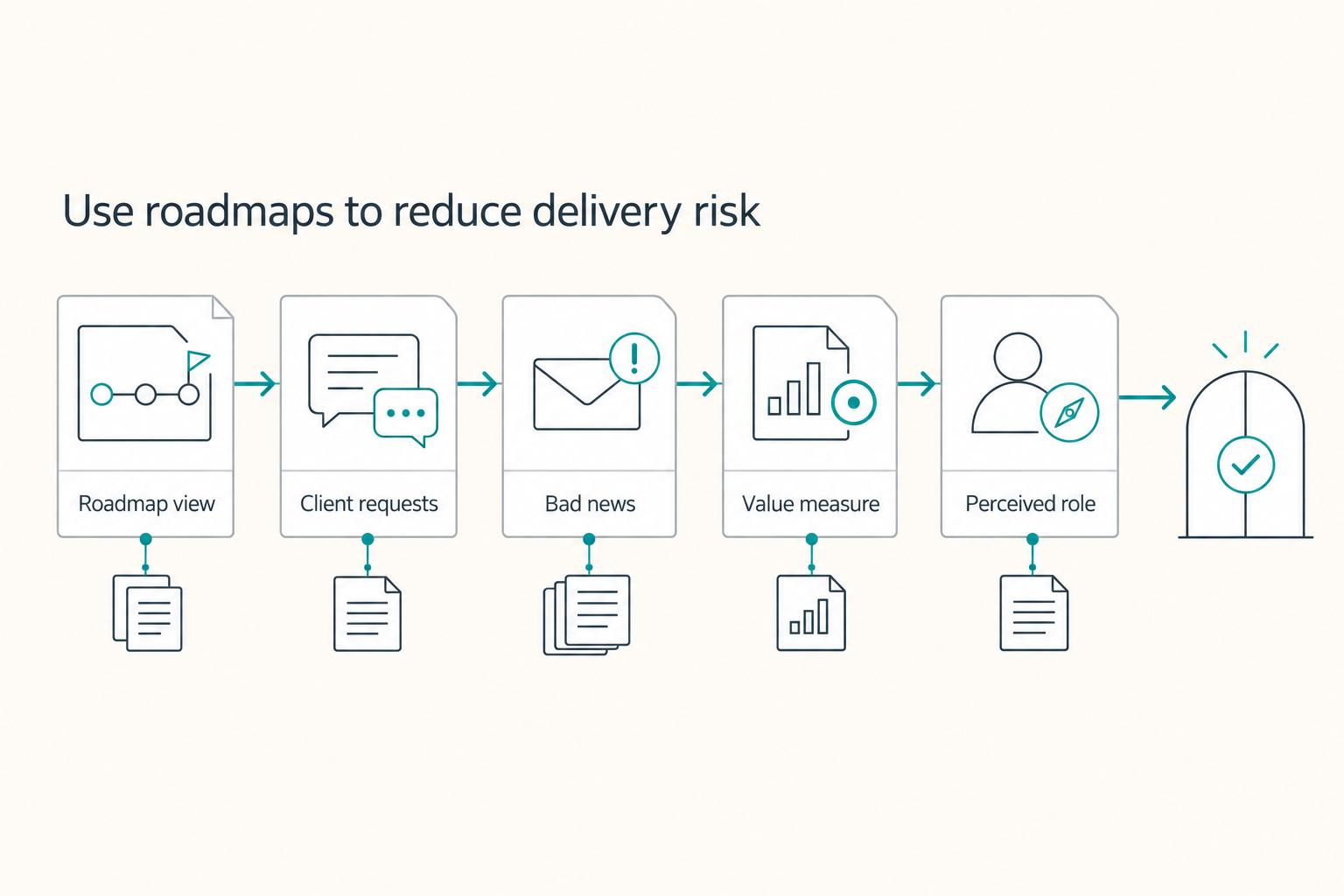
Quick Answer
A trust-first project roadmap is a client-facing system that reduces risk before work starts, keeps communication clear during execution, and turns delivery into follow-on work. Build it with compliance details, clear outcomes, deliverables, a what-is-not-included boundary, milestone-based payments, and a simple Now-Next-Later view, then reinforce trust through weekly updates, early delay communication, and a final value-delivered review.
How a Roadmap Prevents Client Conflicts Over Expectations#
Your expertise is your product, but your client relationship is your business. For a global professional, a mismanaged project isn't just a setback; it's an existential threat. It means payment disputes that disrupt cash flow, scope creep that destroys profitability, and reputational damage that can take years to repair. Forget the generic advice written for corporate teams. This is your operating manual for transforming a project plan into a powerful shield - a 'Bulletproof' Roadmap that engineers certainty, eliminates compliance anxiety, and puts you in complete control.
This isn't about creating a more complex Gantt chart. It's about fundamentally reframing the purpose of a roadmap. For a solo professional, a roadmap is your single most important communication and risk-management tool, not just a planning document. Most client conflicts stem from a simple, preventable source: a mismatch in expectations. Vague scopes lead directly to disagreements over deliverables, which in turn cause payment disputes and damage the relationship. Your 'Bulletproof' Roadmap is the system you will use to eradicate this ambiguity from day one.
It's a strategic shift from being a reactive service provider to becoming a early business partner. This is the core of a trust-first approach. When clients have faith in your process, they have confidence in your work. Building this trust isn't about grand gestures; it's the result of consistent, reliable, and professional execution - qualities embedded into the very structure of this roadmap.
This guide outlines a system built across three distinct phases:
- Phase 1: The Trust Blueprint. De-risk the entire engagement before it begins by embedding compliance and clarity into your proposal and contract, establishing yourself as a credible, low-risk partner.
- Phase 2: The Transparency Engine. Turn your roadmap into a dynamic communication tool for flawless execution, managing expectations, and handling project delays without losing client confidence.
- Phase 3: The Value Lock-In. Use the roadmap to demonstrate the immense value you've delivered, converting the successful completion of one project into a profitable, long-term partnership.
By implementing this system, you move beyond simply managing projects. You start architecting successful client relationships, building the operational foundation needed to scale your business-of-one with confidence.
Phase 1: De-Risk the Engagement Before It Begins#
The first phase of your roadmap begins long before the work does. This is where you architect the client relationship for success by early eliminating the primary sources of friction: compliance, scope, and payment uncertainty. You must establish yourself not as a transient freelancer, but as a professional, low-risk business partner.
| Roadmap element | What to include | Purpose |
|---|---|---|
| Compliance-first trust signals | Business registration details; professional liability insurance information; for clients in the European Union, VAT ID and a VIES verification link | Shows the business is real, verifiable, and easy to pay |
| SOW as the master roadmap | Project outcomes; key deliverables; "What's Not Included" | Codifies the project and helps prevent scope creep |
| Payment certainty schedule | Non-refundable deposit due upon signing; milestone payments tied to specific, pre-defined deliverables | Secures commitment and creates a clear, predictable financial rhythm |
| Professional onboarding kick-off | Walk through the roadmap; confirm key stakeholders; establish a precise communication cadence | Creates shared understanding and de-risks the engagement before it begins |
Your proposal and contract are the first tangible artifacts of your professionalism. Use them to signal your legitimacy from the outset.
- Embed "Compliance-First" Trust Signals: Don't wait for your client's procurement department to put you on the defensive. Early include your business registration details and professional liability insurance information in your proposal. For clients in the European Union, provide your VAT ID and a VIES verification link. The VAT Information Exchange System (VIES) is a European Commission tool that confirms the validity of a VAT number for cross-border transactions. This simple step answers the client's unspoken question: "Is this a real, verifiable business that will be easy to pay?"
- Reframe the Contract as the "Master Roadmap": Your Statement of Work (SOW) is more than a legal formality; it is the foundational document of your entire engagement. It codifies the project and serves as your primary defense against the profit-destroying poison of scope creep. Structure it with absolute clarity:
- Project Outcomes: Clearly state the business goal (The "Why").
- Key Deliverables: List the tangible outputs (The "What").
- "What's Not Included": Explicitly define the boundaries of the project to prevent future misunderstandings.
- Establish a "Payment Certainty" Schedule: Link your payment schedule directly to tangible progress on the roadmap. This moves the conversation away from hours billed and toward value delivered, especially when the roadmap already points back to the SaaS SOW structure the client approved. The structure is simple and powerful:
- Deposit: The first invoice is for a non-refundable deposit, due upon signing the contract. This secures their commitment and improves your cash flow.
- Milestone Payments: Subsequent invoices are tied to the completion of specific, pre-defined deliverables in the roadmap. This creates a clear, predictable financial rhythm for both you and the client.
Finally, translate this blueprint into a shared understanding. The professional onboarding kick-off is a collaborative alignment session, not a presentation. Use this first call to walk through the roadmap, confirm key stakeholders, and establish a precise communication cadence. Stating, "You will receive a brief status update from me every Friday at 10 AM CET," sets a professional rhythm and manages expectations from day one. This is how you take control and de-risk the entire engagement before it begins.
Phase 2: Turn the Roadmap Into Your Primary Communication Tool#
With your professional blueprint established and the project in flight, your roadmap transforms from a static document into your primary communication tool. This is no longer about planning; it is about executing with unwavering transparency. Treat your communication as a system - an engine for building credibility, managing expectations, and demonstrating absolute control, especially when challenges arise.
Your first move is to radically simplify how you present progress. Ditch the complex Gantt charts that overwhelm clients and create a fragile, deadline-focused dynamic. Instead, adopt the "Now-Next-Later" format. It is a powerful tool for clarity that anyone can understand in a 30-second glance, focusing the conversation on priorities rather than rigid dates.
| Now | Next | Later |
|---|---|---|
| The tasks currently in active development. | The immediate priorities for the next cycle. | The backlog of validated future tasks. |
This format provides immediate clarity and manages the client's expectations about what is - and is not - currently the focus, enhancing their experience of the project itself.
Of course, no project is without its challenges. Delays are inevitable; the erosion of client trust, however, is not. When you hit a snag, master the "Early, Honest, Solution-Oriented" delay script. The moment you are certain a delay will occur, you communicate it. Be direct about the cause without assigning blame, and critically, always present a revised plan that shows you are in command of the solution.
For instance: "Quick update: we've encountered a challenge with the third-party API integration that requires a workaround. To resolve this, I am reallocating my development time from Task B to solve it today. This means the beta feature launch will shift by two days, but the final project delivery date remains secure. I will confirm the moment the issue is fully resolved."
This early approach strengthens client relationships in high-stakes situations. As Niclas Schlopsna, Managing Consultant and CEO of spectup, shared from his own experience: "In a project with a healthcare client, we encountered unexpected technical challenges. Instead of waiting for issues to escalate, we early communicated, explaining the situation and our proposed solutions. By being transparent and outlining a clear plan, we built trust and kept the client in the loop. This made a huge difference."
Finally, systematize this transparency with relentless consistency. Your weekly status update is the rhythm that reinforces your reliability. It should be a concise, powerful email directly referencing the "Now-Next-Later" roadmap. Use a simple, scannable format:
- What I Accomplished This Week: (Reference completed "Now" items)
- What's Next: (Reference the upcoming "Next" items)
- Blockers: (Any issues where you require client input)
This weekly report is more than an update; it is a recurring proof point of your control and professionalism, compounding the credibility you need to turn this project into a long-term partnership.
Phase 3: The Value Lock-In - Converting Project Completion into a Profitable Partnership#
The credibility you've carefully built is your most valuable asset as the project draws to a close. Many professionals mistakenly treat project delivery as a finish line. It is not. The end of a project is your single greatest opportunity for business development, and your final roadmap review is the tool you will use to seize it. This is where you transition from a service provider to a strategic partner, cementing the value you created and paving a natural path to your next contract.
First, reframe the final meeting as a "Value Delivered" off-boarding session. Do not simply demo the final product. Instead, construct a powerful narrative. Present the initial roadmap - the one outlining the client's core business problems - side-by-side with the final deliverables. Walk them through the journey, explicitly connecting each outcome to the original pain point it was designed to solve. Use language that reinforces this link: "Here was the initial goal: to reduce customer support tickets by 25%. This new dashboard directly addresses that by providing self-service analytics, and in beta testing, we've already seen a 30% reduction." This reframes the engagement around the tangible business value you generated, making your fee an investment that produced a clear return.
Immediately after this session, while the positive impact is fresh, systematize your request for social proof. The ideal time to ask for a testimonial is when the value you've delivered is most appreciated. Don't be vague. Send a follow-up email within hours of your value-delivery call and make it effortless for them by providing a simple prompt.
- Subject: So glad we could achieve [Specific Outcome] together
- Body: Hi the client's name, I'm thrilled with the outcome of the project name and how it's already impacting their business goal. While the result is fresh in our minds, would you be open to providing a brief testimonial? A few sentences focusing on the challenge you faced and how our work helped you overcome it would be incredibly helpful. Thank you for a great partnership!
Finally, use the roadmap itself to seed your next contract. Your "Now-Next-Later" roadmap has a secret weapon: the "Later" column. This isn't a backlog of forgotten ideas; it is a pre-validated pipeline of future work. When you frame it against a broader trust-to-transaction business model, the upsell feels like the next logical control point, not a random add-on. Transform this column from a project artifact into a early proposal. The upsell becomes a logical continuation of the success you've already delivered, not an awkward sales pitch. Frame it as the obvious next step: "Now that we've successfully launched the core platform, the logical next step is to tackle the advanced analytics suite we placed in the 'Later' column. This will allow you to capitalize on the user data we're now collecting. I've put together a brief proposal for a Phase 2 retainer to begin that work next month."
This completes the cycle, turning a single, successful project into a predictable, profitable, and long-term client partnership.
Why Corporate Buyers Value Professionals, Not "Gig-Workers"#
This disciplined approach isn't just about protecting yourself; it's a direct response to what your ideal clients - especially corporate finance and procurement departments - desperately need. When a large company engages an independent professional, their primary concern isn't just the quality of your work. It's the mitigation of risk. They are asking a series of silent but critical questions: "Is this a real, compliant business we can pay easily?" "Will they create a legal headache for us?" "Do they have professional systems in place, or will they disappear mid-project?"
Failing to answer these questions is the fastest way to be dismissed as a high-risk "gig worker" instead of being valued as a strategic business partner. Your commitment to a trust-first roadmap is tangible proof of your professionalism. Your clear contract, formalized change order process, and predictable communication are important signals of "business hygiene" that make you a safe choice. This perspective is validated by experts who see the friction that amateurs create. As Nabil Mohamed-Krachaï, Co-founder of the Freelance Buyers Club (CAF), explains, "The strength of freelance buyers lies in their prior experience in procurement roles. They understand the importance of business relationships, respect contracts, and ensure flawless service continuity."
Let's break down what that means for you:
- "Respect Contracts": Your careful SOW and disciplined use of Change Orders demonstrate that you see the contract as the central source of truth. This gives procurement teams confidence that the scope and budget are under control.
- "Business Relationships": A professional relationship is built on clear communication and predictable processes. Your roadmap and weekly updates are relationship management tools that build compounding trust over time.
- "Flawless Service Continuity": This is the ultimate goal for any buyer. Your entire system - from onboarding to off-boarding - is designed to engineer this exact outcome, making you a reliable and repeatable investment.
In the end, corporate buyers don't hire freelancers; they procure services from businesses. By operating as a legitimate, compliant, and process-driven Business-of-One, you align perfectly with their procurement requirements. That same posture is what makes a compliance-first operating model easier for buyers to trust. You are not just another creative or technical expert. You are a low-risk, high-value partner who understands how real business works, making you the obvious choice for the best projects.
How Daily Practice Changes When the Roadmap Is a Risk-Mitigation System#
Becoming that obvious choice is an internal transformation, not just a matter of external perception. For many independent professionals, the default state is the Anxious Operator - constantly reacting to client whims, dreading out-of-scope requests, and feeling the low-grade stress of not being in control. This reactive stance is unsustainable. It leads to burnout, erodes profitability, and keeps you trapped in a cycle of trading time for money.
The shift from this state to that of a Confident CEO is deep, and the trust-first roadmap is the mechanism that makes it possible. You move from being a passenger in your own project to being the one who holds the map. When the roadmap is reframed as a system for risk mitigation, it ceases to be a source of pressure. Instead, it becomes your most powerful tool for professional dialogue. It provides a shared, objective foundation that depersonalizes difficult conversations about budget, scope, and delays. A client request that once caused anxiety is now simply an input to be evaluated against the agreed-upon plan.
This evolution in mindset and methodology can be seen in the daily realities of running your business:
| Mindset & Behavior | The Anxious Operator | The Confident CEO |
|---|---|---|
| View of the Roadmap | A fragile timeline of deadlines. | A strategic system for mitigating risk. |
| Handles Client Requests | Reacts with obligation; fears saying "no." | Manages requests through a formal Change Order process. |
| Communicates Bad News | Delays difficult conversations. | Communicates early, presenting a revised plan. |
| Measures Value | Focuses on hours billed or tasks completed. | Focuses on achieving defined business outcomes. |
| Perceived Role | A reactive "doer" fulfilling a task list. | A early leader guiding the engagement. |
Embracing this CEO mindset is the final step in professionalizing your service. It's the ultimate expression of your strategy, where the experience of working with you is as valuable as the deliverable itself. A project roadmap is more than a document; it's a reflection of your professionalism. By shifting your perspective - from seeing it as a timeline to seeing it as a system for building trust and eliminating risk - you fundamentally change the dynamic of your client relationships. You are no longer just reacting to their demands. You are early guiding the engagement, eliminating your own anxiety, and proving that you are not just an expert in your craft, but the CEO of a well-run, reliable, and bulletproof Business-of-One.
Frequently Asked Questions
What should be in a project roadmap?
A project roadmap should be a simple communication tool a client can understand quickly. Include clear business outcomes, key deliverables and milestones tied to payment, a Now-Next-Later view, and a what-is-not-included section. These elements create clarity and help prevent scope creep.
How do you build trust with a new client?
Build trust by reducing client risk before the project starts. Include business registration details, relevant tax IDs such as a VAT number, and professional liability insurance in your proposal, and provide the right tax forms upfront when needed. Then set a clear kickoff and reliable weekly update cadence so the client sees a professional process from day one.
How do you communicate project delays professionally?
Communicate project delays early, honestly, and with a solution. Tell the client as soon as you know there will be a delay, explain the cause clearly without blame, and present a revised plan and timeline. That keeps the conversation focused on professional problem-solving instead of surprise.
Why is a project roadmap important for consultants?
For consultants, a project roadmap is a risk-management system, not just a plan. It codifies scope to prevent unpaid work, links payments to tangible progress, and gives clients predictable communication. It also helps turn one project into a longer-term partnership by using the Later column to seed future work.
How do I handle a client changing requirements mid-project?
Acknowledge the request and assess its impact on the current timeline and budget before agreeing to anything. Then document the change in a Change Order that defines the new scope, added cost, and any timeline adjustments, and submit it for approval before starting the new work. This protects you from unbilled work and keeps the project aligned with the roadmap.
Researched and edited by the Gruv editorial team. Gruv builds cross-border billing, payouts, and finance-operations software for global businesses.
Sources
Includes 1 external source outside the trusted-domain allowlist.
Educational content only. Not legal, tax, or financial advice.
Related Posts

Digital Nomad Health Insurance Comparison for Long-Stay Moves
Use focused time now to avoid expensive mistakes later. Start with a practical `digital nomad health insurance comparison`, then map your route in [Gruv's visa planner](/tools/visa-for-digital-nomads) so we anchor policy checks to your real plan before pricing pages pull you off course.
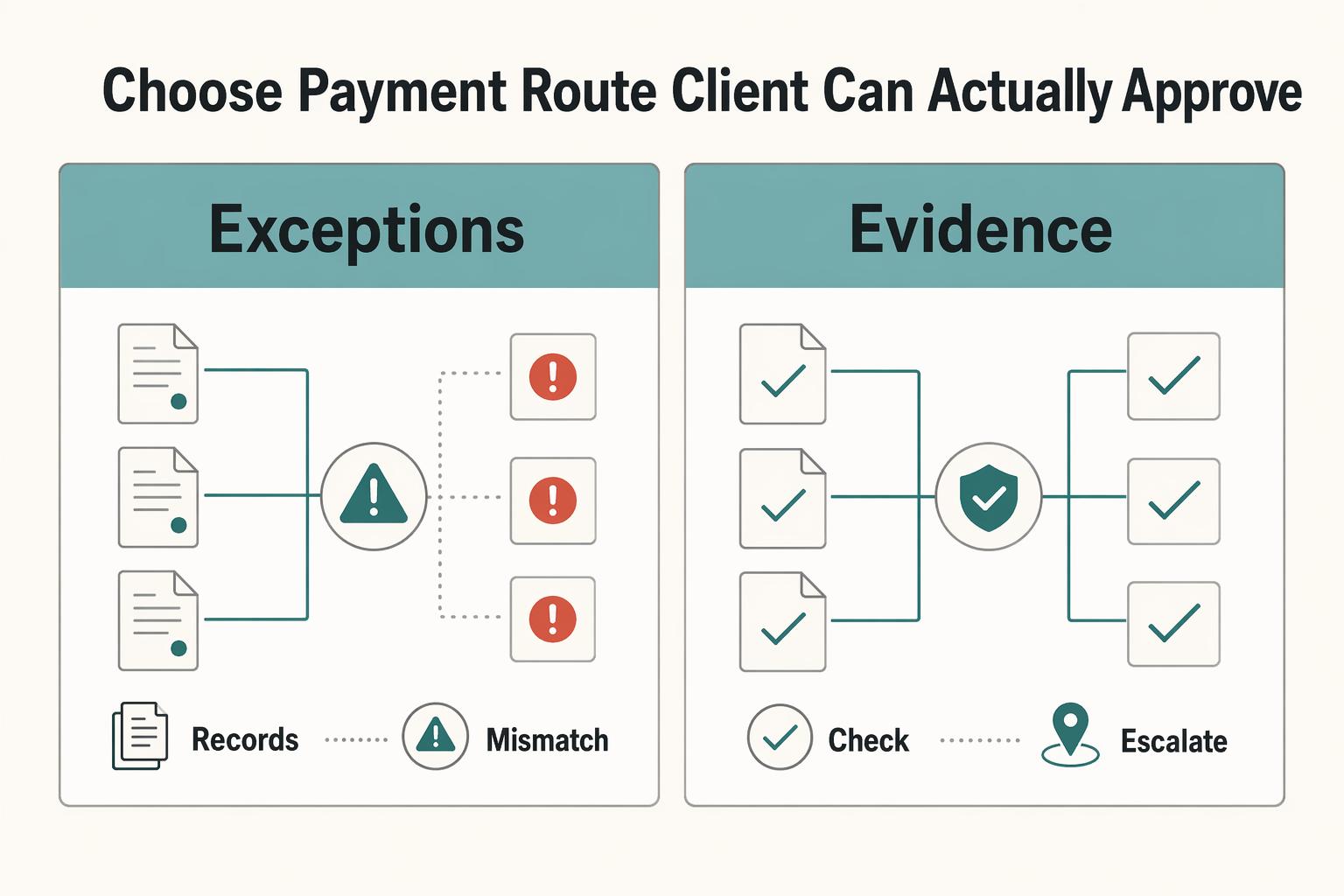
How the Trust-to-Transaction Business Model Wins Client Approval
If you sell your work across borders, clients are buying certainty as much as skill. The **trust-to-transaction model** is a simple operating rule: make it easy for a client to see that working with you will be orderly, legible, and low drama. The real friction is usually not whether you can do the work. It is whether hiring you will create admin, payment, or communication problems they will have to clean up later.
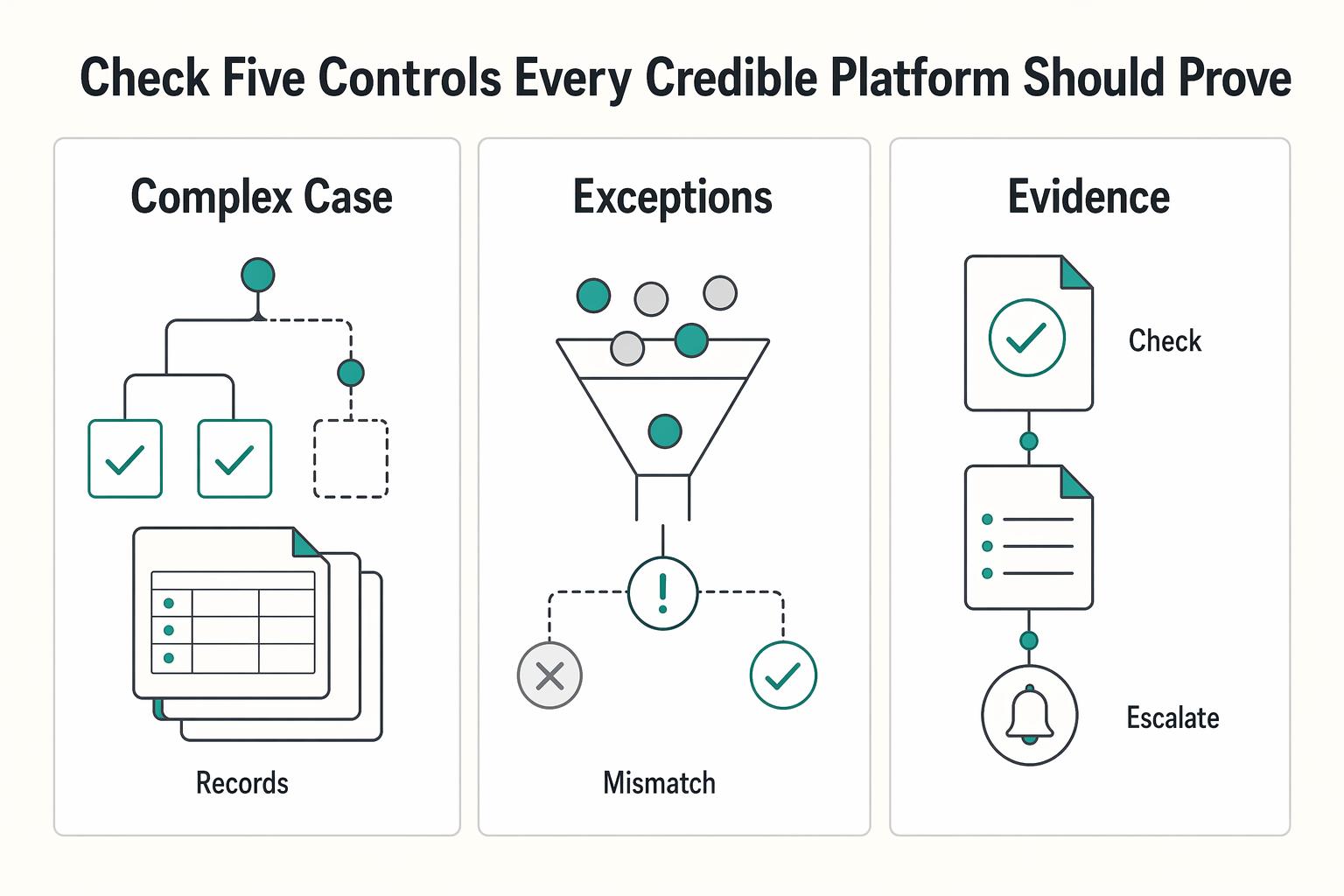
How Freelancers Choose a Compliance-First Fintech Platform
Use this as a buyer guide, not a vendor-pitch decoder. Compliance-first fintech means compliance controls are built into product architecture from day one, not added after launch. If a platform cannot show where KYC checks, AML monitoring, and transaction controls happen in the product flow, treat that as added risk. In practice, that means live behavior, not policy documents: how users are verified, how access is controlled, how suspicious activity is handled, and how actions are logged when money moves.