
Quick Answer
Independent professionals should answer behavioral interview questions with specific STAR-based examples while treating the first call as a mutual qualification meeting. Use clear ownership, concrete actions, defensible results, and one sentence on business value. Then ask follow-up questions that clarify scope, decision-making, timeline, budget posture, and working style so you can judge whether the client is a good fit.
Your Next 'Interview' is a High-Stakes Qualification Meeting#
Treat the first call as a qualification meeting for both sides, not a test you need to pass. You still need to answer well, but you also need to find out whether the work is defined clearly enough to be worth your time.
That shift changes how you show up on the call. These conversations often lean on past behavior as a predictor of future performance, so you will be pushed toward specific examples, concrete actions, and outcomes. If you stay in applicant mode, you wait for approval and give broad summaries. If you show up like a peer, you still answer directly, but you also use each answer to clarify scope, surface constraints, and judge fit. On a first call, the difference often looks like this:
How the stance changes your behavior#
| On the call | Applicant mode | Mutual qualification mode |
|---|---|---|
| Question style | Waits for prompts and answers only what was asked | Answers, then asks a short follow-up to clarify scope, constraints, or success |
| Success criteria | "Did they like me?" | "Do I understand the problem, and can I solve it under conditions that make sense?" |
| Decision discussion | Assumes the other side defines the work unilaterally | Tests assumptions, names tradeoffs, and clarifies who decides what |
| Next-step ownership | Waits for them to say what happens next | Suggests the next step, what inputs are needed, and what would make a proposal credible |
In practice, that means you do not answer "Tell me about a time you handled a difficult project" with a long biography. You give one relevant example, make your role explicit, and connect it to the current problem. Strong answers usually use "I" rather than "we," especially when the work was done with a team. If your contribution is fuzzy, expect follow-up questions about your decision process and the outcome.
A qualification checklist you can run live#
Preparation helps most when it keeps you specific under pressure. Before the meeting, sketch a few stories on a simple worksheet. For each one, note the 4-part STAR structure, your individual role, the result, and the 5 to 7 main steps you took, including alternatives you considered. That is usually enough detail to stay sharp without rambling. During the call, keep checking:
| Check | What to confirm |
|---|---|
| Scope clarity | Can they describe the problem in concrete terms, or only in broad frustration? |
| Decision-maker access | Are you speaking with someone who can define priorities, approve work, or bring in that person quickly? |
| Budget posture | Can they discuss investment seriously, or do they keep pulling the conversation back to the cheapest option? |
| Timeline realism | Do deadlines match the actual work involved, or are they asking for certainty before discovery? |
| Working-style fit | Do they want thoughtful collaboration, or constant responsiveness with little context? |
Those five checks are enough to keep a first call grounded. If several stay blurry by the end of the meeting, do not compensate by overselling. Ask for what you need to evaluate the work properly, or keep the next step narrow.
What to watch for and how to respond#
Red flags only matter if you tie them to something you can observe. If they say "we need everything fixed quickly," first clarify scope and success criteria before you talk about solutions. If they dodge who owns the decision, ask who will approve priorities, budget, and final sign-off. If they want a firm answer while withholding context, you can narrow the next step into a paid diagnostic, a smaller discovery conversation, or a limited proposal. If the conversation stays evasive, you may decide to walk away.
The common failure mode is a polished but generic answer. Vague answers invite follow-ups, and close-ended questions are rarely an invitation to stop at yes or no.
A useful habit is "yes, and": answer the question, then add the context that helps both sides judge fit.
A simple answer structure works well on the call: brief situation, your task, the actions you personally took, the result, then why that result mattered. That last sentence is where you connect the example to business outcomes or risk reduction without stretching the truth. Keep it grounded. Say what problem was resolved, what decision got easier, what delay or confusion got reduced, and why that matters to their situation now.
Related: The Best Interview Questions to Ask a SaaS Sales Candidate.
The STAR-V Method: Translate Experience into Business Value#
Use STAR-V to answer these questions with specifics and clear business meaning: what happened, what you did, what changed, and why it mattered.
Use STAR, then add value#
Situation: Give brief context so the problem is clear. Include the business constraint or friction point that shaped the work. Avoid: long backstory that hides the actual issue.
Task: State your exact responsibility in one line. Avoid: vague ownership like "I helped" or "I was involved."
Action: Walk through the steps you personally took, using "I" language. Show decisions, priorities, and tradeoffs. Avoid: generic verbs or team-credit blur with no personal contribution.
Result: Describe what happened after your actions. Use a verified metric when you have one; if you do not, use a specific observed outcome. Avoid: invented numbers, inflated certainty, or broad claims you cannot defend.
Value: Add one sentence on business impact. Tie the result to revenue, cost, time, or risk, or name the practical consequence for the stakeholder if finance impact is not measurable. Avoid: guessing at dollar impact when you cannot verify it.
| Decision point | Task narration only | STAR plus value |
|---|---|---|
| Core story | "I updated intake." | "I changed intake to reduce rework and speed handoff." |
| Metric type | Activity count or none | Verified outcome metric or specific operational change |
| Risk language | Not addressed | Names delay, error, quality, or other relevant risk |
| Stakeholder relevance | About your workload | About who benefited and what decision improved |
Reusable answer format#
Use this template in your prep notes:
Situation: Describe the specific problem and constraint. Task: State the mandate you owned. Action: Name the steps you took and the reason or tradeoff behind them. Result: Record a verified impact metric, or use a specific observable outcome until the metric is confirmed from source records. Value: Explain whether the work reduced risk, saved time, improved revenue quality, or made a key decision easier for the stakeholder.
Before the meeting, prepare short situation summaries and make sure each answer covers all STAR parts. If a story ends at activity, add the outcome. If a metric is not verifiable, use a precise non-numeric result and the business consequence.
Quick conversion checklist#
- Is this example directly relevant to the role responsibilities being discussed?
- Can you state your task in one sentence with clear ownership?
- Do your actions show what you decided, changed, or prioritized?
- Is the result specific and defensible?
- Can you add one value sentence explaining who benefited and how?
You might also find this useful: How to Write a Job Description That Attracts Top Talent.
Build Your Case Study Arsenal: A System for High-Impact Preparation#
Think of this as a weekly three-step workflow: select a small set of real wins, map each one to a buyer problem, and prep delivery notes you can adapt to different interview prompts without changing facts.
Step 1: Select and tag your core stories#
Keep 5-7 core stories so you have enough coverage without creating note overload. For each story, add two tags:
- Theme tag: revenue growth, cost reduction, risk reduction, relationship repair, or technical problem solving.
- Buyer-intent tag: your own working labels such as growth, efficiency, risk, or stakeholder alignment.
This makes retrieval faster when prompts shift across competencies, for example changing priorities or solving a problem with incomplete information.
Step 2: Use one case-study template for every story#
Use the same template every time so your stories are comparable and easier to improve:
- Context
- Your decision
- Measurable outcome
- Business value
- Confidence level
- Verified metric or pending source-record note
If proof is pending, do not invent numbers. Lower your confidence level and describe the outcome carefully until you can verify it.
| Prep quality | Weak story prep | Strong story prep |
|---|---|---|
| Evidence quality | Memory-only claim, vague impact | Verified metric or clearly bounded outcome |
| Specificity | Team blur and generic verbs | Clear personal decision, tradeoff, and role |
| Interview readiness | One rigid answer | 60-90 second version adaptable to multiple question types |
Step 3: Drill adaptation, not recitation#
Practice converting one core story into different question types, for example results, conflict, and ambiguity, while keeping the facts unchanged. For ambiguity prompts, include what was known, what was unknown, your hypotheses, and the calculated actions you took.
Run mock interviews as part of this step, not just solo rehearsal. They often expose preparation gaps and polished answers that still hide your reasoning process.
For a step-by-step walkthrough, see A Guide to Background Checks for Employees.
The Reverse-Vetting Framework: Are They the Right Client for You?#
Treat this stage as mutual qualification: you are evaluating whether this client is a workable partner, not just trying to get selected. Use your examples to test how they define the problem, make decisions, and respond to reasonable boundaries.
During interviews and follow-up calls, listen for operational clarity. If answers stay vague after one clarifying pass, shift from performing to protecting your time.
Read fit in real time#
Ask open-ended questions that are specific enough to block generic answers. Specific prompts make it easier to see whether they have a real need, internal alignment, and a practical way to work with an external partner.
Screen early before deeper interviews when possible. Confirm there is a real project, identify who owns the decision, and ask what happens next. That quick pre-vet can save time when interest is high but readiness is low.
Assume interview behavior previews delivery behavior. A client who is evasive, disorganized, or disrespectful now can become a high-effort, low-return engagement later.
Red flags and your next move#
| Signal observed | Likely root issue | Your next move |
|---|---|---|
| Repeated focus on price before problem, outcome, or scope | Commodity mindset; limited value framing | Clarify: restate business problem and success criteria. If discussion stays cost-only, walk away |
| Vague scope or shifting objectives | Internal misalignment or unowned ambiguity | Clarify: define what is in/out and how success will be judged. If they resist, set boundary or pause |
| Late, missed, or repeatedly rescheduled meetings | Weak process discipline or low respect for your time | Set boundary: confirm cadence and committed next step. If pattern continues, walk away |
| Negative talk about past consultants/contractors | Blame culture or weak ownership | Clarify: ask what failed and who owned decisions. If accountability stays absent, walk away |
| Pressure to start before approvals, data access, or payment process are clear | Risk transfer or internal chaos | Set boundary: require approval path, access plan, and payment process before kickoff |
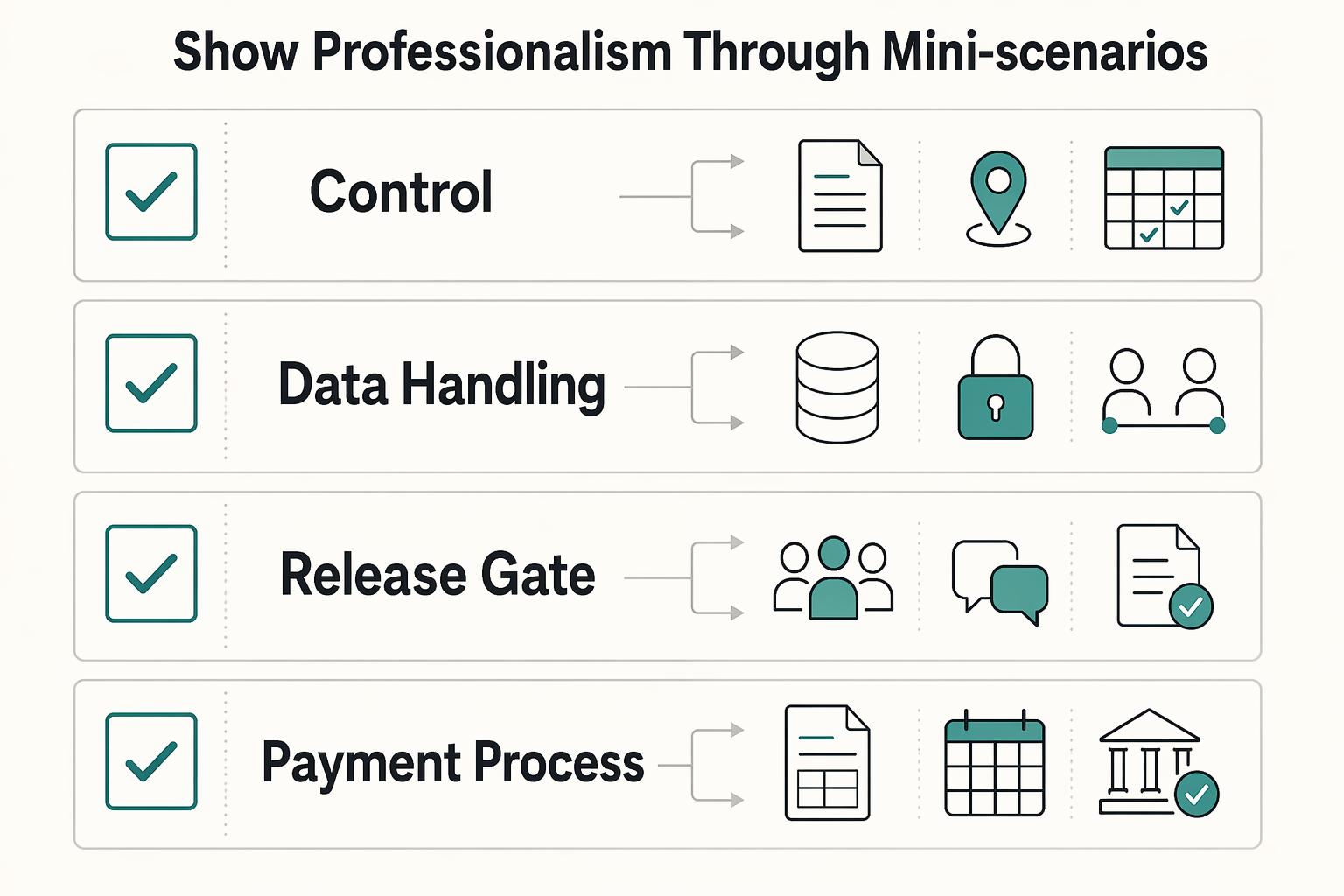
Show professionalism through mini-scenarios#
Use short, neutral scenarios to show how you work. For scope control, explain that new requests are reviewed before they are added so the original deliverables stay on track. For data handling, explain that you confirm needed data and approval owners before work starts. For approvals, explain that one decision owner consolidating feedback keeps execution clean. For payment process, explain that invoicing steps and approvers are confirmed early to avoid operational delays.
| Scenario | What to explain |
|---|---|
| Scope control | New requests are reviewed before they are added so the original deliverables stay on track. |
| Data handling | You confirm needed data and approval owners before work starts. |
| Approvals | One decision owner consolidating feedback keeps execution clean. |
| Payment process | Invoicing steps and approvers are confirmed early to avoid operational delays. |
Watch their reaction. Specific, cooperative responses are a good sign; irritation or hand-waving is not.
State boundaries early and ask better questions#
State boundaries early in one sentence: you work best when scope is explicit, communication has a regular cadence, change requests are reviewed before inclusion, and one person owns final decisions.
| Topic | Question |
|---|---|
| Budget realism | What range is set aside, and who approves it? Verify the current budget range and approval threshold from finance or source records before use. |
| Stakeholder access | Who will I work with directly, and who makes final decisions? |
| Timeline discipline | What date matters most, what drives it, and what could cause slippage? Verify any timeline threshold from hiring or source records before use. |
| Success definition | At the end, what specific outcome makes this engagement worth it? Verify the success metric or threshold from source records before use. |
Use that question bank to qualify fit without sounding combative.
If you want a deeper dive, read What to Do If You've Been Misclassified as an Independent Contractor.
You're Not an Applicant - You're the Solution#
Approach behavioral interview questions as a two-way qualification: you are assessing fit while showing how you work through specific past examples. That means you bring clear evidence, ask practical questions, and decide whether the scope and expectations match how you deliver.
Do not memorize scripts. Exact prompts are unpredictable, so rigid answers break when wording changes.
Instead, prepare a small set of reusable stories you can adapt across common themes, especially collaboration, and make them concrete with scope, team context, timeframe, and outcome. "I worked with a team of five for several months" is more credible than a broad claim.
| Shift | What you say | What you ask | What evidence you bring |
|---|---|---|---|
| From waiting to mapping | "Here's the closest example and what happened." | "Which outcomes matter most in this role?" | A prepared story you can adapt quickly |
| From duties to impact | "Situation, action, result, and business value." | "How do you measure success in the first phase?" | Before-and-after artifacts, metrics, or stakeholder feedback |
| From self-claims to proof | "I can show how I handled this in practice." | "Where is the team currently stuck?" | Notes, outputs, and decision trail from past work |
| From one-way answering to mutual fit | "I can support this scope under these conditions." | "What constraints or decision rights should I plan for?" | Clear boundaries on ownership, timing, and scope |
The main risk is unsupported self-description. Interviewers get a more realistic view from past-performance stories than from claims about style, so if a number is unverified, say that plainly and use the strongest evidence you do have.
Use STAR-V and your Case Study Arsenal as one system: STAR-V gives each answer structure, and your case studies supply the proof you can adapt in real time. Before your next interview, tighten three stories, attach one piece of support to each, and prepare two fit-check questions you will ask.
We covered this in detail in How to Create a Company Culture Deck.
Frequently Asked Questions
How should you answer a question about a mistake or failure?
Use a clear STAR-based response with ownership. Briefly explain the situation and your task, describe the action you took to correct the issue, and end with the result plus what you now do to prevent a repeat. Keep it specific and factual, not blame-based or apologetic.
What if you do not have hard numbers for the result?
You can still give a credible answer without hard numbers. Do not invent precision. Use the strongest proof you have, state whether it is a verified metric, reasonable estimate, or qualitative proxy, and keep backup notes ready if asked how you know.
What kinds of prompts should you expect at a senior level?
Expect prompts about decision-making, communication, prioritization under constraints, teamwork, leadership, and change. You may be asked about difficult decisions, incomplete information, major decisions from the past 6, 12, or 18 months, cross-team work, adaptation, or compliance with a process you did not agree with. Prepare a few real stories you can retell across themes using STAR.
What if you do not have direct experience for the exact scenario?
Do not fake a story. Say you have not handled that exact situation directly, then explain how you would approach it by identifying what facts you would verify, which risks you would control early, what criteria you would use, and when you would escalate or ask for more information. That still shows the judgment the interviewer is testing for.
Try a related tool
Researched and edited by the Gruv editorial team. Gruv builds cross-border billing, payouts, and finance-operations software for global businesses.
Sources
- capd.mit.edu/resources/the-star-method-for-behavioral-int...trusted
- hr.berkeley.edu/sites/default/files/attachments/behavioral-i...trusted
- hr.virginia.edu/sites/default/files/PDFs/behavioralbased-int...trusted
- ischool.sjsu.edu/behavioral-interview-questionstrusted
- ocs.yale.edu/channels/the-behavioral-interviewtrusted
- ohsu.edu/sites/default/files/2019-04/How-to-Answer-th...trusted
- scholarworks.waldenu.edu/cgi/viewcontent.cgitrusted
- training.hr.ufl.edu/resources/leadershiptoolkit/job_aids/behavio...trusted
Educational content only. Not legal, tax, or financial advice.
Related Posts

What to Do If You've Been Misclassified as an Independent Contractor
Treat this as a protection problem first, not a label debate. If your work was treated as an independent contractor arrangement even though the relationship functioned differently, your first goal is to protect pay, rights, and records while you choose the least risky escalation path. You can do that without making accusations on day one, which often keeps communication open while you document what happened.
The Best Interview Questions to Ask a SaaS Sales Candidate
Start by qualifying the company like a prospect. Do not spend real interview energy until you know the company is worth it. In this phase, you gather evidence, separate signal from noise, and walk early if the operating reality looks weak.
How to Write a Job Description That Attracts Top Talent
If you are buying a defined result from an outside professional, start with a project charter, not a hiring document. A charter can make the outcome, boundaries, approval path, and proof of completion clearer before work starts. That clarity is often what keeps projects cleaner than role-based paperwork.