
Quick Answer
Start by treating the battle of the forms ucc problem as document control: compare your MSA and SOW against the client PO, flag added or contradictory clauses, and object in writing before performance continues. Under UCC 2-207, nonmatching forms and conduct can still form a contract, so silence can shift payment, liability, and dispute terms. Keep one complete record of versions, responses, and acceptance steps, and keep governing-law language consistent for mixed or cross-border work.
Why the 'Battle of the Forms' Is a Direct Threat to Your Autonomy#
You can lose control of core deal terms before anyone finishes negotiating. The pattern is familiar: you send your terms, the client sends a purchase order with different boilerplate, and work starts anyway.
That is where the risk starts. For transactions in goods, UCC § 2-207 says a nonmatching response can still operate as acceptance unless it is expressly conditional on assent to the different terms. Contract-by-conduct can also apply when both sides perform even if the writings do not line up.
In practice, the conflict usually lands on terms that control cash flow and risk, not minor wording. Payment timing can shift, or fall back to default rules like § 2-310 if no special term controls. Remedy and damages language can reallocate liability under § 2-719. Dispute clauses can push you into the client's forum or arbitration process. And while § 2-207 does not decide ownership of service deliverables, conflicting boilerplate can still create later disputes over what each side thought it agreed to.
| Term area | Your terms | Client boilerplate | If you stay silent and perform |
|---|---|---|---|
| Payment timing | Defined invoice/payment schedule | Different payment timing language | Timing can be disputed or filled by default rules |
| Liability and remedies | Limited remedies/damages framework | Broader remedies or different risk allocation | Your exposure may increase |
| Other added terms | Narrow, negotiated scope | Broader or different language | Scope disputes can surface after delivery |
| Dispute handling | Your forum/process | Client forum or arbitration terms | Cost and leverage can shift away from you |
Two checks matter right away. First, confirm whether the PO includes additional terms beyond your baseline deal language. Second, send a timely written objection to conflicting terms. UCC § 2-207 treats timely objection as one path to keep added terms out. The next sections show how to prevent the problem up front and how to respond when a conflicting form arrives.
Related: A Guide to the 'Right of First Refusal' in Contracts.
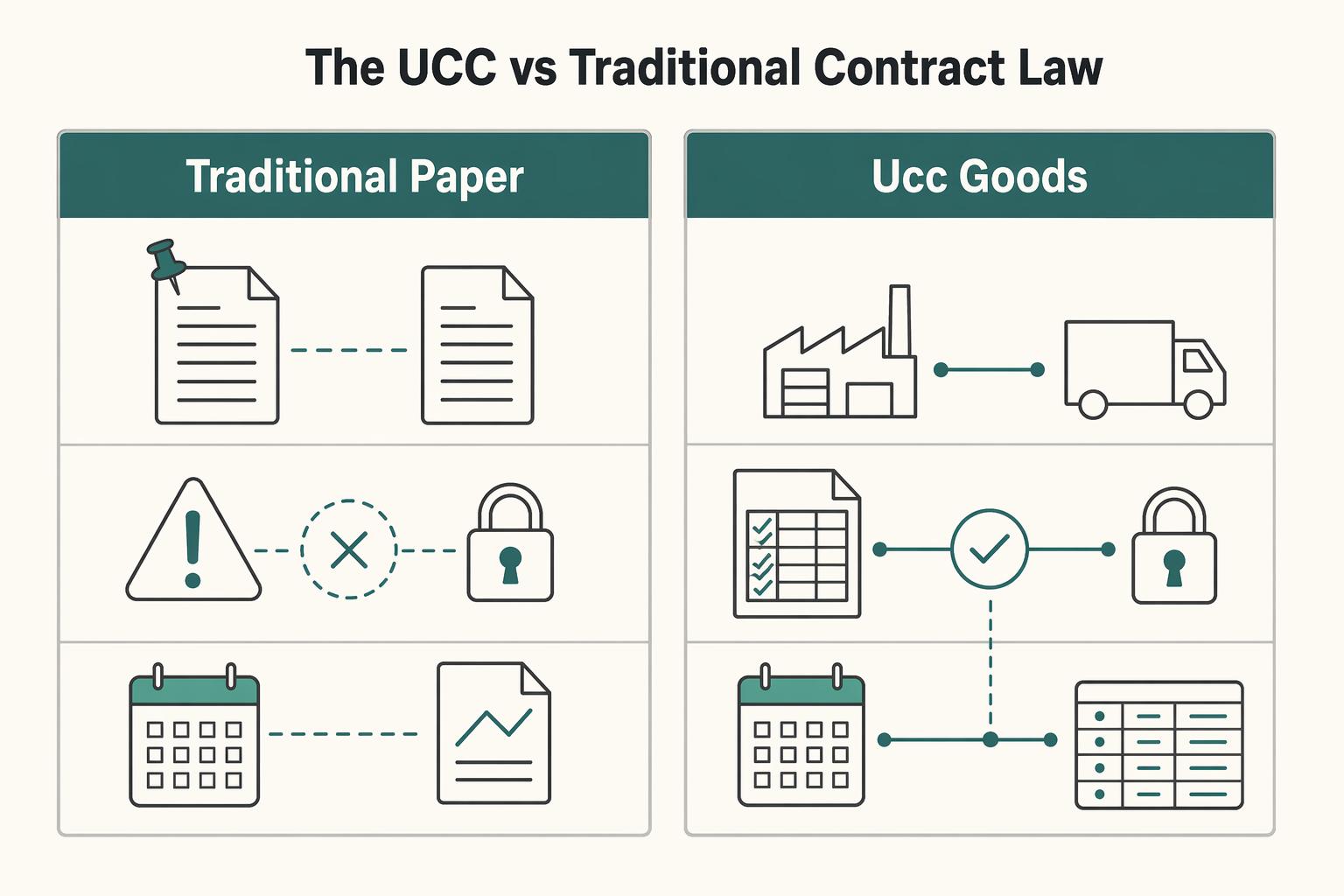
Understanding the Battlefield: The UCC vs. Traditional Contract Law#
This is a practical control problem. Once forms conflict and work continues, you can end up fighting over terms after the deal is already underway. For goods deals, read the sequence first, then the paperwork, then the conflict clauses.
Teams often start with a paper-first framing. Use that as context, not as a shortcut when months of performance records are also in play.
| Approach | Contract formation focus | What happens to conflicting terms | Risk to your protections |
|---|---|---|---|
| Traditional paper-first framing | Whether the acceptance matched the offer cleanly on paper | Conflicts are read from the exchanged documents first | Key protections may be unclear if the documents do not align |
| UCC goods workflow | Whether the exchange plus performance records show an operating deal | Added terms can remain a live dispute point while performance continues | You may discover late that dispute or payment terms were never aligned |
A practical way to analyze this is to track events in order. In the scenario, the buyer's January 9 email requested 2,000 pounds per month beginning February 1, and the January 19 reply added an arbitration condition. From February 1 through October 1, shipments, acceptance, invoices, and checks continued, with no other communications noted in that period. Then complaints arrived on October 14. That sequence shows the risk: a clause added early may not matter until months of routine performance have already created a harder dispute. Use these terms in plain language when you review the exchange:
- Additional term: a clause added in the response that was not in the original request, here arbitration before the American Arbitration Association.
- Dispute-resolution clause: language that directs where or how disputes are handled, here arbitration instead of court.
- Performance trail: records showing ongoing execution, including monthly invoices and payment checks.
That leads to the practical question: how do you stop the conflict before it starts? The next step is to tighten your own paper before procurement sends back its form.
Proactive Defense: Fortifying Your Initial Offer#
Your best protection starts before procurement sends back a PO. In your first outbound packet, do three things: make acceptance conditional on your terms, object in advance to conflicting boilerplate, and make your non-negotiables conspicuous.
This matters most in goods transactions under UCC Article 2, including UCC § 2-207 and merchant-to-merchant context under UCC § 2-104. If your deal is mainly services, use the same discipline, but do not assume Article 2 automatically applies.
| Defense layer | What to include in your first packet | Risk it blocks | If you skip it |
|---|---|---|---|
| Conditional acceptance | State acceptance is limited to your terms and expressly conditional on assent to them | A conflicting response still operating as acceptance | Client paper can enter the deal before conflicts are resolved |
| Advance objection | State now that you object to any additional or different terms in later PO/portal/vendor forms | Later boilerplate slipping in unless you react fast | You end up arguing timing and whether objection was timely |
| Conspicuous non-negotiables | Put core commercial/risk terms under clear headings with visible formatting | "We never saw that term" arguments | Critical terms look like hidden boilerplate instead of negotiated terms |
The three drafting moves to put in the first packet#
Keep this short and operational. State that your offer is limited to its terms and that any acceptance is expressly conditional on assent to those terms. Say now that you object to any additional or different terms in POs, portals, onboarding documents, confirmations, or follow-up emails. Then make key terms easy to spot with clear headings and consistent visible formatting instead of burying them in dense boilerplate.
Do not rely on wording alone. Conduct can still establish a contract when forms conflict. If work starts and payments flow while the paper stays unresolved, the operative terms can end up being the terms both sides' writings agree on, together with supplementary UCC terms.
Your non-negotiables should be concrete, not implied#
State the points that matter in the first packet, not after pushback. At a minimum, make payment timing, liability limits and remedy limits, warranty scope, governing law, and dispute venue explicit. If IP ownership or license scope matters in your deal, state those terms explicitly too.
| Term | What to make explicit | Why it matters |
|---|---|---|
| Payment timing | State it in the first packet | For goods, payment can default to buyer receipt timing if you do not set terms |
| Liability and remedy limits | State them explicitly and draft clearly | Do not leave them for later pushback |
| Warranty scope | State it explicitly | For warranty disclaimers, use clear conspicuous language in writing |
| Governing law | Name it directly | Name the jurisdiction directly |
| Dispute venue | Name it directly | Name the forum directly |
| IP ownership or license scope | State it explicitly where relevant | If it matters in your deal, state those terms explicitly too |
Keep those terms specific and consistent across documents. For goods, payment can default to buyer receipt timing if you do not set terms. For service-heavy deals, defaults may not protect your commercial outcome. Draft liability and remedies clearly. For warranty disclaimers, use clear conspicuous language in writing. For governing law and venue, name the jurisdiction and forum directly.
Document hygiene decides whether your protections hold#
A single hierarchy across the full packet matters more than clever drafting. Pair an integration clause with an order-of-precedence clause so the documents tell the same story if a conflict appears later. A practical structure is a clear hierarchy (for example, MSA -> SOW -> order form) with explicit precedence language if terms conflict. Before sending, verify the mechanics:
| Document control | What to verify | Grounded detail |
|---|---|---|
| Hierarchy | Use one clear hierarchy across the full packet | Example given: MSA -> SOW -> order form |
| Integration and precedence | Pair an integration clause with an order-of-precedence clause | The documents should tell the same story if a conflict appears later |
| Party names | Match them across all documents | MSA, SOW, signature blocks, invoice template, and portal profile |
| Defined terms | Keep them identical | Verify consistency before sending |
| Version/date | Match the footer to what was actually sent | Verify the version/date in the footer |
| Record set | Keep it complete | Sent email, attachments, portal screenshots, signed copies, and follow-up confirmations |
Pre-send self-audit#
Use this checkpoint before anything goes out. If you need a deeper core-agreement framework, use How to Write a Master Service Agreement (MSA) for Long-Term Client Engagements.
- Have I stated acceptance is limited to my terms and expressly conditional on assent?
- Have I objected in advance to additional or different terms in PO/portal/onboarding documents?
- Are payment timing, liability/remedy limits, warranty scope, governing law, and dispute venue explicit, and are any IP ownership/license terms stated where relevant?
- Are critical terms conspicuous enough that a reasonable person should notice them?
- Does the hierarchy clause clearly identify the controlling MSA version/date, SOW version/date, and order form version/date?
- Do party names, defined terms, and signature blocks align across all documents?
- If performance starts tomorrow, can I prove exactly what version was sent and accepted?
For a step-by-step walkthrough, see A deep dive into the 'Waiver of Jury Trial' clause in contracts. You can turn your acceptance and objection clauses into a practical first draft with the freelance contract generator.
Reactive Defense: How to Respond to a Client's Conflicting Terms#
When a client's terms conflict with yours, sequence matters more than speed. Lock the record first. Then decide what you can concede, if anything, based on the whole deal rather than price alone.
Move in this order#
- Lock the record first. Pull the exact versions of the documents and terms tied to the transaction.
- Decide what matters before concessions. Clarify your needs, main concerns, and goals, and map what the client side likely needs most.
- Review total-value terms. Focus on service, access, timing, quality, and payment terms before discussing price.
- Respond in writing with specifics. Identify the conflicting language and propose a concrete path to align documents.
- State your value clearly. Explain why the clause package needs to match the service, access, timing, quality, and payment structure of the deal.
Focused checklist for high-risk changes#
Conflicts usually matter because they change the total value of the deal, not because the wording looks different on the page. When you review the client's paper, check for:
- Service expectations: support scope or responsiveness that changes effort
- Access conditions: limits on the people, systems, or information needed to deliver
- Timing pressure: faster delivery expectations that raise execution risk
- Quality expectations: broader quality demands without matching scope alignment
- Payment terms: timing or structure changes that alter deal value
- Price-only pressure: requests that ignore other variables and push toward a price war
Keep your objection short and specific#
A good objection is direct, narrow, and easy to match to the paper trail.
- Acknowledge receipt of the terms.
- Identify the exact conflict by document and clause or section.
- State what you cannot accept as drafted and what you can accept.
- Anchor your position in total value (service, access, timing, quality, payment terms), not only rate.
- Propose the next step such as a redline, short alignment call, or addendum.
| Common client change | Why it is risky to you | Recommended response posture |
|---|---|---|
| Price-only discount request | Can push the negotiation into a margin-eroding price war | Reframe to total value and trade across service, access, timing, quality, or payment terms |
| Payment terms stretched | Can reduce near-term deal value and planning flexibility | Rebalance with scope, timing, or service terms before conceding on price |
| Compressed timeline request | Can raise delivery pressure and quality risk | Trade timeline changes against scope, access, or payment terms |
| Expanded service expectations | Can increase effort without matching value | Define service scope clearly and align added service with corresponding terms |
| Higher quality bar without scope alignment | Can increase delivery cost and execution risk | Clarify quality expectations and align scope, timing, or payment structure |
| Restricted access to needed inputs | Can slow delivery and reduce outcome quality | Set access requirements early and link them to timing and service commitments |
Escalation for unresolved legal questions#
Some conflicts raise legal questions this process does not resolve. If the legal effect is unclear, say so and escalate for qualified legal review before final agreement. Keep a clean trail: exact conflicting language, your value-based proposal, and who approved each decision point. We covered related posture in Freelance Liability Clauses That Limit Risk Without Stalling the Deal.
The Expert's Edge: Navigating the Services Gray Area#
The first call is not about wording. It is about classification. If you skip that step, the dispute can slide away from your business terms and into a threshold fight over which rules apply.
Classify the deal before you argue the forms#
UCC Article 2 and Section 2-207 are generally used in sales-of-goods disputes. In mixed deals, a practical question is what predominates. The working example here is a goods-plus-installation contract treated under the UCC because goods predominated. Use that lens in intake review:
- Service-dominant example: strategy work where a deck, report, or training file supports the service
- Goods-dominant example: product-style delivery where setup or onboarding is secondary
- Mixed or unclear example: deal papers do not clearly show whether value comes mainly from services or goods
| Deal type | Likely governing framework | Battle-of-forms risk | Your best contract move |
|---|---|---|---|
| Service-dominant deal | Article 2 fit is less clear; parties may still raise UCC-style arguments | Medium | Say the engagement is for services, describe services first, and state which signed documents control |
| Goods-dominant deal | UCC Article 2 / Section 2-207 is more likely to be the frame | High | Use clear form-control terms, flag conflicting terms early, and keep a clean record of exchanged documents |
| Mixed or unclear deal | Uncertain unless the contract resolves it or a court later does | Highest | Resolve governing law and form-conflict handling inside the contract before performance |
What actually goes wrong if you leave it fuzzy#
When classification stays fuzzy, control drifts. Standard forms are built to centralize control and are used in both paper and electronic contracting. That means conflicting boilerplate can push you into default-rule fights you never planned to have.
At that point, the issues stop being purely commercial. They become process questions about merchant status, material alteration, additional versus different terms, conditional acceptance, and the effect of performance after forms are exchanged. Section 2-207 was built to address this area, but outcomes can still vary across courts. Waiting for a court to sort that out weakens your position because the governing lens is itself contested.
Use a quick checkpoint. Read scope, pricing, and deliverables together. If the commercial center is your labor and judgment, draft it as service-led. If the commercial center is product delivery, treat it as goods-led risk and tighten your form-conflict controls.
A practical opt-in clause for mixed deals#
If the deal is mostly services but you want a clearer way to handle form conflicts, you can add a clause that opts into UCC-style form-conflict principles. Treat that as a drafting choice, not a universal result, and verify jurisdiction-specific wording before finalizing. Here is a plain-language template:
| Clause control | What the article says to specify | Example from the article |
|---|---|---|
| Governing law | Keep the governing law intentional and confirm local wording before signature | Pending: verify the governing-law jurisdiction against the signed agreement and current local law before use. |
| Forms covered | Specify which standard forms are included in the conflict rule | purchase orders, vendor terms, portal terms, acknowledgments, or other standard forms |
| Fallback rule | State what controls if a conflict remains | Pending: verify the fallback rule against the signed agreement, source records, and local counsel before signature. |
Drafting status: the governing-law jurisdiction and fallback rule for unresolved form conflicts remain pending. Before this language is used or signed, verify both against the signed agreement, current local law or local counsel guidance, and source records.
Keep those unresolved items explicit during drafting. Governing law, which forms are covered, and the fallback rule are the controls that matter. Verify them before signature. If you need to tighten the base document first, review your MSA structure.
Conclusion: Reduce battle-of-forms risk through consistent execution#
A practical way to reduce battle-of-forms risk is consistent execution. Fortify your base agreement, respond to conflicting forms in writing, and keep governing-law language aligned with the deal you are actually doing.
Written terms matter, but so does conduct. Standardized forms move through day-to-day operations, and disputes often turn on what the parties sent, accepted, and performed, not just the first draft of the paper.
Start with your MSA as the control document. Put your core commercial positions there, then carry the same language into your SOW and acceptance steps. If the base paper is weak, fix it before the next deal instead of trying to patch it during a rushed PO exchange. If useful, tighten your base form with this guide on how to write a Master Service Agreement (MSA) for long-term client engagements.
When a client PO conflicts, do not rely on verbal assurances that it is "just admin." Compare the forms, quote the changed clause, and respond on the same written record before work starts or continues. For service-led and cross-border work, treat document alignment as a process control and have local counsel confirm final governing-law wording. Use this before signing:
- Confirm the signed MSA or SOW is the commercial base document.
- Check the client PO and any acknowledgment for changes to key commercial terms.
- Confirm how acceptance is actually recorded in this deal.
- Keep one complete file with final documents and your written responses to changed terms.
- Leave final jurisdiction wording for local counsel review in cross-border or mixed-contract work.
This process improves control, but it does not replace jurisdiction-specific legal review. If local law, deal structure, or cross-border language could change the outcome, have counsel verify the final wording.
If you want to pair your contract process with invoicing and payout visibility in one workflow, see Gruv for freelancers here.
Frequently Asked Questions
What should you check first when a client’s form does not match your contract?
Start by identifying the governing law and whether the deal is for goods, services, or mixed work. That determines whether you are in a common-law (mirror-image) frame or a UCC § 2-207 frame, which changes how conflicting forms are handled. Before comparing clauses, line up your signed contract documents, the client’s purchase order, and any order acknowledgment in one file.
Why does UCC § 2-207 matter if you never “agreed” to the client’s boilerplate?
Under UCC § 2-207, a response can still count as acceptance even when it adds or changes terms. That means fine-print terms in exchanged forms can still affect control of the deal. The safest move is to mark changed terms and respond in writing on what you accept and reject.
What should you treat as a possible material alteration?
Use this as a risk flag, not a definitive legal label. If a change shifts core deal risk or control, treat it as a priority review item. In practice, focus on terms that change payment outcomes, responsibility, or dispute rights. If you spot one, quote it, restate your controlling language, and ask for written confirmation before performance.
What is the difference between an additional term, a different term, and a conflicting term?
For quick triage, treat the labels this way: an additional term adds a topic your form did not cover; a different term covers the same topic with different wording; and a conflicting term is a flat contradiction between forms. Use the quick sort below to decide how to respond. | Term type | Plain-English meaning | Practical risk | Your next move | |---|---|---|---| | Additional term | Adds a topic your form did not cover | Can slip in as an extra condition | Accept or reject it explicitly in writing | | Different term | Covers the same topic with different wording | Creates direct competition with your clause | Restate your clause and reject the change in writing | | Conflicting term | Flat contradiction between forms | Creates uncertainty over what survives | Resolve in signed revised terms before work continues | If a clause is hard to classify, treat it as a conflict and clear it up before you proceed.
What is the knockout rule, and should you rely on it?
The knockout rule is a label for one possible outcome when directly conflicting terms are present. It is not a guaranteed outcome, and you may not keep the clause you tried to impose. Do not build your process around that outcome. Prevent the clash by confirming the controlling documents in writing.
Does this matter if you mainly provide services, not goods?
Yes. The paperwork problem can look the same even when the legal frame changes. Services and other nongoods are generally handled under common law, while goods deals use the UCC framework. If your engagement is mixed, define the service center clearly and state which signed document controls.
Where do the risky terms usually hide in client paperwork?
They often show up in preprinted purchase orders and order acknowledgments, including boilerplate in less visible sections. That is where one-sided terms can create uncertainty later. Before starting work or accepting in a portal, confirm that you have the full form set and keep copies of each version exchanged.
How should you handle international deals and the CISG?
For cross-border goods transactions, treat CISG as part of the governing-law review instead of assuming a U.S.-only framework will control. Keep your governing-law position consistent across deal documents, and have counsel confirm final jurisdiction language and any CISG opt-out language. If the engagement is service-led or mixed, keep that classification explicit.
What is the most practical paperwork habit to reduce battle-of-forms risk?
Keep one complete deal record: your offer, signed contract documents, client forms, and your written responses to changed terms. That gives you a clear sequence of what was sent, what conflicted, and how you answered. If the client insists on its form, respond on that same paper trail and state your acceptance conditions explicitly.
Try a related tool
Researched and edited by the Gruv editorial team. Gruv builds cross-border billing, payouts, and finance-operations software for global businesses.
Sources
- acquisition.gov/far/52.215-8trusted
- budget.nv.gov/uploadedFiles/budgetnvgov/content/Meetings/B...trusted
- cms.gov/files/document/prrb-jurisdictional-decisions...trusted
- congress.gov/119/chrg/CHRG-119shrg61560/CHRG-119shrg61560...trusted
- connect.ncdot.gov/resources/Logistics-Freight/Documents/Materi...trusted
- govinfo.gov/content/pkg/CHRG-115hhrg26907/html/CHRG-115h...trusted
- irs.gov/pub/irs-utl/constructionindustry_atg.pdftrusted
- law.cornell.edu/ucc/2/2-207trusted
Educational content only. Not legal, tax, or financial advice.
Related Posts

Germany Freelance Visa Application Path for Freiberufler and Gewerbe
Choose your track before you collect documents. That first decision determines what your file needs to prove and which label should appear everywhere: `Freiberufler` for liberal-profession services, or `Selbständiger/Gewerbetreibender` for business and trade activity.

Master Service Agreement for Freelancers in Long-Term Client Engagements
If you expect repeat work with the same client, set the contract architecture first: one reusable MSA for standing terms, then project documents for each engagement. The point is not just speed. It is making sure your baseline terms are set before they repeat across future projects. Treat each document as a separate layer:

The Freelance Payment Penalty: A Modeled Audit of Platform Fees, FX Spreads, and Payout Delays
The money rarely disappears through a single, easy-to-spot fee. The real loss is stacked. A marketplace takes its commission, a processor adds a charge for international cards, a bank or payment company converts the currency at a spread, a platform holds the funds before release, and a wire sheds a little to intermediaries on the way in. Each layer looks defensible on its own, but the worker feels the combined result as a smaller deposit and a later payday.