
Quick Answer
A backdoor Roth IRA is a two-step strategy for high earners who may be blocked from making a direct Roth IRA contribution: make a nondeductible contribution to a traditional IRA, then convert it to a Roth IRA. The key checkpoint is the pro-rata rule, because pre-tax balances in traditional, SEP, and SIMPLE IRAs can make part of the conversion taxable. Clean documentation and Form 8606 reporting are essential.
Introduction: You Don't Need Another Guide. You Need an SOP.#
A backdoor Roth IRA is a strategy, not a separate account. You make a non-deductible contribution to a traditional IRA, then convert that amount to a Roth IRA. This usually matters when your modified AGI limits or blocks a direct Roth IRA contribution, even though Roth conversions are not income-limited.
The key definitions here are operational, not academic. A non-deductible contribution means you contribute to a traditional IRA without taking a tax deduction. A Roth conversion is a reportable move from a traditional, SEP, or SIMPLE IRA into a Roth IRA. The main risk checkpoint is pro-rata exposure.
For this analysis, the IRS traditional IRA scope includes SEP and SIMPLE IRAs, so existing IRA balances can affect the taxable portion of a conversion. Documentation matters because Form 8606 reports both non-deductible contributions and conversion activity.
For 2026, this strategy may be worth evaluating if your income is in or above the Roth phaseout ranges: $153,000-$168,000 for single or head of household and $242,000-$252,000 for married filing jointly. Your annual IRA contribution cap is still $7,500 in 2026, or $8,600 if you are age 50 or older.
Pause before acting if you hold funds in any traditional, SEP, or SIMPLE IRA and have not modeled the tax effect. Get tax help before moving money if you have prior-year IRA basis, are unsure whether earlier IRA contributions were deducted, or cannot clearly trace balances by IRA type.
What this guide gives you#
This is a process you can actually run: pre-check your IRA mix, execute the contribution and conversion, report it on Form 8606, then fix mistakes if needed.
| Generic explainer | This SOP |
|---|---|
| Defines the strategy | Tells you when to proceed and when to pause |
| Mentions pro-rata briefly | Uses IRA account mix as the first checkpoint |
| Treats filing as admin | Treats Form 8606 as a required execution step |
One warning up front: missing a required Form 8606 filing can trigger a $50 penalty unless you can show reasonable cause.
Phase 1: Check whether pre-tax IRA balances make your conversion taxable#
Treat this phase as a strict go/no-go gate before any backdoor Roth IRA move. Income by itself does not block conversion mechanics. The real risk is whether pre-tax IRA balances can make part of the conversion taxable.
The core rule is pro-rata aggregation. Under IRC 408(d)(2), the IRS treats your IRAs as one combined contract for this tax treatment, not as isolated accounts. In practice, opening a new empty IRA does not shield you from pre-tax money sitting in other traditional, SEP, or SIMPLE IRAs.
For this check, a pre-tax IRA balance means IRA money that has not yet been taxed. For Form 8606 purposes, traditional IRA includes traditional, SEP, and SIMPLE IRAs, so those balances all feed the same calculation. Form 8606 also uses a year-end input: the value of all traditional IRAs as of December 31, plus outstanding rollovers. This is not just a conversion-day snapshot.
Your decision checklist#
Before contributing, document each item in writing and keep evidence, not assumptions:
| Checklist item | When |
|---|---|
| List every traditional IRA, rollover IRA, SEP IRA, and SIMPLE IRA in your name. | Before contributing |
| Label each account as pre-tax, after-tax basis, or mixed if prior non-deductible contributions exist. | Before contributing |
| For each pre-tax balance, verify whether an eligible workplace plan will accept a roll-in. | Before contributing |
| If using a one-participant 401(k), confirm owner-only eligibility: owner, or owner plus spouse. | Before contributing |
| If any rollover is indirect, plan around the 60-day rollover deadline. | Around the 60-day rollover deadline |
| Confirm zero pre-tax IRA balance after transfer with updated statements before year-end. | After transfer, before year-end |
Keep pre-transfer balance proof, rollover confirmation, and post-transfer zero-balance statements.
Primary cleanup path for self-employed readers#
For many freelancers and owner-operators, a common cleanup path is moving pre-tax IRA assets into a Solo 401(k). That can remove those assets from traditional, SEP, and SIMPLE IRA aggregation for Form 8606 math.
Do the operational checks before you start paperwork. First, confirm the plan accepts IRA roll-ins because that is plan-dependent. Next, check timing. Adoption timing matters, and 401(k) features cannot take effect before the adoption date.
Also remember that rollover logistics and contribution limits are separate issues, so verify the current limits before you act. If plan assets reach $250,000 or more at year-end, Form 5500-EZ filing applies.
| Remediation path | Best use case | Tradeoff | When to choose |
|---|---|---|---|
| Roll pre-tax IRA funds into an eligible workplace plan, including a Solo 401(k) | You want a cleaner conversion and have a plan that accepts roll-ins | Setup and admin work, plus plan-rule validation | Choose when you can finish the transfer and document a zero pre-tax IRA balance before year-end |
| Keep the pre-tax IRA balance and convert anyway | You accept partial taxation | Higher tax complexity and weaker conversion economics | Choose only after modeling the tax impact |
| Pause the strategy | Basis is unclear, accounts are mixed, or the rollover destination is not ready | Delayed Roth funding | Choose when cleanup cannot be completed and documented confidently |
If you cannot reach a documented zero pre-tax IRA balance by December 31, do not treat this as routine execution. Either pause or proceed knowing part of the conversion may be taxable.
You might also find this useful: Salary Sacrificing into Super in Australia for Sole Traders and Directors.
Phase 2: Run the contribution and conversion as separate documented steps#
Once Phase 1 is truly clean, execution should be boring. Your job here is to run a simple two-step backdoor Roth IRA process and leave a paper trail that makes filing easy.
Terms that matter#
A non-deductible contribution is a traditional IRA contribution you track on Form 8606. This does not include employer SEP or SIMPLE contributions.
A conversion event is moving money from a traditional IRA to a Roth IRA.
Settlement status means the transfer is officially complete, not just submitted. A contribution can appear in the account and still be unavailable because of a hold, and processing windows vary by custodian.
Full available balance matters because Form 8606 uses annual ratio math and asks for your year-end traditional IRA value, plus outstanding rollovers. Leaving small amounts behind can complicate reporting.
Timing rules you can actually use#
Do not use a fixed day-count rule. Convert only when all three are true:
- Your contribution is posted to the traditional IRA.
- The funds are available to transfer.
- Your custodian confirms the conversion can be processed now.
Keep the contribution and conversion as separate, documented actions with distinct dates, amounts, and confirmations. If funds are pending or unavailable, wait. Also treat the conversion as a committed step because traditional-to-Roth conversions made after 2017 cannot be recharacterized back to a traditional IRA.
The checklist#
| Step | What to do | Control point |
|---|---|---|
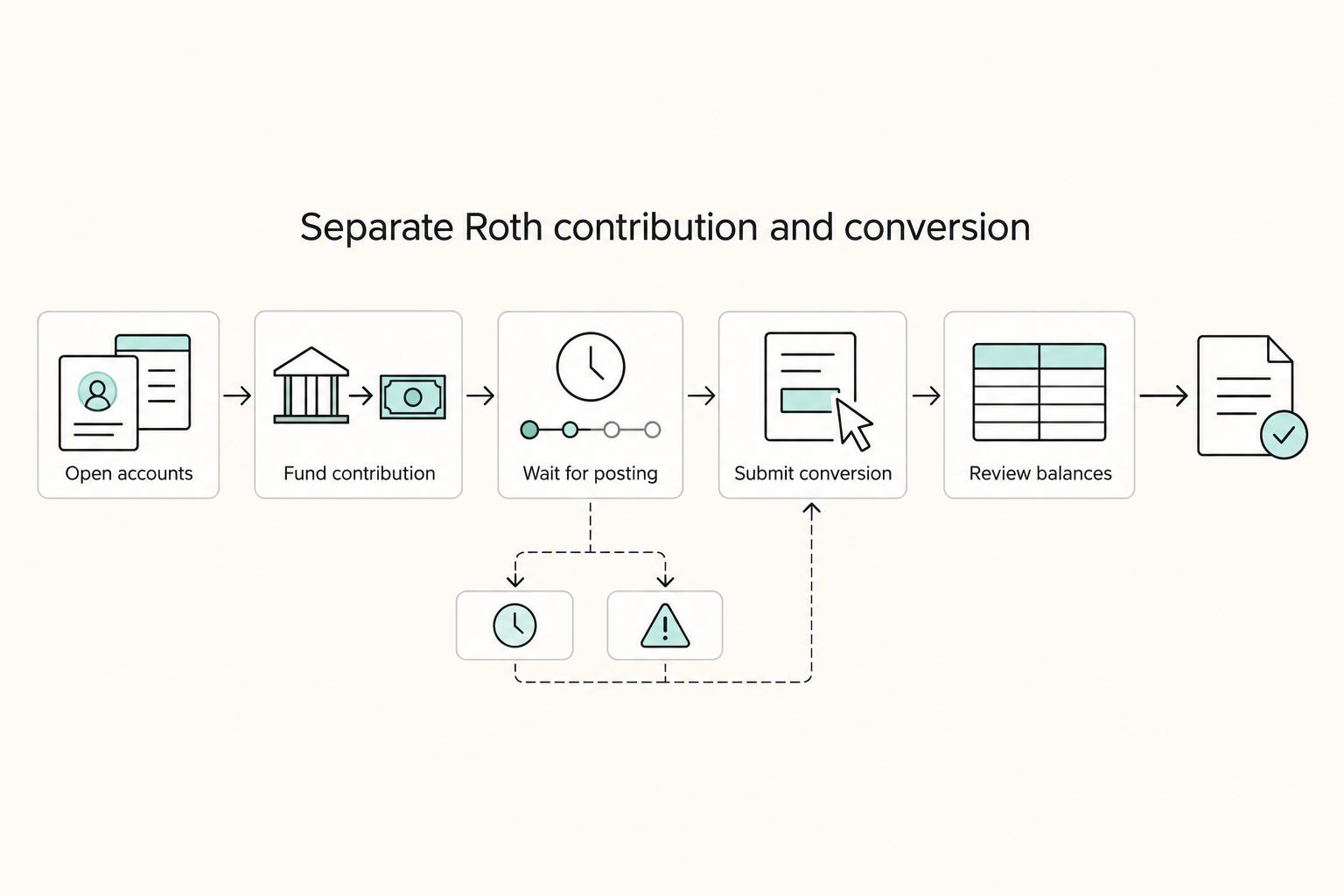
| Open the accounts clean. | Confirm the traditional IRA and destination Roth IRA are open and verified, and document the traditional IRA starting balance before funding. | Capture proof of the traditional IRA starting balance before funding. |
| Make the contribution and code it correctly. | Submit it as a non-deductible traditional IRA contribution for the correct tax year, within your annual IRA limit. | Save the confirmation showing account type, contribution year, and amount. |
| Wait for posted and available status. | Confirm the funds are fully posted and transferable. | Save a screenshot or statement showing available status. |
| Submit the conversion request correctly. | Convert to the Roth IRA and, where available, select the full available balance to reduce leftover residuals. Verify destination account details before submitting. | Save the conversion confirmation with date and amount. |
| Review post-conversion balances. | Confirm the Roth received the conversion and review the traditional IRA balance after processing. Recheck the next statement cycle for any residual amount. | Retain post-conversion statements. |
- Open the accounts clean.
Confirm the traditional IRA and destination Roth IRA are open and verified, and document the traditional IRA starting balance before funding. Control point: capture proof of the traditional IRA starting balance before funding.
- Make the contribution and code it correctly.
Submit it as a non-deductible traditional IRA contribution for the correct tax year, within your annual IRA limit. Control point: save the confirmation showing account type, contribution year, and amount.
- Wait for posted and available status.
Do not convert from an initiation screen alone. Confirm the funds are fully posted and transferable. Control point: save a screenshot or statement showing available status.
- Submit the conversion request correctly.
Convert to the Roth IRA and, where available, select the full available balance to reduce leftover residuals. Verify destination account details before submitting. Control point: save the conversion confirmation with date and amount.
- Review post-conversion balances.
Confirm the Roth received the conversion and review the traditional IRA balance after processing. Recheck the next statement cycle for any residual amount. Control point: retain post-conversion statements.
Your evidence pack#
If you ever have to reconstruct the transaction, the documents matter more than memory. Keep records that support what you report on your return. At minimum, save:
- Pre-funding traditional IRA balance proof
- Contribution confirmation showing amount and tax year
- Proof the funds were posted and available
- Conversion confirmation showing date and amount
- Post-conversion traditional IRA statement
- Year-end statements for all traditional, SEP, and SIMPLE IRAs in your name
Use sortable filenames, for example:
2026-01-08_TradIRA_starting-balance.pdf2026-01-09_TradIRA_2026-nondeductible-contribution.pdf2026-01-12_TradIRA_funds-available.png2026-01-12_Roth-conversion-confirmation.pdf2026-01-31_TradIRA_post-conversion-statement.pdf
If anything is missing, request duplicate statements from the custodian before you file Form 8606. For a step-by-step walkthrough, see A Guide to Superannuation for Australian Freelancers.
Once your conversion checklist is drafted, consider using Gruv's tools hub to organize related tax and documentation workflows in the same operating rhythm.
Phase 3: The Compliance Lock-in - Reporting on Form 8606 with Confidence#
The money move is only half the job. The last step is making sure your return matches what actually happened.
Keep these terms simple:
- A nondeductible contribution is a traditional IRA contribution you track as nondeductible in your records.
- A conversion is money moved from that traditional IRA to your Roth IRA.
- For this process, keep tracking nondeductible contributions and conversions in your paperwork.
The clean path if your setup was truly clean#
If the setup stayed clean, reporting is usually straightforward. You contributed after-tax money, converted it, and your records support what you are reporting. Form 8606 is where those pieces come together.
Use this sequence:
- Start with your contribution records.
- Use them to report your nondeductible contribution on Form 8606.
- Add conversion records that show what was moved and when.
- Check that dates and amounts agree across your documents.
After that, use current Form 8606 line mapping only after verification.
| Form section | What to enter | Source document |
|---|---|---|
| Nondeductible contribution section | Your nondeductible traditional IRA contribution for the relevant tax year | Contribution records showing tax year and amount |
| Roth conversion section | Amount converted from traditional IRA to Roth IRA | Conversion records showing date and amount |
| Final consistency check | Whether your contribution and conversion records align with what you are filing | Your contribution and conversion paperwork |
When to stop and reconcile before filing#
Do not force the form if the facts are messy. Pause and reconcile before filing if any of these are true:
- Your contribution and conversion records do not align.
- Dates or amounts conflict across documents.
- You are unsure how to complete a Form 8606 entry and have not verified current IRS instructions.
In those cases, pause, gather the paperwork, and verify the form steps before entering figures. Missteps here can create unexpected taxes or penalties.
Prevention checklist for common reporting failures#
Use this checklist before filing:
- Untracked paperwork
Confirm you can document both the nondeductible contribution and the conversion.
- Timing or amount mismatches
Reconcile inconsistencies before filing. Execution quality depends on timing and documentation discipline.
- Unverified form entry
Use current Form 8606 instructions before finalizing entries.
- Open questions you cannot resolve from your records
Pause and reconcile before filing.
Paperwork is the last control point. When your records map cleanly into Form 8606, your backdoor Roth filing position is documented and supportable.
We covered this in detail in How to Handle a Roth Conversion Ladder for Early Retirement.
What if I Make a Mistake? A 'Course Correction' Protocol#
Even a clean process can go sideways. Triage in the right order: classify the error, verify what actually happened from your records, then choose a correction path before you take any new IRA action.
Name the mistake before you try to fix it#
Start by separating contribution, conversion, and reporting errors. They do not share the same fix.
For contribution errors, recharacterization may be available in some cases. For conversions, the rule is firm: traditional IRA to Roth IRA conversions after 2017 may not be recharacterized. If the problem is conversion-related, do not build a plan around an undo that is not available.
Use that distinction right away:
- Wrong IRA type or wrong destination contribution: contribution-correction track
- Conversion transaction or conversion reporting mismatch: conversion or reporting track
Reconstruct what actually happened from records#
Use documents, not memory. Pull transaction confirmations, account statements, Form 1099-R for the distribution side, and Form 5498 for the contribution side.
Cross-check Form 5498 carefully before you file or amend. IRS guidance flags that Form 5498 errors can lead to IRA reporting mistakes, especially:
- contribution reported for the wrong tax year
- conversion not reported as a conversion
If records conflict, pause and get custodian clarification or corrections first.
| Mistake type | Why it matters | Immediate fix path | Records to keep | When to escalate to a tax professional |
|---|---|---|---|---|
| Excess IRA contribution | Can trigger a 6% per year excise tax while uncorrected | Confirm total IRA contributions. If an excess exists, remove the excess and attributable income by your return due date, including extensions. | Contribution confirmations, statements, custodian correction request, updated tax forms | Excess spans multiple years, or the excess amount is unclear |
| Wrong contribution type or wrong IRA destination | Contribution correction rules differ from conversion rules | Confirm with your custodian whether contribution recharacterization is available and appropriate before any new IRA action | Original contribution record, recharacterization request, revised statements, Form 5498 copies | Multiple contributions, mixed tax years, or prior IRA reporting is unclear |
| Conversion problem | Post-2017 conversions cannot be recharacterized | Recalculate reporting on Form 8606. Do not try to reverse the conversion through recharacterization. | Form 1099-R, relevant IRA statements, prior Form 8606 | Conversion amounts or prior IRA reporting are unclear |
| Missing or incorrect reporting | Reporting errors can affect how IRA activity is reflected on your return | File or correct Form 8606 after verification. Use Form 5329 if additional IRA taxes apply. | Filed return, corrected Form 8606, supporting statements, custodian corrections | Prior-year forms were missed, or you already received an IRS notice |
Pick the correction path, then move once#
Do not stack fixes on top of each other. Choose one correction track and complete it before your next IRA step.
For excess contributions, verify your annual total first. For 2026, combined traditional and Roth IRA contributions generally cannot exceed $7,500 or $8,600 if age 50 or older. If you are over, correct that first because the 6% excise tax can continue each year until fixed.
For reporting-only issues, file the missing or corrected Form 8606 once amounts are verified. For conversion-related issues, reconcile from records first and then report from that reconciled position. The rule is simple: classify, verify, correct, then proceed.
This pairs well with our guide on The Best Disability Insurance Companies for High-Earners.
Run the same three steps each year, then reconcile before filing#
The point of this strategy is not cleverness. It is repeatability. Each year, run the same three steps in order: verify your IRA balance picture, execute the contribution and conversion, then reconcile reporting before filing.
Start with the December 31 checkpoint. Form 8606 line 6 uses the year-end value of all traditional IRAs, and that scope includes traditional SEP and traditional SIMPLE IRAs. If you expected a clean after-tax basis conversion but still see pre-tax balances, pause and resolve that before you file.
For 2026, total IRA contributions are up to $7,500, or $8,600 if you are age 50 or older, across traditional and Roth IRAs combined. If you make a prior-year nondeductible traditional IRA contribution during filing season, keep the timing straight. A contribution made between January 1, 2026 and April 15, 2026 can count for the prior tax year, while the conversion is reported in the calendar year it happens and can still have a taxable portion under IRA distribution rules.
Annual review checklist#
| Review area | What to confirm | Records or forms |
|---|---|---|
| Account status check | Pull December 31 statements for every traditional, SEP, and SIMPLE IRA, plus any outstanding rollover records. Confirm whether unexpected pre-tax dollars remained. | December 31 statements and outstanding rollover records |
| Custodian records check | Keep contribution and conversion confirmations, then match them to Form 5498 for contributions and fair market value and Form 1099-R for distributions. | Contribution and conversion confirmations, Form 5498, Form 1099-R |
| Tax form confirmation | File Form 8606 for nondeductible traditional IRA contributions, even if you otherwise would not need to file a return. | Form 8606 |
| Escalation point | Stop and get tax support if basis records do not reconcile, Forms 5498 and 1099-R do not match your transactions, or transaction coding is unclear. Check whether Form 5329 also applies if review suggests excess-contribution or early-distribution issues. | Forms 5498 and 1099-R, and possibly Form 5329 |
- Account status check: Pull December 31 statements for every traditional, SEP, and SIMPLE IRA, plus any outstanding rollover records. Confirm whether unexpected pre-tax dollars remained.
- Custodian records check: Keep contribution and conversion confirmations, then match them to Form 5498 for contributions and fair market value and Form 1099-R for distributions.
- Tax form confirmation: File Form 8606 for nondeductible traditional IRA contributions, even if you otherwise would not need to file a return. A required but missing Form 8606 can trigger a $50 penalty unless you show reasonable cause.
- Escalation point: Stop and get tax support if basis records do not reconcile, Forms 5498 and 1099-R do not match your transactions, or transaction coding is unclear. If review suggests excess-contribution or early-distribution issues, check whether Form 5329 also applies.
If the records reconcile, repeat this SOP next year. If the data conflicts, pause and fix the records before you file.
Related: Mega Backdoor Roth Conversions for Freelancers With Uneven Cashflow.
If you also run cross-border client income and want clearer controls around money movement and records, talk to Gruv.
Frequently Asked Questions
Is a backdoor Roth IRA taxable?
Sometimes. The tax result depends on your combined traditional, SEP, and SIMPLE IRA balances at year-end. The portion that reflects after-tax basis is not taxed again, while any pre-tax portion included in the conversion can be taxable.
What exactly is the pro-rata rule?
It means you generally cannot isolate only after-tax IRA dollars by choosing one account. For Form 8606, traditional IRA includes traditional, SEP, and SIMPLE IRAs, and the calculation uses the year-end value of all of them. Pull December 31 statements and any outstanding rollover records before taking another IRA step.
Can I still do this if I already have a Traditional, SEP, or SIMPLE IRA balance?
Yes, but the result may be partly taxable unless pre-tax IRA balances are addressed. Model the tax impact before converting. With a SIMPLE IRA, timing is a separate issue because IRS guidance ties Roth rollover and conversion options to a 2-year period, so get custodian confirmation in writing if you are unsure.
Do the contribution and conversion have to happen in the same year?
No. Split-year timing can make reporting more complex, especially when a prior-year traditional IRA contribution is made during the filing window. Keep clear contribution and conversion records with your filed Form 8606, and resolve any date mismatch before filing.
What is the difference between the standard method and the Mega version?
They are different mechanisms. The standard route uses a traditional IRA to Roth IRA conversion, while the Mega route is workplace-plan-based and depends on plan features. The standard route is mainly gated by existing pre-tax traditional, SEP, or SIMPLE IRA balances, while the Mega route depends on workplace-plan rules and plan limits.
What form do I file, and what if I forgot it?
Use Form 8606 to report nondeductible traditional IRA basis and conversions from traditional, SEP, or SIMPLE IRAs to Roth IRAs. Missing a required Form 8606 can trigger a $50 penalty unless you can show reasonable cause. If you missed it, file the missing or corrected form, even if you are not otherwise required to file an income tax return.
Try a related tool
Researched and edited by the Gruv editorial team. Gruv builds cross-border billing, payouts, and finance-operations software for global businesses.
Sources
Educational content only. Not legal, tax, or financial advice.
Related Posts

Japan Digital Nomad Visa 2026: Six-Month Planning Runbook
Treat this as your operating model: identify the right mission first, commit to one route, and keep dated records before you make irreversible plans. That is what keeps the rest of your timeline, paperwork, and decisions coherent.

The Freelance Payment Penalty: A Modeled Audit of Platform Fees, FX Spreads, and Payout Delays
The money rarely disappears through a single, easy-to-spot fee. The real loss is stacked. A marketplace takes its commission, a processor adds a charge for international cards, a bank or payment company converts the currency at a spread, a platform holds the funds before release, and a wire sheds a little to intermediaries on the way in. Each layer looks defensible on its own, but the worker feels the combined result as a smaller deposit and a later payday.

How to Respond to a Subpoena for Business Records
Move fast, but do not produce records on instinct. If you need to **respond to a subpoena for business records**, your immediate job is to control deadlines, preserve records, and make any later production defensible.