
Quick Answer
Start by separating near-term operating money from investable surplus, then set your portfolio mix by time horizon and risk tolerance. In this asset allocation guide, choose target weights for stocks, fixed income, and cash, and document why each bucket exists before picking funds. Follow a transfer sequence from incoming payment to tax set-aside to reserve top-up, and invest only what remains. Execute the plan with periodic reviews and a predefined drift rule so decisions are not driven by headlines.
Start With the Outcome You Actually Need#
Start here: keep money you may need in the near term separate, and invest only money that can stay invested. Your portfolio should serve long-term goals, not compete with short-term needs. That is the job of asset allocation: set target percentages across major asset classes like stocks, bonds, and cash, then maintain that mix with rebalancing from time to time instead of reacting to headlines.
Use a simple decision filter before you invest:
- What is this money for?
- When will I likely need it?
- How much loss can I realistically tolerate?
Those inputs are personal, and they should drive the mix. Money you may need sooner usually calls for less risk. Money you do not expect to use for years can usually handle more volatility.
Equities can support long-term growth, but they can also go through deep drawdowns. Those losses are hard to recover from. A 50% drop needs a 100% gain to break even. The goal is a plan you can stick with through changing conditions, not one that works only when markets are calm.
Define the Core Terms Before You Pick Percentages#
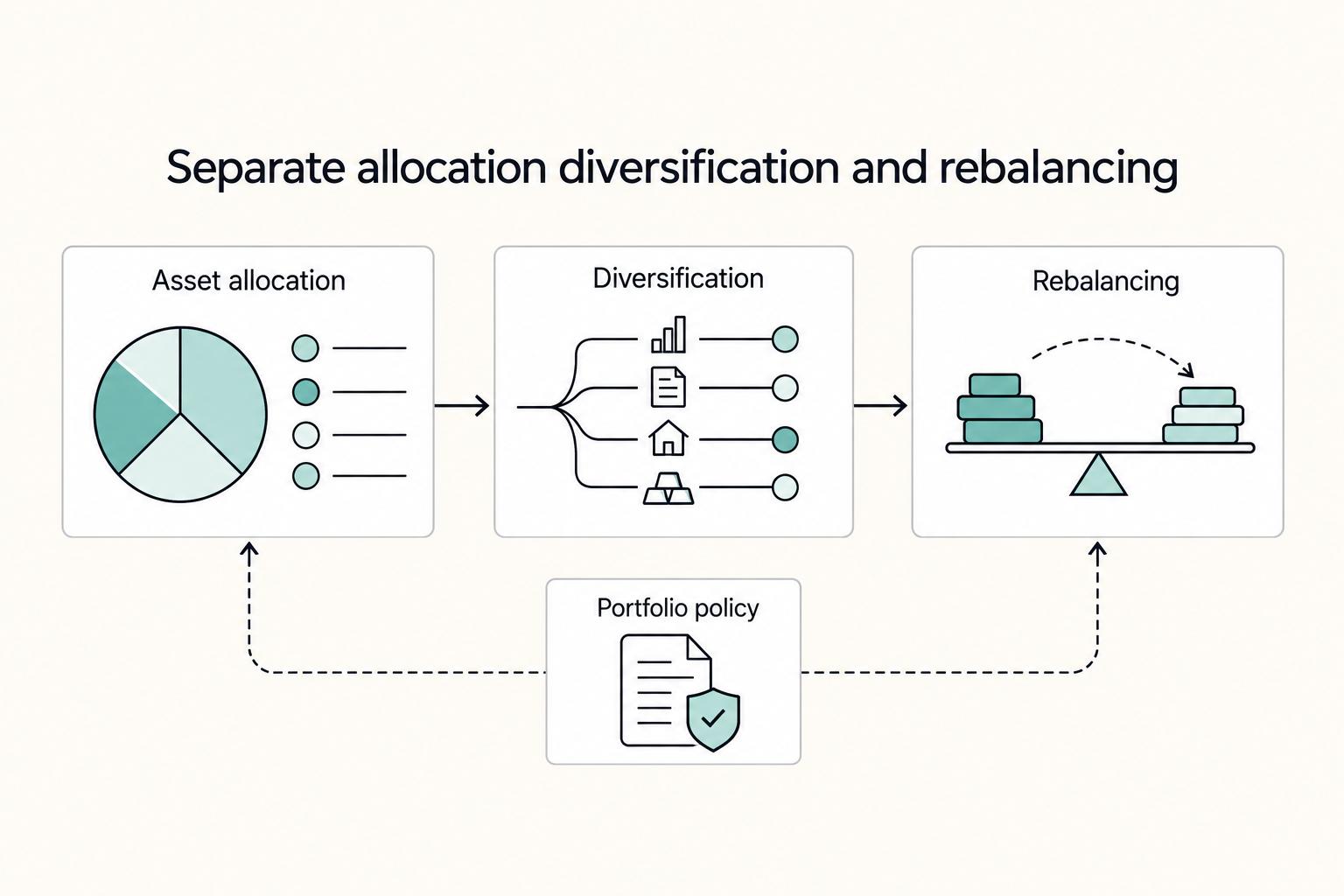
Before you pick percentages, separate three ideas that often get blurred together: allocation, diversification, and rebalancing.
| Term | Meaning | Key point |
|---|---|---|
| Asset allocation | How you divide your portfolio across stocks, fixed income (bonds), and cash | Should reflect your time horizon and risk tolerance |
| Diversification | Reduce risk by spreading exposure instead of relying on one outcome | Works with allocation, but is not interchangeable with it |
| Rebalancing | Periodic maintenance step that helps keep your portfolio aligned with your target mix | Return toward target from time to time instead of reacting to headlines |
These terms work together, but they are not interchangeable. Your allocation should reflect your time horizon and risk tolerance because different asset classes carry different risk and return profiles and behave differently over time. In practice, shorter horizons usually call for less risk, while longer ones may allow more volatility. There is no single right allocation for everyone.
Why long-term targets matter. Set your target percentages, then review them periodically to confirm they still match your goals. Once that target exists on paper, the next step is deciding how much money you can afford to expose to market risk.
For a step-by-step walkthrough, see A Guide to Setting Up a Trust for Asset Protection.
Ring-Fence Operating Cash Before You Invest Anything#
Separate money by job before you choose any stock or bond mix. Keep operating cash and your long-term investment portfolio in two distinct buckets, with a real barrier between them.
Ring-fencing is that barrier: a way to separate assets for a specific purpose. In practice, for a freelancer or small team, that can mean separate accounts and no commingling, so money reserved for continuity is not treated as investable surplus.
Use two buckets with real separation. Give each one a clear purpose:
- Operating cash bucket: funds for near-term obligations, tax set-asides, and reserve needs tied to continuity.
- Investment bucket: long-term capital for wealth building, not routine operating needs.
If those purposes sit in one mixed pool, short-term demands can override long-term allocation decisions.
Set the transfer order before you buy risk assets#
A pre-set transfer sequence can help the separation hold when things get tight. One practical sequence is:
- Incoming client payment
- Tax and obligation set-aside
- Operating reserve top-up
- Only then move surplus to Stocks and Bonds
This is an operating rule, not a universal law. The point is to avoid treating every bank dollar as investable when part of it is already committed.
Stress-test the same separation under stable and uneven income#
| Decision factor | Stable monthly income | Uneven income |
|---|---|---|
| Time horizon for new surplus | Define when surplus is truly long-term before investing | Use a stricter definition of "surplus" until the next invoicing cycle is clearer |
| Operating cash buffer posture | Keep operating cash clearly separated from investment funds | Keep operating cash clearly separated from investment funds |
| Allocation behavior | Move money to risk assets only after obligations and reserves are ring-fenced | Move money to risk assets only after obligations and reserves are ring-fenced |
| Stress outcome if reserve is weak | It becomes harder to avoid commingling when short-term needs and long-term funds share one pool | It becomes harder to avoid commingling when short-term needs and long-term funds share one pool |
The failure mode to avoid. Ring-fencing is meant to reserve money for specific purposes and help protect against losses from mixing purposes in one pool. In formal legal structures, related failure modes include parent-entity bankruptcy and substantive consolidation risk. That is why separateness controls emphasize separate accounts and no commingling.
Set Your Inputs So Your Allocation Is Defensible#
A defensible allocation is tied to a goal, a time horizon, and your ability to stay invested under stress, not to a copied template like 60/40.
Turn goals into real buckets#
Start by labeling goals as near-term, mid-term, and long-term, then assign each one a clear Time Horizon based on when you may need the money.
If money might be used soon, many investors use a more defensive mix with more Bonds and Cash and less exposure to stock volatility. If it is truly long-term, investors may choose to accept wider swings. The main mistake to avoid is horizon mismatch: calling money long-term when you may need it earlier.
Treat risk tolerance as separate tests#
Do not reduce risk tolerance to a single score. Use checks such as:
- Emotional tolerance: how much decline you can handle without abandoning the plan.
- Time horizon: how soon this bucket may be spent.
- Personal circumstances and objectives: whether this mix fits your broader financial context, not just a generic model.
These tests are different. Passing one does not mean you pass the others. That gap is where panic decisions often start.
Use an if/then rule before you shop for funds#
Write one practical guardrail before you choose investments: if your income is volatile or payment timing is uncertain, consider a more defensive mix, for example more Cash or higher-quality Bonds, before adding more Stocks.
Treat this as a judgment rule, not a formula. The tradeoff is straightforward. A more defensive mix can reduce downside pressure, but it may also limit upside in strong markets.
Verify the plan before you implement it. Before choosing funds, document each bucket with:
- goal name
- Time Horizon
- target mix across Stocks, Bonds, and Cash
- one sentence explaining why that mix fits the goal
Do this before volatility hits. A simple written rationale makes it easier to stick to the plan when markets are stressed.
Choose a Baseline Mix Without Blindly Following Rules of Thumb#
Use age-based rules only as a starting prompt. Your baseline mix should come from the three inputs you already defined: Time Horizon, risk tolerance, and how likely you are to need liquidity during market stress.
The core risk is simple. If you need money during a downturn, you can get forced into selling growth assets at the wrong time. That same sequence-of-returns problem is why shortcuts break when real spending needs collide with bad early returns.
Why the shortcut breaks#
Rules of thumb can help with orientation, but they hide important assumptions. Treat the 4% rule as a planning guideline, not a fixed formula, and note that it can be a poor fit for a 40-year horizon. Applicability can also vary by geography.
Use heuristics as guidance, not fixed formulas. The broader lesson is the same across planning shortcuts: start with the rule if it helps, then adjust for your actual constraints.
Three usable baseline profiles#
Pick the profile you can hold through both a weak market and a messy cash flow period.
| Profile | Stocks | Fixed Income | Cash | Best fit signals |
|---|---|---|---|---|
| Conservative | Smaller share than growth-oriented profiles | Primary stabilizer | Meaningful reserve | Lower risk tolerance, shorter or uncertain horizon, higher chance of near-term liquidity needs |
| Balanced | Meaningful growth role | Meaningful stabilizer | Deliberate buffer | Moderate tolerance, mixed mid/long horizons, cash flow that is mostly stable but not perfectly predictable |
| Growth-leaning | Main return driver | Secondary shock absorber | Minimal in-portfolio cash (with near-term needs covered elsewhere) | Higher drawdown tolerance, long horizon, strong confidence you will not need to tap investments in a downturn |
These are relationship-based profiles, not fixed percentage templates.
Make the tradeoff explicit. A larger equity share can improve growth potential, but it also increases downside risk when liquidity is needed at a bad time. More fixed income and reserves can reduce that pressure, but usually at the cost of slower upside in strong markets.
A useful planning principle is to hold enough safer assets to buy time when conditions turn against you. One example is keeping about 7-10 years of essential expenses in safer assets to reduce forced selling pressure.
Quick profile check before you implement#
Use this checkpoint before you buy:
- Would you likely need to draw from this portfolio within a year?
- Is this bucket's Time Horizon truly long, or just labeled long to justify more stock risk?
- If markets dropped soon after you invest, could you follow the plan without changing course?
If the first answer is yes, shift one step more conservative before you buy. If your horizon is genuinely long and near-term needs are ring-fenced, a balanced or growth-leaning mix can be reasonable.
Related reading: A Guide to Backdoor Roth IRAs for High-Earners.
Place the Allocation in the Right Account and Tax Context#
Placement matters. The same allocation can produce different after-tax results depending on whether assets sit in a taxable account, a tax-deferred account, or a tax-exempt account.
That is asset location: set the allocation from your goals and constraints first, then decide where each bucket should live. Different account types are taxed differently, and putting more tax-inefficient holdings in tax-deferred or tax-exempt accounts can improve overall tax efficiency.
Decide placement before execution. If you have more than one account type available, decide where each major bucket will be held before you buy. That keeps maintenance cleaner and helps you avoid accidental placement that weakens after-tax results.
Confirm tax ID details early#
Account opening and tax reporting can require a tax identifier. You may see SSN, ITIN, and EIN, but confirm the required identifier for your exact account and owner setup before submission, especially if you are deciding between personal and entity ownership.
If you need a terminology refresher, use ITIN vs. EIN vs. SSN: What's the Difference?.
Treat jurisdiction and provider rules as case-specific#
Documentation, eligibility, and reporting requirements can vary by jurisdiction and provider, so confirm current requirements directly with your broker, custodian, or tax professional.
If an entity is involved, be especially careful with current BOI scope. In the FinCEN interim-rule context dated March 26, 2025, reporting-company scope was revised to certain foreign-formed entities registered to do business in a U.S. jurisdiction. In that same context, U.S.-created entities and their beneficial owners are exempt from BOI reporting. The same FinCEN guide also warns that parts of its guidance were not fully updated for that interim rule, so stale summaries can mislead decisions.
Keep a compact compliance record#
Keep a short record set for each account:
| Record | What to keep | Applies when |
|---|---|---|
| Account registration name | Exact account registration name | Each account |
| Tax ID | Tax ID used | Each account |
| Account type | Taxable, tax-deferred, or tax-exempt | Each account |
| Opening records | Opening confirmations and statements | Each account |
| Entity records | Formation and registration documents tied to the account | If using an entity |
When checking U.S. rule changes, do not rely only on FederalRegister.gov web text. Verify against the linked official PDF on govinfo.gov. That extra check helps prevent avoidable tax and reporting errors later.
Implement the Mix With Simple, Repeatable Investment Choices#
Implementation should be disciplined and repeatable. Map each target bucket to a clear role, buy to your target percentages, and verify the result after trades settle.
Map each bucket to one role#
Start with your strategic allocation and time horizon, then assign each bucket one job: Stocks, Bonds / Fixed Income, and Cash. Keep each holding tied to a single bucket so you can see what it is doing and why it is there.
At this stage, keep the setup simple enough to monitor consistently. If two positions appear to serve the same role, check whether that overlap is intentional.
Build from target percentages, not market mood#
Use the same sequence every time:
- Write your target percentages for stocks, fixed income, and cash.
- Choose investment vehicles that fit one bucket each.
- Review holdings for unintended overlap before placing orders.
- Place orders using a method you can repeat consistently.
If you want tactical changes, treat them as short-term adjustments around your core strategic mix, not as a replacement for it. Use a structured framework, for example economic data and market valuations, and plan for ongoing monitoring and potentially higher transaction fees.
Check for fake diversification before you buy#
Review what each holding actually owns before you buy, and decide whether any overlap is intentional for your plan. This check is especially useful across multiple accounts.
Verify immediately after purchase. After orders settle, compare actual allocation to target and log the gap.
| Bucket | Target % | Actual % | Gap | Notes |
|---|---|---|---|---|
| Stocks | ||||
| Bonds / Fixed Income | ||||
| Cash |
If gaps are meaningful, correct them now or record when and how you will complete the implementation.
Rebalance With Rules, Not Emotions#
Set the rule before markets move: if drift breaks your preset band, rebalance. If it does not, leave the portfolio alone. Rebalancing is simply buying and selling to return to your intended allocation, and its value is discipline under stress.
Drift changes risk even when you make no decision at all. A 60% stocks / 40% bonds mix can drift to 70% stocks after a strong equity run, and a 50/50 mix can become 75/25 over time. That can leave you carrying more downside risk than your plan intended.
Use two trigger types#
Use calendar-based reviews, threshold-based drift controls, or both.
Calendar-based rebalancing means checking on a fixed cadence, such as quarterly or annual. Its main benefit is behavioral: a set schedule can reduce headline-driven decisions.
Threshold-based rebalancing means acting when allocations move outside your preset band. Its main benefit is risk control: you trade when exposure changes, not just because a date arrived.
If you self-manage accounts, you may need to execute trades manually. If your account or tool supports automated rebalancing, it can reduce maintenance work, but you still need to confirm settings and coverage.
Write the decision rule now. Keep the rule short enough to follow in volatile markets:
- If a core bucket moves outside my preset drift band, I rebalance toward target.
- If no bucket is outside the band, I leave the portfolio alone.
That second line matters as much as the first. Scary headlines and sharp corrections can push you to act when nothing in the plan has actually changed.
Choose the style that fits your operating reality#
| Trigger style | Best use case | Operational note | Watch-out |
|---|---|---|---|
| Calendar-based | You want a repeatable routine with fixed review dates | Set review dates in advance and stick to them | Treating every review date as a reason to tinker |
| Threshold-based drift control | You want tighter control of risk exposure versus target | Define the drift band before volatility hits | Not defining the band in advance, or ignoring it in volatile periods |
| Automated rebalancing | Your account/tool can adjust allocations automatically | Some accounts and tools automate adjustments, but setup checks still matter | Assuming all accounts auto-rebalance or never verifying settings |
Treat rebalancing as risk control and process discipline, not as a guaranteed return enhancer.
Avoid the Mistakes That Break Allocation Plans#
Allocation plans usually break when core inputs change or portfolio weights drift and you keep treating the old target as current. Keep your target mix anchored to your Time Horizon and your true Risk Tolerance.
A common mistake is feeling more aggressive after a strong run in Stocks. Market gains can make risk feel easier than it really is. A more reliable rule is to size risk to horizon: longer horizons can usually absorb more volatility, while shorter ones generally call for less. If your strategic base is 60% stocks / 40% bonds, treat it as the reference point and rebalance back when drift pushes risk above plan.
Cash is part of asset allocation, alongside stocks and bonds. Set a long-term target mix across major asset categories, then use regular rebalancing check-ins to bring weights back toward plan when markets move.
Market commentary can inform you, but it is not a decision rule. Keep a strategic long-term mix as the base plan. If you make a temporary tactical change, write down the trigger, the size of the change, and when you will reassess.
Use a short review note each time:
- review date and current target mix
- any change in Time Horizon or Risk Tolerance
- whether you rebalanced, changed targets, or made no change
That last outcome matters. If your Time Horizon and Risk Tolerance are unchanged, the default should be to maintain the plan and rebalance, not rewrite the targets.
Use This 90-Day Execution Checklist#
A simple 90-day plan helps you move from theory to practice without improvising.
| Phase | Focus | Key actions |
|---|---|---|
| Days 1-30 | Define the portfolio's job and document the target mix | Write each goal with its time horizon; assess risk tolerance from behavioral loss tolerance, ability to take risk, and need to take risk; finalize the target mix; create a one-page allocation note; confirm required onboarding information |
| Days 31-60 | Execute the allocation and centralize records | Fund accounts; place trades; map targets into actual holdings across stocks, bonds, and cash; compare actual allocation to target; set up a central asset register; check concentration risk |
| Days 61-90 | Set behavior and monitoring rules | Define your rebalancing method; set review dates; store a short policy note; state what you track, how often you review, and how you change course; make documentation audit-ready |
Days 1-30#
Start by defining the portfolio's job before choosing holdings. Write each goal with its time horizon, then assess risk tolerance from three angles: behavioral loss tolerance, ability to take risk, and need to take risk. Finalize the target mix across stocks, bonds or fixed income, and cash, including your cash-flow reality in the plan itself.
Create a one-page allocation note with target percentages, the purpose of each bucket, and what would justify a target change. Allocation is the core decision because it sets expected return and risk exposure, so document the rationale before selecting funds.
In the second half of this phase, clear account-setup friction so execution can start on schedule. Confirm required onboarding information with your provider before funding and trading.
Days 31-60#
Month 2 is execution. Fund accounts, place trades, and map targets into actual holdings across stocks, bonds, and cash. If you implement in tranches, predefine that approach so it does not drift into headline-driven timing.
After trades settle, compare actual allocation to target and log any gaps. Set up a central asset register, even if it is just a simple spreadsheet, with account, holding, asset class, target weight, actual weight, and trade date. Clear records and a consolidated view reduce decision friction when markets get volatile.
Check concentration risk, not just fund count. A portfolio can look diversified while still leaning heavily on one exposure, and bonds still carry inflation and interest-rate risk.
Days 61-90#
Month 3 is about behavior under stress. Define your rebalancing method, set review dates, and store a short policy note you can use when markets are uncomfortable. A monitoring process should state what you track, how often you review, and how you change course.
Your policy note should include:
- target allocation and current accounts
- what counts as a review trigger
- what changes justify updating targets
- where your asset register and key records are stored
Make documentation audit-ready so you are less likely to improvise at the worst time. The behavioral risk is selling after losses and buying after gains. Recovery math is asymmetric: a 10% decline needs an 11% gain to recover, while a 50% decline needs a 100% gain.
If your allocation plan depends on uneven client payments, standardize billing terms and timing first with this free invoice generator.
Build a Portfolio You Can Actually Stick To#
Start with one core decision: separate near-term cash needs from long-term investing, then invest surplus with written allocation and rebalancing rules. For uneven income, that structure can be easier to maintain than reacting to market moves.
Keep short-horizon obligations separate from long-term investing so you are less likely to sell volatile holdings for liquidity. Then set your mix across stocks, bonds, and cash based on the two inputs that matter most: time horizon and risk tolerance. Longer horizons can support more volatility, but higher-risk allocations can still lose principal.
Rules over reactions. Simple rules can reduce ad hoc decisions made after a big payment, a slow month, or a scary headline. Stock-heavy portfolios may deliver stronger long-term growth, but they also come with meaningful volatility and crash periods. That tradeoff is easier to handle when your plan matches your horizon and tolerance for loss.
If your circumstances change, treat that as an allocation input rather than a reason to improvise. If cash-flow stability worsens, consider increasing the role of reserves. If a goal moves closer, consider reducing risk.
Put the policy on one page. Write a one-page policy you can follow under pressure. Keep it short and specific:
- target weights for cash, bonds, and stocks
- the job of each bucket, especially what cash is protecting
- your rebalancing approach and review rhythm
- why this mix fits your time horizon, risk tolerance, and personal circumstances
- a rule that mix changes require a real goal or constraint change, not market noise
Practical next step: write the policy now, review it on a consistent schedule, and revise it only when your goals or constraints actually change.
Frequently Asked Questions
What is asset allocation in plain English?
Asset allocation is the percentage split of your portfolio across major buckets like stocks, bonds, and cash. It is the big-picture mix of your investments, and it should align with your goals, time horizon, and preferences.
How is asset allocation different from diversification and rebalancing?
Allocation is the top-level mix across asset categories. Diversification is how you spread exposure so a single outcome has less impact. Rebalancing is reviewing and adjusting that mix from time to time so it stays aligned with your goals.
How do risk tolerance and time horizon change my portfolio mix?
They shape how much volatility you can accept and how much risk may fit a given goal. Time horizon can span months, years, or decades, and longer horizons can support more volatility. If money may be needed sooner or you are less willing to accept losses, a steadier mix may be more appropriate.
Is the Rule of 100 good enough for freelancers with uneven income?
This guide does not validate or invalidate the Rule of 100. The grounded principle is that there is no single best allocation for everyone, and your mix should fit your goals, time horizon, and preferences. If income is uneven, separate near-term needs from long-term investing decisions when setting your mix.
How often should I rebalance, and what should trigger it?
Use a recurring review habit and compare your current allocation with your intended mix. Periodic review and rebalancing over time are important, but there is no single universal schedule or drift threshold. Rebalancing decisions should stay tied to your goals and overall allocation plan.
How much cash should I keep separate from my long-term investment portfolio?
There is no single grounded number provided here. A practical approach is to keep near-term money needs separate from long-term investments so each can follow its own time horizon.
What are the biggest beginner mistakes when setting an allocation?
A pitfall can be choosing a mix without clearly defining goals, time horizon, and risk tolerance. Another is treating allocation as one-and-done instead of reviewing it periodically to confirm it still fits your goals. Keeping diversification in mind can also reduce the impact of any single outcome.
Try a related tool
Researched and edited by the Gruv editorial team. Gruv builds cross-border billing, payouts, and finance-operations software for global businesses.
Sources
- admisiones.unicah.edu/libweb/2NMoEK/6OK114/modern_investment_theor...trusted
- asbury.edu/wp-content/uploads/2025/09/2024-2025-Course-...trusted
- cn.edu/wp-content/uploads/2023/07/23-24-undergradua...trusted
- fdic.gov/resources/bankers/call-reports/crinst-051/20...trusted
- federalregister.gov/documents/2019/11/14/2019-22695/prohibitions...trusted
- federalreserve.gov/aboutthefed/files/bstfinaccountingmanual.pdftrusted
- fincen.gov/system/files/shared/BOI_Small_Compliance_Gui...trusted
- investor.gov/additional-resources/general-resources/publi...trusted
Educational content only. Not legal, tax, or financial advice.
Related Posts

Japan Digital Nomad Visa 2026: Six-Month Planning Runbook
Treat this as your operating model: identify the right mission first, commit to one route, and keep dated records before you make irreversible plans. That is what keeps the rest of your timeline, paperwork, and decisions coherent.

ITIN vs. EIN vs. SSN: What's the Difference?
As the CEO of your business-of-one, you are not here for vibes. You need a repeatable system you can run.

How Freelancers Can Build a Diversified Investment Portfolio Without Breaking Cashflow
If you run a business-of-one, you do not need vibes; you need a repeatable system you can run.