
Quick Answer
Choose the route your records can defend, then test the tax result. For andorra low-tax residency, the article’s core rule is to align permit type, day-count reality, and filing position before you apply or renew. It contrasts Active residency, Passive residency, and a verify-first digital nomad option, and flags the 90-day versus 183-day tension as a practical risk checkpoint. If your facts are mixed, pause and get professional review before filing.
Start here if you want low tax without compliance surprises#
Treat Andorra as a compliance decision first and a lifestyle decision second. If you are exploring andorra low-tax residency, the key question is whether your permit route, tax position, and evidence all support the same real-world story.
Tax residence turns on objective facts, including where you spend time, where your main home is, and where your economic and personal interests are centered. If those facts still point somewhere else, another country may still treat you as tax resident there.
The decision you are actually making#
The practical choice is often between Active residency, Passive residency, and the Digital nomad residence permit. These routes are not interchangeable. Each fits a different fact pattern and calls for different proof.
At a high level, one advisory source describes Active Residency as a company-led path that can allow company setup without substantial upfront investment. The same source describes Passive Residency as investment-led and cites 600,000 euros as a commonly discussed commitment. Treat figures like that, and headline tax claims such as 10%, as items to verify against current official rules, not assumptions.
The digital nomad route belongs in the same set of choices, but a permit alone does not settle your tax-residence position. Your filing position still has to match facts you can prove.
What this guide will give you#
By the end, you should have:
- route-selection rules based on how you actually work and earn
- an evidence checklist so your move is supported by documentation
- renewal guardrails so your application and tax filings stay aligned
- clear escalation points for mixed facts or strong prior-country ties that require professional advice
The goal is simple: make one route choice that stays consistent across your application, renewal, and tax filings. If you want a deeper dive, read the digital nomad tax guide.
Define the terms before you choose a route#
Most mistakes start here: administrative residence is not tax residence. Treat your permit as immigration status first, then assess tax residence separately based on facts you can prove.
In plain language, Andorran tax residency means Andorra is treated as the country with the right to tax your worldwide income. Tax residence is the same idea more generally: which country has first claim to tax your global income based on where you are actually present and where your ties sit. Administrative residence means legal permission to live in Andorra. The Andorran residence card, the "green card", is a checkpoint for authorized residence, not proof of tax status.
People often summarize the ties review with two practical checks:
- Personal and social ties: where your day-to-day life is anchored, including family and social ties.
- Economic ties: where your main economic activity is centered.
Day count matters, but it is only part of the analysis. One commonly cited ground is more than 183 days in 12 months, and another is having Andorra as the centre of economic and vital activities.
Do not file based on marketing claims alone. A passive permit may require only 90 days a year, but that by itself does not secure tax residence if your stronger ties remain elsewhere. If your day-to-day life and ties still point outside Andorra, stop and verify before filing. Also keep scope clear: the EU-Andorra association text dated 5 March 2026 says taxation is outside that agreement's scope, so filing decisions still require checking the tax rules directly. For related filing context, see Can Digital Nomads Claim the Home Office Deduction?.
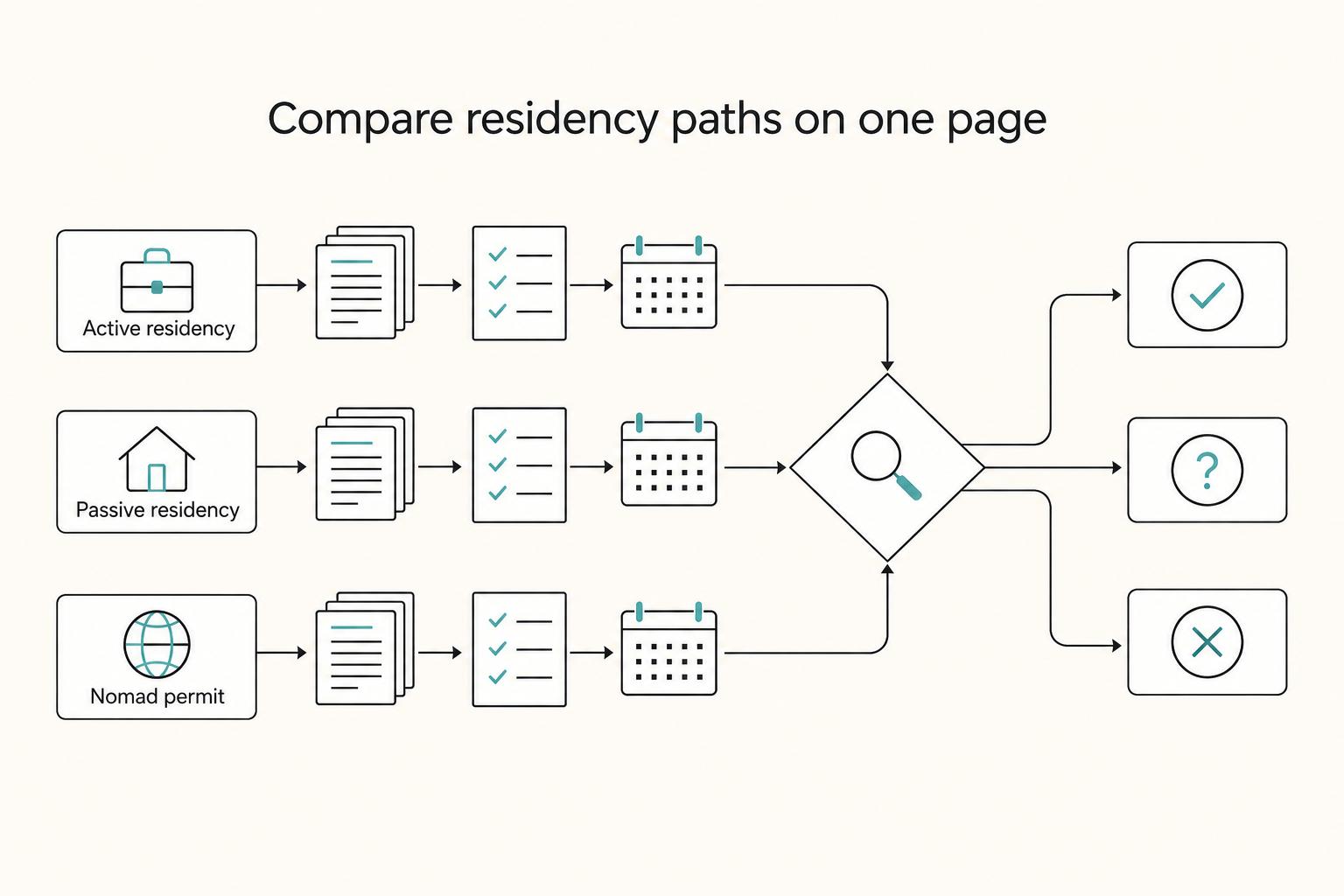
Compare the three residency paths on one page#
If your work is genuinely local, active residency is usually the cleaner fit. If you want more lifestyle flexibility, the passive route, Residence Without Lucrative Activity, can fit. But it can involve stricter proof, significant money commitments, and a higher risk that permit facts and tax position do not line up.
The digital nomad residence permit remains unresolved here. Its eligibility, work rights, day-count rules, and renewals are not established, so treat it as a verify-first option, not a headline decision.
| Route | Basic fit from available guidance | Work rights | Physical presence signal in sources | Renewal / duration in sources | Core constraint or caution |
|---|---|---|---|---|---|
| Active residency | People intending to live and work in Andorra | Reported as a right to work in Andorra; verify before relying on it | One source contrasts active residents as needing at least 183 days/year | Not established | Better fit when activity is truly local; verify current permit mechanics directly |
| Passive residency / Residence Without Lucrative Activity | People living in Andorra without local employment | Source framing indicates no local employment | One source states 90 days/year to maintain status; another cites more than 183 days/year for tax-residency liability | Reported as 2 years, then 2 years, then 3 years | More flexibility, but passive status does not necessarily make you a tax/fiscal resident; Category A public guidance also points to clean, apostilled/legalized police certificates |
| Digital nomad residence permit | Named option — confirm details with official guidance | Not established | Not established | Not established | Keep as unresolved until current official rules are confirmed |
An exact Ministry of Economy approval step for a specific route is not established, so treat that item as unresolved and verify it directly.
| Money commitment or holding point | Amount or formula shown in sources | Timing or holding note | Institution / confidence note |
|---|---|---|---|
| Residence Without Lucrative Activity listed amount | EUR 50,000 main applicant + EUR 10,000 per dependent | Presented as part of the route's commitment picture | Source-specific only; not a settled single threshold |
| Qualifying investment path | EUR 1,000,000 in qualifying Andorran assets | Reported as 6 months after approval for initial investment | Same source references AFA non-remunerated deposits |
| Housing Fund alternative | EUR 400,000 in the Housing Fund | Same 6-month timing note in that source | Non-official source; verify before relying on it |
| Alternative passive framework from another source | EUR 600,000 total, including EUR 47,500 with AFA + EUR 9,500 per dependent | Framed as allocation to Andorran assets | Conflicts with figures above; verify before committing funds |
The tradeoff is straightforward: passive routes can offer more lifestyle flexibility, but they can require heavier evidence and create more ambiguity if your real ties and tax facts sit elsewhere. Active routes are generally less ambiguous when your work and day-to-day activity are genuinely in Andorra.
For a separate jurisdiction comparison, see A Guide to Tax Residency in Malaysia for Digital Nomads.
Choose your route with simple if-then decisions#
Start with the facts you can document, not tax headlines. If you are comparing Andorra permit routes such as Active residency, Passive residency, or Residence without gainful activity, treat those as options to verify with official Andorran authorities first. Permit eligibility and route-selection rules are not established.
Use this routing logic:
- If your plan includes local operations anchored in Andorra, verify the relevant immigration criteria directly before assuming route fit.
- If your plan is mainly outside income or remote work without local employment, verify the relevant non-local route criteria directly before assuming route fit.
- If your facts are mixed, do not choose a permit first. Split the work: verify immigration route and tax position separately.
Separate permit choice from tax residence#
Do not treat a residence permit as proof of a settled Tax residence position. If your filing facts are not clean yet, delay filing-position decisions until an advisor has reviewed the full record.
Use one practical checkpoint: can your address history, travel pattern, contracts, invoicing trail, and banking flows support one consistent story? If not, do not force a filing position around a low-tax headline.
If your clients are in Spain or France#
For freelancers concentrated in Spain or France, plan VAT evidence early. The source guidance here is EU VAT guidance, and both countries are listed in the VAT Cross-border Rulings (CBR) participating-country list.
| VAT point | Article detail | Context |
|---|---|---|
| CBR request | Filed in a participating EU country where you are already VAT-registered | Spain and France are listed in the VAT Cross-border Rulings (CBR) participating-country list |
| OSS optionality | OSS is optional | If you use One Stop Shop (OSS) |
| OSS returns | OSS returns are additional and do not replace domestic VAT returns | If you use One Stop Shop (OSS) |
| Supplies covered by OSS | Declare all supplies covered by that scheme through OSS | If you use a given OSS scheme |
This does not determine tax residence. It does mean that for complex cross-border VAT treatment, a CBR request is filed in a participating EU country where you are already VAT-registered. It is not simply filed where your client is located.
If you use One Stop Shop (OSS), keep three operating rules in view:
- OSS is optional.
- OSS returns are additional and do not replace domestic VAT returns.
- If you use a given OSS scheme, declare all supplies covered by that scheme through OSS.
If your clients are concentrated elsewhere#
If your client mix is mostly outside Spain and France, keep the same evidence discipline: a country-by-country client map, service descriptions, invoice timing, payment proof, and the VAT treatment you applied.
If you may rely on the EU cross-border SME scheme through an EU Member State of establishment, check two items early:
- Union turnover cap: EUR 100 000.
- Prior notification filed in the Member State of establishment (MSEST).
The published target processing window is 35 working days, but cases can run longer when anti-evasion or anti-avoidance checks are triggered.
The rule here is simple: if you are selecting a route mainly for a low-tax headline, stop and re-check. Choose the path your documents can defend first, then decide whether the tax outcome is acceptable. For a related comparison, see A Guide to Tax Residency in the Czech Republic for Nomads.
Build your application evidence pack in the right order#
Build your evidence pack in this working order: identity, address and presence, funds, compliance items, then route-specific files. Use it as an organization method so your narrative stays coherent while you verify current official requirements.
Treat this as a working order, not an official checklist. The exact filing sequence and complete required-document list for each permit route are not established.
- Identity base file
Keep identity records internally consistent.
- Address and presence file
Keep a dated address and travel record that can support your residency narrative, including the 183 days in 12 months checkpoint where relevant.
- Income and funds file
Group the records you plan to rely on so your support story is easy to follow.
- Compliance file
Keep compliance-related records organized and current.
- Route-specific file
After your base file is coherent, add documents tied to your selected route.
Route evidence should prioritize coherence over volume#
For any route, coherence matters more than volume. Your stated income source, activity pattern, and supporting records should match.
If your real pattern is daily commuting from Spain or France, address that risk early. A frontier worker is described here as not being considered an Andorran tax resident. Resident vs non-resident status is also indicated here to affect which taxes and rates apply. If public summaries reference the Institut Andorra de Finances, verify current requirements directly before relying on any checklist, because exact amounts or procedures are not confirmed.
| Working file cluster (example) | Main question it helps you check | Internal check |
|---|---|---|
| Identity records | Are names and core details consistent across your file? | Consistency |
| Address, travel, local-presence records | Does your residence timeline hold up, including day-count support where relevant? | Timeline coherence |
| Income/funds records | Is your support story clear and traceable? | Narrative coherence |
| Compliance records | Are records organized and current? | Readiness |
| Route explanation memo | Does your real activity match the route you selected? | Route fit |
Before filing, write a one-page memo that states where you live, how you earn, and how each document supports that story. If the memo and the evidence conflict, fix that first.
Protect your status in year one with a compliance calendar#
The safest approach is to track your records from day one, not reconstruct them later. Use a simple monthly and quarterly review so your file keeps supporting the tax-residence position you plan to take.
For passive residents, watch the day-count gap closely. The source for this guide says passive status can be maintained with 90 days per year in Andorra. Passive tax residency is only fully recognized if you exceed 183 days in Andorra. Put both thresholds on your calendar and track against the one that matches your intended position.
Monthly rhythm#
Keep this routine repeatable and evidence-based:
| Every month | What to check | What to keep |
|---|---|---|
| Day count | Your nights and travel days in Andorra and other countries where you spend time | Calendar export, tickets, accommodation records |
| Living pattern | Whether your day-to-day footprint still matches your declared home base | Housing and local-service records, dated local payments |
| Economic pattern | Whether your work and payment flow still match your declared position | Invoices, contracts, bank and payment records |
Use one master log and reconcile it monthly. A common failure mode is conflicting records. For example, travel notes show one location while spending or bookings point to another location on the same dates.
Quarterly reality check#
Once per quarter, run one direct test: does your actual footprint still support your declared tax residence position? Use personal-ties and economic-ties checks as internal labels, without treating that review as a legal conclusion by itself. If personal-life signals point one way and income or payment signals point another, flag it early and adjust behavior or get case-specific advice before filing season.
Use this quarter-end checklist:
- Recount days in Andorra versus your target path.
- Review where your personal ties were concentrated that quarter.
- Review where income activity and payment flows were concentrated.
- Save a dated snapshot folder for that quarter.
Failure modes to catch early#
- Inconsistent travel logs across countries where you spend time.
- Weak evidence when more than one country could appear relevant.
- Missing supporting records because documentation was not maintained during the year.
Freelancers should keep records synchronized#
For each month, your work, billing, payment, and location records should tell one coherent story. A practical standard is a clear chain from work performed to invoice to payment received, aligned with your address and travel records for the same period.
Need the full breakdown? Read A Guide to Tax Residency in Cyprus for Digital Nomads.
Before you lock your route, map your 12-month day count so your documents and residency position stay aligned: Use the tax residency tracker.
If you are a US person, your US filing duties still apply#
Moving to Andorra can change your tax outcome, but it does not by itself remove U.S. filing duties for U.S. citizens or people treated as U.S. residents for filing purposes.
| US filing point | Requirement or limit | Article note |
|---|---|---|
| FEIE physical presence test | At least 330 full days in 12 consecutive months in foreign country/countries | A full day is 24 consecutive hours (midnight to midnight) |
| FEIE bona fide residence test | Bona fide residence in a foreign country for an uninterrupted period that includes an entire tax year | Living abroad for about a year is not automatically enough |
| FEIE maximum | $132,900 per person | Tax year 2026 |
| General housing limit | 30% of the FEIE maximum | Listed as $39,870 for 2026 |
| Form 1116 by income category | Use a separate Form 1116 for each income category | Execution detail matters on Form 1116 |
| Form 1116 by country or territory | If taxes were paid to more than one country or territory, use separate country or territory columns and lines | Execution detail matters on Form 1116 |
The two main relief tools are the Foreign Earned Income Exclusion (FEIE) and the Foreign Tax Credit (FTC). They can reduce double-tax exposure, but they do not replace the requirement to file a U.S. return and report the income used for those claims.
For FEIE, qualify first, then calculate:
- Physical presence test: at least 330 full days in 12 consecutive months in foreign country/countries. A full day is 24 consecutive hours (midnight to midnight), so travel-day gaps can affect eligibility.
- Bona fide residence test: bona fide residence in a foreign country for an uninterrupted period that includes an entire tax year. Living abroad for about a year is not automatically enough.
If you qualify, keep the limits straight. For tax year 2026, the FEIE maximum is $132,900 per person. If you are also using the foreign housing exclusion or deduction, compute that first because it limits remaining FEIE. The general housing limit is 30% of the FEIE maximum (listed as $39,870 for 2026).
For FTC, execution detail matters on Form 1116:
- Use a separate Form 1116 for each income category.
- If taxes were paid to more than one country or territory, use separate country or territory columns and lines.
For FEIE/FTC claims, keep documentation that supports your position:
- travel records supporting any 330-day position
- residence records supporting bona fide residence analysis
- income summaries by type and country
- foreign tax payment records
If prior-year U.S. filings are incomplete, treat next steps as a qualified-advice topic, not a self-diagnosis task.
Red flags that mean talk to a professional now#
If your records point to more than one possible tax residence, stop and get professional advice before filing or renewing. An Andorra administrative permit on its own does not prove Andorra tax residence.
More than one country can plausibly claim you#
This is the main escalation trigger, especially if your life is split across Andorra and one or more other countries. With passive residence, you may meet the 90 days/year Andorra stay requirement and still be treated as tax resident elsewhere if most of your year and substantial ties are outside Andorra. With active residence, expected presence is usually at least 183 days/year, so materially lower real presence is also a warning sign.
Run one timeline across your travel records, lease dates, company and invoice records, payroll dates if any, and immigration dates. If those records conflict, or your tax-residency status was not updated as your footprint changed, escalate now.
You cannot show where your core ties actually sit#
If you cannot clearly evidence where your core personal and economic ties sit, treat that as a red flag. Do not guess. Build a defensible evidence pack first.
Useful proof can include:
- entry and exit records, calendar history, and housing records
- client and invoice concentration, bank activity, and company management records
- family or dependency documents where relevant
A common failure pattern is inconsistency, not intent: one address in permit records, another in banking, and a third in client contracts.
Your permit intent and real work pattern conflict#
If you are on a passive route but your day-to-day pattern looks like active local work, get professional review now. Route mismatch can become costly. Self-employed active residence can involve a €50,000 non-refundable payment to the AFA and a minimum 34% stake in an Andorran company you effectively manage.
Also treat repeated short-term extensions, payroll-versus-immigration date mismatches, and missing residency updates as early warning signs. Audit exposure often comes from repeated inconsistency patterns, even without bad intent.
You might also find this useful: How to Write a Professional Bio That Attracts Clients.
The mistakes that most often break renewals#
Renewals can get derailed by documentation drift, not one dramatic mistake. The problem is simple: your permit file, tax position, travel pattern, and business records stop telling the same story.
Approval is the start of compliance, not the finish line#
First approval does not remove the need for ongoing proof. This matters especially where the route has heavy administrative and financial checkpoints.
| Passive-route checkpoint | Amount or timing | Article note |
|---|---|---|
| Minimum investment | €600,000 | Included in the documented framework after the December 2022 overhaul |
| AFA deposit, main applicant | €47,500 | Refundable AFA deposit |
| AFA deposit, per dependent | €9,500 | Refundable AFA deposit |
| AFA holding fee | 0.2% annual | For new applicants since September 2024 |
| Asset allocation deadline | Six months after issuance | Keep dated records showing when and how that was completed |
For passive routes, keep a live renewal file from day one. The documented framework includes stricter documentation after the December 2022 overhaul. It also includes a €600,000 minimum investment, a €47,500 refundable AFA deposit for the main applicant, €9,500 per dependent, and a 0.2% annual AFA holding fee for new applicants since September 2024. If your permit allowed six months after issuance to finalize asset allocation, keep dated records showing exactly when and how that was completed.
Tax headlines do not replace tax-residency evidence#
Low-tax marketing is not evidence for renewal. Keep one consistent evidence pack through the year: housing records, travel timeline, banking activity, and client or company records. Your records still need to support the tax-residency position you are taking. If those point in different directions, renewal review can get harder quickly.
Mixed personal and business records create contradictions#
If you operate through a company, align business admin records with your personal residency file. A key checkpoint is basic but strict: companies must obtain a Tax Registration Number (NRT) before commencing operations.
Use consistent dates, addresses, and timelines across contracts, invoices, banking, company records, and permit records unless there is a documented reason not to. In a system often described as opaque, ambiguity works against you.
Cross-border drift should be handled before renewal#
If your pattern shifts toward nearby countries such as Spain or France, review your file early instead of waiting for renewal season. More time abroad, more work managed outside Andorra, or stronger non-Andorra ties can be signals to reassess your documentation and position.
Do not guess on filing or renewal decisions from general online guidance alone. Escalate for professional review when your facts become mixed or unclear.
Set up money and record systems before you move#
Before your first foreign account opens, set up your record system. The goal is simple: a clean trail from invoice to payment confirmation to statement line, organized by filing period so Form 8938 and FBAR prep is faster and less error-prone.
Build the record stack before first payment lands#
For a cross-border move, keep this minimum stack from day one:
- every invoice
- the payment confirmation tied to that invoice
- the account statement line showing where funds arrived
- a year-end account register of foreign accounts opened, kept, or closed
- a reconciliation sheet with invoice date, payment date, receiving account, currency, and statement reference
Organize records by tax year and period, not by app or client, so a preparer can follow one chain without guesswork.
This matters because Form 8938 applies when specified foreign financial assets exceed the applicable reporting threshold, and higher thresholds can apply for joint filers and taxpayers residing abroad. Form 8938 also asks whether foreign deposit or custodial accounts were closed during the year and requires maximum-value tracking for foreign deposit accounts. If you do not log openings, closures, and peak values as you go, year-end prep gets harder quickly.
Keep business and personal flows separate#
Use one control rule: keep business and personal money flows separate from day one. Do not run client revenue through the same account used for personal spending and transfers.
That can keep your U.S. return support cleaner and reduce FBAR prep friction. Review monthly, not annually: each invoice issued should tie to a payment confirmation and then to a receiving-account statement line. Fix gaps immediately while details are still fresh.
Where Gruv can help, and where it does not replace the file#
Where supported, Gruv can help centralize auditable invoices, payout traces, and exportable records. That can make Form 8938 prep and FBAR support easier to assemble.
Treat platform exports as part of your file, not the full file. You still need underlying bank statements, your account inventory, and your own reconciliation records. Form 8938 is attached to your annual return and filed by that return's due date, including extensions, and it does not replace a separate FBAR filing when FBAR rules apply. Coverage and compliance features vary by market and program.
This pairs well with our guide on A Guide to Tax Residency in Brazil for Digital Nomads.
What is still unknown and how to verify safely in 2026#
Treat this as a verification step, not a marketing step. The main unknowns are still the full legal exceptions, current processing realities, and complete official rate and exemption details you would rely on at filing time.
As of 2026, Andorra tax liability is tied to tax residence, domicile is stated as not relevant, and tax residence is regulated by Act 5/2014 (24 April). The same material cites a permanence test of more than 183 days per calendar year. A secondary 2025 guide uses more than 183 days in 12 months and also references the centre of economic and vital activities. Treat that mismatch as a required verification point, not a minor wording issue.
Use this verification ladder:
- Start with official Andorra authority guidance and the law text. Confirm the current wording of Act 5/2014, the exact day-count basis, and any exceptions or definitions relevant to your facts.
- Confirm your fact pattern with licensed local counsel in Andorra. Ask for a case-specific view of whether your position depends on physical presence, the centre of economic and vital activities, or both.
- If you have cross-border tax links, add cross-border tax advice. A position that works locally can still fail in another filing jurisdiction.
One secondary source also says daily frontier workers commuting from Spain or France are not considered Andorran tax residents. If your pattern is close to that, verify before filing.
Final check before filing: every major claim in your plan should map to a document you can produce. If a claim exists only in a blog post or an email summary, treat it as unverified.
The bottom line for freelancers choosing Andorra#
Choose the route that matches your real life, not the cleanest tax headline. If your facts are mixed, pause before you apply, renew, or file and get qualified local advice.
Public material on Andorra can mix useful facts with marketing. Some pages frame company setup as a path to tax residency, and some tax guides explicitly say they are general information, not legal or tax advice. Treat your position as an evidence question: your permit path, day-to-day reality, and records should tell the same story.
Keep a living evidence pack#
Keep one working folder that you update year-round, not at filing time. Include:
- travel logs and address proof
- permit and renewal records
- client contracts, invoices, and payment confirmations
- bank records that match your invoice trail
- cross-border filing records, where relevant
Run a simple quarterly check: does your real footprint match your filing position? If not, fix gaps early. Also avoid relying on archived government pages that are marked as not updated.
Separate company setup from personal status#
If you freelance through an Andorran company, keep company compliance separate from your personal residency analysis. A company is treated as tax resident if it is incorporated under Andorran law or effectively managed in Andorra, and it must obtain a Tax Registration Number (NRT) before operations.
Those are concrete checkpoints, but they do not decide your personal outcome. Stated corporate rates, such as 10%, or 2% in limited cases, are not a shortcut to a defensible personal residency position.
Escalate when facts are mixed#
Escalate early when your setup is not clean, especially with split-country patterns or cross-border filings. Use one rule: if a major claim in your plan cannot be matched to documents you can produce, do not force the filing position. Get qualified advice before paperwork goes in.
For a step-by-step walkthrough, see Tax Residency in Georgia (the country) for a Crypto Trader.
Frequently Asked Questions
How do I become a tax resident in Andorra if my work is fully remote?
Start by separating immigration status from tax residence. For this article’s safe-default approach, confirm the current Andorra tax-residency rules with licensed local counsel and align your records from day one. Keep travel logs, address proof, and income records consistent before you file.
What is the practical difference between Active residency and Residence without gainful activity?
Do not rely on the label alone. This section does not establish permit-specific work rights or restrictions. Before applying or renewing, confirm the current rules for your route with licensed local counsel. If your documents and day-to-day activity do not match, treat it as a compliance risk and fix it before filing.
Is the Digital nomad residence permit enough for long-term tax residency planning?
Not necessarily, by itself. A permit can support your right to stay, but your tax position still depends on how local tax-residency rules apply to your facts and evidence over time. Build your file around actual presence, home, banking, and work pattern.
Do Americans in Andorra still need to file with the Internal Revenue Service?
If you are claiming the Foreign Earned Income Exclusion, you still file a U.S. tax return and report the income. The exclusion is claimed through filing, not instead of filing. Treat filing as a separate obligation from where you live.
How do FEIE and Foreign Tax Credit interact when I live in Andorra?
They are different tools, so do not treat them as interchangeable. FEIE depends on qualification tests, including the physical presence test of 330 full days in any 12 consecutive months, with a full day defined as 24 consecutive hours from midnight to midnight. The Foreign Tax Credit is claimed on Form 1116, and the IRS requires a separate Form 1116 for each income category. For 2026, the FEIE maximum is $132,900 per person, and partial-year qualification reduces that limit by qualifying days.
Are low Andorra tax-rate claims enough to make my tax position defensible?
No. A defensible position is document-backed and consistent with the rules you are relying on, not a headline rate claim. Before filing, make sure each major claim maps to records you can produce, such as day counts, housing proof, permit records, and income documentation.
Try a related tool
Researched and edited by the Gruv editorial team. Gruv builds cross-border billing, payouts, and finance-operations software for global businesses.
Sources
- 2021-2025.state.gov/report/custom/e03b3c77c0trusted
- 2021-2025.state.gov/reports/2024-investment-climate-statements/a...trusted
- fincen.gov/report-foreign-bank-and-financial-accountstrusted
- irs.gov/individuals/international-taxpayers/figuring...trusted
- irs.gov/individuals/international-taxpayers/foreign-...trusted
- oecd.org/content/dam/oecd/en/publications/reports/201...trusted
- oecd.org/content/dam/oecd/en/publications/reports/201...trusted
- scholarlycommons.law.wlu.edu/cgi/viewcontent.cgitrusted
Educational content only. Not legal, tax, or financial advice.
Related Posts

Digital Nomad Taxes in 2026 With a Defensible Filing Plan
With digital nomad taxes, the first move is not optimization. It is figuring out where you may be taxable, where filings may be required, and what proof supports that position.

Can Digital Nomads Claim the Home Office Deduction?
Claim the deduction only when your facts and records can carry it. With the home office deduction for digital nomads, the real decision is usually a three-way call: claim it, do not claim it, or pause and get help because your file is not ready.

How to Write a Professional Bio That Attracts Clients
If you want to know **how to write a freelance bio** that is client-focused, write for scan speed, not autobiography. Clients often read your headline before they open your portfolio, and first impressions can form in less than seven seconds. Your opening should show fit, proof, and a clear next step fast.