
Quick Answer
Amazon Ads can work for authors when the book page is ready to convert and you run small, readable tests. Start with the simplest direct-response option your account supports, keep page state stable, verify ACOS and breakeven inputs against your own royalties, then pause weak targets, isolate proven ones, and scale one variable at a time.
Before You Spend a Cent: Building Your Ad-Ready Foundation#
Making ad spend predictable starts before you ever open the Amazon Ads dashboard. It starts with the thing you are advertising: your book. Driving traffic to a product page that isn't ready to convert is the fastest way to lose money and morale. Before you run anything, make sure your book is retail-ready. An ad's job is to get a curious reader to your page; your page's job is to close the sale.
That readiness rests on three non-negotiable pillars:
- A Professional, Genre-Appropriate Cover: In the digital scroll, your cover is your first - and often only - impression. It must instantly signal the genre and tone of your book to the right audience. A cover that looks amateurish or misrepresents the genre (e.g., a cartoonish cover for a gritty thriller) creates a disconnect that kills a potential sale before the reader even clicks. The job of your cover in an ad is to earn the click.
- A Compelling, Keyword-Optimized Book Description: Your book description is your most critical piece of sales copy. It must start with a powerful hook, introduce the central conflict or promise, and create an emotional connection that compels the reader to want more. Weaving in relevant, high-traffic keywords can also help your book's organic visibility within Amazon's search algorithm.
- A Review Pattern That Reinforces Fit: Reviews are social proof, but the useful signal is not a magic number. Look for recent reviews that confirm the book matches reader expectations and do not surface the same trust issue repeatedly. If you still need to strengthen that layer, use How to Get Book Reviews on Amazon and Goodreads before you increase spend.
Once the product is ready, you can use the ad platform strategically. If you are sending newsletter, podcast, or social traffic to Amazon, set up Amazon Attribution before you scale, and if the page itself still needs work, review The Best Book Cover Design Services for Indie Authors before you buy more clicks.
Understanding the Amazon Ads Machine: Your Core Levers#
Don't treat the ad platform like a black box. It has distinct levers, and each one does a different job. Your goal is to move from guessing to making calculated decisions. Understanding these core components is the first step toward a profitable book-marketing system.
Sponsored Products: Your Primary Sales Driver#
Sponsored Products are the clearest direct-response option documented for authors: they can appear in relevant shopping results and on book detail pages, and a click sends the reader to the book page. That makes them a practical first testing lane when you want clean conversion feedback, but you should still verify current setup details in Amazon's author guide to Sponsored Products.
Keyword vs. Product Targeting: The "Hunter" vs. "Trapper" Approach#
Within Sponsored Products, you have two fundamental ways to find readers. Thinking of them as strategic mindsets rather than just technical settings makes their purpose clearer.
- Keyword targeting: Use this route only when the search language you care about closely matches the way the book is positioned on the page, and verify the reporting behavior in your current account before you scale it.
- Product targeting: Use this route when comparable books or categories give you a cleaner read on audience fit than one broad search term, and keep the target set tight enough that you can explain why each placement belongs.
Campaign Labels You Should Verify Before You Scale#
Campaign labels are useful only if you know what they actually mean in your current account. Before you trust any performance pattern, confirm the behavior of the controls you are using and log the listing state readers saw at the same time.
| Match Type | Level of Control & Risk | How It Works | Strategic Use for Authors |
|---|---|---|---|
| Sponsored Products / Sponsored Brands / other formats | Verify availability and placements | Confirm which formats your account supports, where they can appear, and what page the click lands on. | Logging: Keep a note of the format you used so later performance changes are not confused with a placement change. |
| Keyword vs. product targeting | Verify the route you are testing | Make sure you know whether the signal you are reading came from search terms, comparison books, or category placements. | Interpretation: This is what lets you separate targeting noise from page-conversion problems. |
| Exact / phrase / broad labels | Verify matching and reports | Check how your current account reports incoming queries before you treat the labels as interchangeable testing lanes. | Risk control: Review search-term quality before you scale the wider-matching lane. |
Sponsored Brands & Lockscreen Ads: Scaling for the Author with a Catalog#
While Sponsored Products are your primary tool, two other ad types become more relevant as your business grows.
- Sponsored Brands: These are banner-style ads that appear prominently, often at the top of search results. They allow you to showcase your author brand, a custom headline, and a collection of your books, driving readers to a dedicated landing page or your Amazon author page. This is a powerful tool for established authors with a series or a backlist to build brand recognition.
- Lockscreen Ads: These ads place your eBook cover directly onto the lock screens of Kindle E-readers and Fire tablets. This provides a direct line to highly engaged readers on their preferred device. It's an excellent way to capture the attention of an audience already in a reading mindset, but it's best viewed as a complementary strategy once you have mastered Sponsored Products.
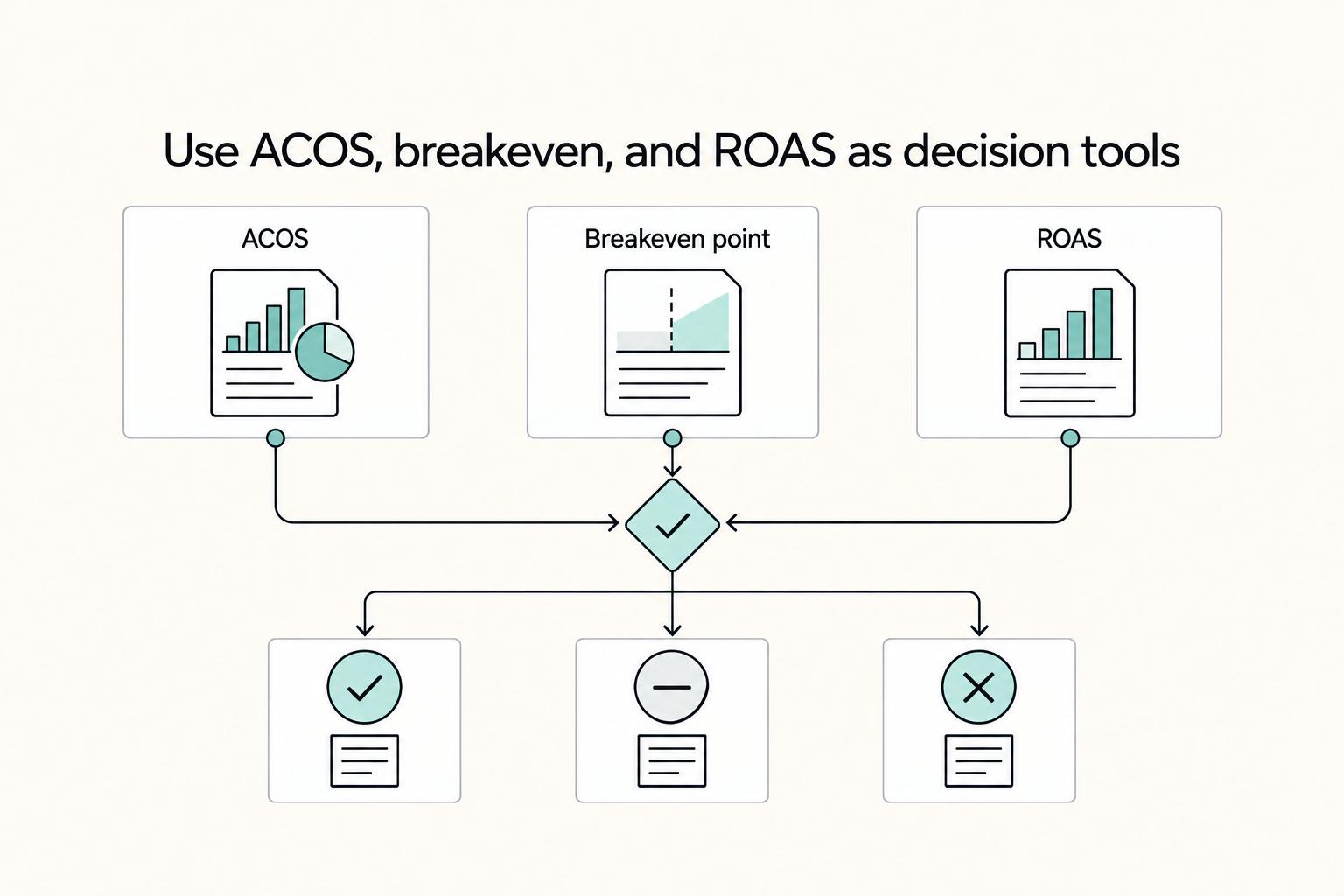
Measuring Ad Profitability: ACOS, Breakeven, and ROAS as Decision Tools#
Once your listing state is stable, the next question is simple: should this spend continue, get tightened, or stop? Use ACOS, breakeven ACOS, and ROAS as decision tools, not dashboard trophies.
ACOS (Advertising Cost of Sale): Your Core Health Metric#
ACOS is the quickest way to see whether a campaign is efficient enough for its current job.
Working formula: Ad Spend ÷ Ad-Attributed Sales = ACOS
That formula is common and useful, but it should not turn into copied policy. A launch test can tolerate a very different ACOS than a profit-protection campaign, and the only threshold that matters operationally is the one that fits your own royalty model.
- Launch-learning mode: Use ACOS trend and search-term quality as signals while you are still checking whether the page and audience match.
- Profit-protection mode: Compare ACOS against a verified breakeven line once the page state is stable and reporting has had time to settle.
Calculating Your Breakeven Point: The Magic Number for Profitability#
Breakeven ACOS is the point where an ad stops making economic sense for that specific book. The input is not a copied benchmark; it is your own royalty model after you account for format, pricing, print cost, and any downstream value you have actually proven.
| Book format or role | Royalty model to verify | Breakeven input you must insert | Use this for bidding decisions |
|---|---|---|---|
| Ebook edition | Percentage-based royalty model | Verified royalty per sale or effective royalty rate | Set the ceiling for profit-protection mode |
| Print edition | Percentage less unit-cost model | Verified net royalty after print costs | Usually requires tighter bids than digital |
| Series entry title | Front-end royalty plus downstream read-through value | Verified first-sale royalty and your own read-through assumption | Only bid past front-end breakeven if backlist economics support it |
That table is less about formula theater and more about discipline. Once you verify the inputs, you have a ceiling you can use to continue, tighten, or pause targets without guessing.
ROAS (Return on Ad Spend): The True Investment Mindset#
ROAS is the flip side of the same picture: how much sales value a dollar of ad spend produces.
Working formula: Ad-Attributed Sales ÷ Ad Spend = ROAS
ROAS is helpful because it reads like an investment ratio, but it shares ACOS's blind spot: it depends on attributed sales, not your entire author income picture. Use it next to KDP royalties, not instead of them. For a broader pricing mindset, Value-Based Pricing: A Freelancer's Guide is a useful companion.
Run one weekly profitability review the same way every time: verify the current royalty inputs, compare ACOS against the breakeven line you actually use, check whether ROAS is improving or flattening, and note any page-state change that could have distorted the result. Consistency matters more than complexity because it stops you from rewriting the rules after a single good or bad day.
Your System: From a Test Campaign to a Scalable Profit Engine#
Adopting an investment mindset is the first step; building a system to manage that investment is what makes it useful. Profitability doesn't happen by accident. It comes from a disciplined, phased approach that turns ad spend from a gamble into a repeatable engine for growth.
Phase 1: The Data-Gathering Campaign (Low Budget, High Learning)#
Your first campaign has one purpose: data acquisition. You are not trying to make sales right away. You are spending a small, controlled amount of money to buy market intelligence. The goal is to discover which keywords and targets actually persuade a reader to click and eventually buy your book. Rushing this phase is one of the most common and costly mistakes in author advertising.
Here is a simple framework for this initial test:
- Create one direct-response test lane. Use a supported campaign format that sends traffic to the book page and is simple enough to interpret.
- Start with a focused target set. Keep the inputs narrow enough that you can tell whether the traffic matches your genre, promise, and positioning.
- Freeze the page state while the test runs. Record price, cover, description, and any major listing changes so you do not blame targeting for page problems.
- Wait for reporting to settle before you judge it. Review the search terms, attributed sales, and page notes together before you label a target a winner or a loser.
Phase 2: The Validation Campaign (Isolate and Optimize)#
After a few weeks, you will have the raw data you paid for. Now you need to act on it with precision. This phase is about doubling down on what works and cutting what doesn't. Check your campaign's search term report to identify two distinct groups:
- Losers: Keywords that generated clicks but no sales, or sales at an ACOS far above your breakeven point. These are simply wasting your money.
- Winners: Keywords that resulted in sales at a profitable ACOS. These are your proven assets.
Then work the list systematically. First, turn off every losing keyword in your initial campaign. Then, for each winning keyword, isolate it by creating a brand-new, dedicated campaign for that single keyword. That sounds like more work, but it gives you granular control over the budget and bidding for your most profitable targets, which is essential for the next phase.
Phase 3: The Scaling Campaign (Calculated Growth)#
With single-keyword campaigns built around validated, profitable targets, you can begin to scale your sales volume. This is not about abruptly cranking up your budget; it's about calculated growth. The process is a methodical loop of increasing your investment and monitoring performance.
Here's how you build your profit engine:
- Increase the daily budget on a "winner" campaign by a small, controlled amount (e.g., 20-30%).
- Let it run for a full week without making other changes.
- At the end of the week, check your ACOS. Is it still below your breakeven point?
- If yes, you can repeat the process, adding another small budget increase. If the ACOS has risen above your profit ceiling, pull the budget back to its previous level.
By repeating this process, you methodically find the sweet spot where you can maximize sales volume while maintaining profitability. This disciplined, three-phase system - Test, Validate, Scale - is the core of effective author advertising. It removes emotion and guesswork, replacing them with a data-driven process that builds a predictable and scalable sales engine for your business. For launch sequencing around the wider catalog, pair it with The best 'launch strategies' for a self-published book.
The one-variable rule is the real safeguard here. If you raise budgets, change bids, and widen targeting at the same time, you lose the ability to explain what actually moved performance. Keep a simple change log with date, target, price, and page notes so your decisions stay readable. If your offer is still evolving, revisit The Best Book Cover Design Services for Indie Authors before you assume the targeting is the problem.
Managing Your Ad Spend Like a Business: Compliance and Tracking#
Rigorous financial oversight is the final step in the Author-CEO mindset. Building a scalable profit engine is only half the battle; you must also manage the money it generates with the precision of a CFO. This isn't about complex accounting. It's about creating simple, reliable systems that protect your business, clarify your profitability, and help you make smarter investment decisions.
Ad Spend as a Deductible Business Expense#
Record every ad charge as a marketing or advertising expense in your business records. That gives you a clean trail for reporting and helps you see whether campaigns are earning their keep instead of disappearing into a card balance.
Do not assume the tax treatment is identical everywhere. Your jurisdiction, business structure, filing status, and local rules all matter, so verify treatment with a qualified tax professional. Keep the invoice, statement, or export for each month and tie ad payments back to the same books you use for royalties and other publishing costs.
Separating Ad Income from Other Royalties#
Use Amazon Ads to judge ad-attributed performance and KDP to judge blended royalty reality. Those are related views, not identical ones, so do not force them into false precision. Amazon's Ads FAQ is useful for current reporting mechanics, but your real operating view comes from reviewing both exports side by side.
Pull the same month from both systems, keep the lines separate, and note the export date. That is what lets you decide whether a title deserves more budget, should hold steady, or should be cut before the next month closes.
Creating a Simple Monthly "Ad P&L"#
This is where you consolidate everything into one useful document: a monthly advertising Profit and Loss (P&L) statement. This doesn't need to be complicated. It's a straightforward calculation that gives you an instant snapshot of your advertising's financial health.
Formula: Total Ad-Attributed Royalties - Total Ad Spend = Net Profit/Loss
At the end of each month, take the total royalties generated from your advertising dashboard and subtract the total amount you spent on ads for that same period. The result is your net profit or loss. Capturing this in a simple table turns abstract data into practical business intelligence.
| Month | Total Ad Spend | Ad-Attributed Royalties | Net Profit / Loss |
|---|---|---|---|
| January | $150.00 | $225.00 | $75.00 |
| February | $200.00 | $250.00 | $50.00 |
| March | $275.00 | $260.00 | -$15.00 |
This simple monthly exercise is the hallmark of a data-driven business owner. It moves you beyond hoping your ads are working and gives you a clear, factual understanding of your marketing's financial performance.
A clean month-end close should capture four things: all ad charges, the matching Amazon Ads export date, the matching KDP export date, and a short note about any unusual jump in spend or sales. That note becomes valuable later, especially if a campaign looked efficient in the ads console but failed to lift blended royalties. If you are rebuilding trust signals at the same time, pair the tracking work with How to Get Book Reviews on Amazon and Goodreads.
Applying Ad Strategy Across a Growing Series Catalog#
A clear understanding of your monthly performance is the foundation, but the real advantage comes when you apply it across a growing catalog. A single book is a product; a series is a business asset. Once you have more than one book, your advertising strategy can evolve from chasing individual sales to building a sustainable system for acquiring loyal readers. That requires a deeper shift in thinking, moving from month-to-month profit to long-term reader value.
The "Loss Leader" Strategy for Series Authors#
This brings us to an advanced - and for many, counterintuitive - tactic: the loss leader. A loss leader strategy involves intentionally advertising a product at a breakeven point or even a slight loss to attract customers who will then buy other, more profitable products. For an author with a series, this means running your ads for Book 1 not necessarily for immediate profit, but to acquire a reader who will ideally purchase the rest of the series at full price.
This can feel risky. After spending so much time focusing on a profitable ACOS for a single book, deliberately aiming for breakeven can seem like a step backward. It's not. It's a calculated investment in a larger return. You are using the first book as a marketing tool, an entry point into your catalog. The small, documented loss on that initial sale is the cost of acquiring a new customer who may in the end spend far more with you over time.
Calculating "Total Series Read-Through Value"#
To execute a loss leader strategy without gambling, you need your own read-through estimate. That means tracking title-level royalties, sell-through from Book 1 into later books, format mix, and any Kindle Unlimited behavior that materially changes margin.
Here's a simplified way to estimate it:
- Track your sell-through rate: For a set period (like a month), divide the number of Book 2 sales by the number of Book 1 sales. If you sold 100 copies of Book 1 and 60 copies of Book 2, your sell-through rate is 60%. Do this for each subsequent book.
- Calculate the potential royalty: Add up the royalty earned from one sale of each book in the series (e.g., Book 1 royalty + Book 2 royalty + Book 3 royalty).
- Estimate the value: Multiply the total potential royalty by your sell-through rates to get a more conservative, realistic estimate of what a new reader is actually worth.
Once you know the front-end value of Book 1 and the verified downstream value of later titles, you can decide whether a series-entry campaign deserves more room than a standalone title. If the read-through is weak, keep Book 1 on strict profit rules.
Data quality matters more than optimism in this model. Pull the numbers from comparable periods, save the export date, and do not mix experimental series campaigns with must-run evergreen campaigns under the same budget cap. If a portfolio limit is hit, every campaign inside it can stop delivering. When the wider goal is author-platform growth rather than one title's ACOS, How to Write a Book to Establish Your Freelance Expertise is the adjacent planning article.
Using Sponsored Brands to Build Your Author Platform#
As your catalog grows, Sponsored Brands can work as a discovery layer above direct-response campaigns. Amazon's Sponsored Brands guide for authors and the Author Page landing-page update are the current places to verify placements and destinations.
Use Sponsored Brands to:
- Showcase a full series: Send the click to a destination that makes reading order obvious.
- Promote an organized Author Page: Use it when broader backlist discovery is the real goal.
- Keep the promise consistent: Match headline, featured books, and landing destination so readers see what the ad implied.
This type of advertising shifts the goal from a one-time transaction to creating a long-term fan. It's a long-game strategy that turns ad clicks into loyal readers who are eager for your next release. If you are coordinating a wider release push, pair it with The best 'launch strategies' for a self-published book.
Conclusion: From Gambling on Ads to Investing in Your Author Business#
Patience - the willingness to wait for reliable data before acting - is the critical first step in leaving the gambler's mindset behind. Too many authors treat the Amazon Ads dashboard like a slot machine, pulling levers based on hope and feeding it money out of anxiety. This playbook is meant to change that. By adopting the Author-CEO mindset, you transform advertising from a confusing expense into a controllable business asset.
This framework gives you that system. Successful advertising isn't about finding one "magic" keyword. It's about building a stable foundation with a retail-ready product, defining clear objectives, and executing a phased, data-driven campaign strategy. You have learned to isolate variables, test assumptions with small, calculated budgets, and validate what works before scaling. This methodical process removes emotion from the equation. It replaces anxiety with analysis and gives you the control every serious business owner needs over investments.
This is the Author-CEO shift. You now have the tools and, more importantly, the perspective to operate your publishing career with a new level of professional discipline. You can look at your ad spend not as a cost center, but as an engine for growth that you build piece by piece. Armed with a clear understanding of your metrics, a systematic approach to testing, and the discipline to let data guide your decisions, you can move beyond simply hoping for sales. You can start building a predictable, profitable, and scalable marketing system that will support your career for years to come. That is the return on this investment.
Frequently Asked Questions
What is a good ACOS for Amazon book ads?
There is no universal good ACOS. Judge it against the job of the campaign and your verified royalty economics. A launch test can tolerate a different ACOS than a profit-protection campaign, but your own breakeven line matters more than a copied benchmark.
How do you calculate the ROI of Amazon Ads for authors?
Use ROI as a profit check by comparing ad-attributed value against ad spend, then sanity-check the result against KDP royalties and any verified read-through value. Keep the method consistent across comparable periods and wait for reporting to settle.
Are Amazon Ads profitable for authors?
Amazon Ads can be profitable, but only when the book page converts and the economics support the click cost. Ads amplify page quality; they do not fix weak positioning, a confusing series handoff, or an unready listing.
How much should an author budget for an Amazon ad campaign?
Budget for learning first. Fund a small set of high-intent targets, let the data settle, and scale only after results repeat under stable page conditions.
What are the best keywords to target for a book?
Start with close author comps, specific subgenre phrases, and branded searches if readers already look for you. Split different intent buckets so you can see which terms bring qualified traffic.
How long does it take for Amazon Ads to become effective?
You may see early clicks quickly, but decision-quality data takes longer. Wait for attribution and reporting to settle before you call a test winner or loser.
Researched and edited by the Gruv editorial team. Gruv builds cross-border billing, payouts, and finance-operations software for global businesses.
Sources
Includes 4 external sources outside the trusted-domain allowlist.
Educational content only. Not legal, tax, or financial advice.
Related Posts
Value-Based Pricing for Freelancers Under Real Payment Risk
Value-based pricing works when you and the client can name the business result before kickoff and agree on how progress will be judged. If that link is weak, use a tighter model first. This is not about defending one pricing philosophy over another. It is about avoiding surprises by keeping pricing, scope, delivery, and payment aligned from day one.

How to Write a Book as a Freelancer Without Scope Drift
The book needs a defined job and a defined boundary before you draft. In this cycle, give it one job: either support your client book services, or strengthen your own authority book so your niche, offer, and sales conversations become clearer.
Launch Strategies for a Self-Published Book That Drive Client Work
For consultants and global professionals, writing a book is usually a business decision, not a bid for literary fame. The frustration starts when people follow the standard author path: write, publish, hope for traction, then wonder why a burst of Amazon sales does not turn into serious client work.