
Quick Answer
To rank higher on Airbnb, strengthen the business behind the listing first, then sharpen guest fit, and finally manage pricing and service with discipline. This framework treats Airbnb SEO as a three-part system: verify compliance and insurance, align photos and copy to one trip type, and review pricing, reviews, and key metrics on a consistent cadence.
You're a professional. You manage projects, portfolios, and teams around two core principles: maximizing return and controlling risk. So why run a six-figure property from a generic checklist built for a side hustle?
You are not a casual host. Your property is a strategic asset, and it should be managed that way.
Most Airbnb advice does not reflect that. It leans on scattered tips like changing your title, uploading more photos, or buying a new welcome mat. It skips the issues that actually shape performance: local compliance, tax handling, insurance gaps, and the operational failures that can stop a listing cold.
This is not another tip list. It is a practical operating model. We built The Airbnb Asset Optimization Framework for professionals who want more control. It uses three pillars to move you from reactive host to disciplined asset manager.
If you want to rank higher on Airbnb, start by making the business itself more durable. Build a solid foundation, turn compliance from a source of stress into a point of control, and run the property like a predictable revenue asset, not a collection of one-off tasks.
Pillar 1: Fortify Your Asset - The Compliance-First Foundation#
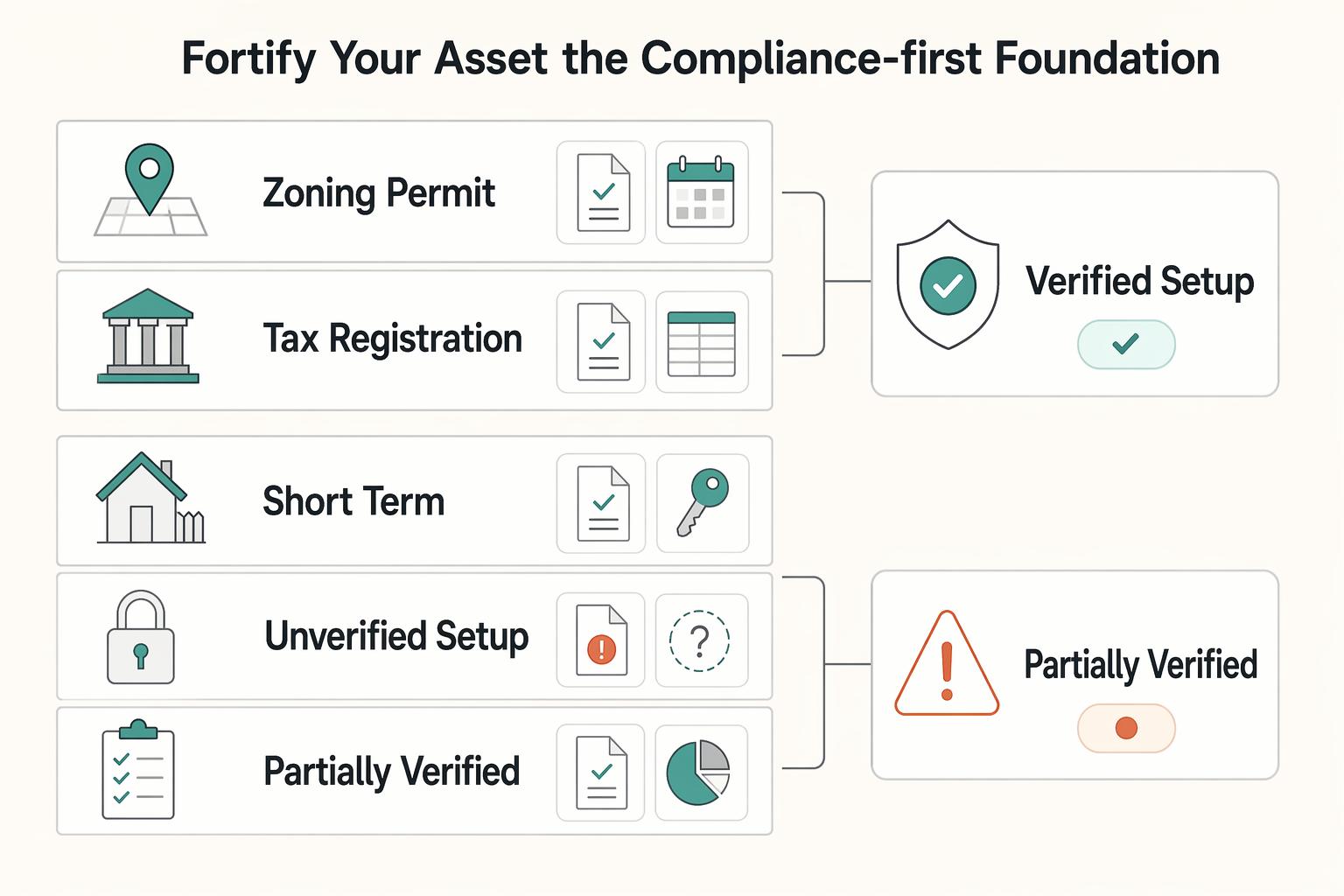
Before you tune copy, photos, or pricing, verify that the business itself can stand up to scrutiny. If your setup is unverified, the real problem is not airbnb seo. It is listing fragility.
| Area | What to confirm | Evidence to keep |
|---|---|---|
| Zoning and permit status | Applicable local or contractual rules through official channels in your jurisdiction | Source page, approval notice, permit record, or written response relied on |
| Tax registration and remittance workflow | Which taxes may apply, who collects them, and what remains your responsibility | Registration confirmations, filing logins, and remittance receipts |
| Short-term-rental insurance verification | Whether your current policy contemplates guest stays and income-producing use | Written confirmation of relevant terms and exclusions |
A compliance-first foundation protects continuity. You can improve conversion, reviews, and booking rate more safely when your operating model is documented and repeatable.
This section is grounded in Airbnb's Form S-1 filing (filed on November 16, 2020) and general platform-principles guidance. It does not include jurisdiction-specific short-term-rental zoning, permit, tax-remittance, or host-insurance requirements. Treat the checklist below as an operations framework to validate locally.
| Compliance state | Listing stability | Account risk | Ability to scale |
|---|---|---|---|
| Unverified setup | Fragile. You are operating on assumptions. | Highest, because you cannot quickly prove anything if questioned. | Poor. Every new property multiplies unknowns. |
| Partially verified setup | Better, but still exposed where documentation is missing. | Moderate. One weak area can stall operations. | Limited. Expansion adds admin drag. |
| Verified setup | More durable because your evidence is organized and current. | Lower, because you can show what you checked and when. | Stronger. You can repeat the same setup process across units. |
Your checklist should cover three areas, and each one needs evidence, not memory:
- Zoning and permit status: Confirm applicable local or contractual rules through official channels in your jurisdiction. Save the source page, approval notice, permit record, or written response you relied on.
- Tax registration and remittance workflow: Confirm which taxes may apply, who collects them, and what remains your responsibility. Keep registration confirmations, filing logins, and remittance receipts together.
- Short-term-rental insurance verification: Ask your carrier or broker whether your current policy contemplates guest stays and income-producing use. Request written confirmation of relevant terms and exclusions.
Make tax handling executable#
Tax problems usually start with ambiguity. Give one person clear ownership, even if that person is you.
- Map obligations by jurisdiction and booking channel. Note what is confirmed, what is assumed, and what still needs an answer.
- Assign an owner for registrations, filings, and notice handling.
- Automate collection or remittance where your software stack or booking channel supports it, then verify the settings.
- Run a recurring reconciliation monthly or quarterly. Compare booking totals, tax collected, tax remitted, and what remains payable.
The checkpoint is straightforward. Your payout reports, accounting records, and remittance confirmations should align. If they do not, pause and resolve the mismatch before it compounds.
Verify insurance like an operator#
Verify insurance against the activity you actually run. In practice, check whether your current coverage documentation addresses property damage, liability, income interruption, and claims handling when a unit is unavailable.
If your operating pattern has changed, send your carrier or broker a written summary of current use and request a written coverage position.
Before you move to Pillar 2, make sure you can answer yes to each of these:
- I have identified applicable operating rules and saved verification evidence.
- I know which taxes I need to track, and one owner is accountable.
- My collection and remittance process is documented and reconciled.
- My insurer or broker has my real operating model in writing.
- I can produce my evidence pack within minutes, not days.
Once that foundation is in place, optimization has something solid to build on.
Related: The Pros and Cons of Short-Term vs. Long-Term Rentals.
Pillar 2: Master Your Market Positioning - The Strategic SEO Engine#
Once your operations are stable, focus on positioning before polish. The goal is to make your listing the clearest fit for one trip type, then show that fit consistently across the listing.
Treat this like a go-to-market plan for your stay. Without a clear plan, edits drift and effort gets wasted.
Use older Airbnb growth write-ups as background, not as your playbook. For example, a widely shared growth case study was published on 28 May 2019, while newer positioning guidance is framed for 2026. The takeaway is the same: specific market fit is stronger than generic appeal.
Build a one-page guest worksheet first#
Before editing photos or copy, define your target guest in one page:
| Worksheet item | Prompt |
|---|---|
| Trip outcome | What are they trying to make happen? |
| Must-have conditions | What has to be true for the stay to work? |
| Likely objections | What could make them hesitate? |
| Booking triggers | What proof helps them decide confidently? |
Your checkpoint is simple: someone else should be able to read this and describe exactly who the stay is for. If the answer is "everyone," your positioning is still too broad.
Align photos and copy to that intent#
Do not treat listing edits as guaranteed ranking hacks. Use them as clarity and trust tools so the right guest can confirm fit quickly.
Keep the structure consistent:
- Lead with the clearest visual of the stay your target guest wants.
- Order photos so the space is easy to understand.
- Show proof of the amenities that matter most for that trip.
- Write copy in the same sequence: fit, proof, reassurance.
| Listing element | Too generic | Clearer positioning |
|---|---|---|
| Title | Cozy apartment in great area | Quiet 2BR near medical district with full kitchen |
| Opening line | Perfect for any traveler | Built for longer stays with laundry, workspace, and self check-in |
| Feature proof | Has everything you need | Blackout curtains, dining table for four, and a separate laptop-friendly work spot |
Audit discoverability before chasing more traffic#
Being listed is not the same as being chosen. In general search, indexed content can still fail to appear; the same practical lesson applies here: visibility and fit both matter.
Audit from the guest view, not just the editor view:
- Search like your target guest would.
- Narrow results the way they would narrow them.
- Confirm your listing still appears and still looks like a strong fit at card and gallery level.
- Check that key amenities are accurately reflected in listing fields, not only implied in prose.
Keep a short positioning file with your worksheet, current title and opening paragraph, photo order, and key listing-field choices. That makes future refreshes faster and more consistent.
Before moving to Pillar 3, confirm:
- You can name the primary guest and trip purpose in one sentence.
- Your title and opening paragraph match that trip.
- Your top photos prove the stay works for that guest.
- Key amenities are clearly represented in the listing setup.
- A guest-side search check still presents your listing as a strong fit after narrowing.
If guest experience is the next bottleneck after visibility, see The Best Welcome Gift Ideas for Airbnb Guests.
Pillar 3: Run Pricing, KPIs, and Service as Documented Routines#
Once your listing is aimed at the right guest, performance management should be systematic, not reactive. Run a documented pricing routine, track a small KPI set in one place, and keep a service loop you can audit later.
Price with controls, not mood#
Use a written calendar process so every pricing change is traceable. Keep one working sheet with your baseline nightly rate, date-specific demand notes, active minimum-stay settings, and each manual override with a short reason.
Tool-assisted pricing can improve coverage, but you still need to review it. The risk is not the tool itself, but letting recommendations drift away from the guest profile and stay pattern you want.
| Approach | Where it helps | Where it breaks | What you still need to do |
|---|---|---|---|
| Manual pricing | Full control on a small calendar | Easy to miss events, inconsistent updates | Review the calendar regularly and log exceptions |
| Tool-assisted pricing | Faster updates across many dates | Can follow market movement you would not choose | Review suggestions, lock key dates, track overrides |
| Hybrid | Balanced control and coverage | Requires discipline to keep rules current | Use tools for coverage, approve key dates yourself |
Change one lever at a time when possible. If you change price, minimum stay, and booking rules together, it becomes harder to tell what actually drove the result.
Read the KPI set together#
Treat your KPI view as a diagnostic panel, not a scoreboard. If you track RevPAR, ADR, occupancy, and net revenue after platform and operating costs, review them together in the same monthly view before making changes.
The key habit is consistency: check the same set, on the same cadence, against your payout records and calendar notes. That helps you avoid reacting to noise or solving the wrong problem.
Close the review and reliability loop#
Reviews are usually a byproduct of reliable operations, not one checkout message. Build a simple SOP that covers pre-stay expectations, an in-stay check-in, and a post-stay review request only after issues are resolved.
| Stage | Action | Details |
|---|---|---|
| Pre-stay | Send one clear message | Access steps, arrival notes, house rules, and any limitations |
| In-stay | Ask a short check-in question | Early enough to fix issues during the stay |
| Post-stay | Request a review | After confirming there are no unresolved issues |
| Service fixes | Keep a complaint log | Issue, date, fix taken, and recurrence |
Apply the same SOP mindset to response, acceptance, and cancellation controls. If a platform threshold matters, track it as a pending verification item in your SOP and update it only from a current source.
How the 3 Pillars Create an Unbeatable SEO Flywheel#
The three pillars work when you run them as one operating loop: reduce avoidable failures, improve guest fit, and reinforce the quality signals that influence booking probability in search.
Foundation work is the risk-control layer, not a direct ranking shortcut. It helps you avoid cancellations, communication breakdowns, and service misses that can weaken listing quality over time. From there, positioning improves click fit, and performance management keeps price and service decisions aligned with what guests actually book.
In practical terms:
- Visibility: how competitively your listing appears for a search, influenced by factors like quality, popularity, price, and location.
- Conversion: whether the guest clicks and books once they see your listing.
- Guest satisfaction: what shows up later in ratings and review quality.
- Reliability: whether communication and service consistency make your listing a lower-risk choice.
Because 2025 updates reportedly shifted weight toward personalization and more recent guest satisfaction, stale wins matter less than current execution.
| Approach | Likely outcome |
|---|---|
| Better photos but weak operations | More clicks, but avoidable issues can hurt reviews and consistency |
| Discounts without clear positioning | More occupancy potential, but weaker fit and thinner margins |
| Integrated 3-pillar loop | Better fit, cleaner stays, stronger reviews, and steadier visibility over time |
Track listing-level and host-level signals separately. Guest Favorites is listing-level, while Superhost is host-level. A listing can earn Guest Favorites with a 4.9+ overall rating and consistently strong reviews, while Superhost uses a 4.8+ host-level threshold. If you only watch host status, you can miss listing-level underperformance.
Keep the loop simple: audit foundation controls, refine positioning assets, review pricing and guest-feedback patterns, then feed those lessons back into the listing. That is how optimization becomes a repeatable operating habit instead of one-off tweaks.
Conclusion: Your Property Is an Asset. Manage It Like One.#
If you want better results from your Airbnb listing, stop treating it like a one-time setup. Treat it like an asset you review on purpose. The three pillars are still the right lens, but each one only matters if it becomes a repeatable operating habit that keeps the listing competitive, protects visibility, or prevents review damage.
| Pillar | What you control | Primary workflow | Success signal |
|---|---|---|---|
| Compliance | Safety and local regulatory readiness | Check fire safety, gas checks, and local council rules on a regular cadence | Fewer preventable compliance misses |
| Positioning | Who the stay is for and how clearly the listing promises it | Refresh photos and listing copy when guest questions or reviews show expectation mismatch | Clearer expectations before booking |
| Performance | Pricing, response speed, cleaning quality, stay execution | Review demand-responsive pricing, guest enquiries, vetting, check-in instructions, and maintenance follow-up | Stronger review quality, fewer recurring complaints, steadier visibility and bookings |
Your next move is simple. For Pillar 1, run a compliance check on a regular cadence. For Pillar 2, update the listing only when the promise is unclear, not because you are bored with the copy. For Pillar 3, review pricing and operations on the same cadence. Late responses, subpar cleaning, or slow maintenance handling can become negative reviews that hurt both visibility and bookings.
One last reality check: self-managing can swell into 20 to 30 hours. Some UK owners compare that time cost against management fees of 12% to 20% of booking revenue. Whether you self-manage or outsource, use the same review cycle:
- Verify compliance and safety items are current
- Update positioning if reviews or enquiries show mismatch
- Review pricing, response quality, and repeat review complaints
For a step-by-step walkthrough, see A Freelance Writer's Guide to On-Page SEO.
Frequently Asked Questions
How does dynamic pricing affect Airbnb search rank?
Dynamic pricing ensures your property is always priced competitively, which has a powerful effect on your booking rate. When a guest sees your listing, its price appears perfectly aligned with their expectations for that date, increasing the likelihood they will book. The Airbnb algorithm registers this higher conversion rate as a strong signal of your listing's relevance and value. It concludes that when guests see your property, they book it. As a reward, the algorithm boosts your visibility, creating a positive feedback loop: better pricing leads to more bookings, which leads to a higher rank.
What are the most important legal factors for an Airbnb listing?
For a professional, managing legal risk is paramount. While regulations vary, four areas of compliance are universal for protecting your asset. First, verify local zoning laws to ensure short-term rentals are permitted. Second, secure all necessary business licenses or rental permits from your city or county. Third, establish a workflow for remitting occupancy and tourism taxes. Finally, and most critically, secure adequate commercial liability insurance, as standard homeowner's policies often don't cover business activities.
How do I calculate the ROI for an Airbnb property?
As an asset manager, you must focus on your return on investment (ROI). The standard formula is: ROI = (Annual Net Profit / Total Investment Cost) x 100. Annual Net Profit is your gross rental income minus all operating expenses (mortgage, insurance, utilities, cleaning, maintenance, management fees, taxes). Total Investment Cost includes the purchase price plus all initial costs like closing fees, renovations, and furnishing. A strong ROI for a short-term rental is typically between 8% and 12%. This framework is designed to aggressively increase the 'Annual Net Profit' side of the equation.
What is the best way to handle negative Airbnb reviews?
A negative review is a public relations opportunity. Address it swiftly and professionally. First, respond publicly within 24 hours. Acknowledge the guest's experience, thank them for the feedback, and apologize for any shortcomings without making excuses. Second, offer to take the conversation offline to resolve their specific issue. Third, and most importantly, publicly state how you've used their feedback to improve. For example: 'Thank you for highlighting this. We've since upgraded the Wi-Fi router to ensure seamless connectivity for future guests.' This shows prospective guests that you are a responsive and professional operator.
Does enabling "Instant Book" help my Airbnb ranking?
Yes, enabling "Instant Book" is one of the most significant single actions you can take to improve your ranking. The algorithm rewards hosts who provide a seamless, low-friction experience. By activating it, you improve your response rate metrics and qualify for a specific search filter many guests use. The risk mitigation work you did in Pillar 1 is what gives you the confidence to turn this powerful feature on, signaling to the algorithm that you are a reliable, professional host.
How do I find the right keywords for my Airbnb title?
Stop thinking about generic keywords and start thinking about your Ideal Guest Avatar. The most effective title speaks directly to the person you want to attract. A powerful title combines three elements: a Primary Benefit (e.g., 'Relaxing,' 'Spacious'), a High-Value Feature (e.g., 'Hot Tub,' 'Chef's Kitchen'), and a Specific Location (e.g., 'Near Downtown,' 'Steps to Beach'). An example for a remote worker might be: 'Quiet Urban Retreat w/ Blazing Fast WiFi & Dedicated Workspace.' This title doesn't just describe a property; it solves a problem for a specific guest.
Researched and edited by the Gruv editorial team. Gruv builds cross-border billing, payouts, and finance-operations software for global businesses.
Sources
Includes 3 external sources outside the trusted-domain allowlist.
Educational content only. Not legal, tax, or financial advice.
Related Posts

LinkedIn for Freelancers Who Want a Predictable Client Pipeline
Treat LinkedIn as two jobs you run at the same time: a credibility check and a conversation engine. If you only chase attention, you can get noise. If you only send messages, prospects may click through to a thin profile and hesitate.

How to Use SEO to Attract High-Quality Freelance Clients
**Build your *seo for freelancers* around qualified leads, not raw traffic: tighten who you target, what you prove, and how you gate inquiries.** You're the CEO of a business-of-one. Your marketing job isn't "get more attention." It's "get the right work, predictably, without turning your calendar into a sorting machine."
The Pros and Cons of Short-Term vs. Long-Term Rentals
You are probably not chasing the biggest headline revenue number. You want rent that arrives, stays collected, and does not turn into a second job or a cross-border tax headache. For an owner living internationally, the real choice between a short stay and a long-term lease is about risk first. Which model gives you lower compliance exposure, less remote operating drag, and more cash left after fees, taxes, and reporting?