
Quick Answer
Use an s-corp accountable plan to reimburse business costs only after business connection, substantiation, and excess-return checks are satisfied. Put the policy in writing, attach each payment to a dated expense report, and document mixed-use allocation before funds move. If the file is incomplete, hold reimbursement and correct it first, because weak support can push treatment toward wages and increase payroll-tax cleanup risk.
Start Here if You Want Tax-Free Reimbursements Without Audit Drama#
Start here: treat reimbursements as a formal employer process, not informal owner spending. That matters most when you are a solo owner-employee, because you are both the spender and the approver. When the business purpose and support are unclear, you are not running a reimbursement process you can defend. You are moving money and creating cleanup risk later.
Scope check: this article focuses on U.S. S corp reimbursement workflows and practical friction points. Use it to classify expenses, tighten documentation habits, and spot when a reimbursement question needs deeper review. Keep a simple default: documentation first, reimbursement second. If support is incomplete or unclear, pause and fix the file before money moves.
One verification habit matters early: confirm legal claims in official sources. FederalRegister.gov explicitly says its web display is not an official legal edition and tells readers to verify against an official Federal Register edition. FAR Part 22 is about labor laws in government acquisitions, not S corp reimbursement mechanics. If your policy is built from generic blogs, procurement rules, or recycled templates, verify the underlying tax point before you rely on it.
By the end of this guide, you should be able to:
- Classify expenses into likely reimbursable, needs stronger support, or hold for review.
- Run a repeatable documentation process instead of year-end reconstruction.
- Escalate to a tax professional when facts are complex or consistently mixed-use.
What an S Corp Accountable Plan Actually Changes#
What changes is the tax treatment of the reimbursement payment, not whether the expense itself exists. Under the Internal Revenue Service (IRS) baseline rule, fringe benefits are taxable wages unless a specific exclusion applies. An accountable plan is the employer reimbursement method that can keep legitimate business reimbursements out of employee income when the conditions are met. If they are not, the treatment shifts to nonaccountable, and reimbursements are treated as taxable wages.
That distinction became more important after the 2017 tax law changes. The practitioner source for this section says the prior Schedule A path for unreimbursed employee business expenses was no longer available after those changes. In practice, if your S corp does not reimburse correctly, there may be no clean personal-return fallback. That can mean lost treatment and later cleanup.
For an owner-employee, reimbursement design sits inside compensation design. You are both the employee incurring the cost and the owner deciding how the company pays it. IRS guidance also says S corporations must pay reasonable compensation to shareholder-employees before non-wage distributions, so reimbursements are not a side issue.
Use this operating checkpoint before you treat any payment as a clean reimbursement:
- The file clearly shows amount, date, time, and business purpose.
- Support includes receipts, logs, or worksheets.
- Substantiation is handled promptly. One source points to a 60 day window as a practical discipline.
If that support is weak, stop there. The common failure modes are boring but expensive: the payment can become taxable wages, with payroll-tax exposure, or be treated as a distribution the S corp cannot deduct.
Accountable Plan vs Non-Accountable Plan in Plain English#
Start with a conservative rule: if you cannot clearly support a payment as reimbursement, assume wage treatment.
This comparison stays conservative. IRS guidance does say that distributions and other payments to a corporate officer must be treated as wages, and that S corporations must pay reasonable compensation to shareholder-employees. So if a payment cannot be supported as reimbursement, wage treatment is the safer assumption.
| Issue | If treated as accountable reimbursement | If treated as non-accountable or unsupported payment |
|---|---|---|
| Tax treatment | May be treated as reimbursement when support is clear | Conservative assumption is compensation |
| Reporting path | Usually handled in reimbursement records | If treated as wages, it generally moves through payroll reporting |
| Payroll taxes | Typically less wage-based payroll-tax exposure from that payment | Wage treatment can increase payroll-tax exposure |
| Social Security tax and Medicare tax | Exposure is generally lower if the payment is not classified as wages | If treated as wages, exposure can increase; in cross-border cases this can also affect where Social Security and Medicare taxes apply |
| Submission evidence | Keep clear, dated records that support reimbursement treatment | Weak or missing support pushes the outcome toward wage treatment |
| Review cadence | Use a review cycle you can maintain | Delayed review can make corrections harder later |
| If overpaid | Address and document any excess promptly | Unresolved excess can increase reclassification and payroll-cleanup risk |
The tradeoff is simple: a bit more admin now, or more reclassification and payroll cleanup risk later. If your records are loose, treat the payment like wages early instead of relying on labels after the fact.
If you live or work abroad, keep one nuance in mind: U.S. totalization agreements are designed to avoid dual Social Security taxation, and for the United States they cover both Social Security and Medicare taxes. That can help with cross-border coverage conflicts, but it does not fix weak payment classification.
Related reading: The S-Corp Election for LLCs: A Tax-Saving Strategy for High-Earning Freelancers.
Use This Five-Step Test Before Reimbursing Any Expense#
Run the same screen for every expense before money moves. If an item fails any step, pause it and complete the file first.
That discipline matters in an S corporation (and C corporation), where owners are treated as employees for this purpose. The core risk is straightforward: without a plan-based process, reimbursements can be reclassified as wages, which can increase payroll and income tax exposure.
The five-step sequence#
These test names are practical review anchors. They are not quoted IRS wording.
| Step | What to confirm | Pause if |
|---|---|---|
| Business Connection Test | The expense is clearly a business expense, or the business portion of a mixed-use expense | You cannot state the business purpose clearly |
| Mixed-use check | The allocation is defensible when personal and business use are both present | The split is guesswork or habit-based |
| Adequate substantiation requirement | You have contemporaneous support before payment, such as a bill, receipt, invoice, or log with business-purpose notes | Support exists only in memory |
| Report checkpoint | Each reimbursement is tied to a written reimbursement record under the policy, with business-purpose notes | It is not in the file |
| Excess Reimbursement Return Rule | The reimbursement matches the supported business amount and nothing more | The reimbursement exceeds the supported business amount |
- Business Connection Test
Is this clearly a business expense, or the business portion of a mixed-use expense? If you cannot state the business purpose clearly, do not reimburse yet.
- Mixed-use check
If personal and business use are both present, is the allocation defensible? If the split is guesswork or habit-based, stop and document a real method first.
- Adequate substantiation requirement
Do you have contemporaneous support before payment, for example a bill, receipt, invoice, or log with business-purpose notes? If support exists only in memory, treat it as not ready.
- Report checkpoint
Tie each reimbursement to a written reimbursement record under your policy, with business-purpose notes. If it is not in the file, it is not ready to pay.
- Excess Reimbursement Return Rule
Does the reimbursement match the supported business amount and nothing more? If an overpayment appears, identify and return the excess under your policy.
If-then rule: if business purpose is weak or the mixed-use allocation is not defensible, do not reimburse until the evidence is complete.
Category checkpoint table#
Use this as a conservative internal checklist, not as a claim of IRS-prescribed field-by-field requirements.
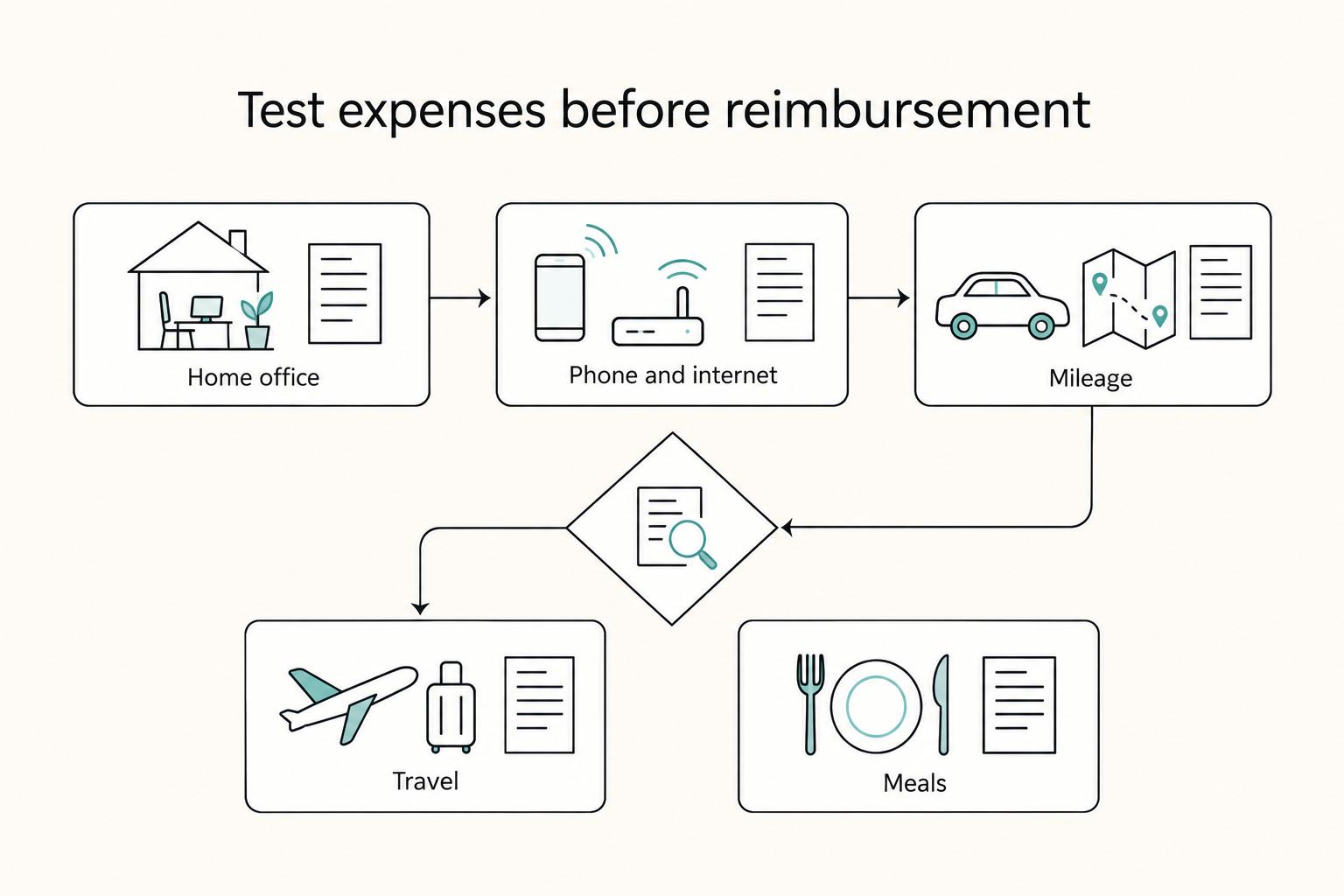
| Category | Internal evidence examples before reimbursement | Red flag to stop on |
|---|---|---|
| Home office related costs | Record of the expense plus a written business-use allocation method | Flat amount with no period support or no allocation basis |
| Phone and internet | Record of total cost plus the business-use share and allocation note | Full-bill reimbursement despite personal use, or repeated unsupported percentage |
| Mileage | Contemporaneous record supporting business-use miles claimed | Reconstructed totals with no usable record |
| Travel | Records that identify the business purpose and separate business from personal portions | Personal and business time mixed with no clear separation |
| Meals | Record of amount spent and the business purpose or counterpart | No business relationship detail or vague purpose-only notes |
Verify before payment#
Before cash leaves the company, reconcile the reimbursement amount to the reimbursement record, source document, and any mixed-use allocation worksheet. If the numbers do not tie, fix the file first.
Category labels alone do not make an item reimbursable. Reimburse only what you can explain, document, and reconcile now. Everything else waits.
Before you submit a mixed-use reimbursement, run the allocation once and save it with your evidence pack using the Home Office Deduction Calculator.
Put the Policy in Writing Even if You Heard It Is Optional#
Put the policy in writing. Whether IRS rules strictly require a written accountable plan in every case is not established. The practical risk is still clear: in an S corporation, payments to shareholder-employees can be treated as wages, the IRS can reclassify non-wage distributions, and fringe benefits are taxable wages unless a specific IRC exclusion applies.
A written Accountable Plan gives you one standard to apply before money moves. It reduces ambiguity, supports consistent review, and creates a record you can defend if a reimbursement is questioned.
What the policy should say#
Treat this as an internal control document. These are practical policy choices, not a claimed IRS minimum list:
- Eligibility
State who may submit reimbursable expenses.
- Submission timeline
Set a clear internal deadline for when expenses should be reported.
- Review authority
Name who approves reimbursement after reviewing the submission and support.
- Correction process
Define what happens when support is incomplete or amounts do not reconcile.
- Excess reimbursement handling
Require overpayments to be returned or corrected through a documented offset.
One-person S corp governance still matters#
In a solo S corp, keep the employee-employer distinction visible in your process even if one person performs both roles. Submit documentation in your employee capacity, then approve and archive the reimbursement in employer records.
At minimum, keep a dated report, attached support, and an approval record tied to the reimbursement transaction. That structure helps you avoid year-end reconstruction and weak files.
Use IRS language so the policy holds up over time#
Use terms that match IRS concepts: employee, fringe benefit, taxable wages, reimbursement, and excess amount. Avoid internal shorthand that blurs treatment.
If support is missing or amounts do not reconcile, stop and correct the file before reimbursement. Taxable fringe-benefit amounts can flow into wage reporting on Forms W-2 and 1099-MISC and may trigger federal income, Social Security, and Medicare withholding.
Related: A Deep Dive into the 'At-Risk' Rules for S-Corp Losses.
Build a Monthly Evidence Pack You Could Defend in an IRS Review#
Your protection is the file, not the transfer. Build each reimbursement cycle so you can show the employee adequately accounted to the employer under an accountable plan.
Publication 463 frames the review checkpoint that way: did the employee adequately account to the employer under an accountable plan. Use that as your operating standard and avoid treating documentation as a year-end cleanup task.
What to include every reimbursement cycle#
Use a consistent evidence pack for each reimbursement:
| Evidence item | What it should show |
|---|---|
| Receipt or invoice | Vendor, amount, and date |
| Business purpose note | The company connection |
| Allocation method | For mixed-use costs, enough detail to show how the reimbursed amount was calculated |
| Dated report | How submitted items tie to the approval and payment cycle |
In very small teams, still document the submit, approve, and archive steps clearly, even when one person performs multiple steps.
Organize for traceability, not just storage#
Organize records so a reviewer can trace each reimbursed dollar from support to approval to payment without guessing. A practical approach is to file by reimbursement cycle, with supporting documents grouped the same way every time. That makes the record easier to review quickly and reconstruct later without memory-based edits.
The failure mode to avoid#
Weak substantiation can increase compensation-treatment risk. Fringe benefits are taxable wages unless a specific IRC exclusion applies, and taxable fringe-benefit value may be reported on Form W-2 with related federal income, Social Security, and Medicare withholding exposure.
If support is incomplete, the business purpose is unclear, or the allocation basis is not defensible, pause reimbursement and correct the file first.
Add one monthly close checkpoint#
Before cash moves, run a reimbursement reconciliation log as an internal control choice. This is not an IRS requirement stated in the excerpt, and it can help catch mismatches early.
Keep the log simple: report date, employee, total requested, total approved, exception notes, payment date, and where support is stored. If amounts do not tie, hold payment until the file reconciles.
Handle Mixed-Use Expenses Without Guesswork#
For mixed-use costs, reimburse only the business share you can document. The defensible path is simple: document the business reason, keep proof such as receipts or logs, and avoid estimate-by-memory percentages.
Mixed-use items are common, and they are also where files get weak fastest. Home office, phone, internet, travel, and vehicle use can all be reimbursable when the business portion is clear and the amount ties back to support.
Use a documented method by category#
Before reimbursement, write down how you determined the business share and keep that method with the report.
| Mixed-use category | Reimbursement approach | Allocation basis to document | Evidence to keep |
|---|---|---|---|
| Home office related costs | Reimburse only the documented business portion | Document how the business share was determined | Business-use calculation, bill or invoice, business purpose note, dated report |
| Phone and internet | Reimburse only the documented business-use portion | Document the business-use percentage and how you determined it | Bill, short percentage note, usage log or explanation, dated report |
| Vehicle mileage | Reimburse business driving using a mileage method supported by logs | Track business miles; if using the standard mileage method, apply the 2025 rate of 70 cents ($0.70) per mile | Mileage log and dated report |
Keep methods and records clear#
For recurring costs, use a clear internal method and apply it consistently in your own process. If facts change, update the method and leave a brief note explaining why.
If reimbursement amounts change but usage and support do not, pause and reconcile before approval.
Red flags that should pause payment#
Pause mixed-use reimbursement when support does not match the amount. Common warning signs include:
- Percentages with no documented basis
- Missing logs or other proof
- Reimbursement amounts drifting from bills, logs, or stated percentages
- Advances that exceed the final business amount and are not returned in a timely way
Run two checks before payment#
For each line item, run two internal checks: clear business purpose and adequate proof. A charge can look business-related and still fail if the file lacks the bill, log, or written allocation basis.
If you cannot explain the business share in writing and show proof, do not reimburse yet. Missing accountable-plan steps can push the amount into taxable wages reported on Form W-2.
For a step-by-step walkthrough, see The Best Way to Track Vehicle Mileage for Your S-Corp.
Avoid Wage Reclassification and Payroll Tax Surprises#
The real risk is usually not one missing receipt. It is a reimbursement pattern that starts to look like compensation. Keep reimbursements and payroll as separate controls, and review them together before the pattern gets hard to unwind.
The IRS position is clear on the broader compensation rule: an S corporation must pay shareholder-employees reasonable compensation for services before non-wage distributions, and the IRS can reclassify payments made to shareholders from non-wage distributions. Form 1120-S instructions also state that certain officer payments and distributions must be treated as wages to the extent they are reasonable compensation. That is why reimbursement files should be reviewed alongside payroll, not treated as admin noise.
How the breakdown usually starts#
Breakdowns often start with routine process drift: documentation comes in late, mixed-use support gets thinner over time, or reconciliation lags. Any one item may be fixable. Repeated weak files can point to a control problem.
If officer payroll stays flat or unusually low while reimbursements rise, pause and reassess your reasonable compensation position before approving more payments. That can be the higher-risk issue behind messy expense records. If helpful, see What is 'Reasonable Salary' for an S-Corp? A Guide to IRS Compliance.
Where the cost shows up#
If payments are treated as wages, exposure can include Payroll Taxes, including Social Security Tax and Medicare Tax, plus the operational cost of fixing books and payroll records.
For owner-employees abroad, do not assume the outcome is the same in every country. Totalization agreements can assign coverage to one country, and for the United States they cover Social Security and Medicare taxes, but treatment is agreement-specific. If U.S. coverage applies, keep the Certificate of Coverage in your records.
Use a quarterly review, not a year-end scramble#
A quarterly file review is a practical control, not an IRS mandate. It helps you catch pattern risk while facts are still easy to verify.
Each quarter, check reimbursements for:
- dated reports
- receipt or invoice support
- written business purpose
- allocation support for mixed-use items
- documented correction notes for issues found
Then compare quarterly reimbursements against officer payroll for the same period. If support is weak or reimbursements appear to substitute for pay, stop and clean up the file before processing more reimbursements.
Cross-Border Realities for U.S. Owner-Employees Living Abroad#
If you live abroad, a clean reimbursement file helps. It does not replace foreign-asset reporting.
Keep reimbursement compliance in its own lane#
Your reimbursement file answers whether business expenses were properly substantiated and reimbursed. Foreign-account reporting is a separate lane: the IRS says to use Form 8938 for specified foreign financial assets when the applicable threshold is met, and it treats FATCA as a related topic. FBAR is a separate filing on FinCEN Form 114.
Most important, filing Form 8938 does not relieve you of an FBAR filing requirement when FBAR is otherwise required. Keep these as separate controls so one clean process does not create a false sense that the other is handled.
What to verify on Form 8938#
Before filing, confirm which filer category applies to you: specified individual or, in some cases, specified domestic entity such as certain domestic corporations, partnerships, and trusts when the criteria are met.
Use this checklist:
- Attach Form 8938 to your annual return and file it by that return's due date, including extensions.
- Make sure the form shows the applicable calendar year or tax year at the top.
- If you are not required to file an income tax return for the year, Form 8938 is not required.
- Do not assume one threshold fits all cases. IRS guidance says higher thresholds apply to joint filers and taxpayers residing abroad.
For context, IRS materials state that certain U.S. taxpayers report when aggregate specified foreign financial assets exceed $50,000. The instructions state a trigger for specified domestic entities of more than $50,000 on the last day of the tax year or more than $75,000 at any time during the year.
State residency is a separate risk file#
State tax residency questions are outside the Form 8938/FBAR rules summarized here and are fact-specific. If you need a starting point, see Do I Have to Pay State Taxes While Living Abroad as a Digital Nomad?.
Use this sequence#
Start with reimbursement hygiene, then coordinate Form 8938, FBAR, FATCA-related questions, and state residency with a cross-border tax professional.
This order keeps advisor time focused on cross-border judgment, not cleanup. Validate assumptions before filing.
Your First 30 Days of Implementation#
Use the first 30 days to build a repeatable reimbursement process before exceptions pile up. The goal is simple: every reimbursement should show business connection, adequate substantiation within a reasonable period, and return of any excess to reduce the risk that amounts are treated as wages on Form W-2.
| Week | Focus | Actions |
|---|---|---|
| Week 1 | Set the operating rules before reimbursements go out | Base the accountable-plan workflow on Treasury Regulation 1.62-2; set one submission cadence; create one standard report template; require amount, business purpose, and supporting proof before payment |
| Week 2 | Tighten repeatability for mixed-use and recurring items | Classify recurring expense categories; document allocation methods for mixed-use expenses; define how approvals are recorded; define where reports and receipts are archived |
| Week 3 | Run a pilot cycle and enforce the checks | Test each expense against the Business Connection Test and Adequate Substantiation Requirement; hold reimbursement when support is incomplete or unclear; note that meals are generally still only 50% deductible |
| Week 4 | Close the loop and clean up any overpayment risk | Reconcile what was submitted, approved, and paid; confirm paid amounts do not exceed substantiated business expenses; return excess amounts within a reasonable period; prepare year-end notes covering categories used, allocation methods, and exceptions corrected |
Week 1. Set the operating rules before reimbursements go out#
Set the operating rules before reimbursements go out:
- Base your accountable-plan workflow on Treasury Regulation 1.62-2.
- Set one submission cadence you can maintain.
- Create one standard report template.
- Require each line item to include amount, business purpose, and supporting proof, such as receipts and reports, before payment.
Week 2. Tighten repeatability for mixed-use and recurring items#
Tighten repeatability so mixed-use and recurring items are handled consistently:
- Classify the recurring expense categories you actually use.
- Document allocation methods for mixed-use expenses before reimbursing them.
- Define how approvals are recorded.
- Define where reports and receipts are archived so records stay together.
Week 3. Run a pilot cycle and enforce the checks#
Run a pilot cycle and enforce the checks:
- Test each expense against the Business Connection Test.
- Test each expense against the Adequate Substantiation Requirement.
- Hold reimbursement when support is incomplete or unclear.
- Flag category-specific tax treatment in your notes, for example that meals are generally still only 50% deductible.
Week 4. Close the loop and clean up overpayment risk#
Close the loop and clean up any overpayment risk:
- Reconcile what was submitted, approved, and paid.
- Confirm paid amounts do not exceed substantiated business expenses.
- If they do, return excess amounts under the Excess Reimbursement Return Rule within a reasonable period.
- Prepare year-end notes covering categories used, allocation methods, and exceptions corrected.
After this first month, pair this process with How to Set Up a Health Reimbursement Arrangement (HRA) for an S-Corp. Keep state-residency work in a separate file with Do I Have to Pay State Taxes While Living Abroad as a Digital Nomad?.
Keep It Simple and Defensible#
Use one defensible standard every cycle: reimburse only expenses you can clearly explain and document. If the file is incomplete, hold the reimbursement until it is complete.
Keep the process simple and repeatable: a dated report, source document, business-purpose note, support for mixed-use allocations, approval, and a clear reimbursement trail. The goal is a clean employer reimbursement record, not a patchwork you fix later.
If you have foreign financial assets, keep that compliance track separate. FATCA reporting on Form 8938 can apply to certain U.S. taxpayers, and it is separate from reimbursement records. Filing Form 8938 does not replace FBAR on FinCEN Form 114 when FBAR applies.
If Form 8938 applies, attach it to your annual return and file it by that return's due date, including extensions. If you are not required to file an income tax return for the year, Form 8938 is not required for that year. Thresholds are not one-size-fits-all. The IRS notes higher thresholds for some groups, including joint filers and certain taxpayers abroad, and the Form 8938 instructions include $50,000 year-end / $75,000 anytime thresholds for certain specified domestic entities.
Take the practical next step now: run your closeout checklist so your reimbursement process is stable before year-end. Then get professional review early if you have cross-border complexity, unsettled State Tax Residency, or possible FBAR or FATCA filing exposure. Start with State Tax Residency planning if that is your open issue.
If you moved countries or states this year, keep residency documentation separate from reimbursements by maintaining a monthly log in the Tax Residency Tracker.
Frequently Asked Questions
What is an s-corp accountable plan in one sentence?
An S-corp accountable plan is a formal reimbursement policy for business expenses, so reimbursements are generally not treated as wages when the plan rules are met. In practice, you reimburse documented business costs through that process instead of handling them informally.
What are the three IRS rules I must satisfy every time?
Practitioner guidance summarizes three requirements to pass IRS muster: business connection, adequate substantiation, and return of any excess reimbursement. That means the expense is for company work, you keep support such as a dated report plus receipts or similar proof, and you repay overpayments promptly. A practical checkpoint is a detailed monthly or quarterly submission with documentation attached.
What happens if I reimburse myself without an accountable plan?
Treat this as wage-reclassification risk. Practitioner guidance says reimbursements without a formal plan can be treated as taxable wages and trigger payroll-tax exposure, and the IRS has authority to reclassify shareholder payments. If this is already happening, stop adding new informal reimbursements and have a CPA review cleanup promptly.
Can I reimburse home office, phone, and internet from my S corp?
Yes, but only for the business-use portion and only with a supportable allocation method. Mixed-use allocations can be hard to defend, so keep the method, period covered, and supporting records with the reimbursement request.
Do I legally need a written policy, or is an informal process enough?
It is not settled that the IRS explicitly requires a written policy in every case. A written policy is still the safer default because it keeps your business-connection, substantiation, and excess-return process consistent. For a one-owner S corp, a short policy plus a standard report can be easier to defend than an informal process.
What records should I keep each month to support reimbursements?
Keep a dated, detailed expense report with attached documentation, a business-purpose note, and allocation support for mixed-use items. Keep proof that any overpayment was returned. For travel advances, repay excess promptly. One cited example uses a 120-day repayment window for advances above actual expenses.
When should a globally mobile freelancer escalate to a CPA or tax attorney?
Escalate when your mixed-use percentages are hard to defend or when reimbursement treatment is getting blurred with compensation. A simple trigger: if you cannot explain the business purpose, percentage, and documentation quickly, get professional review before reimbursing.
Try a related tool
Researched and edited by the Gruv editorial team. Gruv builds cross-border billing, payouts, and finance-operations software for global businesses.
Sources
Includes 1 external source outside the trusted-domain allowlist.
Educational content only. Not legal, tax, or financial advice.
Related Posts

Do I Have to Pay State Taxes While Living Abroad as a Digital Nomad?
Living abroad does not end `state income tax` exposure by itself. The first decision is practical: choose a filing position your facts can support, then build records that support the same story all year.
How to Set Up a Health Reimbursement Arrangement (HRA) for an S-Corp
An HRA can still work in an S corporation, but owner treatment and employee treatment are not the same. In practice, you win or lose the deduction in payroll handling, reporting, and the order in which you set things up.

The Freelance Payment Penalty: A Modeled Audit of Platform Fees, FX Spreads, and Payout Delays
The money rarely disappears through a single, easy-to-spot fee. The real loss is stacked. A marketplace takes its commission, a processor adds a charge for international cards, a bank or payment company converts the currency at a spread, a platform holds the funds before release, and a wire sheds a little to intermediaries on the way in. Each layer looks defensible on its own, but the worker feels the combined result as a smaller deposit and a later payday.