
Quick Answer
Yes. For a lean SaaS team, run ABM when deals involve 3+ stakeholders, longer cycles, and account economics that justify deeper work (the guide flags examples like ACV above $30k and cycles past 180 days). Start with ICP rules, score and tier a small named list, and require a complete account brief before outreach. Judge progress by role coverage and accepted next steps in CRM, not by clicks or reply volume.
How ABM differs from demand generation and why sequence comes first#
Use ABM when you have a defined set of high-value accounts and those deals need several people to agree before anything closes. Keep demand generation in the lead when you still need broader reach, wider lead capture, or you do not yet have enough account insight to justify one-by-one research and tailored follow-up.
In plain terms, account-based marketing, or ABM, means sales and marketing work together on a defined list of high-value companies. Demand generation works the other way around. You publish, promote, and capture interest from a wider market, then sort through who fits. For a lean SaaS team, that difference matters because it changes what you do first. With ABM, named accounts and buying context come before campaign scale.
The first decision is sequence, not channel. If you skip that order, you can end up doing personalized work for the wrong companies or broad campaigns that attract activity without strong fit. Start here:
- Define your ICP first. Be specific enough that you can explain why a company belongs in scope, not just why it sounds familiar.
- Build your target account list from that ICP. Segment before you personalize.
- Only then start outreach. For ABM, that means going to key decision-makers with tailored ads, cold emails, and content instead of hoping broad traffic turns into the right conversations.
Use this checkpoint before outreach starts. Every priority account should have a clear reason it made the list. If the list is mostly low-fit or loosely justified accounts, you are probably too early for an ABM-led motion. One common failure mode is broad, low-fit pursuit that leaves you with a thin pipeline and ad spend that does not convert.
| Decision area | ABM-led | Demand-gen-led |
|---|---|---|
| Trigger condition | Long sales cycles, several stakeholders, and generic marketing is getting ignored | You need broader awareness and a larger pool of leads before narrowing |
| What you plan first | ICP, segments, target account list, key decision-makers | Audience reach, content topics, lead capture, wider campaign coverage |
| Common failure mode | Broad, low-fit pursuit leaves the pipeline thin and ad spend not converting | Broad activity captures interest, but fit stays mixed and prioritization is harder |
That is the lens for the rest of this guide. You will get clearer selection criteria for when ABM should lead, practical execution guidance once you choose it, and checkpoints to evaluate account progression versus noisy activity. If your demand generation foundation needs work first, A Guide to Content Marketing for B2B SaaS is a useful companion.
Related reading: SaaS Usage-Based Pricing for Predictable Cashflow and Fewer Disputes.
What ABM means in a lean B2B SaaS business#
In a lean B2B SaaS team, ABM means coordinated account-level execution across sales and marketing, not just personalized outbound or tighter segmentation. You are working the same named accounts, shared buying context, and a clear next action per account.
The operating difference is simple: ABM starts with specific accounts, while demand generation starts broad and captures interest through channels like ads, SEO, and cold outreach. If your sales cycle is short and transactional, demand-capture activity should usually lead.
Use this readiness check before you launch:
| Checkpoint | ABM-ready | Not ready yet |
|---|---|---|
| ICP clarity | You can explain why each account is in scope using shared fit criteria | The list is mostly familiar logos, recent visitors, or preference picks |
| Buying-group visibility | You can identify likely influencers and approvers, especially when 3+ people shape the decision | You are single-threaded with one contact and no clear map of the rest |
| Owned next action | Every priority account has a defined next step and owner | Activity is happening, but follow-up is generic or ownership is unclear |
As a fit guardrail, ABM is more likely to be worth the effort when deal complexity and economics are higher, such as ACV above $30k, sales cycles longer than 180 days, buying decisions influenced by 3+ people, or a TAM under 1000 companies (often 500-1000). Treat these as checklist prompts, not universal rules.
Watch for early failure signals: account activity increases, but buying-group coverage stays thin and opportunities do not progress. The next section uses this setup to decide when ABM should lead your motion and when demand generation should lead.
For a step-by-step walkthrough, see How to Build a Waitlist for Your SaaS Product Launch.
Decide when ABM should lead and when demand generation should lead#
Choose one primary motion for this cycle, and define the other as support in one clear sentence. If you treat both as equal priorities, lean teams usually end up with broad activity and incomplete account execution.
Let ABM lead when your pipeline shows that named accounts need coordinated, multi-stakeholder work to move. Let demand generation lead when buyers can discover, evaluate, and convert through a simpler path with lighter sales involvement. The supporting motion should stay narrow: ABM-led can use demand gen to capture ICP-fit demand, while demand-gen-led can reserve ABM for a small set of high-intent or expansion accounts.
| Decision factor | ABM-led should lead when you see this | Demand generation should lead when you see this |
|---|---|---|
| Buying-group complexity | Deals slow down unless you engage multiple stakeholders | One main buyer or champion can usually move the deal forward |
| Sales involvement | Sales needs to shape outreach, proof, and follow-up early | Marketing can create and qualify demand before sales joins |
| Deal economics | Account-level effort is justified by upside per won account | Efficient volume matters more than deep account work |
| Conversion path | Progress depends on account context, internal alignment, and repeat follow-up | The path is more standardized, with clearer handoffs and less custom work |
| Personalization burden | You can support true account context for a limited, high-value list | Personalization at scale would likely become shallow name-swapping |
Do not ignore that last row. Generic name-swap "personalization" is a known ABM failure mode because target accounts stop paying attention. If you want to reach 100+ target accounts, you need hierarchical rules and smart automation; otherwise, keep the list smaller and execute with depth.
Fit check before budget shift#
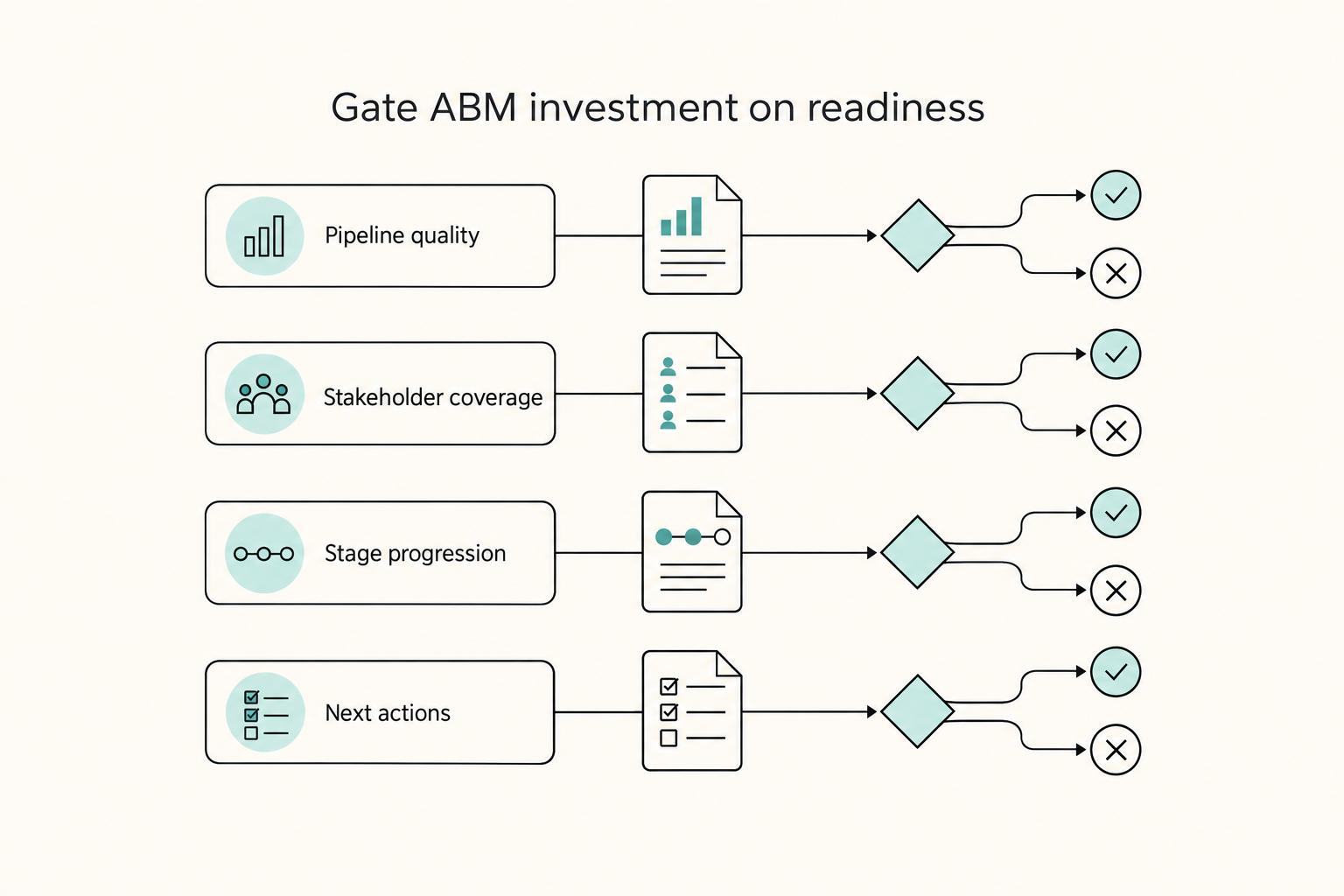
Before you move budget between motions, verify these in your CRM and pipeline review:
| Checkpoint | What to verify |
|---|---|
| Account-level pipeline quality | Review pipeline quality at the account level, not just lead count |
| Stakeholder coverage | Check stakeholder coverage on priority opportunities |
| Stage progression | Review stage progression across recent review cycles |
| Documented next actions | Confirm documented next actions for each priority account |
If two or more are weak, fix execution before you add spend. Review a sample of active opportunities and confirm who owns the next move, which stakeholder roles are missing, and whether the account is actually advancing.
If you cannot run both motions well, make the smaller bet: run one narrow ABM segment for accounts that clearly require multi-person selling, and keep demand generation focused on the same ICP until progression improves.
We covered this in detail in How to Create a Referral Program for Your SaaS Product.
Build an ICP and target account list you can defend#
When ABM leads, list quality protects your time. If activity outranks fit, you spend cycles on accounts that look busy but are unlikely to become strong customers.
Keep the sequence fixed: ICP -> scoring -> tiering -> disqualification -> account brief. That order keeps decisions defensible and answers one practical question: which accounts should you pursue now, and why?
Define your ICP with signals two teammates would score the same way#
Make each ICP rule observable so two people can reach the same conclusion from the same evidence.
| ICP criterion | Observable signal | Evidence to collect |
|---|---|---|
| Industry and business model | The company operates in the industries and commercial model your product already serves well | Website, product pages, pricing page, CRM closed-won notes |
| Company size | Employee count sits in your working range (for example, if your team sells best to mid-market, keep that range explicit) | LinkedIn company profile, data provider record, CRM account data |
| Revenue or growth shape | The business has scale and growth signals that support adoption and rollout | Funding news, annual reports if public, press releases, account notes |
| Technology stack | Current tools and technical environment make adoption realistic | Technographic data, job posts, implementation notes |
| Operating maturity | There are signs the company can buy, adopt, and expand a B2B software product | Team pages, open roles, case-study match, sales discovery notes |
Before you roll out the full list, test these criteria on a small sample. If two teammates cannot score the same account the same way with evidence, tighten the rule text.
Score first, then tier for attention#
Score with signals you can defend: account fit and intent. Fit reflects ICP alignment (firmographic and technographic). Intent reflects whether the account appears in-market, including first-party engagement such as visits, downloads, or form fills.
Use a clear tie-break rule so high activity does not override weak fit.
| If this is true | Then do this |
|---|---|
| Fit differs meaningfully | Prioritize stronger ICP fit first |
| Fit is similar | Use intent to rank |
| Fit and intent are both close | Use your internal access check as final tie-break (for example, whether you have a credible route to the right stakeholders) |
Then tier by attention level, not by labels: pursue now, monitor and warm, and park. The goal is a prioritized list sales can actually use.
Apply disqualification rules before outreach#
Set stop rules before prospecting starts and enforce them consistently.
- Stop if the account misses a core ICP condition (industry, size, or technology environment).
- Stop if the account sits outside your current working range.
- Stop if the only positive signal is activity and fit is weak.
- Stop if you cannot identify a plausible trigger or problem context for outreach.
- Stop if account data is too thin for a credible first message.
- Stop if the account score falls below your internal launch threshold; verify that threshold against current CRM records, source records, and approved operating targets before using it.
Require a minimum-ready account brief before personalization#
Do not launch personalized outreach until each priority account has a short brief with all four items:
- Trigger context you can reference.
- Buying-group hypothesis.
- Risk notes or likely objections.
- First message angle tied to the trigger.
If the brief is incomplete, move the account back to research. This protects you from name-swap "personalization" that does not hold up in real buying conversations.
You might also find this useful: How to Build a 'Glocal' Marketing Strategy for Your SaaS Product.
Map the buying committee and tailor messaging by role#
Before you send outreach, map who can approve, block, and influence the decision in that account. If you skip this, your team can run polished activity while the real decision-makers stay uncovered.
Use three roles as your starting hypothesis: economic buyer, technical evaluator, and end-user champion. Treat that as a draft, not a fixed template. In some accounts, a security lead, finance partner, procurement contact, or department head may carry more weight, so validate roles account by account.
Build a stakeholder map you can act on#
Keep one working table in the account brief that both sales and marketing use. Its job is to surface coverage gaps early, not to be exhaustive.
| Role | Current contact coverage | Key pain | Required proof | Objection risk | Next action owner |
|---|---|---|---|---|---|
| Economic buyer | Named contact, weak relationship, or no contact | Business impact, cost, speed, risk reduction | Commercial case, outcome story, rollout effort | Budget pressure, competing priorities | Sales |
| Technical evaluator | Active contact or inferred role only | Integration effort, security, reliability, admin burden | Technical docs, implementation detail, product answers | Stack mismatch, hidden complexity | Sales engineer or founder |
| End-user champion | Team lead, manager, or power user | Daily friction, manual work, adoption pain | Product fit, workflow example, ease of use | Change resistance, low urgency | Marketing plus sales |
Use one quick readiness check: can you name at least one person, or a credible route, for each critical role? If not, pause and fix coverage before you add more touches.
Keep one account story, then vary the proof by role#
Work from one shared account narrative so sales and marketing stay aligned: what changed, what problem it creates, and why this account should care now. Then tailor the value narrative by role in substance, not just wording.
For the economic buyer, lead with commercial logic. For the technical evaluator, lead with implementation and risk detail. For the end-user champion, lead with day-to-day workflow improvement. If your sequences read the same with only title swaps, rewrite them.
Disconnected follow-up is a common failure mode: sales pursues activity without context from earlier engagement, and progress slows.
Match channel and depth to the person#
Match message format and depth to how each role consumes information. Economic buyers usually need a short, commercially clear message. Evaluators usually need deeper technical detail they can review independently. Champions usually need practical examples tied to current workflow.
Use your weekly ABM standup as a reset point before launch. Compare role sequences side by side. If they sound interchangeable, revise them before they go live.
This pairs well with our guide on How to Create a Sales Playbook for Your SaaS Team.
Run a 90 day ABM execution cadence with minimal tooling#
Use this 90-day plan as your operating rhythm for named accounts, not as a fixed industry formula. Keep demand generation running in parallel, and run this cadence in one shared CRM with one shared account brief format so sales and marketing make the same decisions from the same evidence.
Use this structure to keep ABM focused on account quality, team alignment, and measurable progress across the buying group.
| Phase | Goal | Owner | Required artifacts | Continue vs reset |
|---|---|---|---|---|
| Days 1-30 | Lock enforceable operating definitions before outreach volume grows | Sales lead + marketing lead | Target-account list, account brief template, owner field, status definitions, evidence-note template | Continue when accounts are classified consistently against [your qualification criteria] and every active account has a named owner + dated next action. Reset when teammates classify the same account differently or handoffs break at [your handoff checkpoints]. |
| Days 31-60 | Improve buying-group progression and message quality | Account owner (with marketing support) | Weekly account review notes, role-specific message variants, proof library, blocker log | Continue when coverage improves across key roles and message quality improves against [your progression criteria]. Reset when activity rises but role coverage stays thin, objections repeat, or next steps stay vague. |
| Days 61-90 | Escalate real opportunities and remove stalled work | Deal owner (with sales lead oversight) | Net-new escalation plan, expansion hypothesis template, next-action tracker, deprioritized-account log | Continue when each priority account has a credible path to a commercial or technical next step under [your intent criteria]. Reset or deprioritize when status does not change across [your review window] and no stronger intent evidence appears. |
Days 1-30#
Use the first month to define terms you can enforce, not just discuss. Decide what qualifies an account for this batch, what disqualifies it, who owns first outreach, who owns follow-up, and what "blocked" means in plain language.
Then pressure-test those definitions. Have two teammates classify the same small set of accounts, assign ownership, and name the next step. If their decisions diverge, tighten the rules before you scale outreach.
Set an evidence standard from day one. In each account brief, capture: who engaged, what problem they confirmed, what proof they requested, what objection appeared, and the dated next action. Without that baseline, you cannot tell real progression from polite activity.
Days 31-60#
Your weekly review should answer one question first: is the buying group advancing? Channel totals can support the review, but they should not lead it.
Use a short weekly checklist per account:
- Did you add or strengthen coverage for key decision roles?
- Which role-specific message got the clearest response, and why?
- Which proof asset moved the conversation, and with which role?
- What objection repeated, and who owns the response update?
- Is there a dated, accepted next action, or only tentative interest?
If the same objection appears across multiple accounts, update your proof and message framing before you add more touches. If one engaged contact is active but you still lack a route to decision authority, treat the account as constrained until coverage improves.
For proof-format ideas you can adapt to role-based outreach, use A Guide to Content Marketing for B2B SaaS.
Days 61-90#
Split final-phase decisions into two lanes so execution stays clear.
For net-new accounts, escalate only when you can name a credible path to the buying committee and a concrete next step (for example, technical review, commercial discussion, or decision-maker introduction). For existing accounts, run expansion as a separate motion with its own hypothesis: which team or use case expands, who owns budget, and what existing value proof transfers.
Close each account review with three fields completed: next action, owner, deadline. If any field is missing, the account is not advancing and should not consume priority capacity.
Set deprioritization rules before the review cycle ends. If an account remains in the same status through your defined window, with no new stakeholder coverage and no stronger intent evidence, move it out of the active batch, log the reason, and reopen only when account conditions change.
This cadence works best when it sits inside a broader planning routine, so align it with your operating plan in How to Create a Marketing Plan for Your Freelance Business.
Measure progress with leading and lagging ABM metrics#
Review each target account in order: engagement first, progression second, revenue last. That sequence keeps you from mistaking channel activity for account progress or judging revenue too early.
Keep measurement account-first even when Google Ads, LinkedIn Ads, and outbound are in the mix. Channel reports help with tuning, but your operating question is whether each named account is adding stakeholder coverage, accepting a dated next step, and moving toward pipeline or Net New ARR.
| Signal layer | What to review at account level | Owner | Data source | Cadence | Continue | Adjust | De-prioritize |
|---|---|---|---|---|---|---|---|
| Leading signals | Stakeholder engagement quality, role coverage, proof requests, accepted meetings | Account owner + marketing | CRM account brief + campaign data (if used) | Weekly | Coverage expands and responses become role-specific | Activity rises but stays shallow or single-contact | Surface activity continues without broader buying-group movement |
| Progression signals | Status movement, blocker removal, dated next action, movement to technical or commercial step | Sales lead or deal owner | CRM notes + shared status fields | Weekly + review windows | Next step is named, owned, and accepted | Objections repeat or status stalls | Same status across the review window with no stronger intent |
| Lagging outcomes | Pipeline created, Net New ARR, CPA-to-ARR attribution, 90-day payback metric (if paid acquisition is involved) | Revenue owner + finance/ops | HubSpot or Salesforce; include GCLID-CRM integration where relevant | Monthly + end of 90-day cycle | Progression converts to attributable revenue | Spend is visible but attribution is weak | Motion remains costly and unproven after a full cycle |
Review cohorts before channels#
Decide your cohorts first, then keep them stable for the cycle. A practical setup is to split by target tier, segment, and expansion vs net-new so each review compares like with like.
For each cohort review, capture the same minimum evidence: account count, named owner, current status, roles reached, strongest objection, proof requested, dated next step, and expansion vs net-new classification. If paid search is included, also confirm spend can be traced to ARR in CRM; without that link, CPA-to-ARR is not reliable.
Keep one scorecard through the full cycle#
Keep one scorecard from setup through initial results instead of rewriting it midstream. If setup takes 4 to 6 weeks and results are expected within 90 days, consistency is what makes diagnosis possible.
When progression stays flat, diagnose in this order:
- List quality: tighten inclusion and disqualification rules.
- Message fit: if objections repeat and proof requests stay weak, revise role-based messaging and assets (see A Guide to Content Marketing for B2B SaaS).
- Follow-up execution: if interest appears but no accepted next step is logged, reassign ownership and enforce dated next actions in CRM.
Spot-check five active accounts and confirm CRM status, stakeholder notes, and next action all match the account brief. If they do not, fix operating discipline before you trust the metrics. For planning support, use How to Create a Marketing Plan for Your Freelance Business.
Catch the ABM mistakes that create expensive surprises#
Most expensive ABM problems are execution problems, not strategy problems. You can usually spot them early: your list expands while personalization weakens, activity climbs without account movement, or alignment meetings end without owned follow-through.
| Failure pattern | Early warning signal (how you spot it) | Likely root cause | Immediate fix owner | Prevention control (what you change next) |
|---|---|---|---|---|
| Weak ICP and bloated target list | Fit notes are thin, disqualification reasons are missing, and outreach sounds generic across accounts | Account selection drift and a list that outgrew your team's ability to personalize | Marketing lead with sales lead | Freeze new additions until inclusion and disqualification criteria are clear. Activate only accounts with a named owner, fit notes, and role-based messaging. |
| Activity without progression | Clicks, views, or replies rise, but stakeholder coverage, proof requests, accepted meetings, and dated next steps do not | Optimization shifted to visibility metrics instead of account progression | Channel owner with account owner | Run weekly account-first reviews before increasing spend. If visibility rises across review windows and progression stays flat, pause channel expansion and fix targeting or message fit first. |
| Alignment without follow-through | Meetings sound aligned, but the CRM has no owner, next action, or checkpoint date | Decisions are discussed but not closed into accountable execution | Meeting lead or deal owner | End every review with a named owner, a dated next action, and a follow-up checkpoint logged in the CRM or account brief. |
Use this quick diagnostic before you expand channels:
- Ask: "Did this account actually progress, or did we only gain visibility?"
- If it is visibility only, hold expansion and fix execution first.
- If progression is still flat after you verify CRM status, stakeholder notes, and next actions, apply a reset trigger only after it has been confirmed from current CRM records, stakeholder notes, and approved operating targets.
For list quality control, spot-check active accounts and confirm the fit rationale is specific enough that a teammate could reach the same conclusion. For messaging blockers, use A Guide to Content Marketing for B2B SaaS.
Conclusion#
If you treat ABM as a campaign label, you can create motion without much account movement. Treat it as a working discipline instead: sales and marketing aligned on specific accounts, role-specific messaging, and account-level measurement that tells you whether the right companies are actually progressing.
The practical next step is usually smaller than most teams expect. Do not start by making more content, buying more software, or widening your list. Start by choosing a short account set you can genuinely research, validate, and follow through on.
Do these four things next#
Shortlist accounts first. Pick the companies that match your Ideal Customer Profile closely enough that two people on your team would give similar reasons for including them. If you cannot write a clear fit note for each logo, the issue may be account selection before outreach quality.
Validate your fit logic next. For every account on the list, keep a short evidence pack in your CRM or shared sheet. Record why the company fits, what problem you believe is active, what disqualifies it, and who owns the next action. This is your first checkpoint. If those notes are thin, inconsistent, or missing, pause before launch.
Define the role map after that. You do not need a perfect org chart, but you do need a working view of the buying group. Name the likely evaluator, economic buyer, day-to-day user, and possible champion. Then pressure-test your message: does each role get a different reason to care, or are you sending one generic value statement with job titles swapped in?
Launch messaging last. Keep the first version narrow and specific. A personalized message should reflect the account context and the role context. If your note to a finance lead and your note to an operations lead look nearly the same, personalization is not doing its job yet.
What to check after launch#
The sequence is a useful baseline: identify target accounts, create personalized experiences, and measure performance. That order matters because teams often skip from account selection straight to activity. When that happens, they can mistake output for traction. Keep your review habit simple and documented. On a steady cadence, check:
- Are the target accounts still defensible against your ICP?
- Are you reaching the right roles, not just the most responsive ones?
- Did any account move to a clearer next step, such as a meeting, proof request, technical review, or dated follow-up?
One useful failure test is simple: activity is rising, but account progression is flat. That can mean one of three things is off: your list is too broad, your role map is incomplete, or your messaging is too generic to earn internal discussion. Shrink scope before you add spend.
Keep the tradeoff in view#
This approach can ask for extra time, resources, and money compared with broader outreach, so the main risk is overcommitting before you have the discipline to support it. A lean team can get into trouble by selecting too many accounts, chasing engagement from the wrong contacts, or failing to document why an account remains active. Those are not small admin issues. They are early warning signs that the work may be becoming harder to manage than the expected deal value can justify.
So leave this article with one decision, not five. Pick a small list of accounts. Confirm the fit logic in writing. Map the likely buying roles. Send the first round of role-specific messages. Then review account movement, not channel noise, and tighten the list if the evidence is weak.
If you need the broader top-of-funnel work that supports this motion, A Guide to Content Marketing for B2B SaaS is the relevant next read. If you want help applying this to your setup, Talk to Gruv.
Frequently Asked Questions
What is ABM for B2B SaaS in one sentence?
You choose a defined set of high-value accounts and treat each one like a market of one, with outreach shaped to that account instead of broad lead volume. If your message would look basically the same across every logo, you are not really running ABM.
How do you choose between ABM and demand generation when your team is small?
Choose the primary motion by how buyers move. Let demand generation cover the wider market, then let ABM lead where you can name the accounts, align sales and marketing, and support account-level personalization.
How many accounts should your first target list include?
Start with a focused list your team can personalize consistently. If account research or execution quality gets thin, narrow the list before you scale it.
What should happen first when you launch ABM?
First, identify the right accounts to target. Next, align sales and marketing on owners and plans for those accounts. Then run personalized outreach and measure success as you go.
Which metrics matter first if you need early signal before revenue closes?
Start with signals tied to target-account engagement and progression, and with signs that sales-marketing alignment is improving. Use those early signals directionally, then connect them to pipeline and revenue over time.
Can you run ABM without enterprise tooling?
Yes, if you can keep account notes, owner status, and progression visible. ABM is a strategy, not a software product, so your tools should support execution, alignment, and measurement.
What are the fastest warning signs that ABM needs a reset?
Reset when activity rises but target-account progress does not, personalization gets thinner, or team ownership and plans are unclear. Before you add spend or expand the list, recheck account selection, team alignment, and how success is being measured.
Try a related tool
Researched and edited by the Gruv editorial team. Gruv builds cross-border billing, payouts, and finance-operations software for global businesses.
Sources
Includes 7 external sources outside the trusted-domain allowlist.
- hammer.purdue.edu/ndownloader/files/26629859trusted
- abmagency.com/account-based-marketing-saasexternal
- abmagency.com/what-is-account-based-marketing-2external
- arisegtm.com/blog/lead-vs-account-based-marketing-saasexternal
- blog.hubspot.com/website/abm-website-personalization-rulesexternal
- cameldigital.co/blog/account-based-marketing-saasexternal
- demandbase.com/blog/account-scoringexternal
- directiveconsulting.com/blog/important-kpis-in-abm-leading-and-laggi...external
Educational content only. Not legal, tax, or financial advice.
Related Posts

LinkedIn for Freelancers Who Want a Predictable Client Pipeline
Treat LinkedIn as two jobs you run at the same time: a credibility check and a conversation engine. If you only chase attention, you can get noise. If you only send messages, prospects may click through to a thin profile and hesitate.

Build a Freelance Marketing Plan You Can Run Every Week
A usable **freelance marketing plan** starts with one business result, not a pile of activity. If a task cannot be tied to pipeline movement, client acquisition, or revenue, cut it before it takes up calendar space.
Content Marketing for B2B SaaS That Holds Up Under Real Work
If your publishing is inconsistent, nobody clearly owns decisions, and each post dies after one channel, you do not have an ideas problem. You have an operating problem. For a solo operator or lean team, your content gets more reliable when you document a few non-negotiable rules and review points.