
Quick Answer
A/B testing helps UX designers make defensible client decisions by comparing a control and a variant against a named business metric before rollout. It shifts the discussion from design preference to observed behavior, reduces the risk of costly wrong calls, and creates a clear decision trail with screenshots, metrics, caveats, and a final ship, iterate, or stop recommendation.
How A/B Testing De-Risks UX Decisions Before Rollout#
A/B testing helps you de-risk UX decisions by comparing a control and a variant against a named business metric before rollout. Your job is not to win an argument about design taste. Your job is to reduce the chance of an expensive wrong decision.
That is the real value of A/B testing in UX work. It moves the conversation from preference to evidence before your client commits budget, engineering time, or political capital. Lead with that framing and you stop sounding like someone asking for one more experiment. You sound like someone protecting the business from guesswork.
Lead with the decision chain#
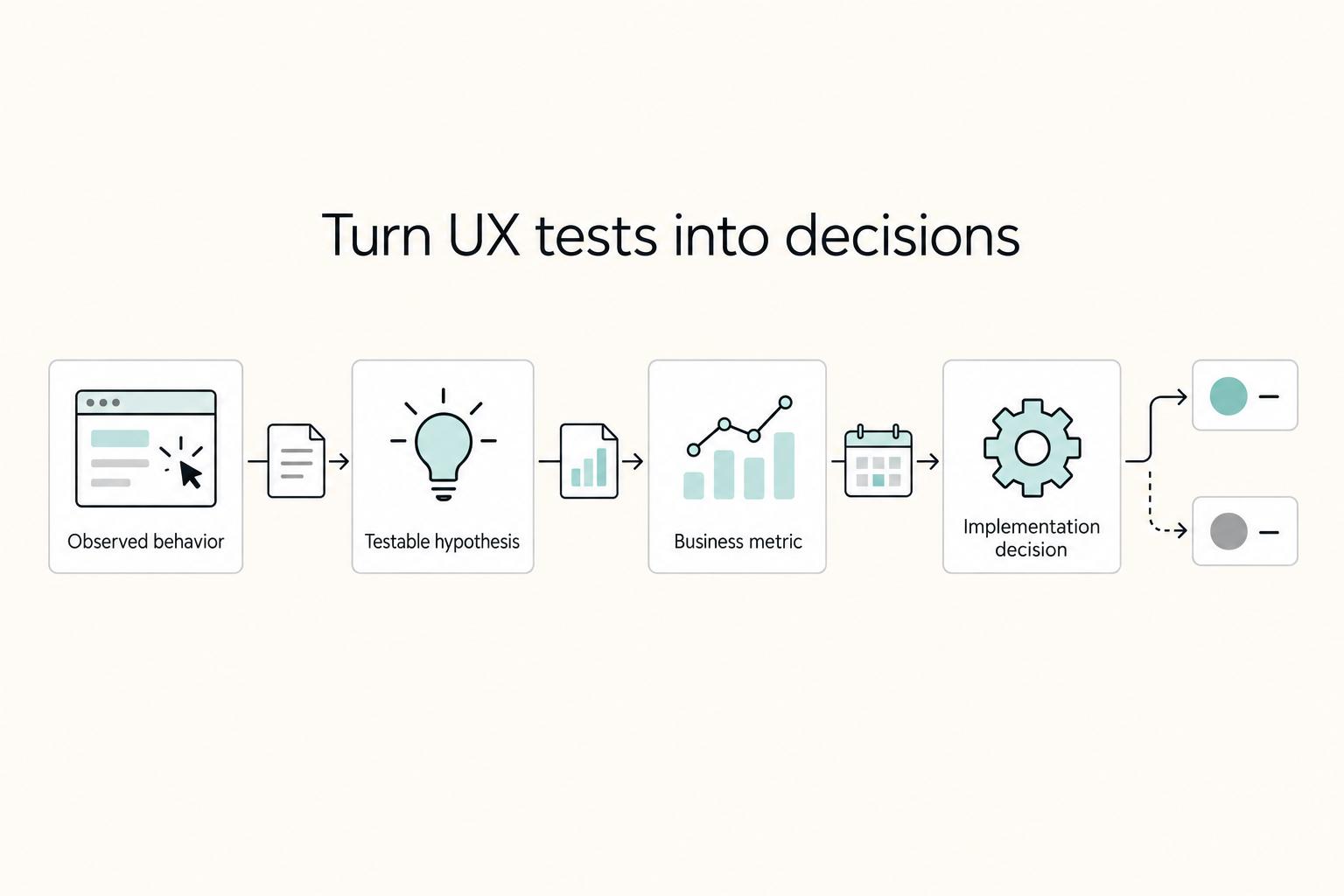
In client conversations, keep the sequence simple: observed behavior, testable hypothesis, business metric, implementation decision. For example: "We are seeing drop-off on the pricing page after users reach the plan comparison block. Our hypothesis is that simplifying the plan labels and call to action will increase completed signups. We will measure signup completion rate as the primary metric. If the variant outperforms the current page, we ship that change. If it does not, we avoid a larger rollout and revisit the diagnosis."
| Step | What to state | Example |
|---|---|---|
| Observed behavior | What users are doing on the page or flow | Drop-off on the pricing page after users reach the plan comparison block |
| Testable hypothesis | What change you believe will help | Simplifying the plan labels and call to action will increase completed signups |
| Business metric | What outcome will judge the test | Signup completion rate as the primary metric |
| Implementation decision | What happens after results | Ship the change if the variant outperforms the current page; otherwise avoid a larger rollout and revisit the diagnosis |
That structure keeps you out of vague promises. You are not saying, "this redesign will work." You are saying, "this is what we observed. This is what we believe. This is how we will check. This is the next decision." If you need a business case, state that the impact estimate must be verified from product analytics or experiment records before anyone uses it in a client recommendation.
Before launch, do the boring checks that prevent bad decisions later. Verify that the primary metric fires correctly on both versions, confirm the audience segment, and make sure the variant matches the approved mockup. A weak test result can come from bad instrumentation or mixed changes, not only from a bad idea.
| Approach | Risk | Stakeholder alignment | Budget confidence | Accountability |
|---|---|---|---|---|
| Opinion-led recommendation | Higher chance of shipping a costly assumption | Debates tend to center on seniority or taste | Harder to justify dev and design effort | Blame is diffuse when results disappoint |
| Evidence-led recommendation | Lower exposure before full rollout | Team can discuss the same observed behavior and metric | Stronger basis for phased investment | Decision trail is clearer and easier to defend |
Handle pushback without getting defensive#
You will hear some version of "we already know what users want" or "our competitor does this." Do not answer with more opinion. One practical pattern is:
- Acknowledge the concern.
- Restate the business goal.
- Point to the test design.
- Define the next decision point.
That sounds like this: "I get why you want to move fast. The goal is still more completed signups, not just a cleaner page. We can test this change against the current version and compare actual behavior. Then we decide whether to roll it out, revise it, or stop."
Name one red flag early. Avoid random big bang rollouts copied from competitors or generic best-practice lists. If several elements change at once, you may get a result without learning which decision caused it. Keep an evidence pack for every test with the observed issue, hypothesis, screenshots of both variants, primary metric, segment, and final decision. That record is how you quantify your value later, especially when a losing test saves the client from a larger mistake.
That same discipline matters even more when you are the only person holding the process together. Related: A Freelancer's Guide to A/B Testing Your Website and Emails.
The 'Team of One' Framework: A Lean A/B Testing Process#
You can run credible A/B tests solo if you keep a tight four-step loop: observe, prioritize, scope, decide. In lean product work, this is enough to test specific UI component choices without turning every question into a long research cycle.
| Loop step | Core action | Key check |
|---|---|---|
| Observe | Start with analytics and add qualitative context from session behavior review | Write one testable hypothesis grounded in what users did and what they seemed to experience |
| Prioritize | Use PIE as a sorting tool | Break ties with business impact first and implementation effort second |
| Scope | Lock a minimum viable test before any build starts | Isolate one variable, define the exposure channel, set stop conditions, and document implementation constraints |
| Decide | Read results like an operator | Check the primary metric, guardrail metric, confidence rule, and sample-ratio mismatch before choosing ship, iterate, or stop |
1. Start with evidence, then write one testable hypothesis. Begin with what you can verify now: behavior signals from your analytics, then qualitative context from session behavior review. Use both, so your test idea is grounded in what users did and what they seemed to experience.
Use the same one-sentence structure every time: state the observed behavior and page or flow, name the single element and audience, define the primary metric, and name the guardrail metric. Use primary and guardrail baselines only once product analytics or experiment records verify them. Keep exactly one primary metric and one guardrail metric.
2. Prioritize with PIE, then break ties the same way every time. If you already use PIE, keep it as a sorting tool, not as objective truth. After scoring, use one explicit tie-break rule: business impact first, implementation effort second.
| Idea | Business impact | Implementation effort | Run now or park | Why |
|---|---|---|---|---|
| Simplify checkout form fields | High | Medium | Run now | Directly tied to completion in a high-value step |
| Rewrite pricing page CTA copy | Medium to high | Low | Run now | Small build with clear decision value |
| Tweak blog card hover styling | Low | Low | Park | Easy, but weak link to core metric |
This also answers the common pressure question: "Why this test now?"
3. Scope a minimum viable test before any build starts. Before launch, lock scope with a short checklist:
- isolate one variable
- define the exposure channel
- set stop conditions
- document implementation constraints
Then keep threshold values unresolved until the right owner verifies the confidence rule, planned traffic split, minimum runtime, and any early-stop business rule from product analytics, experiment records, or the experimentation platform. Also confirm both variants fire the same primary and guardrail events correctly before traffic goes live.
4. Read results like an operator, then make one decision. Evaluate in order: primary metric, guardrail metric, confidence check against your pre-agreed rule, then a sample-ratio mismatch sanity check (does real traffic allocation materially match intended split?). If allocation looks off, investigate targeting or instrumentation before recommending rollout.
After checks, choose one path:
shipif the primary improves, guardrail remains acceptable, and setup checks are cleaniterateif the signal is promising but scope/audience/constraints limited claritystopif results are flat, contradictory, or contaminated by setup issues
Keep your stack tool-agnostic so the process stays current: analytics (baselines/outcomes), session behavior tools (diagnosis), experimentation platform (variant delivery), and reporting (decision record). Once this loop is reliable, the next step is packaging it as a client-ready service with clear scope and success criteria. You might also find this useful: How to Find a Doctor or Dentist Abroad.
How to Sell, Scope, and Manage A/B Testing as a High-Value Service#
Position this as a Discovery & Validation Sprint when the client has one clear business question and one change to test against a control. If they want a full redesign or answers to every UX concern, reset scope first. A/B testing works best as a way to polish a defined solution through observed behavior, not to rescue an unclear strategy.
Your credibility comes from agreeing decision rules before launch. Lock these scope boundaries up front: business question, single testable change, primary success metric, guardrail metrics, decision owner, and handoff plan. Keep assumptions and tradeoffs visible, and confirm your measurement setup is consistent across control and variant before traffic is split. Unplanned testing with fuzzy metrics can create worse decisions than not testing.
Mini-brief template#
| Field | Include |
|---|---|
| Business question | Decision this test will inform |
| Testable change | Describe one change only |
| Primary success metric | Confirm the current primary metric baseline from product analytics |
| Guardrail metrics | No more than two; confirm each guardrail baseline from product analytics |
| Assumptions and tradeoffs | Document known constraints, audience limits, and what this test will not answer |
| Decision owner | Name the person who will choose ship, iterate, or stop |
| Handoff plan | State what happens after results, including implementation or follow-up research |
| Projected impact | Projected impact pending product analytics and source-record verification |
| Package | Fit | Commitment | Reporting cadence | Risk profile |
|---|---|---|---|---|
| Single sprint | One high-stakes decision with narrow scope | Short, fixed engagement | End-of-sprint readout | Lower delivery risk, narrower learning |
| Ongoing experimentation retainer | Continuous optimization tied to strategy | Ongoing engagement | Recurring review cycle | Stronger continuity, higher coordination risk |
Pre-agree what happens for each result so the team does not treat only a win as useful.
| Result | Action | Why it still reduces risk |
|---|---|---|
| Win | Ship or expand the variant if the primary metric improves and guardrails stay acceptable | You scale a change supported by observed behavior |
| Neutral | Iterate scope, segment, or message if the signal is flat but setup is clean | You avoid overconfident rollout from weak evidence |
| Loss | Stop rollout and document what underperformed | You prevent broader impact from a weaker variant, including potential loyalty harm |
When you report back, focus on the decision made, the assumptions tested, and the documented tradeoffs. That is how you show this is an operational service, not a one-off tactic. If you want a deeper dive, read Thailand's Long-Term Resident (LTR) Visa for Professionals.
The Art of the Reveal: Presenting Results to Prove Undeniable ROI#
Run your readout like a decision memo, not a metric dump. Ask for one decision, show evidence quality, translate likely business impact, and assign the next owner.
Open with an executive summary that restores context fast:
- Business question: the decision this test supports
- What changed: variant compared with control
- Current status: where the test ended
- Decision requested today: ship, iterate, or hold
If this test ran across multiple check-ins, add a short context recap: intent, decisions/breadcrumbs, and status. Progress-only updates are not enough for decision meetings because they do not restore the what/why context.
Use a decision-ready script#
Use a short readout script: name the variant and control, restate the business question, ask for one decision, describe the evidence quality and reason, translate the projected business impact once verified, and name the next owner and date.
Show the control and variant visuals early. Side-by-side images usually remove ambiguity faster than extra slides.
| Reporting style | Clarity | Stakeholder confidence | Implementation speed | Risk of misinterpretation |
|---|---|---|---|---|
| Metric-only reporting | Low: numbers appear without a clear decision ask | Lower: people must infer what the results mean | Slower: unresolved questions carry into follow-up | Higher |
| Decision-ready reporting | High: ask, evidence, and next step are explicit | Higher: reasoning is visible and systematic | Faster: ownership and action are pre-assigned | Lower |
Translate impact without overstating certainty#
Use projected ROI framing, but make assumptions explicit:
Baseline metric: verify the current baseline from product analytics. Incremental change: use the observed variant-versus-control change from experiment records. Conversion value proxy: verify the revenue, lead value, or other proxy before estimating impact. Confidence statement: describe the strength of the evidence against the agreed rule and observed data. Assumptions: unresolved assumptions stay pending source-record verification.
Keep attribution language disciplined: classic A/B logic is strongest when the UI variant is isolated and other factors are steady. If the experience is AI-driven, state uncertainty plainly; probabilistic outputs can add variance, so even high traffic may not produce a stable winner.
Decision matrix: what happens next#
| Outcome | When to choose it | Next move |
|---|---|---|
| Ship | Result is favorable and evidence is decision-ready | Assign rollout owner and implementation date |
| Iterate | Signal is useful but mixed or unclear | Run one narrower follow-up experiment |
| Hold | Result underperforms or evidence is too unstable | Pause rollout and document caveats |
Include this checklist in every report:
- control and variant visuals
- test setup summary + decision requested
- caveats and evidence-quality notes
- owner for rollout or follow-up experiment
For a step-by-step walkthrough, see A Guide to Font Licensing for Freelance Designers.
Conclusion: From Consultant to Indispensable Partner#
What changes your role is not the test alone. It is your ability to turn a design opinion into a decision with a clear objective, a controlled comparison, and a documented recommendation the client can act on. That is a stronger position than saying, "I prefer this version," and hoping the room agrees.
A good A/B test compares a control and a variant by splitting traffic into two groups, then judging the outcome against predefined metrics such as conversions, click-through rate, time on page, or bounce rate. The discipline matters as much as the idea. Define objectives before launch. Change one variable at a time when you need cleaner interpretation. Review the evidence by analyzing and interpreting results instead of reading too much into a noisy outcome. If preparation is weak, inconclusive results are a normal failure mode, not a surprise.
| Working style | What you actually do | Likely decision outcome |
|---|---|---|
| Opinion-led consultant | Recommends changes from experience alone | Decisions rely more on intuition than observed behavior |
| Evidence-led partner | Prioritizes one decision to de-risk, tests a control against a variant, and ties results to a named metric | Decisions are easier to justify with observed results |
| Evidence-led partner with good documentation | Saves screenshots, metric definitions, caveats, and the final recommendation | Clearer readouts and easier follow-up decisions |
Your value goes up when you can say, "We tested this change, here is what moved, here is what did not, and here is the business implication." That does not guarantee a win on every experiment. It does give you a stronger basis for shipping controlled iterations instead of making full redesign bets.
If you want a simple next step, do this:
- define one decision you need to de-risk
- pick one realistic test candidate with a clear control and variant
- align on predefined success metrics before launch
- pre-commit the readout format: screenshots, metric definitions, caveats, and recommendation
Related reading: A Guide to Webflow for Freelance Designers.
Frequently Asked Questions
How do you create a strong A/B test hypothesis?
Start with an observed behavior, then link one design change to one business metric. Keep the hypothesis narrow enough that you can tell what changed and whether it mattered. Before launch, define the problem behavior, exact variant, primary metric, and at least one guardrail, then save the original hypothesis next to the final screenshots.
How should you choose a testing tool?
Choose by fit, not reputation. Compare implementation method, analytics depth, governance needs, and reporting workflow. If you cannot dry-run traffic assignment, verify event tracking, and export a clean result summary with visuals and caveats, the setup risk is likely higher.
When should you use A/B testing versus qualitative research?
Use A/B testing when you need to compare variations with a live audience and have enough traffic for a usable result. Use qualitative research when you need to understand why people struggle or traffic is too thin for a reliable test. Often the stronger sequence is qualitative work first to shape the hypothesis, then a live experiment to validate it at scale.
What should you do if traffic is low?
Do not force a test just because experimentation sounds rigorous. If traffic is low, narrow the question, wait for a higher-volume moment, or use qualitative research to reduce uncertainty first. State plainly in the readout if low traffic limited the decision.
How long should you run a test, and what confidence level should you use?
Set the stopping rule before launch, then stick to it. Minimum runtime guidance and the confidence standard must be verified from product analytics, experiment records, or the experimentation platform before use, because rules that fit one product or audience may not fit another. Document any contamination that weakens attribution, especially if pricing, messaging, or traffic sources changed during the run.
What has to be in the final readout so the decision is usable?
Include enough evidence that someone who missed the meeting can still understand what changed, what happened, and what you recommend next. Show the control and variant visuals, a short setup summary with the decision requested, metric definitions, caveats, and evidence-quality notes. End with the final recommendation, named owner, and next date.
Try a related tool
Researched and edited by the Gruv editorial team. Gruv builds cross-border billing, payouts, and finance-operations software for global businesses.
Sources
Includes 5 external sources outside the trusted-domain allowlist.
- puc.pa.gov/pcdocs/1494146.pdftrusted
- weblink.auburnwa.gov/External/DocView.aspxtrusted
- ixdf.org/literature/topics/a-b-testingexternal
- nngroup.com/articles/ab-testingexternal
- piwik.pro/blog/best-a-b-testing-tools-google-optimize-...external
- toptal.com/designers/ux/roi-of-ux-convince-executivesexternal
- toptal.com/designers/ux/ab-testing-uxexternal
Educational content only. Not legal, tax, or financial advice.
Related Posts

Thailand's Long-Term Resident (LTR) Visa for Professionals
For a long stay in Thailand, the biggest avoidable risk is doing the right steps in the wrong order. Pick the LTR track first, build the evidence pack that matches it second, and verify live official checkpoints right before every submission or payment. That extra day of discipline usually saves far more time than it costs.
A Freelancer's Guide to A/B Testing Your Website and Emails
**A/B testing can help only when your process is explicit.** If **a/b testing for freelancers** is going to help your business, it needs boring rules. The useful version is not "test more ideas." It is knowing when to launch, when to pause, and when to close a test so you can make one clean decision.

How to Find a Doctor or Dentist Abroad
**To find a doctor abroad under pressure, run a simple system with clear decision gates, clean documentation, and backup paths.** You are not hunting random listings. You are running a repeatable process you can use for routine care, travel disruptions, and true emergencies.