
Quick Answer
Start by running 409a valuation startups as a controlled cycle: submit a reconciled cap table, founder brief, and financing records; pick a provider through a written rubric; and confirm Section 409A safe-harbor positioning with counsel. Use the final report to set common-stock FMV and strike price for grants, then maintain a trigger log so material changes prompt re-review before more options are issued.
For many founders, a 409A valuation feels like a compliance chore: hand it off, get through it, and move on. It gets treated like a bureaucratic hurdle, and the result is a number people accept without really understanding. That is a mistake.
A 409A valuation is more than an annual task. It is where your company story gets translated into a number that has to hold up. If you handle it deliberately, it becomes a tool for control, not just a report for the file. This playbook is here to help you run that cycle well, so you are not passively receiving a valuation. You are directing it and using it to support grants, board decisions, and hiring.
Phase 1: The Preparation Sprint - De-Risk Your Valuation Before It Begins#
Before you engage a valuation firm, focus on three prep moves: build a traceable kickoff pack, draft a founder brief, and reconcile your cap table. That keeps the appraiser focused on valuation judgment and support, not avoidable data cleanup.
Build a kickoff pack the appraiser can actually use#
A weak kickoff pack leads to delays, follow-up questions, and avoidable judgment calls. Set a simple quality bar for every file: current, internally consistent, reconciled across systems, and traceable to a signed document or source report.
| Core kickoff inputs | Quality standard | Optional but useful |
|---|---|---|
| Current and historical financial statements (income statement, balance sheet, cash flow) | Numbers match internal reporting and tie to figures used in your deck and projections | Supporting schedules if the provider requests deeper detail |
| Current cap table | Every class, grant, issuance, and conversion is reflected and traceable | A short internal ownership summary |
| Recent financing documents (if applicable) | Signed term sheets and stock purchase documents align with cap table terms | One-page financing terms summary |
| Founder brief: business model, pitch deck, and 12-24 month projections | Assumptions are consistent across memo, deck, and financial model | Names of private comparable companies (recommend at least 3), with short fit notes |
The goal is not to overwhelm the appraiser with files. It is to give them a support set they can trust and use without guesswork.
Write the founder brief before the first call#
Do not wait for the kickoff meeting to explain the company. Write the memo first, while your facts are organized and before the provider starts forming views from incomplete context.
Keep it tight and concrete. Cover your business model, what changed in the last 12 months (for example: milestones, customer growth, product progress, fundraising, and key hires), your forward projections, and why your comparables fit your stage and profile. That gives the appraiser usable context on assets, cash flows, and market comparability instead of a generic narrative.
A good brief also creates a reference point for the rest of the process. If your deck, forecast, and memo do not match, fix that before the first call.
Reconcile the cap table before submission#
Cap table errors can quickly undermine a valuation. Before you submit anything, run a pre-submission check on common failure points. Review draft or unissued shares, warrants, convertible instruments, rights and preferences, and any grant or conversion that does not tie cleanly to supporting records.
Confirm that the corporate actions needed to create each grant are complete before treating any grant as final, since grant date cannot be earlier than the corporate action that creates the binding right. Then close the loop with internal sign-off from finance and equity administration before kickoff.
If records do not reconcile, stop and fix them first. Safe harbor is a presumption of reasonableness, not automatic immunity if the valuation method or its application is grossly unreasonable.
Phase 2: Choosing Your Guardian - Vet for a Partner, Not a Vendor#
Once your records are clean, the next risk is provider selection. A polished sales process does not tell you how a report will hold up under follow-up. Do not choose on brand, referral, or fee alone. Use a structured review and ask for evidence behind the claims.
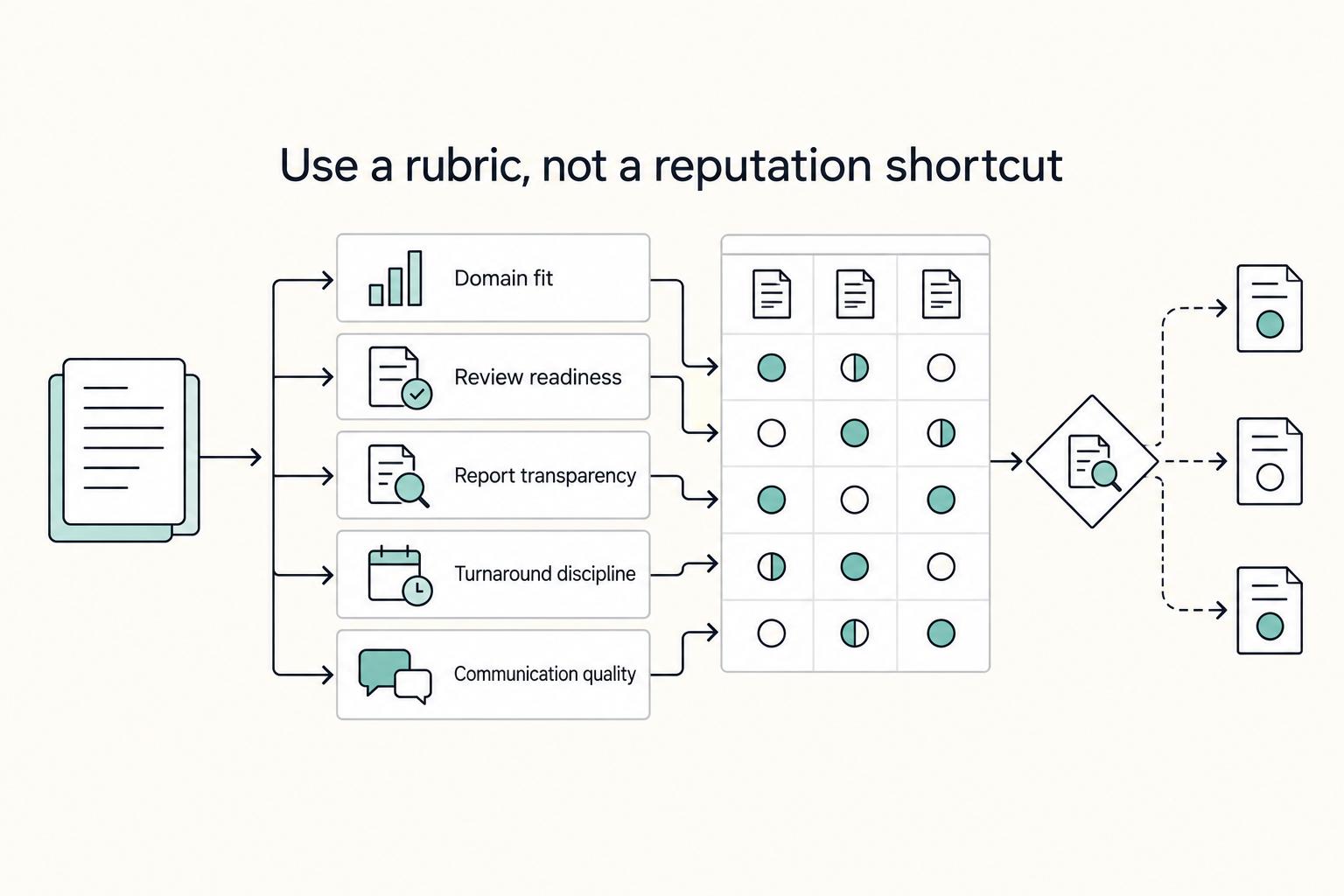
Use a rubric, not a reputation shortcut#
A side-by-side process usually works better than relying only on referrals or reputation. Send one intake packet to every finalist, ask the same questions, and score the responses the same way. That keeps the decision tied to execution quality instead of sales polish.
| Check | What to verify |
|---|---|
| Domain fit | Can they restate your cap table and financing context accurately from your documents, without you correcting basics? |
| Review readiness | Can they explain, in writing, who handles follow-up questions and what support records they keep? |
| Report transparency | Can they show a redacted sample where assumptions are tied to dated source documents? |
| Turnaround discipline | Can they commit to explicit milestones and explain what changes if facts shift mid-process? |
| Communication quality | Can the actual analyst explain tradeoffs clearly, or only the salesperson? |
Score each provider on those five checks. If two options score about the same, choose the one that gives clearer, evidence-backed answers early.
Compare engagement structure, not just provider branding#
The engagement structure matters because it affects accountability, communication, and conflict pressure. Compare the setup, not just the logo on the proposal.
| Point | What to confirm in writing |
|---|---|
| Conflict disclosure | Both parties are informed about potential conflicts. |
| Written consent | Where legally appropriate, both parties provide informed written consent. |
| Independent review | Prefer independent counsel so each side has separate legal review. |
| Conflict escalation | Clarify what happens if a conflict appears mid-process, including whether counsel may need to withdraw from one or both parties. |
When any shared-advisor or dual-representation-style setup is proposed, confirm each of those points in writing. Counterparties can have opposing goals on price, terms, value, and liability. Where interests can diverge, treat conflict controls as a required process step, not fine print.
Treat safe harbor as a verification checklist#
Do not let "safe harbor" stay a vague sales label. This article does not establish specific Section 409A legal criteria, so require the provider to state their position in writing and have counsel confirm what applies.
Use this checkpoint list before sign-off:
- Applicable legal criteria:
[Counsel-confirmed criteria here] - Conflict controls:
[Conflict disclosure + written consent records here] - Documentation set: Dated source files and version logs confirming what inputs were used
- Record retention: Storage location and access ownership for all 409A records
If any shared-advisor element exists, require written conflict disclosure. Where legally appropriate, include informed written consent, and still prefer independent counsel for separate review.
For record integrity, archive the original source files used for key assumptions. If a filing is part of the support set, keep the version with visible cover metadata. For example, preserve filing date fields such as "February 23, 2026" and identifiers such as "333-293204," so the audit trail can be reconstructed later.
Match method choice to data you can defend#
You do not need to choose the final valuation method yourself, but you do need a defensible support chain. This article is not a method-selection matrix, so require the provider and counsel to explain why their approach fits your facts and documents.
Before final sign-off, ask one direct question: which assumptions changed the result most, and which source file supports each one? If no one can answer that clearly, pause approval until the support chain is explicit.
You might also find this useful: How to Perform a Business Valuation for a Small Agency.
As you shortlist valuation partners, align your payment operations to the same control standard. That way, approvals, payout status, and audit records can stay in one workflow with Gruv Payouts.
Phase 3: The Strategic Rollout - Turn Your 409A into a Hiring Weapon#
Once the report is done, the job shifts from valuation to use. That means controlled communication to the board, disciplined explanations to candidates, and renewal decisions tied to real triggers instead of habit.
Send the board a decision brief, not the raw report alone#
Do not send the raw report with no framing and expect the board to infer the operating decision. First send a one-page brief that answers four questions:
- What changed since the last valuation?
- How do those changes affect your grant strategy?
- What are the dilution implications for the next hiring window?
- What approvals or follow-ups do you need from the board and counsel?
Keep the change summary dated and linked to sources. If forecast assumptions, financing context, or the comparable set changed, say that directly and tie each point to the supporting documents. Valuation conclusions are sensitive to detail, so the board should be able to trace each one back to evidence.
Then state the operating decision. For example: continue routine grants, tighten grant sizes for later-stage hires, or reserve larger grants for critical roles. You do not need unsupported dilution math, but you should show the path from option pool status to hiring plan to likely pressure points.
Close with explicit asks and owners. Board mechanics vary, so confirm required approvals with counsel and your corporate secretary, then list the actions and deadlines.
If filings or registration materials are part of your support chain, archive the exact versions with visible metadata. For example: "Amendment No. 3," "Registration No. 333-292284," and "As filed with the Securities and Exchange Commission on February 27, 2026."
Explain equity to candidates without implying a promised outcome#
Candidate communication is where otherwise careful teams get sloppy. Use one consistent talk track that separates plan terms from uncertain outcomes, and confirm exact wording with counsel:
"Your grant terms, including strike price and vesting, are defined in the plan documents. Our current valuation informs grant-setting, but it is not cash you receive today. Liquidity is separate, and we cannot promise timing or outcome."
If a candidate asks what the equity could be worth, use scenario framing, not prediction framing:
| Future outcome after grant | Responsible explanation |
|---|---|
| Value remains below strike price | The option may have no economic gain at that point. |
| Value rises modestly above strike price | There may be potential spread, but outcome depends on plan terms and a real path to liquidity. |
| Value rises materially above strike price | Upside can be meaningful, but realization still depends on future liquidity and individual exercise decisions. |
If you also use phantom equity, explain it separately. It can provide financial upside without diluting actual equity, but it is a contractual cash compensation promise, not ownership. Poor structuring can trigger immediate taxation plus a 20% penalty.
Train hiring managers on approved language. Do not let them improvise value math on recruiting calls.
Run renewals on triggers, not memory#
The common failure mode here is simple: teams keep using a report because no one stopped to ask whether the facts changed. For startup equity grants, run a trigger log tied to valuation use. Do not rely on "we revisit this annually." Record the exact next checkpoint only after verifying it against the valuation report, counsel or adviser records, board records, or official source records.
| Checkpoint | Action |
|---|---|
| At approval | Log report date, version, documents reviewed, and the next checkpoint once verified from the valuation report, counsel or adviser records, board records, or official source records. |
| On material change | If financing, forecast, transaction context, or other value-relevant facts shift, pause and confirm with counsel and your valuation provider before new grants. |
| Before each grant cycle | Confirm no unlogged changes affect the cap table, company narrative, or support set. |
| On re-review | Archive the exact documentation used so the record shows what management knew at that time. |
If facts move, pause, verify, document, then resume. That is what keeps the valuation usable instead of stale.
For a step-by-step walkthrough, see A Guide to 'Comparables Analysis' for Business Valuation.
Conclusion: Close Each Cycle With Records, a Report Trail, and a Clear Message#
You own the outcome of each 409A cycle. A provider can produce the report, but you still own the provider-selection decision and whether the company has the structure, documentation, and qualified independent appraisal needed before options are issued.
Close each cycle with three deliverables: a complete record set, a defensible report trail, and a clear internal message. Keep the final report and the supporting documents the provider reviewed in one dated file path so someone outside the process can follow it. The test is not whether the number feels right. It is whether you can show what was reviewed, what common-stock fair market value was set, and how that value set the strike price for grants during the valuation's validity period.
Keep internal communication precise. A 409A valuation sets common-stock FMV for option pricing, not your investor headline valuation. If anyone on the hiring, recruiting, or leadership team mixes those up, correct it before the next grant cycle. That confusion can lead to an incorrectly set strike price, which can create serious tax consequences for your team. The same discipline applies if you are pre-revenue: you still need a defensible FMV before issuing options.
| Area | Passive compliance approach | Owner-led approach |
|---|---|---|
| Risk control | Treats the report as a box checked | Confirms structure, documentation, and qualified independent appraisal before grants |
| Hiring clarity | Discusses option upside without clarifying pricing basis | Explains that the report sets common-stock FMV and strike price, not investor valuation |
| Audit defensibility | Saves the PDF but not the support trail | Stores report, reviewed inputs, approvals, and decision notes together |
Right after each valuation cycle, do this:
- Save the final report and full documentation set in one accessible, dated folder.
- Record the valuation date, documents reviewed, and who approved using the result for grants.
- Send recruiting, finance, payroll, and legal a short note on the strike price and what the report does and does not cover.
- Log the next review point and update internal notes only after you verify current refresh-trigger guidance.
Related: How to Structure an Employee Stock Option Plan (ESOP) for a US Startup.
If you are ready to pair your valuation process with a cleaner global money workflow, review implementation options and coverage notes in the Gruv docs.
Frequently Asked Questions
What are the biggest risks of a bad 409A valuation?
If Section 409A applies and the arrangement fails, deferred compensation can be pulled into current income, with an additional federal tax of 20 percent and interest at the underpayment rate plus 1 percentage point. This can also affect payroll reporting and employee tax treatment, including whether Form W-2 Code Z needs review. Pause new grants, pull the report and approval records, and ask counsel and payroll to confirm the right treatment before you proceed.
How should you prepare for a valuation?
Start with a clean, dated record set. A reasonable valuation method should be tied to actual company facts, including tangible and intangible assets and other value drivers. Weak records lead to weak support. Send one package with your cap table, current forecast, financing documents, board approvals, prior report, and a short memo explaining material changes.
What does 409A safe harbor actually mean?
For you, safe harbor is the rebuttable presumption that your stock valuation is reasonable. That matters because the IRS would need to show the valuation was grossly unreasonable, instead of forcing you to rebuild the defense from zero. Ask your provider to state in writing which current presumption route they are using and which assumptions or missing documents could weaken it.
Does an independent appraiser help more than a non-independent advisor?
Treat this as a standards question, not a title question. Focus on whether the valuation fits a current safe-harbor path and is supported by a documented reasonable method. Provider title alone does not replace method quality or documentation. | Valuation setup | What it means for you | Next check | |---|---|---| | Report prepared to fit a current safe-harbor path | Clearer presumption position if requirements are met | Confirm route used, report date, documents reviewed, and defense support | | Advisor opinion not mapped to current safe-harbor requirements | May still inform decisions, but protection is less clear | Have counsel confirm whether it supports grant pricing | | Internal estimate or board shorthand | Useful for planning, weak for grant-setting | Do not use it alone to set strike price | Before using any result for grants, have counsel test the proposal and final report against current Section 409A rules.
How much does a 409A valuation cost?
Cost depends on scope and provider. Compare proposals line by line and confirm which documents are reviewed, what the deliverable includes, and whether the work is intended to support Section 409A grant pricing.
When do you need to refresh it?
Do not keep issuing grants from an older report just because no one revisited it. Material company changes can affect fair market value. Keep a trigger log and confirm current timing requirements with counsel before each grant cycle.
Can your law firm do the valuation?
Possibly, but legal involvement alone does not establish that a valuation meets a current safe-harbor path. Ask for written confirmation of valuation role, methodology, and whether the deliverable is intended to support Section 409A grant pricing.
Try a related tool
Researched and edited by the Gruv editorial team. Gruv builds cross-border billing, payouts, and finance-operations software for global businesses.
Sources
Includes 1 external source outside the trusted-domain allowlist.
- ecfr.gov/current/title-26/chapter-I/subchapter-A/part...trusted
- ecfr.gov/current/title-26/chapter-I/subchapter-A/part...trusted
- irs.gov/instructions/iw2w3trusted
- irs.gov/irb/2007-19_IRBtrusted
- law.cornell.edu/uscode/text/26/409Atrusted
- law.cornell.edu/cfr/text/26/1.409A-1trusted
- sec.gov/Archives/edgar/data/2062583/0001628280260128...trusted
- rsmus.com/insights/services/business-tax/stock-options...external
Educational content only. Not legal, tax, or financial advice.
Related Posts

Sole Proprietorship vs LLC for Global Freelancers in 2026
For most freelancers in 2026, the practical default is still simple: use the simplest structure you can run cleanly, then formalize when risk actually rises. If your work is still in validation mode and the downside is contained, a sole proprietorship is often the practical starting point. When contract exposure, delivery stakes, or dispute risk starts climbing, forming an LLC deserves earlier attention.
How to Structure an Employee Stock Option Plan (ESOP) for a US Startup
If you searched for **employee stock option plan esop**, stop and sort out the label first. In startup conversations, people often say "ESOP" when they mean a stock option plan or option pool. A formal **Employee Stock Ownership Plan (ESOP)** is different. It is often discussed as a business transition option for owners, while startup stock options are commonly used to give employees a stake in the business.
How to Perform a Business Valuation for a Small Agency
**Treat valuation for a small agency as a risk control system, not a headline multiple, and you are more likely to protect agency value before you ever start selling a business.**