
Quick Answer
A strong revenue share agreement for a game should define revenue, deductions, recoupment, approval rights, reporting, audit access, IP ownership, and reversion before launch. This article recommends managing the deal in three phases, due diligence, negotiation, and post-launch compliance, so the studio can verify payments, control risk, and enforce the contract after release.
A game developer revenue sharing agreement is not a document you sign and forget. It is the financial blueprint for your studio's survival and the practical foundation of your most important business partnership.
Too many founders, caught up in the relief of getting signed, treat the contract like the last hurdle. That is a mistake. The strongest studio heads treat the publishing contract as the operating manual for the entire relationship.
A good agreement does more than set payment terms. It forces clarity before problems show up by defining who pays, who approves, who carries risk, and who benefits if the game breaks out. In plain terms, it decides who funds marketing, who absorbs the downside if the game misses, and who captures the upside if it hits.
Review that allocation before you commit. Define the economics and operating responsibilities well enough to test them after launch, then manage the agreement across three phases:
- Due Diligence: The work you do before you see a contract, when you vet the partner and build leverage.
- Negotiation: The stage where you shape the contract, clause by clause, to protect your position.
- Compliance: The post-launch work of monitoring, auditing, and enforcing the agreement so you are paid correctly and on time.
Keep the diligence record, negotiated terms and reporting controls connected so the studio can identify a missed obligation and respond.
Phase 1: Build leverage with evidence before the first redline#
Most of your leverage is built before the first redline. In this kind of agreement, the publisher usually comes in with more deal memory, more benchmark data, and more practice. Your job is to close that gap with evidence.
Use backchannel checks to test behavior, not branding#
Treat reference calls as a behavior audit under pressure, not a vibe check. The useful question is not whether people "liked" working with them. It is what happened when money, delays, or launch problems showed up. Use this checklist to keep the call concrete:
- Payment reliability: Were payments on time and in full once milestones were delivered?
- Reporting clarity: Were periodic royalty reports clear enough to understand and reconcile deductions?
- Delivery against promises: What evidence shows marketing, platform outreach, and launch support matched what was pitched?
- Escalation behavior: When problems hit, who owned resolution and how quickly did they respond?
If possible, ask for a scrubbed sample of real reporting. "They were transparent" is much weaker than seeing the reporting format yourself. Also keep one practical point in view. Without an audit clause, you may have no way to verify royalty calculations, and platform dashboards alone may not show deduction detail. If multiple former partners describe the same failure pattern, treat it as a negotiation signal, not background noise.
Screen for signals before talks advance#
You are not trying to predict everything. You are deciding whether this publisher can execute what it is promising.
| Area | Strong signal | Caution signal | Walk-away signal |
|---|---|---|---|
| Reputation | Former partners give consistent, specific feedback and would work together again | Mixed feedback with recurring process complaints | Repeated, specific reports of late payments, opaque reporting, or commitments not delivered |
| Marketing execution | Comparable titles show clear launch planning and documented campaign activity | Some wins, but weak pattern on similar titles | Vague "big push" claims with no comparable launch evidence |
| Distribution access | They explain concrete platform execution from past launches | They mention relationships but cannot tie them to execution details | Name-dropping without proof of delivery history |
| Operational transparency | They share draft terms early and answer diligence questions directly | Contract timing slips or key answers stay high level | They withhold the contract until late-stage discussions or resist basic diligence |
If contract disclosure comes late, treat it as a pressure and control risk, not a harmless process quirk.
Ask for evidence, not pitch language#
Do not advance on pitch language alone. Move forward only when claims are backed by comparable execution evidence. Ask for:
- Comparable launch examples: What they handled, not just what they "supported."
- Platform execution pattern: Store setup, timing, update cadence, featuring efforts, and post-launch support.
- Your readiness requirements: What they expect now on budget breakdown, console lotcheck timing, and cross-platform multiplayer support.
If they cannot answer in concrete terms, price that execution risk into your deal terms.
Read financial stability as a negotiation risk map#
You do not need perfect certainty here. You need enough current evidence to decide how cautious the contract should be, so use the diligence record as a risk map:
- Funding durability: If funding plans are vague, tighten milestone timing, approvals, and payment protections.
- Portfolio concentration: If revenue appears concentrated in a few franchises or customers, negotiate clearer commitments to your title.
- Dependency risk: If disclosures show heavy platform or customer concentration, tighten deductions and delivery obligations.
- Restructuring risk: If restructuring is active or recent, treat execution capacity as potentially shifting mid-deal and push for clearer obligations and approvals.
This is where diligence starts turning into leverage.
Build a pre-negotiation dossier#
Your diligence should leave you with more than a gut feeling. It should give you a dossier that ties your proof to the clauses you want changed.
| Dossier item | Clause areas it can support |
|---|---|
| Playable vertical slice or stable demo | Stronger milestone payment terms and fewer approval choke points |
| Community traction data | Stronger split and recoup discussions |
| Budget breakdown and production timeline | Tighter milestone definitions, acceptance criteria, and payment dates |
| Technical readiness notes (lotcheck and cross-platform plan) | Realistic delivery obligations |
| Core team bios and shipped-title history | Stronger creative-control and staffing terms |
When you hear "market standard," verify it. Use external benchmarks and peer checks as a reality test, not as automatic acceptance.
Related: How to Structure a 'Key Person' Clause in a Consulting Agreement.
Phase 2: The Negotiation Framework - Turning Key Clauses into Strategic Levers#
Leverage only matters if it makes it into the paper. In a game developer revenue sharing agreement, you want closed definitions, clear approval controls, and a true license rather than a transfer. You also want a recoupment path you can model line by line. Open language can push payout risk back onto you.
That matters because each side can hold private signals about demand. The draft should reduce room for interpretation after launch, not create more of it.
Define revenue so the math is auditable#
If a cost can come out before your share is calculated, it needs a full definition. "Net revenue" can sound precise while still giving the publisher broad room to deduct.
Define whether gross revenue means customer billings, storefront receipts or another agreed base. Then specify refunds, transaction taxes, storefront commissions and currency conversion in the formula. Every permitted deduction needs a source and a statement line, and amounts already excluded from the revenue base must not be deducted again.
| Deduction category | Negotiation posture | Why it changes payout risk |
|---|---|---|
| Explicitly defined deduction tied to a clear source and calculation | Acceptable if explicitly defined | You can reconcile it against reporting data |
| Publisher-controlled spend that could expand after signing | Acceptable only with approval | It can delay or reduce your payout if unchecked |
| Broad catch-all language (for example, undefined "related" or "general" costs) | Unacceptable catch-all language | You cannot forecast or verify true net revenue |
A simple test works well here. Ask the publisher to map each deduction to a sample statement line. If they cannot show where it appears, you are agreeing to a black box.
Turn budgets into an approval-control framework#
Do not rely on a broad promise that spending will be "reasonable." Split recoupment treatment in the draft itself into three buckets. Use capped spend, consent-required spend, and non-recoupable spend.
- Capped spend: recoupable only up to the category cap.
- Consent-required spend: define a category cap or approval threshold in the contract, and require written consent before excess amounts become recoupable.
- Non-recoupable spend: publisher operating costs that do not enter your recoupment waterfall.
A publisher may reasonably want room to spend more if the opportunity grows, and that can be good for the game. But broad spending discretion changes the economics. If they want that flexibility, your tradeoff is tighter caps, stronger approval rights, a better split, or some combination of the three.
Keep IP as a license, not a transfer#
Start from a license structure. Your studio keeps ownership, and the publisher gets limited rights for defined uses. That fits the model where the developer continues to own the app. Use this checklist in redlines:
| License element | What to define |
|---|---|
| License scope | Exactly what the publisher may do, for example distribute, market, localize, and port |
| Term | Start date, end date, and termination triggers |
| Territory | Where rights apply |
| Carve-outs | Sequels, DLC, merch, adaptations, soundtrack, and other reserved rights |
| Reversion hooks | What returns to you, when, and what use must stop |
One stop sign matters more than the rest: assignment-style language. If the draft says "assigns," "transfers," or "all right, title, and interest," pause the economics discussion and escalate legal review first. For a quick refresher, see Work for Hire vs. Assignment of Rights: A Freelancer's Guide to Owning Your IP.
Model recoupment before debating the split#
Do not start with headline percentages. First, build a worksheet and run the money in order:
- Confirm waterfall order.
- List every recoupable bucket.
- Check cross-collateralization treatment.
- Mark the exact payout start point.
In practice, payout timing can matter as much as the headline split. A strong top-line percentage can still underperform if too many recoupable costs sit ahead of you. The same is true if one product line is allowed to absorb another's costs.
A hypothetical publisher-first waterfall makes the choice visible. Assume $100,000 gross receipts, $30,000 permitted storefront charges and $10,000 refunds, leaving $60,000 net revenue. If the contract allocates all net revenue first to a $40,000 remaining publisher recoupment balance, $20,000 remains to split. At an assumed 70% developer/30% publisher split, the developer receives $14,000 and the publisher $6,000 in addition to its $40,000 recovery. The closing recoupment balance is zero. These are illustrative inputs, not standard fees or deal terms; a developer-share-only recoupment model would produce different cash timing.
Tie split asks to proof from Phase 1#
Do not anchor on rumor-based percentages. Anchor on risk you have already removed.
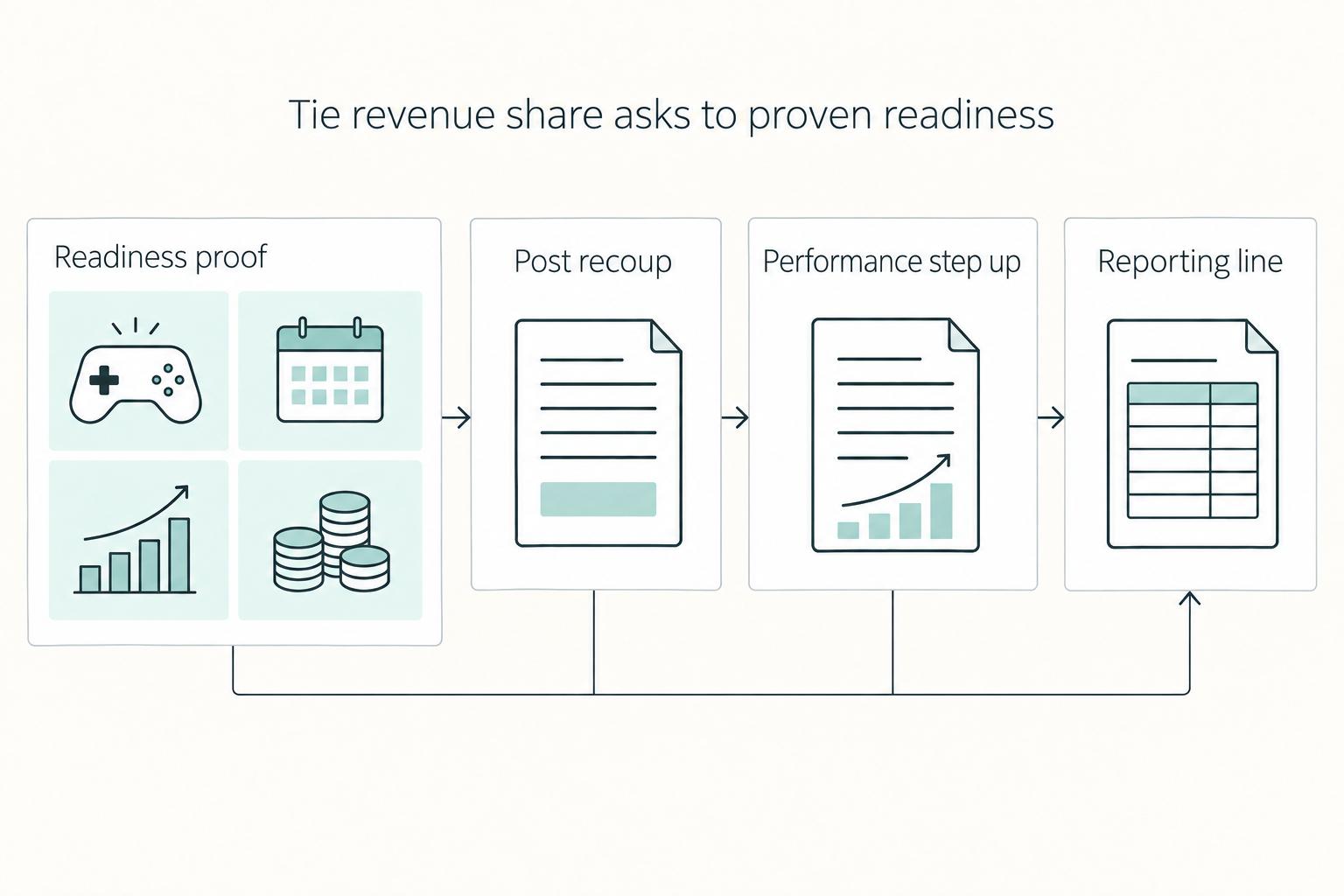
If your Phase 1 evidence shows stronger readiness, whether that is a stable demo, solid production discipline, community traction, or cost efficiency, tie it to specific asks:
- Better post-recoup economics.
- Step-ups tied to defined publisher performance.
- Stronger reporting transparency where the publisher keeps broader economics.
Translate your execution evidence into a commercial proposal. A stable build or credible audience can reduce the publisher's delivery or demand risk; explain that link and ask for a defined split, spending control or performance step-up. Evidence supports the negotiation, but does not establish a standard percentage.
Before you close economics, lock the reporting format. If each financial clause cannot be traced to a report line, you will not be able to verify the payout math later.
Keep a clean publishing-agreement draft, the redline and the worked financial example together for review with counsel. A generic freelance-services template may omit storefront, recoupment and game-rights provisions.
Phase 3: The Post-Launch Compliance Strategy - Enforcing Your Agreement#
Once the deal is signed, enforcement becomes the job. Treat every reporting cycle as a control point. If you cannot rebuild the path from gross revenue to cash received, the statement is incomplete and you should escalate in writing.
Check the statement, not just the payment#
Do not treat cash receipt as proof that the math is right. Reconcile gross revenue, permitted deductions, net revenue, the agreed recoupment waterfall, each party's allocation and remitted cash. Require the recoupment balance movement and any unpaid amounts to be visible, not just a summary total.
Watch for repeat operational red flags: new deduction labels, unexplained recoupment or offset changes, negative adjustments without source detail, or payment with no matching statement packet. If a red flag shows up more than once, move from informal questions to formal notice.
Make the audit clause usable#
An audit clause has to work in practice, not just look good in the draft. In game publishing, this is the clause that lets you verify royalty calculations, usually through an independent accountant reviewing the publisher's records. Use this checklist when drafting or invoking the clause:
| Audit clause item | What it should cover | Illustrative terms to negotiate, not legal defaults |
|---|---|---|
| Access scope | Records must cover the full computation of royalties and all other amounts due | Not just summaries |
| Documentation format | Require supporting schedules that tie deductions and royalty math to underlying records | Tie statement detail to records |
| Response window and mechanics | Define notice, access timing, and frequency limits | 30 days' notice, business-hours access, no more than one routine audit every 12 months |
| Record retention | Define how long books and records must be preserved | 5 years |
| True-up timing | Set a deadline to remit underpayments after audit results | Within 30 days |
| Cost-shift trigger | State the exact underpayment threshold that shifts audit costs to the publisher | For example, more than 5% of royalties due in the audited period; define the denominator, remedy and allocation of costs explicitly |
Build a cash-control workflow#
Tie reporting and payment together in the contract. Set a fixed cadence (for example, monthly or quarterly), a fixed remittance deadline tied to period-end, and a required statement packet. Then run the same workflow each cycle:
- Confirm statement receipt by the contractual due date.
- Reconcile gross to net and validate each adjustment line.
- Verify any recoupment or other offset movement and your share calculation, if applicable.
- Match remittance amount and date to the statement.
- Log variances immediately and issue written notice if unresolved.
Agree the late-payment remedy and check its enforceability under the governing law. Statutory interest is jurisdiction-specific: UK guidance, for example, distinguishes statutory B2B interest from a different agreed contractual rate. Do not assume a remedy from another jurisdiction applies to your royalty obligation.
Escalate disputes in layers and preserve evidence#
Do not let disputes drift into a pile of loose emails. Use a defined sequence:
- Informal resolution: send written notice that defines the issue, affected period, disputed amount, and requested cure.
- Structured mediation: define a start date and deadline, for example 60 days from the mediation request, rather than leaving alternatives in the signed clause.
- Formal adjudication: follow the agreed arbitration or court procedure. Preserve any permitted urgent-relief route and track limitation deadlines while pre-steps run.
At each stage, preserve statements, payment confirmations, notices, signed amendments and chronology. Ask counsel how settlement communications are protected in the relevant jurisdiction; labeling an email without prejudice does not by itself establish privilege everywhere. Keep the underlying transaction records separately.
Draft the exit before you need it#
Define when a license ends, which rights cease and what transition duties survive. If ownership was assigned rather than licensed, an agreed reassignment may be needed; contract remedies and mandatory legal rights can also affect the outcome. Write the termination and rights-return provisions with counsel before relying on them:
- Trigger events and any agreed cure process.
- Stop-use obligations and any agreed sell-off or existing-customer support period.
- Return or destruction of licensed materials, subject to agreed retention and surviving support duties.
- Final statement and payment of unpaid amounts.
- Written confirmation of any rights reversion required by the contract.
If the day-one post-termination steps are not explicit, treat that as a drafting gap and fix it before launch.
For a step-by-step walkthrough, see A Guide to Music Licensing for Video Projects.
Your Contract, Your Control#
Do not sign a draft that leaves ownership, money, or enforcement to implication. Control comes from terms you can verify before signing, negotiate line by line, and enforce after launch.
| Asset | Main risk | Clause category to prioritize |
|---|---|---|
| IP ownership | You transfer ownership when you only meant to grant use rights | Ownership language and license scope |
| Revenue integrity | Your payout can be reduced by vague deductions or bad platform assumptions | Revenue definition, deductions, recoupment, reporting |
| Operational independence | You can lose practical control through broad obligations or dispute pressure | Approval rights, developer obligations, dispute clause design |
Before signing, distinguish an IP assignment from a license. Under 17 U.S.C. 204, transfers of copyright ownership other than by operation of law require a signed writing from the owner or authorized agent. Transferring a physical copy or build does not by itself transfer copyright. Review the rights actually granted, including any exclusive license, rather than relying on the deal label.
During negotiation, test the payout math against applicable storefront terms and record their effective date. For games and apps using Epic's payment system, its current program offers 100% of the first $1 million of qualifying net revenue per title per year, then 88%/12%, with January 1 resets from 2026. Revenue combines supported platforms and offers for the title. The FAQ addresses recoupable obligations and separate program terms that can change the sequence. Apply those conditions rather than assuming a flat 12% fee.
Tailor the dispute clause to the deal: governing law, forum or arbitration seat, language and procedural steps. The ICC recommends avoiding ambiguous wording and considering mandatory requirements where arbitration and enforcement occur. For a cross-border award, assess the applicable New York Convention framework and enforcement grounds where the counterparty has assets; the treaty does not guarantee collection.
Action checklist
- Before signing: tag each clause as ownership, money, control, or dispute, and replace implied rights with explicit language.
- During negotiation: run one sample sale from gross to deductions to recoupment to payout timing. Leave jurisdiction-specific values unresolved until the contract, counsel, or source records verify them.
- After launch: keep the signed agreement, final redline, and worked revenue example together so you can verify performance against the contract quickly.
If you want your contract terms to map cleanly into real payment operations, explore Gruv for Freelancers for invoicing, payout flows, and audit-ready records where supported.
Frequently Asked Questions
What are the biggest red flags in a revenue share agreement?
The biggest red flags are broad discretion and missing definitions: vague deductions, no caps, and silence on affiliate charges or reporting detail. An undefined game scope is also a risk, because disputes can start when DLC, remasters, or sequels were never clearly addressed. Next check: confirm a clearly defined deductions list, cap and approval language, affiliate-service treatment, and explicit include and exclude language for DLC, remasters, and sequels.
How do you calculate net revenue in a game publishing deal?
The agreement must define the revenue base and permitted deductions. Calculate that amount first, then apply the agreed recoupment waterfall and split; recoupment is not automatically another deduction from net revenue. Run a sample period through the formula and use actual storefront statements and applicable terms, without deducting fees twice.
How can you negotiate a better split?
You improve your position by reducing uncertainty and narrowing deduction discretion, not by arguing headline percentages in isolation. Focus negotiation on clearly defined recoupable cost categories and each party's contribution. Next check: challenge every cost bucket, define recoupment categories in writing, and validate any market-range claims against current source records before using them.
Should you give up your IP?
Do not assume ownership outcomes from deal labels. The contract should clearly state ownership and license terms in plain language. If the language is mixed or implied, you are taking avoidable risk. Next check: review ownership and license clauses line by line, confirm the game definition, and verify where DLC, remasters, and sequels sit. For ownership mechanics, see Work for Hire vs. Assignment of Rights: A Freelancer's Guide to Owning Your IP.
What is recoupment, and why does it matter so much?
Recoupment is the contractually permitted recovery of advances or costs from a defined revenue pool. The contract can allocate all of that pool, only the developer's share or another agreed amount toward recovery, so specify the order and when payouts begin. Record the opening balance, new eligible costs, recoveries and closing balance each period.
What is a normal revenue split?
There is no single split that makes a publishing deal fair. Compare offers using the same revenue base, deductions, recoupment order, funding obligations and payout schedule. A larger developer percentage can still produce less cash if the publisher controls an expanding recoupment balance.
How should internal team rev share work?
Document internal team profit sharing directly with each participant and define it clearly. The agreement should spell out the profit pool, deduction logic, reporting cadence, and adjustment rules, especially because participants can receive payouts without shareholder governance rights. Next check: verify who contracts with whom, document the calculation method in writing, require regular reporting or dashboards, and set clear rules for percentage changes when scope or team membership changes.
Try a related tool
Researched and edited by the Gruv editorial team. Gruv builds cross-border billing, payouts, and finance-operations software for global businesses.
Sources
Includes 4 external sources outside the trusted-domain allowlist.
- law.cornell.edu/uscode/text/17/202trusted
- uncitral.un.org/en/texts/arbitration/conventions/foreign_arb...trusted
- uscode.house.gov/view.xhtmltrusted
- deviantlegal.com/guide/game-developers-guide-publishing-agree...external
- gov.uk/late-commercial-payments-interest-debt-recov...external
- iccwbo.org/dispute-resolution/dispute-resolution-servic...external
- store.epicgames.com/distribution/revenue-programs/revenue-shareexternal
Educational content only. Not legal, tax, or financial advice.
Related Posts

Work for Hire vs Assignment of Rights for Freelancers
A freelance agreement is not just about price and scope. It decides who controls the rights in the work. If the ownership language is loose, rights can move earlier than you expect, cutting down your control once the work is delivered or used.

The Freelance Payment Penalty: A Modeled Audit of Platform Fees, FX Spreads, and Payout Delays
The money rarely disappears through a single, easy-to-spot fee. The real loss is stacked. A marketplace takes its commission, a processor adds a charge for international cards, a bank or payment company converts the currency at a spread, a platform holds the funds before release, and a wire sheds a little to intermediaries on the way in. Each layer looks defensible on its own, but the worker feels the combined result as a smaller deposit and a later payday.

How to Respond to a Subpoena for Business Records
Move fast, but do not produce records on instinct. If you need to **respond to a subpoena for business records**, your immediate job is to control deadlines, preserve records, and make any later production defensible.