
Quick Answer
Treat skin in the game for freelancers as an underwriting decision, not a trust exercise. Start only when fixed cash covers your floor, performance pay is tied to controllable metrics, and payout math is verifiable from shared records. If the client pushes urgency, use a seven-calendar-day review window before signing. For equity components, track grant, vest, exercise, and sale as separate events so contract enforcement, cash timing, and tax planning stay manageable.
The Freelancer's Fallacy: Why "Skin in the Game" Isn't About Risk - It's About Investment#
If you accept a performance-heavy deal as "just taking risk," you are already framing it wrong. In this kind of freelance arrangement, your time is the capital, your cash flow is the exposure, and your first job is to decide whether the investment deserves either.
That shift matters because payment friction is common, not rare. The Federal Reserve's 2024 payments report says customer payments are the primary source of cash for small businesses, and roughly four of every five small firms face payments-related challenges. So when a client asks you to defer fees, take upside instead of cash, or wait for a future event, treat that as an underwriting decision, not a vote of confidence.
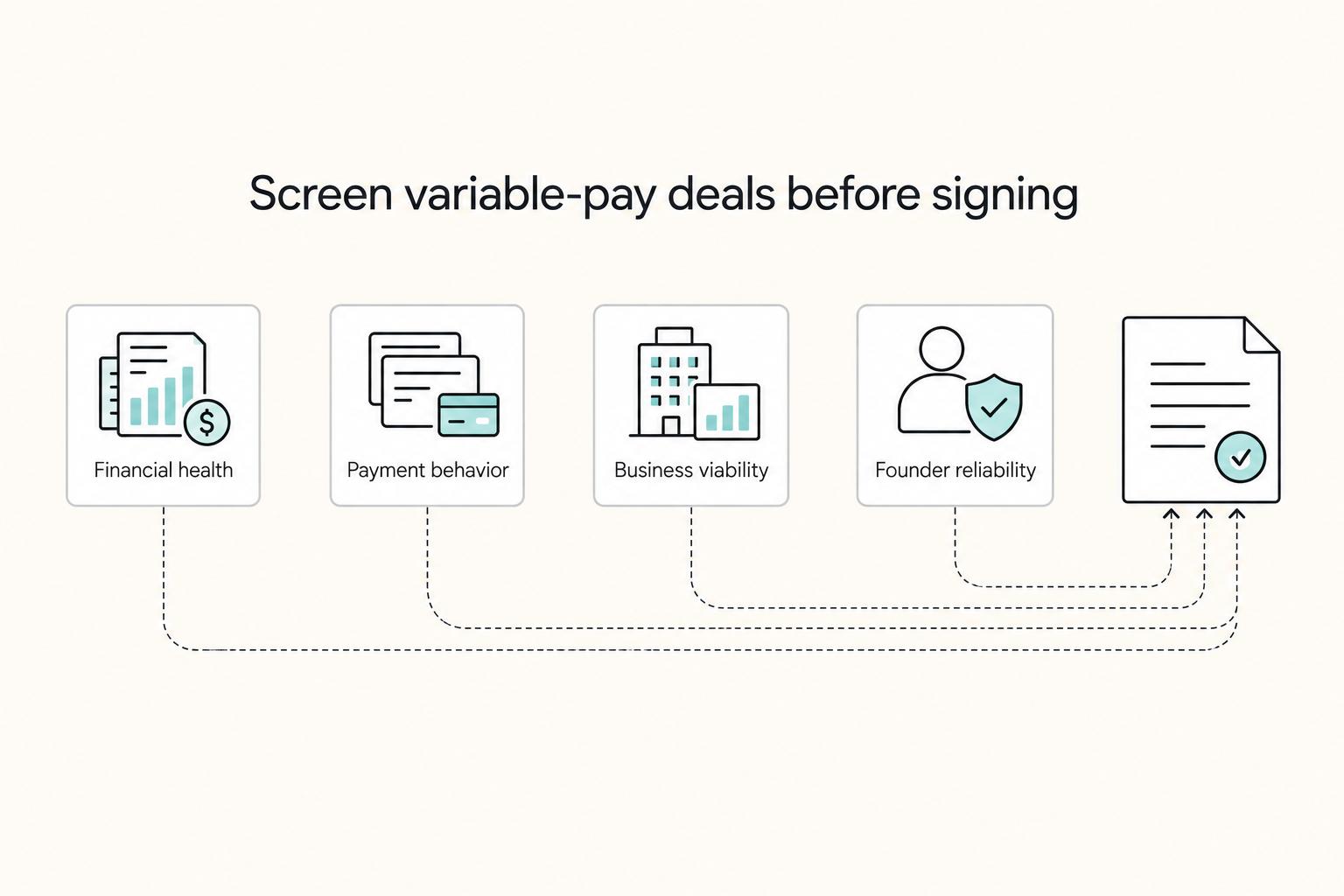
Start with a pre-commit screen#
Before you negotiate terms, find out whether the opportunity is real enough to justify variable pay. Research the business, verify who is making the offer, and ask for written support for any earnings claim. If the pitch is "you'll make it back many times over," ask what documents support that claim today, not after you start.
| Check | What to ask or verify | Why it matters |
|---|---|---|
| Financial health | How the business gets paid, who approves payments, and whether revenue depends heavily on one customer or one channel | 10 percent or more from a single customer is a recognized major-customer disclosure benchmark, and if one client leaving would break the company, your upside is fragile |
| Revenue concentration and payment behavior | Whether they have delayed paying other contractors and how variable incoming cash is month to month | Dodging basic payment questions is a warning sign for potential payment delays |
| Business model viability | What result they need, why that result matters economically, and what would still block growth if you succeed | Your upside can disappear even when you do good work if the business has a separate product, pricing, or retention problem |
| Founder reliability | Names, roles, prior companies, and whether the people selling the vision are the same people who control budget and decisions | Background checking is standard diligence |
Use that checklist before you commit, and pay attention to a few points in particular:
- Financial health: Ask how the business gets paid, who approves payments, and whether revenue depends heavily on one customer or one channel. In public reporting, "10 percent or more" from a single customer is a recognized major-customer disclosure benchmark. It is not a universal cutoff for your deal, but it is a useful prompt. If one client leaving would break the company, your upside is fragile.
- Revenue concentration and payment behavior: Ask whether they have delayed paying other contractors, and how variable their incoming cash is month to month. If they dodge basic payment questions, treat that as a warning sign for potential payment delays.
- Business model viability: Ask what result they need, why that result matters economically, and what would still block growth if you succeed. If your work can improve one metric but the business has a separate product, pricing, or retention problem, your upside can disappear even when you do good work.
- Founder reliability: Verify names, roles, prior companies, and whether the people selling the vision are the same people who control budget and decisions. Background checking is not paranoia here; it is standard diligence.
A useful operator rule is simple: do not sign a variable-comp deal on the same rushed call where it is pitched. FTC business-opportunity rules do not automatically govern freelance contracts, but their evidence-first posture is worth copying. Use at least seven calendar days as a review window before signing or paying; if they resist that pause, slow down or walk.
Tie compensation to results you can actually influence#
If the business passes the first screen, structure the upside so it rises or falls with work you can actually affect. Strong performance terms describe required results, not vague effort, and the incentive should match the standard being measured. If you are paid on company-wide revenue, fundraising, or "success," you are taking risk from parts of the business you do not control.
| Weak term | Freelancer-protective term | Why it matters |
|---|---|---|
| "2% of overall company revenue" | "Bonus amount and CRM/tool source pending contract and source-record verification for each qualified lead from the paid channel you manage" | Keeps payment tied to your work, not the whole company |
| "Equity or bonus if growth improves" | "Bonus or vesting tied to conversion-rate movement; verified baseline, target, page/funnel, and date range pending contract and source-record verification" | Uses measurable performance standards |
| "We'll calculate results internally" | "Client shares source data, dashboard access, or monthly exports used to calculate payout" | Lets you verify the number that triggers payment |
| "Paid when the business can afford it" | "Paid on the next invoice cycle after the metric is achieved, with formula written into the agreement" | Protects cash timing |
| "We can end the project anytime" | "If the client stops the project early, earned performance pay is still payable based on work completed and data to date" | Limits downside from cancellation |
Before you accept upside, ask for the evidence behind the story. Request recent financial statements if available, the current baseline for the metric you will own, historical channel or campaign reports, retention or conversion data, customer concentration notes, and references you can contact directly.
Read observable signals, not charisma#
The fastest read on integrity is behavior you can test. Proceed if they answer questions directly, share documents without drama, explain past failures with ownership, and separate what is known from what is hoped. Renegotiate if the business looks real but the terms stay fuzzy, the metric is not fully controllable, or the payout depends on data only they can see. Walk away if they push urgency, refuse written substantiation, hide who makes payment decisions, or make big earnings claims with nothing you can inspect.
| Action | Signals |
|---|---|
| Proceed | They answer questions directly, share documents without drama, explain past failures with ownership, and separate what is known from what is hoped |
| Renegotiate | The business looks real but the terms stay fuzzy, the metric is not fully controllable, or the payout depends on data only they can see |
| Walk away | They push urgency, refuse written substantiation, hide who makes payment decisions, or make big earnings claims with nothing you can inspect |
That is the real filter. It is not whether you are brave enough to share risk. It is whether the investment is structured so your work can actually get paid.
For related help on setting your floor, see How to Calculate Your Billable Rate as a Freelancer. If you want a quick next step, try the free invoice generator.
Phase 2: The Partner's Legal Architecture#
If you move forward, put every meaningful promise into the contract before work starts. Treat this phase as a way to control asymmetry: if your time and cash flow are on the line, results, payout logic, and ownership terms cannot stay verbal or vague. In Taleb's framing, the risk problem is often hidden in who carries the downside when terms are unclear.
Use this sequence: agree business terms in plain English, convert them into contract language, then start delivery. Do not treat projected upside as real income until the agreement defines how it is earned and proven.
You do not need to do this alone. Freelancers often outsource specialist responsibilities, and contract review for mixed cash/performance/equity deals belongs in that category.
Define the result, the formula, and the proof#
Make success measurable before signing. If payment depends on performance, confirm the baseline, system of record, access path, approver, and fallback process if tools or project scope change.
| Vague promise | Draft toward this definition | Proof to request before signing |
|---|---|---|
| "You'll get a bonus if growth improves" | "Bonus triggers only after baseline metric, current target metric, date range, and named source of record are verified from the contract and source records." | Baseline report, tool export/screenshot, and written confirmation of who approves the calculation |
| "We'll share revenue from accounts you help win" | "Revenue share applies only after customer set/channel, period, and gross-or-net revenue definition are verified from the contract and finance source records." | Sample revenue report, deduction definitions, and named finance owner |
| "You'll get equity if this works out" | "Equity grant amount/type, grant document, and service milestone or start date must be verified by legal and source records before use." | Draft grant paperwork, plan summary, and written conditions that could delay issuance |
| "We can settle the numbers later" | "Statement cadence and dispute review process must be verified from the contract, client records, and counsel-approved terms before use." | Example statement format, delivery method, and error-correction owner |
If you cannot verify the metric now, do not price it as guaranteed compensation.
Equity review items you should not skip#
If payment includes ownership, review each clause as a checklist, not as boilerplate.
| Clause | What it does | What failure it prevents | Ask counsel to request |
|---|---|---|---|
| Vesting or earning schedule | Defines when equity is earned or issued | Completing work without clear vesting or issuance rights | Explicit start date, earning schedule, issuance timing, and early-termination treatment |
| Change of control or exit treatment | Defines treatment if the company is sold or reorganized | Losing expected upside during a transaction because treatment was never written down | Explicit terms for sale, merger, or asset transfer |
| Payout priority and investor overhang | Clarifies where your payout sits relative to investor rights | Assuming exit value without understanding payout order | Written payout-order explanation and any terms that can reduce common-holder outcomes |
If any of these points is missing, you are being asked to price upside before the company has defined what you actually own.
Equity vs cashflow tradeoff#
| Dimension | Cash-heavy structure | Equity/performance-heavy structure |
|---|---|---|
| Payment timing | Tied to invoice/payment terms | Often delayed and event-dependent |
| Planning certainty | Usually easier to budget against | Usually harder to forecast |
| Control over outcome | More tied to defined deliverables and billing terms | More exposed to broader business decisions |
| Downside exposure | Primarily non-payment/late-payment risk | Delay, dilution, or no payout risk |
If this project must fund near-term expenses, prioritize cash and keep upside narrow and defined. If you can absorb delay, consider upside only after terms clearly define what you earn, when, and how it is verified.
Put the kill fee into execution terms#
A kill fee should describe execution, not intent.
- Trigger events: define activation events, such as client cancellation, pause beyond a legally reviewed day count, or failure to provide required approvals/data.
- Payment timing: state due timing only after payment window and jurisdiction-specific requirements are verified by contract and legal records.
- Scope handoff: define required handoff deliverables, work-product status until payment, and access transfer/revocation steps.
- Dispute path: define notice steps, document exchange, and a jurisdiction-specific dispute clause after counsel verification.
If a client asks for your accountability but resists reciprocal contractual accountability, pause, tighten terms, or keep the engagement on standard cash terms.
If you want a deeper dive, read GDPR for Freelancers: A Step-by-Step Compliance Checklist for EU Clients.
Phase 3: Financial Discipline for Equity, Revenue Share, and Tax#
A signed contract protects the terms, but your cash flow survives on execution. Treat any non-cash compensation as a potential tax event, and start tracking it the day the deal starts.
| Compensation form | Timing risk | Tax complexity | Record-keeping burden |
|---|---|---|---|
| Cash fee | Low. You invoice, get paid, and can reserve from cash received. | Lower. Verify income-tax and self-employment treatment for your facts. | Lower. Invoices, payment confirmations, expense records. |
| Revenue share | Medium to high. Payment depends on client reporting and payout timing. | Medium. Variable income can still require estimated-tax planning as income is earned. | Medium to high. Statements, formula backups, dispute trail, contract definitions. |
| Equity or options | High. Taxable events may happen at grant/transfer, exercise, or sale depending on award type and rules. | High. Current tax treatment must be verified from tax, legal, and source records before use. | High. Grant documents, valuation support, exercise records, basis tracking, sale confirmations. |
Track equity by event: grant, vest, exercise, sale#
Do not track equity as one headline; track each event separately.
At grant, save the award agreement, plan document, grant date, award type, and strike price (if any). If the option is not under an employee stock purchase plan or ISO plan, the IRS treats it as a nonstatutory stock option. If property is transferred and you are evaluating an 83(b) election, calendar the deadline immediately: 30 days after transfer. The current election workflow must be verified from tax, legal, and source records before use.
At vest (or other Section 83 trigger points), capture the valuation and the company record supporting it. Section 83 timing generally turns on transferability or lapse of substantial risk of forfeiture.
At exercise, store the exercise notice, payment proof, and fair market value support for that date. At sale, store trade confirmation, date, proceeds, and basis support. Keep Forms 3921/3922 with the same file when they apply. The operating reality is simple: you can owe tax before you have liquid cash.
Keep revenue-share language from drifting into partnership risk#
Use explicit classification language, then get it reviewed before you sign.
- State you are an independent contractor providing services for compensation.
- Deny partnership, joint-venture, and employer-employee status.
- State you have no authority to bind the client, incur debt, or sign on its behalf.
- Limit responsibility to your own services, deliverables, and contract obligations.
- Require review by a qualified business attorney and tax professional before signing.
If the draft introduces shared-loss terms, management rights, or co-owner language, pause and rework the clause set.
Run the same tax-operating cadence each payment cycle#
Repeat this every time cash, a revenue-share payout, or an equity event is recorded:
- Capture valuation or payout support from the source record for that event.
- Transfer a reserve from operating to a separate tax account in the same week.
- Segregate records by deal: contract terms, payout math, basis support, and tax forms.
- Prepare filings against the IRS four-period schedule: April 15, June 15, Sept. 15, and Jan. 15 (following year). Check current IRS and state/local calendars before relying on dates, because weekends, holidays, and local rules can move due dates.
If you expect to owe $1,000 or more, estimated taxes generally apply. If net self-employment earnings are $400 or more, filing obligations generally apply.
Deal-by-deal close checklist#
Before you rely on upside in a new client deal, confirm:
- Event tracker is live for grant, vest, exercise, and sale (if equity/options apply).
- Reserve transfer rule is defined and running.
- Classification and liability boundaries are explicit in the contract.
- Legal and tax reviewers have approved final wording.
You might also find this useful: A guide to 'Antifragile' thinking for building a resilient freelance business.
The Final Shift: From Service Provider to Strategic Partner#
Treat skin in the game for freelancers as an operating model, not a mindset slogan. You are no longer just delivering and invoicing. You are qualifying the deal, locking the terms, and keeping evidence of the value you created.
This framing fits a broader market narrative. A 2023 Forbes piece described freelancing as shifting toward a "strategic sourcing channel," and cited a Q4 2022 snapshot where 40% of companies were hiring contractors to replace laid-off workers and 53% were converting full-time roles to contract. Use that as context, not a forecast: the source is now over two years old, so verify current demand and budget before you accept variable pay.
| Area | Service-provider behavior | Strategic-partner behavior |
|---|---|---|
| Scope control | Starts from a verbal brief | Requires written deliverables, owners, and approval points |
| Compensation design | Accepts blended promises | Separates fixed cash from upside and defines how upside is measured |
| Risk ownership | Absorbs client volatility by default | Limits exposure to factors you can influence and documents dependencies |
| Payment protection | Relies on trust and goodwill | Tracks milestones, acceptance evidence, and invoice triggers |
Run the investor-lawyer-CFO sequence every time:
- Before the deal (investor): confirm who owns budget, why this work matters now, and what changed in the business.
- At signature (lawyer): put success metrics, reporting source, review cadence, and payment conditions in writing.
- During delivery (CFO): maintain an evidence file with approvals, dated deliverables, invoice records, and metric snapshots tied to performance pay.
Give extra weight to misclassification risk. If the arrangement starts looking like managed temp labor instead of an independent engagement, do not shrug that off as wording noise. A cited example described potential exposure of over $530m.
Deal qualification gate#
Use this gate before you sign:
- Proceed if fixed cash covers your minimum floor, success metrics are documented, current budget status is verified, and the approval threshold is confirmed from finance or client source records.
- Renegotiate if upside depends on broad company performance, reporting access is unclear, or approval authority is fuzzy.
- Walk away if you cannot verify the buyer, the metric source, or the payment trigger, or if the arrangement keeps drifting toward controlled temp labor.
For a step-by-step walkthrough, see Crossing the Chasm for Freelancers Without Operational Chaos.
Frequently Asked Questions
What are the tax implications of receiving stock options as a freelancer?
Tax treatment can vary by agreement details, timing, and jurisdiction, so avoid assumptions and verify current treatment before making decisions. Ask for the award agreement, plan document, valuation support, and any exercise paperwork, then have a qualified tax professional review how each step is handled in your case.
How do you value equity in a private company?
Treat valuation materials as a starting point, not a complete answer. Clarify what key terms mean in plain language and confirm the assumptions behind any number before you reduce your cash fee. Request the latest valuation materials and a clear explanation of payout scenarios, then validate your interpretation with appropriate legal or tax advice.
Is a revenue-sharing agreement legally a partnership?
Do not assume the label settles the legal outcome. Ambiguous wording can create false agreement, so clarify exactly what each side means by terms like “partner,” “rev share,” and “profit.” Have counsel review the relationship language and responsibilities in the draft before you sign.
What’s the difference between vesting and exercising stock options?
These terms usually refer to different steps in an equity process, and mixing them up can cause costly confusion. Use the plan documents to define each step for your specific grant, keep a dated file of notices and paperwork, and confirm any legal or tax implications with a professional.
Do I need a lawyer to review a contract with an equity component?
Often yes, especially if the equity meaningfully affects pricing or cash timing. Specialist review can add upfront cost but reduce risk. Share the contract, compensation exhibits, and related terms with a business lawyer and tax advisor before signing.
Try a related tool
Researched and edited by the Gruv editorial team. Gruv builds cross-border billing, payouts, and finance-operations software for global businesses.
Sources
- brooklaw.edu/media/pfcg0idh/cfc_vol3i.pdftrusted
- consumer.ftc.gov/consumer-alerts/2024/03/sure-ways-spot-scammertrusted
- ecfr.gov/current/title-48/chapter-1/subchapter-F/part...trusted
- ecfr.gov/current/title-16/chapter-I/subchapter-D/part...trusted
- ftc.gov/system/filestrusted
- investor.gov/protect-your-investments/fraud/how-avoid-fra...trusted
- irs.gov/taxtopics/tc427trusted
- irs.gov/businesses/partnershipstrusted
Educational content only. Not legal, tax, or financial advice.
Related Posts

GDPR Compliance Checklist for Freelancers Working With EU Clients
Start by separating the decisions you are actually making. For a workable **GDPR setup**, run three distinct tracks and record each one in writing before the first invoice goes out: VAT treatment, GDPR scope and role, and daily privacy operations.
How to Calculate a Freelance Rate You Can Actually Get Paid On
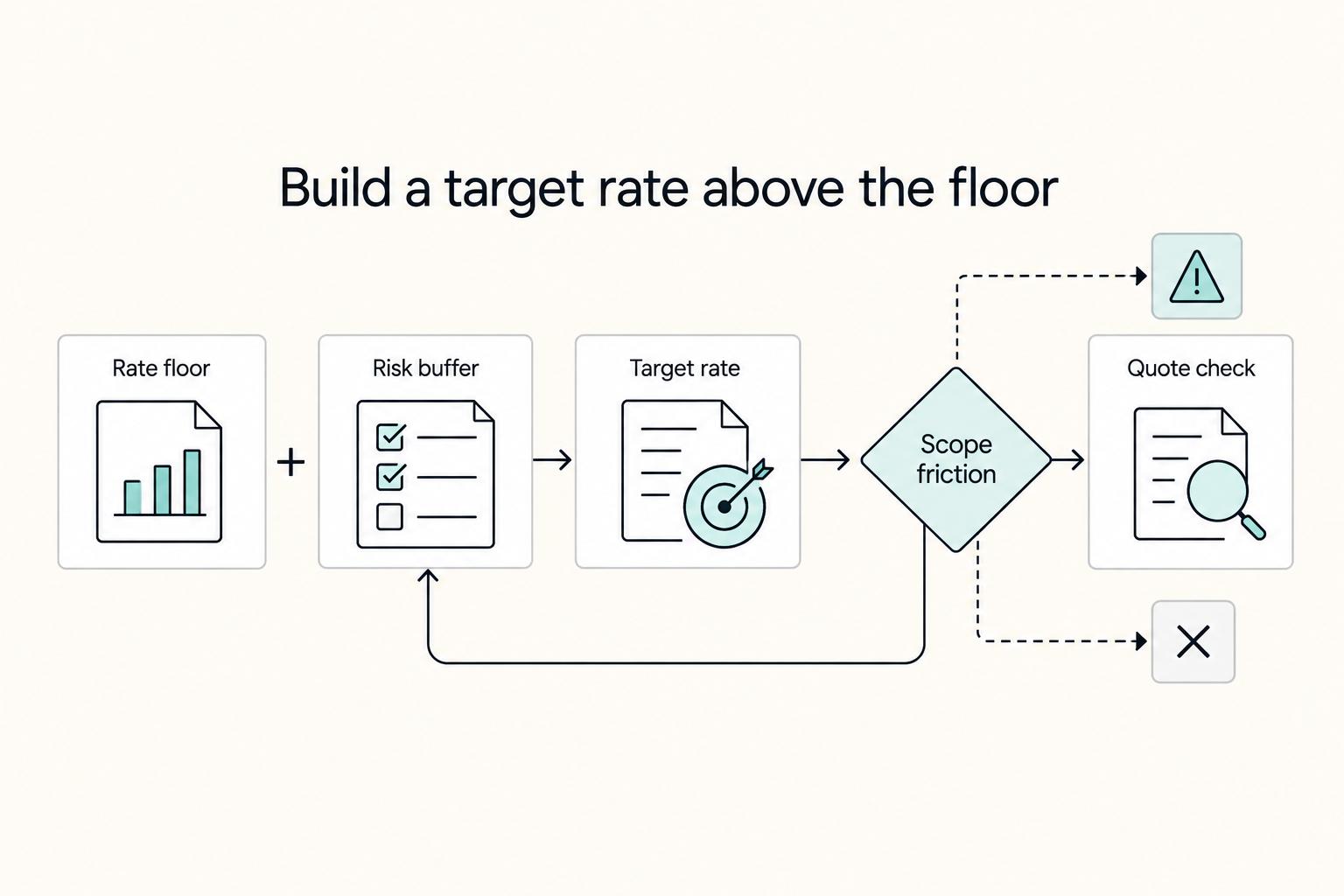
A workable rate is not the neat number a calculator produces. It is the number that still works after you account for real billable capacity, non-client time, scope drift, and the gap between sending an invoice and receiving cleared cash. Start with hourly math even if you do not plan to bill hourly, then turn that number into a quote with clear `payment terms`.
How to Build an Antifragile Freelance Business: Financial Core, Compliance Firewall, and Shock Absorbers
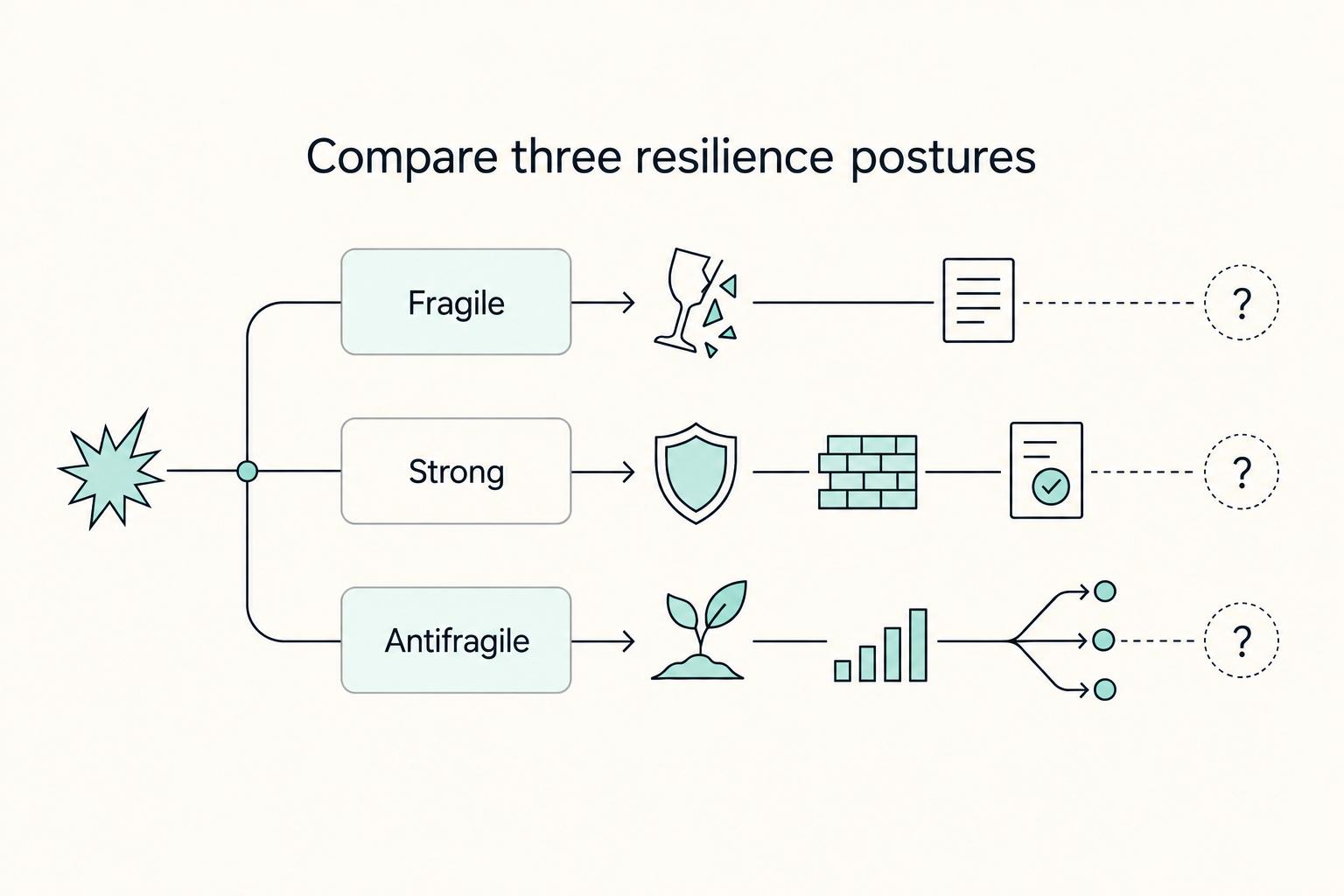
If you want an antifragile freelance business, design your operations to benefit from disruption, not just survive it. Resilience means you absorb a shock and recover. Antifragility, in Taleb's framing, means you improve because of volatility rather than merely endure it.