
Quick Answer
Build optionality for freelancers by treating your work like an operating system, not a series of one-off fixes. Use three pillars together: stabilize cash flow, verify cross-border compliance facts before changes, and tighten operations so admin does not consume delivery time. Keep one current evidence pack with travel dates, client locations, signed agreements, invoices, and account records. Then make decisions through a fixed cadence, escalating early when a move is hard to reverse.
A Freelancer's Guide to 'Optionality': Beyond the Buzzword#
For you, optionality is simple: the practical freedom to say yes, no, later, or not anymore without your business wobbling when you change clients, pricing, country, or schedule. That freedom usually gets harder, not easier, once your work becomes more cross-border. More opportunity tends to bring more admin, more filing questions, and more chances to make inconsistent decisions unless you have a repeatable way to check the facts.
The real tension is not ambition versus caution. It is choice versus complexity. Once your work touches more than one jurisdiction, tax and filing questions can move into everyday decisions. The exact rules vary, so do not rely on memory or online folklore. Verify current requirements first. Even domestic work can get messy. In the US, a tax reciprocal agreement can change which state gets your income tax, and without one you may need two tax returns, one resident and one nonresident. Some states also apply a convenience rule for remote work situations.
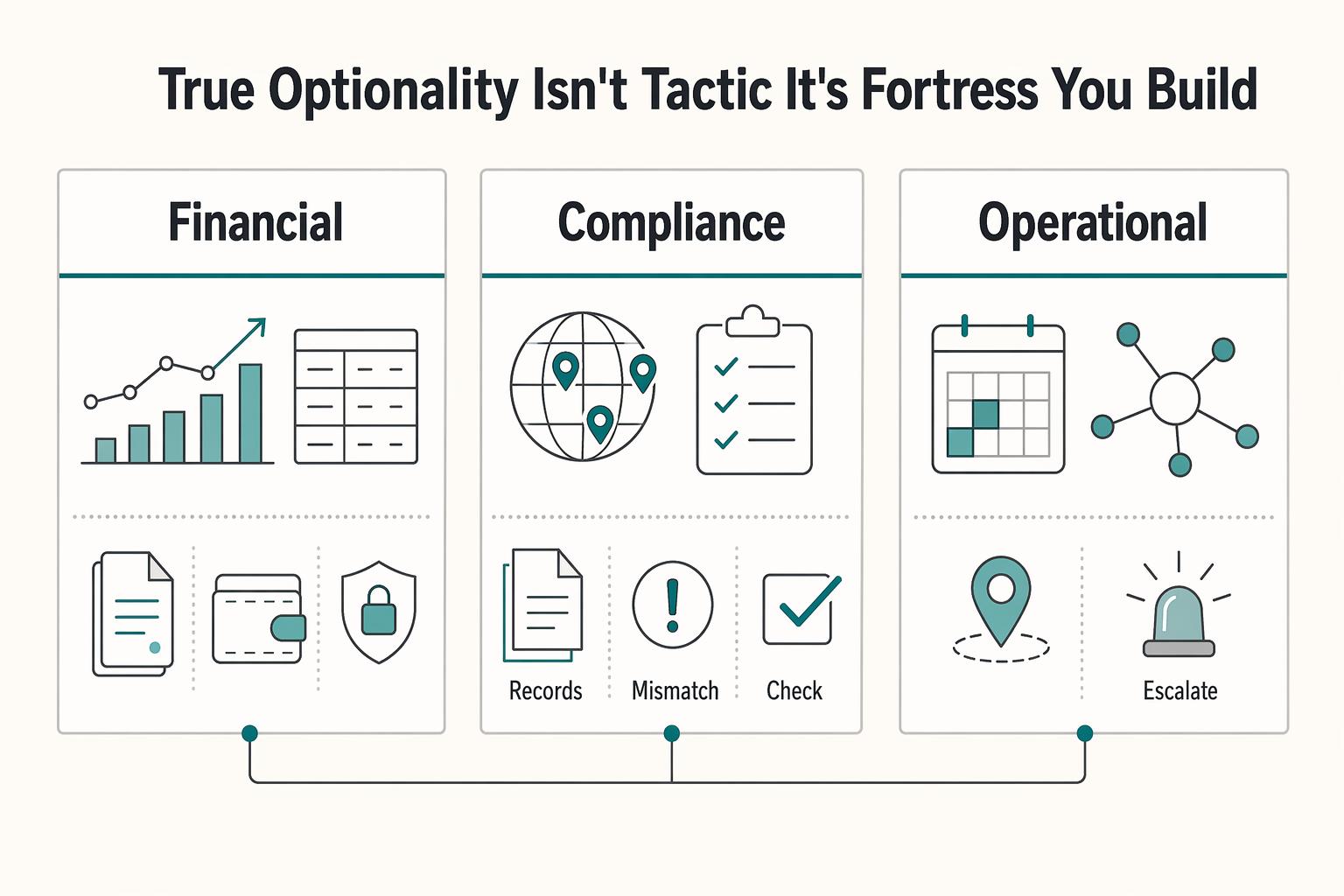
So the goal here is not abstract freedom. It is fewer compliance surprises, cleaner operations, and better client-fit choices for your Business-of-One. The three pillars that follow work together. Financial slack keeps one bad month from forcing a bad decision. Compliance habits help you verify facts before acting. Operating discipline keeps routine admin from swallowing your week. One practical checkpoint is to keep a current evidence pack with your travel dates, client locations, signed contracts, invoice trail, and business account list. It is easy to wait until tax season or a client onboarding form to reconstruct that history from old emails and bank feeds.
You might also find this useful: A guide to 'Bullet Journaling' for freelancers.
Pillar 1: Keep Cash Predictable So You Avoid Forced Decisions#
If cash is unstable, your choices shrink fast. Your first money priority is to avoid forced decisions when a client pays late, work slows down, or a tax bill lands. Keep your business cash flow predictable enough that you can choose clients and timelines on purpose.
Design your income mix deliberately. Each model creates a different kind of flexibility, and each one requires different operating discipline.
| Income model | When to use | Main risk | Operational requirement |
|---|---|---|---|
| Hourly projects | Short, clearly bounded work or trial engagements | Revenue resets every month; admin and revision time gets underquoted | Tight scope, time tracking, fast invoicing, signed change-order process |
| Retainers | Ongoing delivery where the client needs continuity | Scope creep and quiet underpricing when deliverables are vague | Monthly scope definition, renewal dates, usage review, clear response-time terms |
| Advisory or value-based engagements | Work tied to decisions, outcomes, or specialist judgment | Harder to sell without proof; disputes when outcomes are unclear | Strong discovery, written assumptions, decision-owner clarity, evidence of impact |
Retainers are often the simplest move from hourly work because they smooth revenue without rebuilding your whole offer. Advisory work can expand your margin, but only if your proposal and contract define scope, exclusions, and how success is judged. A common failure mode is selling "strategic support" and accidentally delivering unlimited implementation.
Keep your defensive money system simple, visible, and current. Use current verified targets, not old rules of thumb you remember from a post.
| Financial control | Working target | What it protects |
|---|---|---|
| Separate business and personal accounts | In place from first consistent client revenue | Cleaner records, less category confusion, easier evidence gathering |
| Automatic tax set-aside transfer | A verified set-aside rule matched to your tax profile | Reduces the risk of spending money you owe later |
| Cash buffer tracker | A verified reserve target based on fixed costs and income volatility | Buys time to replace income without panic pricing |
For U.S.-relevant contractor-status planning, treat Docket WHD-2026-0001 (RIN 1235-AA46) as a Proposed Rule, not final guidance. Track updates on Regulations.gov; this proposal was posted on Feb 27, 2026, and its listed comment deadline was Apr 28, 2026 at 11:59 PM EDT. Also, verify legal research against official legal editions rather than relying only on FederalRegister.gov text, and do not treat IRS IRB synopses as authoritative interpretations.
Use a short operating cadence so money admin does not pile up:
- Weekly: send invoices on a fixed day, review invoice aging, confirm tax set-aside transfers posted, and categorize expenses while receipts are easy to match.
- Monthly: reconcile accounts, check buffer progress against target, review category drift, and flag client concentration risk.
For long-term investing, use the same framework: pick accounts based on tax treatment now, flexibility later, and portability if your country, entity, or residence changes. Validate country-specific options before funding, and confirm the plan's contribution limit before you fund it. The bigger risk is not one imperfect account choice; it is contributing on autopilot after your rules or structure change. If you also need coverage planning, see Digital Nomad Health Insurance: A Comparison of Top Providers.
Pillar 2: Forge Your Compliance Armor#
Compliance keeps your freedom usable as your work crosses borders. Treat it as a system: track what changed, verify what that change means locally, and make decisions from records instead of memory.
Where surprises usually start#
Most compliance issues start as small documentation gaps, then grow when nobody revisits them. Use this table before small changes compound.
| Threat | Description | Early warning signal | What to track | First mitigation step |
|---|---|---|---|---|
| Tax residency exposure | A country may treat you, or in some cases your company, as tax resident based on facts that must be verified locally. Treaty context and dual residence considerations can matter. | You spend sustained time in one country, relocate, or start making key business decisions from a new location. | Travel days, relocation dates, where work is performed, where management decisions happen, and the local test you are relying on. | Pause long-stay plans until you verify the local test and any double tax treaties and agreements that may apply. |
| Permanent establishment risk | PE risk is a cross-border issue tied to how work is done, where it is done, and how your contractor relationship is structured. | A client asks you to habitually conclude contracts, represent them locally, or take on duties that look like a fixed business presence. | Client country, your authority in deals, relocation events, contract language, and activity changes over time. | Review the contract and scope before you accept the change. If your role expanded, escalate for jurisdiction-specific advice. |
| Foreign account reporting | Holding accounts outside your home jurisdiction can trigger reporting duties that depend on status, jurisdiction, and verified thresholds. | You open a foreign account, platform balances grow, or you gain signatory authority on another account. | Account country, owner name, statements, opening dates, balances, and the reporting test you are relying on. | Build and maintain an account register now so you are not reconstructing records later. |
| Cross-border VAT / reverse-charge handling | Indirect tax treatment depends on who the buyer is, where they belong, and which jurisdiction's rules apply. | A new client is in another country, buyer status is unclear, or you invoice a new service type. | Client legal name, billing country, tax/VAT status if relevant, service description, and invoice wording used. | Run a pre-invoice check before work starts, not after an invoice is challenged. |
A simple compliance cadence#
Four habits cover most of the risk:
- Ongoing tracking: Log travel, relocations, new accounts, and any shift in where you actually work or make decisions.
- Pre-invoice checks: Confirm client legal entity, country, and whether invoice treatment still matches the current setup.
- Contract controls: Keep independent contractor status explicit, limit authority to bind the client, and update scope when responsibilities change.
- Periodic review: Re-test for tax residency exposure, PE questions, and misclassification risk when facts change. Role drift is your key warning sign.
When to escalate#
Escalate when facts change across borders or your role outgrows the original paperwork. Bring in tax or legal specialists when you relocate, add a new country, start working through an entity, face dual residence questions, or a client asks for activities that could affect PE risk.
Before that call, prepare: travel calendar, countries worked from, contracts and scopes, invoice samples, client list by entity and country, bank account register, and a short change timeline. This usually reduces back-and-forth and gets you to clearer guidance faster.
If you want a deeper dive, read GDPR for Freelancers: A Step-by-Step Compliance Checklist for EU Clients.
Pillar 3: Engineer Your Operational Leverage#
After compliance is stable, your next lever is operations. Your goal is to reclaim focus time, reduce handoff errors, and improve delivery consistency so growth stays manageable.
Use a simple test: if one new client, collaborator, or country makes your week hard to read, simplify before you scale. That matters in cross-border work, where freelance setups are often used to avoid overhead but can still add financial and legal complexity.
Cut admin load before you buy more tools#
Start with fewer handoff points, not more apps. Each project should have one home for status, one visible invoice state, one intake path, and one place for final approvals and deliverables.
| Function | Best use case | Failure mode | Minimum setup standard |
|---|---|---|---|
| Project hub | Track active work, next action, owner, deadline, and current scope | Decisions get trapped in chat/email, and deadlines drift | One project record with owner, due date, status, scope link, and next milestone |
| Finance automation | Handle invoices, reminders, expense capture, and cash visibility | Invoice follow-up is inconsistent and records do not match project status | Each invoice tied to client record, issue date, due date, paid date, and verified tax treatment |
| Intake and scheduling | Qualify leads and collect critical facts before kickoff | Calls are booked without enough context to scope accurately | One intake form, one scheduling link, and required fields for client name, entity, country, project type, and target date |
| Documentation | Keep scope, approvals, briefs, deliverables, and closeout proof together | Final files and approvals are scattered, which creates avoidable disputes | Shared folder structure, clear version naming, approval capture, and a closeout folder per project |
Track a baseline over a 12-month window so you can see whether your operating model is actually improving. Use the same measures each month: admin hours per week, overdue invoices, post-handoff clarification rate, and on-time delivery rate.
Make referrals part of closeout#
Treat referrals as a closeout process, not a separate marketing task. Trigger your proof request when work is accepted, when a client confirms a result in writing, or when the engagement expands.
Use one repeatable case-study format: client context, starting problem, what changed, evidence available, and constraints. Store source proof with each case (approval note, before/after artifact, performance comment, and usage permission).
Run a light follow-up cadence tied to closeout: initial testimonial ask, drafted case-study approval request, then a later check-in for outcome updates or introductions. Consistency matters more than volume.
Stack skills around the buyer outcome#
Add skills only when they help you own a larger client outcome in your current niche. That is usually where scope ownership strengthens and replacement risk decreases.
| Core service | Added capability | What the buyer now buys | Effect on pricing power, scope ownership, and replacement risk |
|---|---|---|---|
| UX or product design | Analytics interpretation and conversion testing | Design decisions tied to performance, not just screens | You can frame work around decision quality, own more of testing input, and become harder to replace with execution-only support |
| Content writing | Technical SEO and subject-matter interviewing | Content that supports visibility and authority, not just word count | You move closer to demand outcomes, control more of the brief, and reduce commodity-style pricing pressure |
| Software development | Process mapping and rollout training | Implementation that teams can adopt and run | You own more of discovery and handoff, which lowers the risk of being treated as a build-only vendor |
If a new skill does not help you solve a higher-value buyer problem, skip it. That keeps your options durable instead of noisy. We covered this in detail in A Guide to Local SEO for Freelancers.
Optionality Works When the Three Pillars Run as One System#
Optionality works when your three pillars run as one system: you get fewer avoidable surprises, clearer tradeoffs, and stronger negotiating power. In practice, that means you can choose yes, no, or not yet from a better position, rather than reacting under pressure.
The practical version of "CEO thinking" is a decision method, not a mindset slogan. Set the decision rule before you debate options: how fast the call must be made, what facts are still missing, and how reversible the move is. When uncertainty is high, preserve options. When certainty improves, commit.
A common failure mode is panic disguised as research. Use cadence to prevent that: run a short weekly review for pipeline, delivery load, and cash timing, plus a monthly risk review for work location, client structure, payment accounts, and contract changes. If a decision touches more than one pillar, treat it as higher stakes.
| Pillar | If you stay reactive | Signal to track | If you act strategically | What changes in your options |
|---|---|---|---|---|
| Financial | You wait for pressure, then accept weak-fit work | Revenue concentration, unpaid invoices, upcoming fixed obligations | You review cash timing early and choose to cut spend, increase outreach, or decline risky work | You can say no to bad-fit projects and buy time for better decisions |
| Compliance | You search for answers only after a cross-border change happens | Country worked from, client entity, payment account, contract reality vs paper terms | You keep one record linking country, client, contract, and payment setup, then escalate when facts change or conflict | You can assess new countries, clients, and payment setups without guessing |
| Operational | You patch admin issues until delivery quality drops | Approval delays, scope drift, scattered documents, non-billable admin load | You keep a current evidence pack: signed MSA, active SOW, approval trail, invoice trail, and client notes | You can onboard faster, defend scope, and shift focus without losing control |
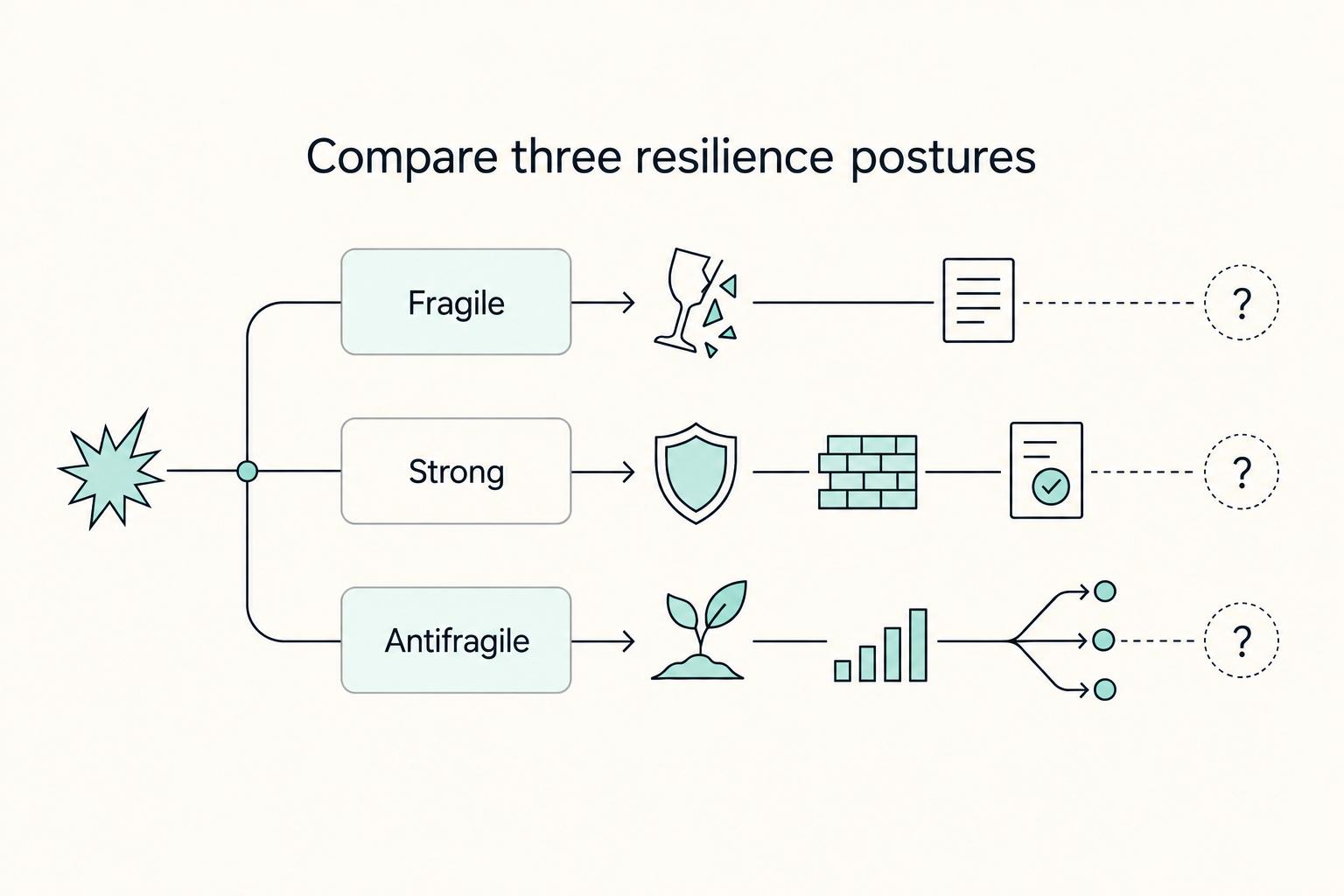
This is antifragile design in day-to-day operations. Your financial buffer buys time, your compliance records make specialist input faster and cleaner, and your operating discipline keeps small issues from becoming expensive ones. If you want the full design logic, read A guide to 'Antifragile' thinking for building a resilient freelance business.
Escalate to specialist support when a choice is hard to reverse, when new facts cross borders or legal obligations, or when you cannot produce your evidence pack quickly. Your next-step checklist is simple: set a weekly decision cadence, run one monthly risk review, keep one current evidence file per client, and escalate early when facts stop being simple. For a step-by-step workflow, see A Guide to 'Deep Work' for Freelancers.
Frequently Asked Questions
What should you monitor first to reduce cross-border compliance mistakes and permanent establishment risk?
Start with a short monthly checklist focused on where you work, relocation changes, and how each contractor relationship is structured in practice, not just on paper. Review potential misclassification risk as work patterns evolve, and keep one record that ties country, client entity, contract, and payment account together. Escalate early when your work pattern changes across countries. The PE risk source behind this guidance was published on February 05, 2025, so verify local legal details again for 2026 before you act.
How do you diversify income without diluting your offer?
Keep your service list narrower than your skills list. Set a baseline income requirement and a stretch goal, then estimate how many gigs you need for each before you add anything new. Add a second revenue stream only when it serves the same buyer problem and you can still explain scope and cost clearly in early conversations. A common failure mode is adding too many services, then attracting confused prospects and mismatched work.
How do you build a financial safety net before you depend on freelance income?
Treat this like a go or no go decision, not a motivational exercise. Check your current runway, your baseline income requirement, your stretch goal, and how many projects you need to hit each. Then prioritize actions that reduce ambiguity in your plan and client pipeline. If you are already under financial stress or repeatedly missing your baseline target, escalate before you treat your buffer as ready.
What does compliance optionality mean in practice?
It means you can review a new client, a new country, or a new payment setup with current records and verified local advice instead of guesswork. It is also jurisdiction dependent. Cross-border compliance and PE analysis do not share one universal test, so your advantage comes from clean documentation and timely escalation, not from memorizing internet summaries.
How do you protect yourself from scope creep and non payment?
Use documents that do different jobs, and keep the signed version plus the approval trail in one place. MSA and SOW scope control can reduce ambiguity early, but it does not eliminate classification or PE issues on its own. If payment or scope becomes fuzzy, do not start with more calls. Send back the current MSA, the active SOW, and the last written approval so the facts are visible. | Document | Best use | What you should verify | | --- | --- | --- | | MSA | Sets baseline relationship and payment process | Legal client name, active terms, signature date, and approver authority | | SOW | Defines project deliverables, timeline, fee, and acceptance points | Exact scope, out of scope items, milestones, and pricing alignment | | Written change or approval record | Confirms added work, revised timing, or acceptance after work starts | Date, approver name, what changed, and any fee or deadline impact | Set scope and cost expectations early, because skipping key questions leads to confusion and costly misunderstandings.
Try a related tool
Researched and edited by the Gruv editorial team. Gruv builds cross-border billing, payouts, and finance-operations software for global businesses.
Sources
- access-board.gov/ict/fria.htmltrusted
- clark.wa.gov/sites/default/files/2025-09/combined-novembe...trusted
- contracosta.edu/wp-content/uploads/2024/01/CCC-Catalog_2023-...trusted
- eprints.qut.edu.au/97741/4/tiana%20templeman%20thesis.pdftrusted
- federalregister.gov/documents/2024/04/25/2024-08065/retirement-s...trusted
- irs.gov/irb/2025-52_IRBtrusted
- irs.gov/pub/irs-access/p2104_accessible.pdftrusted
- regulations.gov/document/WHD-2026-0001-0001trusted
Educational content only. Not legal, tax, or financial advice.
Related Posts

GDPR Compliance Checklist for Freelancers Working With EU Clients
Start by separating the decisions you are actually making. For a workable **GDPR setup**, run three distinct tracks and record each one in writing before the first invoice goes out: VAT treatment, GDPR scope and role, and daily privacy operations.

Digital Nomad Health Insurance Comparison for Long-Stay Moves
Use focused time now to avoid expensive mistakes later. Start with a practical `digital nomad health insurance comparison`, then map your route in [Gruv's visa planner](/tools/visa-for-digital-nomads) so we anchor policy checks to your real plan before pricing pages pull you off course.
How to Build an Antifragile Freelance Business: Financial Core, Compliance Firewall, and Shock Absorbers
If you want an antifragile freelance business, design your operations to benefit from disruption, not just survive it. Resilience means you absorb a shock and recover. Antifragility, in Taleb's framing, means you improve because of volatility rather than merely endure it.