
Quick Answer
Freelancers should use a small three-layer dashboard and one OKR cycle to track operational health, future demand, and compliance risk. The article frames this as the Engine, the Compass, and the Shield. Review fast-moving metrics weekly, stability and risk monthly or on trigger, and tie every key result to records like invoices, calendars, pipeline notes, contracts, and account statements.
The promise of freelance life is autonomy. The reality, for many, is a steady, low-grade anxiety caused by uncertainty. We celebrate top-line revenue, then worry about cash flow. We chase new projects, but rarely stop to ask whether they are actually profitable. That reactive feast-or-famine loop is what most often undermines the freedom you set out to build.
The fix is not more hustle or a bigger spreadsheet. It is a better operating view. To build a resilient business of one, you need a small dashboard that shows three things clearly: how the business is running now, whether the next quarter is getting stronger or weaker, and where hidden risks could do outsized damage.
Here, that means three layers: The Engine, The Compass, and The Shield. When those three layers work together, you stop reacting late and start making decisions earlier.
Layer 1: The Engine - Are You Operationally Healthy?#
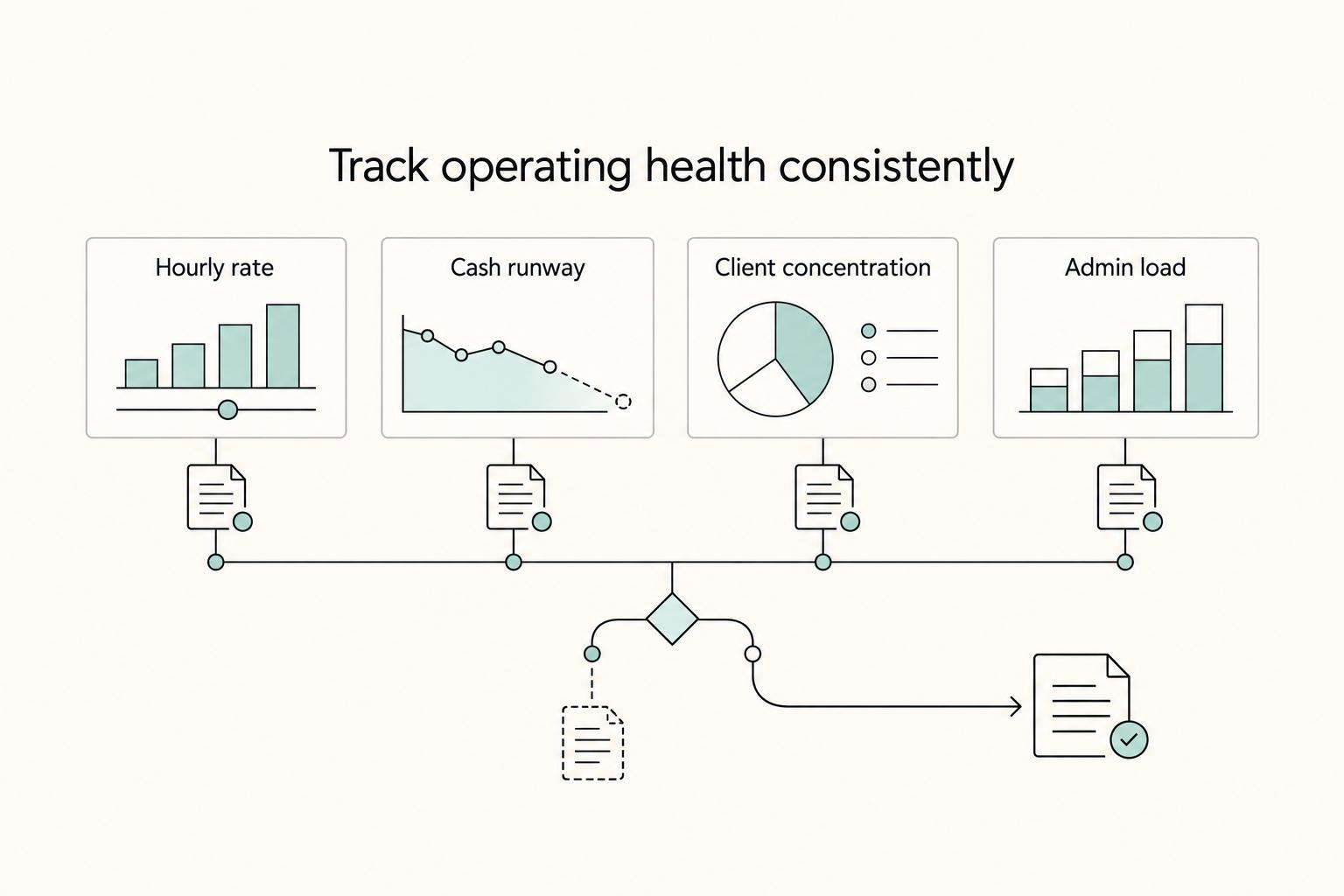
Operational health is not about feeling busy or organized. It means a slow month, a late payment, or a sudden surge in work does not knock delivery off course. To judge that, you need four numbers pulled from actual records, not memory or a feeling that things are "handled."
Use one reporting method and keep it consistent. If your books are cash basis, do not mix paid revenue for one metric with accrued revenue for another. Your recordkeeping should tie back to a summary of business transactions and supporting documents such as invoices, bank statements, expense records, and time logs.
| Metric | Why it matters now | Required inputs | Review cadence | Action if off-track |
|---|---|---|---|---|
| Effective Hourly Rate | Shows whether your work is still profitable after paid and unpaid time. This can quickly show margin erosion from revisions, unpaid scoping, or admin drag. | Total project revenue for a defined period; all hours tied to winning, doing, revising, and closing that work from your time tracker and calendar | Weekly and at project close | First move: tighten scope or reprice before taking on more volume |
| Cash flow runway | Shows how many months you can keep operating at your current burn if cash inflow slows. It answers whether late payments become a stability problem. | Actual cash on hand; recurring business and personal outflows; bookkeeping summary; bank balances; open invoices reviewed separately, not treated as cash | Monthly | First move: accelerate collections, then cut discretionary spend if needed |
| Client concentration | Shows how exposed you are if your largest client pauses, churns, or stretches payment terms. A good month can still be fragile if most revenue comes from one account. | Revenue by client from issued invoices or recognized revenue using the same monthly or quarterly basis each time | Monthly | First move: shift business development toward smaller or new accounts, not deeper dependency |
| Admin load | Shows how much capacity is being absorbed by non-delivery work. If it rises, delivery capacity and sales time can fall. | Billable hours and total available working hours from timesheets or calendar, plus admin categories such as invoicing, email, proposals, scheduling, and coordination | Weekly | First move: remove, batch, automate, or delegate one repeat task before adding tools or more hours |
A few calculation checks matter more than most people admit. For EHR, include unpaid time or the number is less useful. For runway, separate cash on hand from receivables, then watch collection speed through DSO or AR turnover if payments start to slip. For concentration, use the same period every time. If you switch between monthly cash received and quarterly earned revenue, you hide risk instead of showing it.
Turn the Engine into an OKR#
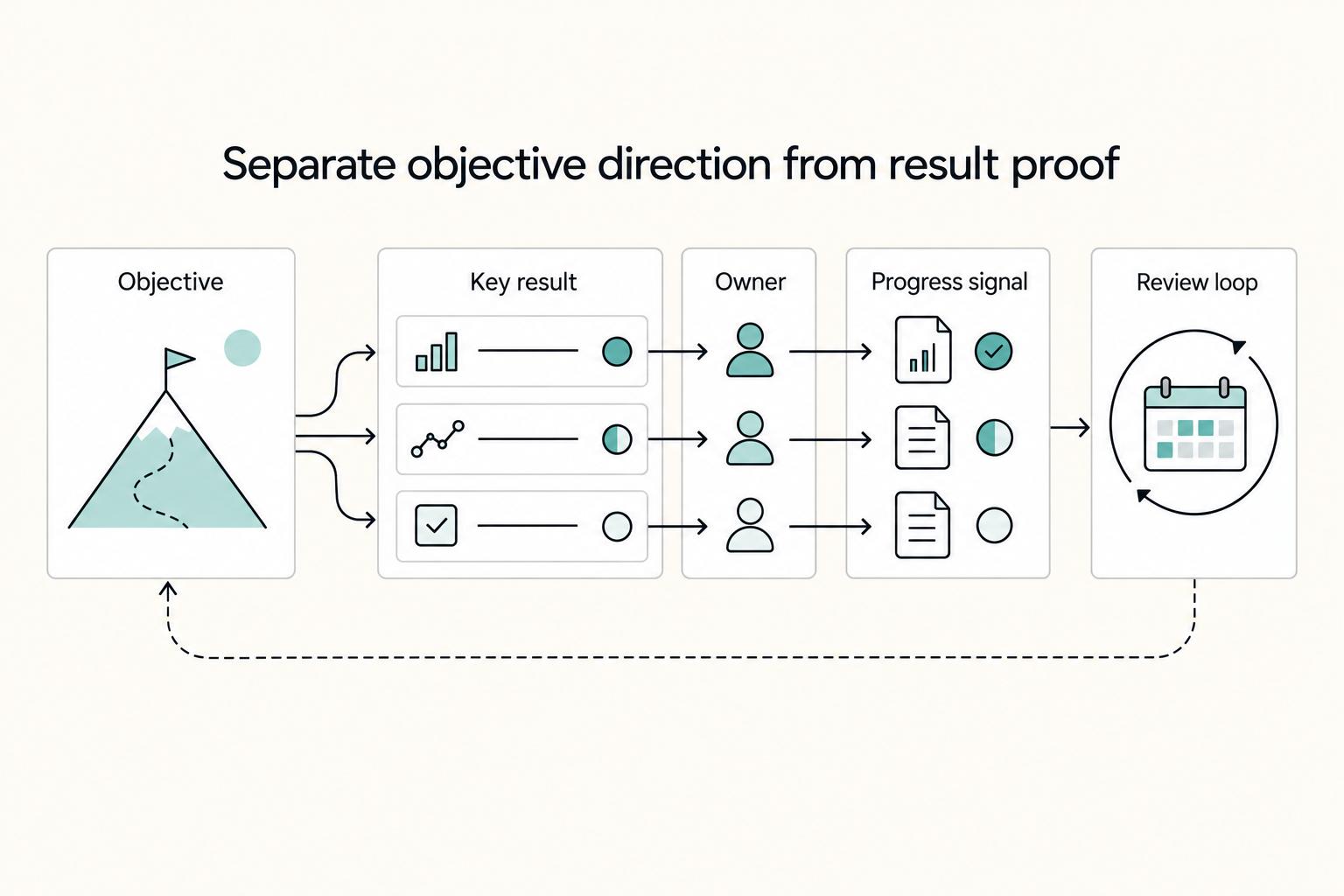
This is where OKRs stop being abstract and become useful. Use a simple Objective: Keep operations stable when workload or payment timing changes. Keep the Key Results tied to outcomes, not activity. A quarterly cycle is common, though cadence is not one-size-fits-all.
| KR | Metric | Target | Owner | Cadence |
|---|---|---|---|---|
| KR1 | Effective Hourly Rate | Set against your records | you | weekly |
| KR2 | Cash flow runway | Set against your cash records | you | monthly |
| KR3 | Largest-client revenue share | Set against your revenue records | you | monthly |
| KR4 | Admin load | Set against your calendar | you | weekly |
If a KR slips, treat it as a signal, not a personal failure. Low scores are data for the next adjustment, and they should trigger a decision instead of blame.
What to review each week and month#
Once the metrics are defined, keep the review rhythm simple. Check the fast-moving numbers weekly and the stability numbers monthly.
- Weekly: Review EHR and admin load using your time tracker, calendar, proposal or scope document, and issued invoices. If EHR drops, fix scope or pricing first. If admin load rises, cut one recurring task before hiring or buying software.
- Monthly: Review runway using bank balances, bookkeeping summaries, recurring expense lists, and receivables. If runway weakens, collect faster first. Then review client concentration from your invoice ledger or revenue report for the same period you used last month.
Do not let a "handled" label close the file too early. A task can be marked done and still be wrong, late, reworked twice, or unpaid. Check closed work for accuracy, timeliness, rework, and payment reliability. An invoice sent with the wrong amount, a deliverable returned for corrections, or a project that is finished but unpaid are all operating problems, even when the task status looks neat.
Layer 2: The Compass - Where Is Your Business Headed?#
Your forecast is only as good as your evidence. Treat this layer as a decision system: count only observable opportunities, assign ownership, and force movement or closure when a deal stalls.
A lead is qualified only when you can verify both profile fit and behavior in your own workflow. Use observable checks, not intuition: fit from CRM/proposal fields, behavior from inbox labels, meeting notes, or document activity. Use BANT as your rubric (budget, authority, need, timeline), set the threshold against your own pipeline evidence, and validate from one source of truth each month (CRM view, inbox labels, or proposal tracker).
| Stage | Qualification standard | Expected value method | Owner | Next-step deadline | Risk flag |
|---|---|---|---|---|---|
| Discovery completed | Fit and need confirmed against your verified qualification benchmark | Deal value x stage probability using your verified stage benchmark | You | Date logged in close date or task field | At risk in your process if no owner or no dated next action |
| Proposal sent | Scope, value, and decision process confirmed against your verified qualification benchmark | Deal value x stage probability using your verified stage benchmark | You | Follow-up date logged | Proposal activity but no reply by the verified follow-up deadline |
| Verbal yes or procurement | Commercial terms accepted; signature or procurement step pending against your verified close standard | Deal value x stage probability using your verified stage benchmark | You | Contract or procurement due date logged | Time in stage exceeds your verified stage-age limit |
Set stage probabilities deliberately on a 0-100 scale. If you change stage definitions, you are also changing forecast behavior, so update assumptions intentionally and recheck your totals.
Use this requalification workflow for quiet deals:
- Flag as at risk when owner or dated next step is missing, or activity goes stale.
- Pull the latest evidence (email thread, call note, proposal activity) and confirm what changed.
- Request one concrete next action with a date.
- If there is no recovery by your verified requalification deadline, close lost or archive so your pipeline stays credible.
Tie this layer to one OKR: Improve revenue predictability.
- KR1: Qualified leads at your verified benchmark (checked in your chosen tracker).
- KR2: Pipeline health metric (coverage or late-stage share) at your verified benchmark.
- KR3: Business-development time per qualified opportunity at your verified benchmark.
Apply ROTI by channel with explicit decisions:
- Continue: Channel consistently produces qualified conversations or proposals, verified in the same tracker.
- Reduce: Channel creates activity but weak qualification or slow movement.
- Stop: Channel remains low-yield after recheck in your evidence source; do not change channel mix without that validation.
If you want a broader framework refresher, see A Guide to OKRs (Objectives and Key Results) for Company Goal Setting.
Layer 3: The Shield - Are You Protected From Catastrophic Risk?#
Your Shield is a live control sheet, not a year-end cleanup task. Use it in three moments: before kickoff, during delivery, and immediately when a trigger appears.
Before kickoff, verify cross-border scope, delivery location, and the exact signing entity. During delivery, reconcile movement, account, and contract activity against your records on a fixed cadence. Escalate the same day when a reporting duty or PE risk may apply.
| Risk area | Evidence to collect | Review trigger | Owner | Escalation path | Status |
|---|---|---|---|---|---|
| Tax residency tracking | Movement log, calendar, travel receipts, lodging records, client work location, workday vs non-workday notes | New country, mid-year move, or days approaching a verified jurisdiction-specific threshold | You | Jurisdiction-specific tax review before return prep | Open / Monitoring / Escalated |
| Foreign account reporting | Account list, ownership type, statements, highest-balance support, currency conversion source, prior filing history | New foreign account, signature authority, or possible filing trigger that needs official verification | You | Immediate review for prior-year omission or unclear filing duty | Open / Monitoring / Escalated |
| Permanent establishment risk | Contract, statement of work, signing entity, delivery location, local office or fixed-place facts, authority to conclude contracts | Any new cross-border client, country, or contract model | You plus contract reviewer | Pause kickoff and obtain country-specific legal and tax review | Open / Monitoring / Escalated |
Pre-kickoff gate and residency log#
Treat PE screening as a hard gate before work starts. A PE can arise from a fixed place of business, and it can also arise where someone habitually concludes contracts for the enterprise, so check location of performance, regular use of client/local premises, signing flow, and in-country contract authority before kickoff.
Run your residency workflow from one movement log. Keep one row per stay with date in, date out, jurisdiction, workday/non-workday, client or project, and links to evidence (calendar events, tickets, invoices, lodging, receipts). Reconcile monthly against calendar and card records so you are not reconstructing facts from memory later.
Use a verify-first rule for day-count and tie tests. Do not apply one global cutoff: validate the current jurisdiction-specific residency method and sourcing rules before you finalize classification.
Foreign accounts and the resilience OKR#
Handle foreign-account reporting as an onboarding-to-filing process, not a year-end scramble. For each engagement cycle, identify all foreign financial accounts, test FBAR and Form 8938 separately, capture ownership and statement support, then confirm the filing trigger and timing from current official guidance.
| Step | Requirement | Timing |
|---|---|---|
| Identify accounts | Identify all foreign financial accounts | For each engagement cycle |
| Test reporting | Test FBAR and Form 8938 separately | For each engagement cycle |
| Capture support | Capture ownership and statement support | For each engagement cycle |
| Verify rules | Confirm the filing trigger and timing from current official guidance | Before filing |
| File FBAR | Submit FBAR through the BSA E-Filing System and keep that workflow separate from tax-return submission | If filing is required |
| Escalate omissions | Escalate immediately if you detect a possible missed filing | Immediately |
If filing is required, submit FBAR through the BSA E-Filing System and keep that workflow separate from tax-return submission. If you detect a possible missed filing, escalate immediately due to penalty exposure.
Keep this layer to one objective and a few measurable results: Reduce catastrophic compliance exposure. Key Results: control sheet complete for the verified set of active clients; pre-kickoff cross-border review completed before start for every relevant engagement; triggered escalations opened within the verified response window.
You might also find this useful: Skin in the Game for Freelancers Starts With Cashflow Protection.
Conclusion: Measure What Matters to Protect Your Autonomy#
You do not need a bigger dashboard. You need one clear Objective, measurable Key Results with evidence, and a review rhythm you will actually keep. That is the practical version of measuring what matters in a freelance business.
| Layer | Key result | Evidence |
|---|---|---|
| Engine | Keep your realized rate and largest-client share at or better than the verified baseline for the cycle | invoicing and calendar records |
| Compass | Restore or maintain qualified pipeline and proposal activity at the verified baseline for the cycle | CRM, inbox, or proposal log |
| Shield | Finish the cycle with zero unverified cross-border changes before kickoff; include an FBAR check against the $10,000 trigger if you are a U.S. person with foreign accounts | saved official URL, page update date, and supporting note |
Keep the three layers simple and practical. Use the Engine to check whether your work is healthy now, using records like invoices and calendar time. Use the Compass to see whether future demand is strengthening or thinning before revenue drops. Use the Shield to stop preventable damage when a country, bank account, client entity, or work location changes and could create a filing or compliance problem.
For the next cycle, start with one OKR, and keep the evidence tied to records you already use:
- Objective: Make the business more stable, easier to review, and harder to surprise.
- Key Result 1, Engine: By cycle end, keep your realized rate and largest-client share at or better than the verified baseline for the cycle, checked against invoicing and calendar records.
- Key Result 2, Compass: Restore or maintain qualified pipeline and proposal activity at the verified baseline for the cycle, checked in your CRM, inbox, or proposal log.
- Key Result 3, Shield: Finish the cycle with zero unverified cross-border changes before kickoff, evidenced by a saved official URL, page update date, and supporting note. If you are a U.S. person with foreign accounts, include an FBAR check against the $10,000 trigger.
Your failure mode is not low scores. It is vague scoring, missing evidence, and changing the metric instead of the decision. Grade each result at cycle end on a 0 to 1.0 scale, then treat weak scores as learning for the next round.
Use this next-cycle checklist:
- Baseline: verified baseline for the cycle
- Owner: named business owner or operations lead
- Review cadence: weekly check-in, plus one formal end-of-cycle review
- Adjustment rule: modify a metric only when priorities change, and document why
If your next issue is compliance, start with GDPR for Freelancers: A Step-by-Step Compliance Checklist for EU Clients. If the rule or consequence is material, pause and get jurisdiction-specific advice before work continues.
For a step-by-step walkthrough, see Use OKRs to Run Your Freelance Business Week to Week.
Frequently Asked Questions
What should you track first if you want a small dashboard that is still useful?
Track one signal in each layer that forces a decision. Start with an Engine signal such as largest-client share or effective hourly rate, a Compass signal such as qualified pipeline movement or proposal activity, and a Shield signal such as a new country, foreign account, signing entity, or work-location change. Keep one short note on what changed, which record you checked, and what you did next.
How do you measure business risk without overcomplicating it?
Use records you already have instead of memory. Review invoicing for concentration, pipeline for future demand, calendar for capacity, and contracts or account changes for Shield triggers on a set cadence. When a signal breaks your rule, open one escalation note and route it to Engine, Compass, or Shield based on whether the threat is cash, delivery, or compliance.
What is the difference between leading and lagging indicators in a freelance business?
Lagging indicators confirm what already happened, such as paid revenue, collected invoices, or last quarter's margin. Leading indicators suggest what may happen next, such as qualified leads, proposal acceptance, repeat work requests, or weaker delivery quality notes. If a leading signal changes first, update your Compass objective or key results before the Engine shows damage.
What should you watch to prevent burnout before it becomes obvious?
Watch for calendar load rising while invoices, realized rate, or delivery quality notes do not improve. More meetings, more revisions, or more after-hours work for the same revenue is an Engine warning. For recurring work, define package caps, what is included, and what is out of scope so unpaid extra labor does not quietly expand.
How is a dashboard different from OKRs?
A dashboard shows the current state of the Engine, Compass, and Shield. An Objective names the change you want, and Key Results show whether that change is happening. If the dashboard shows concentration or a Shield trigger, the OKR should force the next action rather than just describe the problem.
What is the main compliance watchpoint if you work across borders?
The main watchpoint is to verify first, then act. When a trip, client, bank account, or signing entity changes, move it to the Shield and confirm the current rule on an official site, including the page update date and official domain where relevant. Do not rely on old screenshots or stale PDFs, and pause kickoff or filing if the source is unclear or the consequence is material.
Try a related tool
Researched and edited by the Gruv editorial team. Gruv builds cross-border billing, payouts, and finance-operations software for global businesses.
Sources
Includes 3 external sources outside the trusted-domain allowlist.
- irs.gov/businesses/small-businesses-self-employed/re...trusted
- irs.gov/newsroom/details-on-reporting-foreign-bank-a...trusted
- mn.gov/deed/business/starting-business/organizing/f...trusted
- ofac.treasury.gov/faqs/updatedtrusted
- sba.gov/business-guide/manage-your-business/manage-y...trusted
- corporatefinanceinstitute.com/resources/valuation/customer-concentrationexternal
- corporatefinanceinstitute.com/resources/valuation/cash-runway-explainedexternal
- getharvest.com/calculators/calculate-billable-utilization-rateexternal
Educational content only. Not legal, tax, or financial advice.
Related Posts

GDPR Compliance Checklist for Freelancers Working With EU Clients
Start by separating the decisions you are actually making. For a workable **GDPR setup**, run three distinct tracks and record each one in writing before the first invoice goes out: VAT treatment, GDPR scope and role, and daily privacy operations.

Digital Nomad Health Insurance Comparison for Long-Stay Moves
Use focused time now to avoid expensive mistakes later. Start with a practical `digital nomad health insurance comparison`, then map your route in [Gruv's visa planner](/tools/visa-for-digital-nomads) so we anchor policy checks to your real plan before pricing pages pull you off course.
How to Run OKRs for Company Goal Setting Without Losing Focus
OKRs work when they create clarity, not more paperwork. For an independent professional, that means turning ambition into a short list of measurable outcomes with clear ownership, visible progress, and regular control points. You should be able to tell whether the business is actually moving.