
Quick Answer
Use Cialdini's liking principle by making professional trust easy to verify, not by trying to build quick personal chemistry. For freelancers, that means showing competence, reliability, and alignment in proposals and onboarding, using consistent delivery routines, and closing projects with clear handoffs, feedback, and permission-based follow-up. This turns likeability into working trust instead of manipulation.
From Persuasion to Protection: A Risk-Averse Professional's Guide to Cialdini's Liking Principle#
If persuasion language makes you wary, keep that instinct. A safer approach is to use persuasion as transparent trust-building, not as a charm tactic.
The practical distinction is simple. Being liked may warm up a conversation, but trust depends on what people can verify when they feel uncertain. When proof is thin, decisions usually get examined more closely.
Do not start with personal chemistry. Start with professional trust.
- Old rapport advice: find common interests, sound friendly, build quick closeness.
- Better approach: make your competence, reliability, and professional alignment easy to verify.
Those three signals matter most here. Competence means the client can see relevant judgment and proof. Reliability means your communication, follow-through, and handoffs feel predictable. Professional alignment means your standards, boundaries, and decision logic make sense for their business.
Before you send a proposal or start onboarding, do one quick check. Can each trust claim be backed by something concrete, such as a testimonial, review, or a clear example of how you work?
One useful lens here is explainable persuasion. If you are trying to influence a decision, your intent and method should be clear enough that you would be comfortable stating it plainly. In persuasive-interface contexts, transparency and consent-oriented practices were presented as ways to improve user control and address ethical concerns. That gives you a cleaner way to use social proof without slipping into manipulation. It also sets up the three phases ahead: qualification, delivery stability, and retention. One caution: reciprocity can help, but free value is not proof of fit, and it does not guarantee commitment.
You might also find this useful: A freelancer's guide to 'Influence: The Psychology of Persuasion'.
Phase 1: Align on Context, Then Lock a Shared Working Model#
Use your proposal and onboarding to reduce uncertainty before kickoff. In this phase, show three things clearly: you fit the role, you understand the work context, and you can run delivery with a reliable process.
Use a simple sequence: align on business context, validate one smart client decision, then lock a shared working model. If you skip that last step, good rapport can still turn into scope friction.
Use alignment to show role fit#
Show similarity through the work, not personal chemistry. Reflect the client's priorities in your discovery notes, proposal summary, and scope language so they can verify that you understood their goals and constraints.
Productized offers can strengthen this step because a clear package menu, fixed scope, and clear pricing are easier to evaluate than a fully custom proposal every time. If the work has unusual requirements, keep the package structure and state where customization begins instead of rebuilding everything from scratch.
| Proposal area | Weak language | Strong language |
|---|---|---|
| Discovery notes | "I understand your needs." | "From discovery, your priority is clearer handoffs and fewer revision loops during delivery." |
| Scope boundaries | "We'll figure it out as we go." | "This package defines included deliverables, review flow, and how out-of-scope requests are handled." |
| Communication norms | "Message me anytime." | "We'll use one shared channel for decisions, feedback, and blockers." |
| Pricing | "Custom pricing based on complexity." | "You're selecting from a package menu with clear scope and pricing." |
Validate judgment, then define cooperation#
A strategic compliment should confirm a sound client decision with practical relevance. Point to a specific choice that improves execution, then explain why it helps the project run better.
Avoid flattery without evidence. Generic praise does not reduce risk; operationally useful recognition does.
Then move to cooperation. Your scope and onboarding docs should read like a shared operating model: what gets delivered, how feedback moves, who approves, and how changes are routed. Keep boundaries clear, but frame them around execution reliability, not defensiveness.
The pattern to avoid is reinvention for every new client: one-off proposals, endless revision back-and-forth, and ad hoc onboarding. A repeatable workflow with documented procedures is easier for clients to trust.
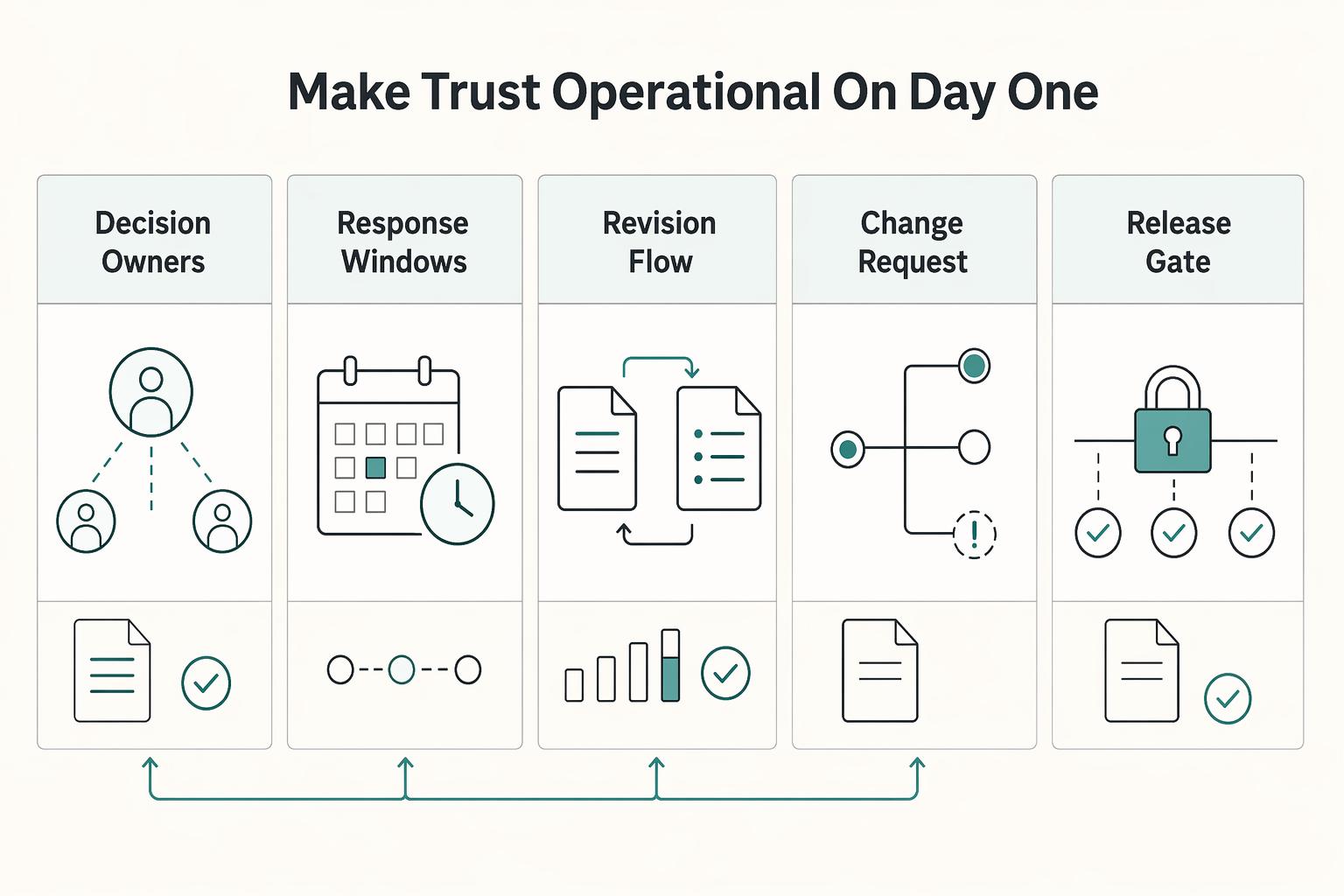
Make trust operational on day one#
Trust becomes tangible when your process starts immediately after signature. Even if you work solo, trigger onboarding right away: create the project folder, send welcome materials, and queue first tasks so the handoff is visible.
| Onboarding item | What to confirm |
|---|---|
| Decision owners | Decision owners and final approver |
| Response windows | Response windows for both sides |
| Revision flow | Revision flow and where feedback is tracked |
| Change-request path | Change-request path for out-of-scope work |
| Approval cadence | Approval cadence for milestones or deliverables |
Use a short onboarding checklist like the one above and confirm it with the client.
This is what turns liking into working trust: the client can see how the engagement operates, not just how you present yourself.
If you want a deeper dive, read GDPR for Freelancers: A Step-by-Step Compliance Checklist for EU Clients.
Phase 2: Build "Collaborative Moats" During Project Delivery#
During delivery, clients judge trust by how you run the work week to week. Use "collaborative moats" as practical routines that reduce misunderstandings, lower delivery risk, and keep decisions calm when pressure rises.
Use one feedback flow every time#
When feedback arrives, your goal is to keep the conversation cooperative, not defensive. Run the same sequence each time:
| Step | Action |
|---|---|
| 1 | Acknowledge the concern |
| 2 | Confirm the shared goal |
| 3 | Propose clear options |
| 4 | Agree the next step |
| 5 | Document the decision in writing |
In practice: "Thanks for flagging this. We're both trying to get the handoff right. I see two options. I recommend option A because it keeps the timeline intact. If you agree, I'll revise the draft and note the change in today's recap." If the decision is not in the project thread, shared doc, or meeting notes, it is likely to resurface.
Make reliability visible#
Clients may not inspect every technical choice, but they can verify your delivery behavior. Keep your trust signals observable and repeatable.
| Delivery area | Risk pattern | Trust signal |
|---|---|---|
| Update cadence | You send updates only after being asked | You send a concise update on a predictable weekly day |
| File/version hygiene | Files are scattered and version names are unclear | One shared location, clear version names, and one current draft |
| Approval checkpoints | Silence is treated as approval | You confirm approver, deadline, and what happens with partial feedback |
| Change-request handling | Extra requests are absorbed without discussion | You name the request, state impact, and confirm scope vs. change path |
| Meeting recap discipline | Verbal decisions fade | Same-day recap with decisions, owners, and next actions |
A practical option: use 15 minute intervals for delivery calls when meetings drift. It is not a universal rule, but it can force clearer agendas and faster decisions.
Protect calm under pressure with deliberate boundaries#
One common failure mode is people-pleasing that turns into reactive delivery. If a request changes scope, timeline, or sequence, name the tradeoff directly and confirm the decision in writing.
If you work through an associate model (a network of trusted freelancers), make ownership explicit. The client should always know the point person, who owns each task, and where approvals land.
Use this weekly checklist to stay consistent without adding scope:
- Send one predictable status update with progress, blockers, and next actions.
- Confirm open approvals needed this week.
- Clean up filenames, folders, and the current working draft.
- Document each decision and scope change in writing.
- Flag one risk early and propose a response.
Phase 3: Secure Future Revenue in Offboarding & Follow-Up#
Treat offboarding as the last part of delivery, not a separate afterthought. Your goal is simple: close cleanly, leave clear records, and make future work easy to scope without blurring boundaries.
Run this sequence after sign-off:
- Confirm the handoff in writing: what was delivered, where assets live, key decisions made, and who owns any remaining internal actions.
- Ask for feedback while the work is still clear in the client's mind, and if they are open to it, turn their own words into a short testimonial draft for approval.
- Follow up with relevant value only, then keep contact permission-based and light.
| Offboarding area | Low-trust pattern | Trust-building pattern |
|---|---|---|
| Debrief style | Ends with "let me know if you need anything" and no clear recap | Short recap of deliverables, decisions, open owners, and next-step triggers |
| Testimonial request timing | Generic ask with no context | Feedback-first ask after handoff clarity, using client language when possible |
| Follow-up message quality | Generic check-in | Brief note tied to goals or priorities the client already shared |
| Referral ask | Broad "send people my way" | Specific, low-pressure prompt when a clear fit is already visible |
Keep reciprocity useful and bounded#
Share value when it is clearly relevant to what the client already told you they care about. Keep that helpful tone, but do not let follow-up slide into unpaid delivery.
| Closeout item | What to do |
|---|---|
| Final handoff note | Send a final handoff note with assets, locations, decisions, and owners |
| Feedback | Capture feedback and, if approved, convert it into a short testimonial draft |
| Referral prompt | Make one specific referral prompt only when there is a natural fit |
| Occasional follow-up | Ask permission for occasional follow-up and note topics in your CRM |
| New requests | Restate scope boundaries and offer the right upgrade path |
Use the same scope discipline you used during the project:
- Define what is included and what is not.
- Keep package caps clear.
- If support needs grow, offer an upgrade path instead of extending work for free.
- If a retainer starts carrying more work than intended, reset terms early.
Use the closeout checklist above each time.
We covered this in detail in A guide to the 'Mere-Exposure Effect' for building your personal brand.
Conclusion: Build Relationships as a Strategic Asset#
The principle works best when you treat it as operating discipline, not charm. The goal is not to seem more personable than you are. The goal is to make similarity, specific appreciation, and cooperation visible in the moments where client trust is shaped: your proposal, your delivery conversations, and your follow-up after the work ends.
That matters because professional relationships affect business outcomes, and in service work you are often building some mix of closeness and security. A useful checkpoint is role clarity. In any live account, are you acting as a manager, a caregiver, or a partner? If you cannot answer that, your communication can drift into mixed signals. One common failure mode is performative likability: too much praise, forced common ground, or a tone that feels like you are trying too hard.
| Moment | Transactional freelancer behavior | Strategic relationship behavior |
|---|---|---|
| Proposal framing | Lists services and price | Connects the scope to shared goals, assumptions, and decision points |
| Feedback handling | Defends choices or absorbs changes silently | Acknowledges the concern, maps it to scope, and agrees the next step together |
| Follow-up cadence | Reappears only when work is needed | Sends occasional, relevant follow-up tied to prior work or client priorities |
If you want this approach to change your day-to-day work, do these three things next:
- Before your next proposal: add one concrete sign of alignment, one specific compliment, and one sentence that frames the statement of work as shared protection for timeline and budget.
- In your next delivery conversation: state the issue, confirm whether it is in scope, and document the decision in writing so cooperation does not turn into ambiguity.
- After your next project: send a short follow-up that references a real business priority from the engagement, not a generic "checking in" note.
That is what durable client relationships look like in practice: clear roles, documented decisions, and steady professional contact that supports more predictable operations.
For a step-by-step walkthrough, see LinkedIn for Freelancers Who Want a Predictable Client Pipeline.
Frequently Asked Questions
How do I use this without sounding fake or manipulative?
Use it as a filter, not a performance. Tie compliments to something specific, make sure the note helps the work move forward, and keep the tone consistent with how you actually communicate and deliver. If warmth, similarity, or praise feels forced, rewrite it.
What does this look like in a proposal?
A good proposal sounds like a capable peer, not a fan. Show alignment with the client's stated priorities, ground any appreciation in observable behavior, and frame the statement of work as a shared working agreement. Keep deliverables, terms, and check-ins clear so cooperation is visible.
Can this help with scope creep?
It can help by making change conversations clearer, not by stopping every extra request. A clear statement of work, regular change discussions, and written decisions reduce conflict. Acknowledge the request, map it to the current scope, and offer clear options such as a swap, a change, or a later phase.
Does this work with corporate or procurement-heavy clients?
Yes, but the signal is more business-to-business than personal. Focus on clear terms, regular change conversations, and dependable delivery. Corporate buyers tend to trust freelancers who act like one side of a B2B relationship.
What if rapport-building starts to feel unprofessional?
That usually means you are drifting from the work toward performance. Bring the conversation back to business facts, decision quality, and shared objectives. If the message still works after you remove the charm, it is probably professional enough.
What red flags should I watch for?
Watch for flattery without evidence, forced similarity, vague promises, and scope changes that never get reflected in the plan. Another warning sign is treating process problems like relationship-building. Keep outreach simple enough to stay consistent, or your pipeline can dry up when client work gets busy.
Try a related tool
Researched and edited by the Gruv editorial team. Gruv builds cross-border billing, payouts, and finance-operations software for global businesses.
Sources
Includes 2 external sources outside the trusted-domain allowlist.
- celina-tx.gov/DocumentCenter/View/10556/Personnel-Policy-2...trusted
- peace.edu/wp-content/uploads/2024-2025-Academic-Catalo...trusted
- pmc.ncbi.nlm.nih.gov/articles/PMC9815531trusted
- pmc.ncbi.nlm.nih.gov/articles/PMC9516526trusted
- repository.upenn.edu/bitstreams/c08112ac-d50a-4798-893a-cfe5d0568...trusted
- scholarworks.utrgv.edu/context/etd/article/2403/viewcontent/940290.pdftrusted
- beafreelanceblogger.com/getting-shit-doneexternal
- beingfreelance.com/season-21/logo-designer-james-barnardexternal
Educational content only. Not legal, tax, or financial advice.
Related Posts

GDPR Compliance Checklist for Freelancers Working With EU Clients
Start by separating the decisions you are actually making. For a workable **GDPR setup**, run three distinct tracks and record each one in writing before the first invoice goes out: VAT treatment, GDPR scope and role, and daily privacy operations.

Thailand's Long-Term Resident (LTR) Visa for Professionals
For a long stay in Thailand, the biggest avoidable risk is doing the right steps in the wrong order. Pick the LTR track first, build the evidence pack that matches it second, and verify live official checkpoints right before every submission or payment. That extra day of discipline usually saves far more time than it costs.
How Freelancers Can Use Cialdini's Influence as a Client Decision System
Use influence across the full client lifecycle, not just on a proposal call. When decisions become hard to revisit, the same pattern usually shows up: persuasion happened, but the reasoning and options were never made explicit.