
Quick Answer
Start by treating persuasion as a recordkeeping practice: prove authority with evidence-led case examples, define real capacity limits, and anchor work to a written SOW. Then run delivery through dated approvals and a change note whenever scope shifts. Close with a Value Summary Report, invoice wording that mirrors approved work, and the required billing reference. This keeps client choice intact while reducing scope creep, payment delays, and handoff confusion.
Make Persuasion Explainable Across the Full Client Lifecycle#
Use influence across the full client lifecycle, not just on a proposal call. When decisions become hard to revisit, the same pattern usually shows up: persuasion happened, but the reasoning and options were never made explicit.
Set the standard early. Your influence should increase clarity, preserve client choice, and make tradeoffs explicit. If you recommend a direction, the client should be able to see what you recommend, why, and what alternatives exist without relying on anyone's memory. That is the core of explainable persuasion: transparency about the persuasion attempt.
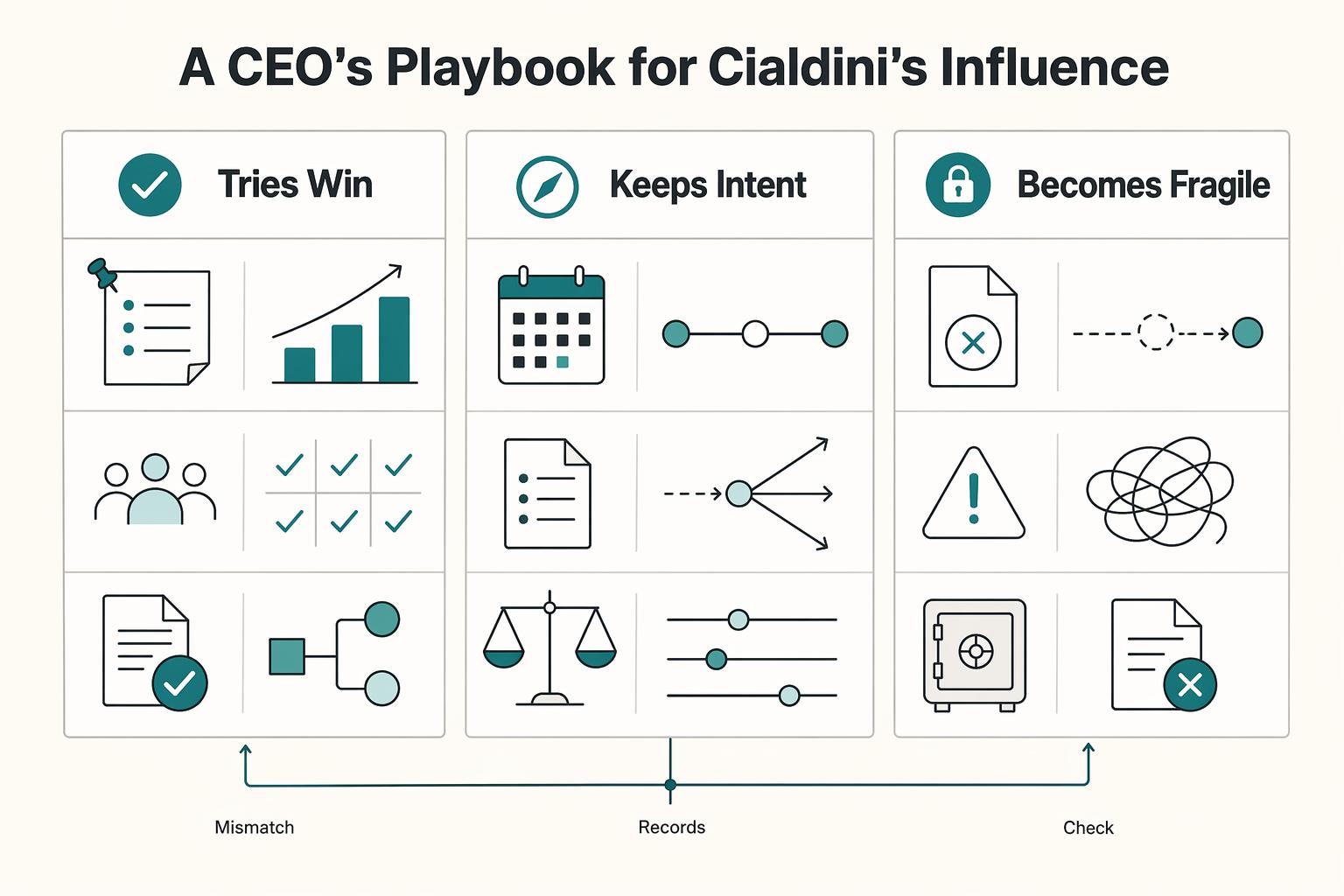
| Tactic-only persuasion | Operating-system approach |
|---|---|
| Tries to win the moment | Makes each decision easy to review later |
| Keeps intent and tradeoffs implicit | Makes intent, options, and tradeoffs explicit |
| Becomes fragile when details get fuzzy | Stays usable because choices and rationale are documented |
Tie each risk to a transparency-first checkpoint. Define what decision is being made now and what is deferred. Record options, tradeoffs, and decision owners in writing. Use informed-consent conditions so people can accept, reject, or question a recommendation with full context.
That is the thread through the rest of the article. Phase 1 covers positioning and project selection. Phase 2 covers delivery control through documented decisions. Phase 3 covers handoff and decision clarity. If your positioning needs tightening first, use How to Create a Unique Selling Proposition (USP) for Your Freelance Business. For related tooling, see The Best SEO Tools for Freelancers.
Phase 1: Positioning - Securing the Right Projects on the Right Terms#
If you want better-fit projects on better terms, make your authority verifiable before you go deep on proposals. This keeps your positioning grounded in evidence, helps you qualify fit earlier, and reduces the risk of signaling urgency or neediness.
Build proof first#
Start with proof, not broad claims. Use a case format built around Authority: client context, business problem, your diagnosis, your recommendation, and the outcome.
If an outcome is not backed by evidence you can recover, label it unverified or pending verification. If the only support is memory, private chat, or anything else you cannot document now, leave it out. Authority is strongest when a careful buyer can inspect what you are claiming without extra explanation from you.
| Less specific positioning signal | Clearer positioning signal |
|---|---|
| Claim-led bio or portfolio | Evidence-led case example with diagnosis and outcome |
| "Available for new work" | Capacity-defined intake with clear start conditions |
| Undocumented discovery | Discovery with a stated scope and output (free triage or paid) |
Set clear capacity boundaries#
Use scarcity as an ethical boundary, not pressure. You are not trying to create urgency for its own sake. You are clarifying the real conditions under which you can do good work: current capacity, the intake window you are reviewing, and when proposal assumptions stop being reliable.
Keep the language plain. Say you are reviewing a limited number of starts. Say proposals hold while current scope and timing assumptions hold. Say deeper diagnosis can become paid discovery once it turns into substantive strategy. Avoid open-ended availability; too many clients can hurt business performance.
Use calls to confirm fit, not invent value#
Once your evidence and boundaries are visible, move qualified conversations to a call. The call is for fit and decision clarity, not for inventing value on the fly.
Use it to confirm fit, decision ownership, timing, and whether discovery needs its own scope before execution starts. If that is still muddy after the call, do not rush into a proposal. Tighten the record first.
A transition checklist for execution#
Before you move into execution, make sure these basics are in place:
| Area | Requirement |
|---|---|
| Evidence-led case example | You have at least one evidence-led case example prepared. |
| Weak outcome claim | Any weak outcome claim is marked unverified or removed. |
| Intake language | Your intake language reflects real capacity boundaries. |
| Proposal conditions | Your proposal states the conditions where assumptions may change. |
| Discovery | Discovery is documented as either free triage or paid scoped work. |
| Next-step expectations | Next-step expectations are written so scope, ownership, and timing are clear. |
For a step-by-step walkthrough, see Color Psychology in Branding for Premium Positioning.
Phase 2: Execution - Running Delivery Through Written Checkpoints#
During execution, goodwill helps collaboration, but it does not replace a retrievable record. A practical control is to treat key decisions as part of a dated record you can find later. If it matters, give it a date, an owner, and a place you can search fast.
Anchor scope in writing#
Use a written scope anchor you can point to, then update it when the work changes. For many projects, that can be an SOW and a short written change note.
Keep the anchor explicit: what is included, what is excluded, and what changes when assumptions move. When a client asks for "one small extra," route it back to the record instead of debating it from memory. Decide in writing whether it is accepted now or deferred to a later phase.
After each scope decision, send a written recap. If you cannot retrieve that recap quickly later, your record system is too loose.
Keep a searchable decision log#
A searchable decision log can be a high-value habit. A shared doc or project page is enough if you update it consistently.
For each entry, capture:
- Decision
- Date
- Owner/approver
- What changed
- What happens next
This helps agreement stay durable after the meeting ends. If timeline progress depends on client input, log that dependency in writing too, with the owner attached.
Set approval gates before work moves downstream#
If you use approval gates, define them before work moves downstream. Typical gates might include strategy signoff, draft approval, pre-launch review, and handoff acceptance. Set the approval format in advance too, such as written approval in email or marked approval in comments.
Used well, these checkpoints keep the process easy to review while making responsibility clearer when interpretation starts to drift.
| Operating area | Memory-first execution | Checkpoint-oriented execution |
|---|---|---|
| Scope control | New requests are handled informally in conversation | New requests are checked against the scope anchor and recorded as accepted now or deferred |
| Rework exposure | Interpretation can shift between calls, chat, and later stages | Stage changes are tied to dated approvals and logged assumptions |
| Escalation handling | Conflicts can rely on memory and message fragments | Conflicts can be reviewed against recorded decisions and approvals |
Close each delivery with a checkpoint note#
Do not end a handoff with just "sent." Close each delivery with a short checkpoint note that states what is included, what remains open, and what decision you need next.
That keeps files, approvals, and dependencies in one place instead of scattered across threads. If you want a stronger script for these conversations, Radical Candor for Freelancers: Scope, Feedback, and Payment Conversations is a useful companion.
Apply this week#
A small process shift here can prevent avoidable confusion later.
- Add one shared decision log to each live project.
- Update approval requests so the response is explicit: approve, revise, or hold.
- Create a one-paragraph written change template tied to your scope anchor.
- End each delivery message with three labels: included, open items, next decision needed.
If you do one thing this week, stop running execution from memory. Keep generosity in the relationship, but run delivery through written checkpoints.
If you want a deeper dive, read GDPR for Freelancers: A Step-by-Step Compliance Checklist for EU Clients. If scope changes keep derailing delivery, draft the next revision in a structured format with the SOW Generator.
Phase 3: Retention - Ensuring Prompt Payment and Building Long-Term Value#
Treat closeout as a clarity system: package what was delivered, who owns what next, and how billing maps to approved work so payment, handoff, and follow-up can tie back to records instead of memory.
Given current source-access limits for this phase, treat the guidance below as a practical closeout checklist, not as a proven performance guarantee.
This phase can reuse the record you built during execution. If scope updates, approvals, and delivery decisions are retrievable, closeout can be a cleaner transfer instead of a scramble.
Build a Value Summary Report#
Build a Value Summary Report as an offboarding packet, not a celebration note. Keep it brief, factual, and tied to materials the client already saw.
| Packet item | Include |
|---|---|
| scope record | original SOW plus approved changes |
| approval trail | major decisions and stage signoffs |
| asset transfer list | files, locations, links, and any access details |
| open items | what is still pending and who is waiting on whom |
| next-owner handoff | the client-side owner after your engagement ends |
If useful for internal clarity, label each result as verified or unverified:
- Verified: traceable to a shared source, approval, or documented observation
- Unverified: directionally promising, but not yet supported by enough shared evidence
Before you send it, run a retrieval test. If you cannot trace each key line back to a dated record quickly, tighten the packet.
| Closeout area | What to document |
|---|---|
| Payment path | Invoice wording that mirrors approved scope and includes required billing reference |
| File context | Approved versions, open items, and any points still marked unverified |
| Ownership clarity | What moved, where it lives, and who owns next steps |
| Follow-up | Optional follow-up tied to documented outcomes or open items |
Run a finance-readiness check before invoicing#
Before you send the invoice, run a short finance-readiness sequence. Treat it as a standard pre-send check to catch mismatches early.
| Check | What to confirm |
|---|---|
| Invoice line wording | Match each invoice line to wording already approved in the SOW or change record. |
| Billing reference | Confirm the billing reference the client requires, such as PO, code, or internal label. |
| Handoff packet | Attach or link the handoff packet so billing and delivery context travel together. |
| Payment route and billing contact | Confirm the agreed payment route and billing contact. |
| Final delivery note | In your final delivery note, restate what was included, what remains open, and what acknowledgment is needed next. |
Language alignment matters. If invoice wording and approved wording do not match, it may require extra clarification.
Send one clear closeout message#
Send one closeout message that puts final assets, the Value Summary Report, and the invoice with the expected billing reference in one place.
Then name the owner for each open item. If no owner is assigned yet, say that directly so it can be resolved. Use written acknowledgment that the packet reached the right contacts as your confirmation point. If follow-up is needed, keep it administrative and specific.
Make retention follow-up optional and specific#
Use retention follow-up as an optional next step tied to documented outcomes. Ask only for what the record supports. If you cannot point to documented results, hold the ask.
- Testimonial ask (optional): reference one concrete problem, one deliverable, and one observable result.
- Referral ask (optional): define the type of project where your work fits.
- Next-phase proposal (optional): connect it to an open item or maintenance need already listed in closeout materials.
You might also find this useful: Using Maslow's Hierarchy to Unblock Client Decisions.
Conclusion: Use Influence as the Operating Logic for Client Decisions#
Use influence as the operating logic for client decisions, not as standalone persuasion lines. Sources describe both six principles and seven levers, so treat the exact count as framing and focus on practical decisions. Keep decisions easy to understand and easy to move forward so you do not lose time in a long sales process.
| Stage | Tactic-only approach | Operations you control |
|---|---|---|
| Positioning | Broad claims and rate defense | Clear offer, concrete proof, and plain-language assumptions/exclusions |
| Execution | Scope handled ad hoc across chats and calls | One current record of agreed scope and key decisions |
| Invoicing | Invoice sent alone | Invoice wording aligned with agreed work and current delivery status |
| Retention | Generic "checking in" | Follow-up with a clear purpose and explicit next step |
Use this checkpoint before your next proposal or invoice:
- Can a client understand your offer, proof, and limits quickly?
- Can you retrieve the latest agreed scope and key decisions quickly?
- Does your invoice language match what was agreed and what is currently delivered?
If any answer is no, fix the record before you add more persuasion.
Do these next, today:
- Rewrite one core offer so the outcome, proof, assumptions, and exclusions are clear in one page or one email. If needed, use How to Create a Unique Selling Proposition (USP) for Your Freelance Business.
- Pick one active client thread and write a single clear next decision to reduce back-and-forth.
- Tighten your next invoice so the description maps directly to agreed work.
- Send one follow-up that asks for a specific next step.
This is the CEO move in a business-of-one. It means clearer decisions and fewer preventable delays.
We covered this in detail in the three-tier operating system for freelancers.
When you are ready to run invoicing and cross-border payout operations in one workflow, review Gruv for Freelancers.
Frequently Asked Questions
How do you handle rate objections without sounding defensive?
Treat rate pushback as a scope decision, not a debate about your worth. Bring the conversation back to the problem, the deliverable, and the option set. If budget is constrained, recommend a narrower or phased path. If the client wants unchanged scope at a lower fee, ask for a scope or timing change before proceeding.
How do you prevent scope creep without turning every request into a fight?
Write the new request down and connect it to its impact on sequence, effort, or timing. Then ask for one decision: approve as a change, defer, or keep current scope. If approval stays vague or verbal, do not start the extra work.
What should you use to document scope-change approval?
Use one dated, retrievable written record that shows the request, the impact, and the client approval. Email, a shared workspace comment, or a formal change note can document the decision, but legal sufficiency depends on your contract and jurisdiction. If you cannot retrieve the approval quickly later, treat it as incomplete.
What do you do when invoice follow-up starts feeling like collection work?
Send a factual follow-up that maps the invoice to approved scope and delivered materials, then request one concrete next step. Keep the ask administrative, such as receipt confirmation or the correct billing owner. If approval is disputed, stop reframing and return to the signed scope, change record, and delivery packet.
How should you handle procurement friction?
Ask for the exact required documents, submission route, and confirming owner before you resubmit anything. Share sensitive information only through official secure channels, such as approved HTTPS portals, not ad hoc routes for sensitive files. If requirements or ownership are unclear, pause and request the responsible procurement contact.
Can you cite persuasion research in a proposal or sales conversation?
Yes, but only after you verify what you repeat from the original record. Confirm a traceable DOI and downloadable PDF are available, then review the source document directly. Treat indexing as discovery, not endorsement, and present unverified points as general guidance.
When should you stop using influence framing and escalate to contract terms?
Escalate when the issue shifts from preference to records, obligations, or disputed approval. At that point, reference the SOW, approved changes, delivery record, and invoice language directly. There is no universal threshold, so use that boundary and escalate earlier when risk grows.
Is it ever appropriate to use scarcity or urgency language?
Yes, but only when the constraint is real and observable, such as actual capacity or sequencing limits. State the constraint plainly and leave the decision with the client. If urgency is mainly pressure, stop and return to clear options and documented choices.
What is the simplest rule for using influence ethically with clients?
Use influence to increase clarity, not to force agreement. State the options, the consequences, and the exact record that will confirm the choice. If that record is not clear yet, document first and decide second.
Try a related tool
Researched and edited by the Gruv editorial team. Gruv builds cross-border billing, payouts, and finance-operations software for global businesses.
Sources
- catalog.southernct.edu/undergraduate/courses.htmltrusted
- commons.erau.edu/cgi/viewcontent.cgitrusted
- journalism.utexas.edu/sites/default/files/sites/journalism.utexas....trusted
- laroche.edu/wp-content/uploads/2025/12/2011-12-Course-Ca...trusted
- openresearch.okstate.edu/bitstreams/871afb18-f9f6-400f-81c7-adf9052ac...trusted
- pmc.ncbi.nlm.nih.gov/articles/PMC11373151trusted
- portal2.fics.edu.py/ysqueezelevelo/zcrackb/3P92E00/060226/influe...trusted
- scholarcommons.scu.edu/cgi/viewcontent.cgitrusted
Educational content only. Not legal, tax, or financial advice.
Related Posts

GDPR Compliance Checklist for Freelancers Working With EU Clients
Start by separating the decisions you are actually making. For a workable **GDPR setup**, run three distinct tracks and record each one in writing before the first invoice goes out: VAT treatment, GDPR scope and role, and daily privacy operations.

LinkedIn for Freelancers Who Want a Predictable Client Pipeline
Treat LinkedIn as two jobs you run at the same time: a credibility check and a conversation engine. If you only chase attention, you can get noise. If you only send messages, prospects may click through to a thin profile and hesitate.

How to Create a Unique Selling Proposition (USP) for Your Freelance Business
Your USP needs to hold up in real buying conversations, not just look polished on a profile. When positioning is vague, clients often compare on price or choose arbitrarily. Start by naming one concrete benefit you can defend with work you already delivered.