
Quick Answer
Build grit for freelancers by running your business with written controls, not mood. Keep a continuity reserve policy from real records, set a max exposure rule for any single client, and maintain a forward cash view with expected inflows and committed outflows. On delivery, require a signed agreement, pause for approved change requests, and keep invoice and timesheet checks on a recurring cadence before small issues become expensive.
Introduction: Forget "Grit." Let's Engineer Resilience.#
If you are relying on willpower alone, you are carrying business risk with your nervous system. For freelancers, that usually shows up in three practical ways: unstable income, pipeline uncertainty, and after-hours workload that can become exhausting.
This article takes a different view. Resilience is something you build, not something you are born with. A better standard is productive worry: turn the stress you already feel into actions that leave you better positioned for the next dry spell. In practice, that means checking whether you have enough client retainers to keep regular work in the pipeline, whether you have at least 3 months' living expenses before a big jump, and whether key business basics, like a freelancer website, are in place before things get messy.
| Mindset-only grit | Engineered resilience |
|---|---|
| "I will push through the slow month." | You have pipeline activity, cash reserves, and a clear next-step list. |
| "I just need more discipline." | You verify readiness with evidence like retainers, savings, and a live website. |
| "I can sort admin out later." | You track admin and delivery tasks early so work does not collide. |
The rest of the article uses a simple operating lens:
- Financial systems: how you create predictability from uneven income and avoid making decisions from urgency.
- Operational systems: how you reduce friction in delivery, communication, and admin so small issues do not become expensive ones.
- Strategic systems: how you choose clients, offers, and commitments from a position of power instead of exhaustion.
That last point matters. Trying to build a freelance business for 2-3 hours after work every day can be exhausting. Resilience is not pretending that is easy. It is designing the business so pressure does not get the final say.
The first place that shows up is money, because if you cannot see risk early, every other decision gets harder.
Related: Growth Mindset for Freelancers Who Want a More Stable Business.
Financial Grit: Are You Building a Balance Sheet or Just a Bank Account?#
Financial resilience is simple to test: can you spot risk early enough to act before it becomes a cash crisis? Since most small businesses do not have a CFO, you are the finance function, whether you enjoy it or not.
A strong account balance alone is not enough. You need three working habits together: a verified continuity reserve, a clear client-exposure policy, and a forward forecast you actually review. Without those, it is easy to fall into money fog: everything feels urgent, but nothing is prioritized.
| Reactive money management | Resilient financial system |
|---|---|
| Behavior | You check your balance when anxiety spikes. |
| Decision quality | You wait until pressure forces a move. |
| Risk exposure | One cancellation or late payment can destabilize operations. |
| Evidence | Memory, inbox, and rough estimates. |
Build a continuity reserve you can verify#
Treat your reserve as a policy, not leftover cash. Define what it is for, what it is not for, and how you calculate it. Set your reserve target based on your runway policy, and verify that target from current finance records before you use it.
Use real records, not memory. Pull recurring business costs, essential owner draw, and committed payments from your bookkeeping or account history, then keep target, current balance, and gap in one place. That tracking habit improves decision quality.
If you are using the same cash for emergencies, new tools, and ad hoc spending, your reserve is not protected yet. Separate it, name it, and verify it from actual expenses.
Set a client exposure policy before one client sets it for you#
Client concentration risk feels manageable until it suddenly is not. A large account can smooth cash flow, but dependency can weaken pricing power and increase delivery fragility.
Set a max-exposure policy for any single client, and verify the threshold from current finance records before you use it. Define early warning triggers and a diversification cadence you will follow even when delivery gets busy.
- Policy: Track each client's share of revenue using one consistent basis.
- Early warnings: A client nears your cap, renewals slow, payments delay, or prospecting pauses because one account expanded.
- Diversification cadence: Keep recurring outreach, referrals, and pipeline review active so one account does not crowd out future options.
If one client is already above your cap, avoid abrupt moves. Freeze added dependency first, then build replacement demand on a timetable you can sustain.
Forecast forward on a fixed rhythm#
Use forecasting to decide early, not to predict perfectly. Keep it current with four inputs: expected cash in, committed cash out, reserve balance, and known decision dates.
| Forecast signal | Response |
|---|---|
| Projected cash drops below your reserve floor | Reduce discretionary spend and increase sales activity |
| One client approaches your exposure cap | Start diversification before renewal pressure |
| Expected inflows are not yet signed | Mark them as uncertain |
Run this on a fixed operating rhythm: a quick recurring check and a deeper assumption review. Decide your triggers in advance so you are not inventing a response under pressure.
Perfectionism creates delay here. A simple forecast you maintain beats a complex one you avoid.
Once your money system is visible, the next step is reducing operational friction before it becomes expensive.
We covered this in detail in The Dunning-Kruger Effect and Imposter Syndrome for Freelancers.
Operational resilience: clear handoffs, records, and a review rhythm#
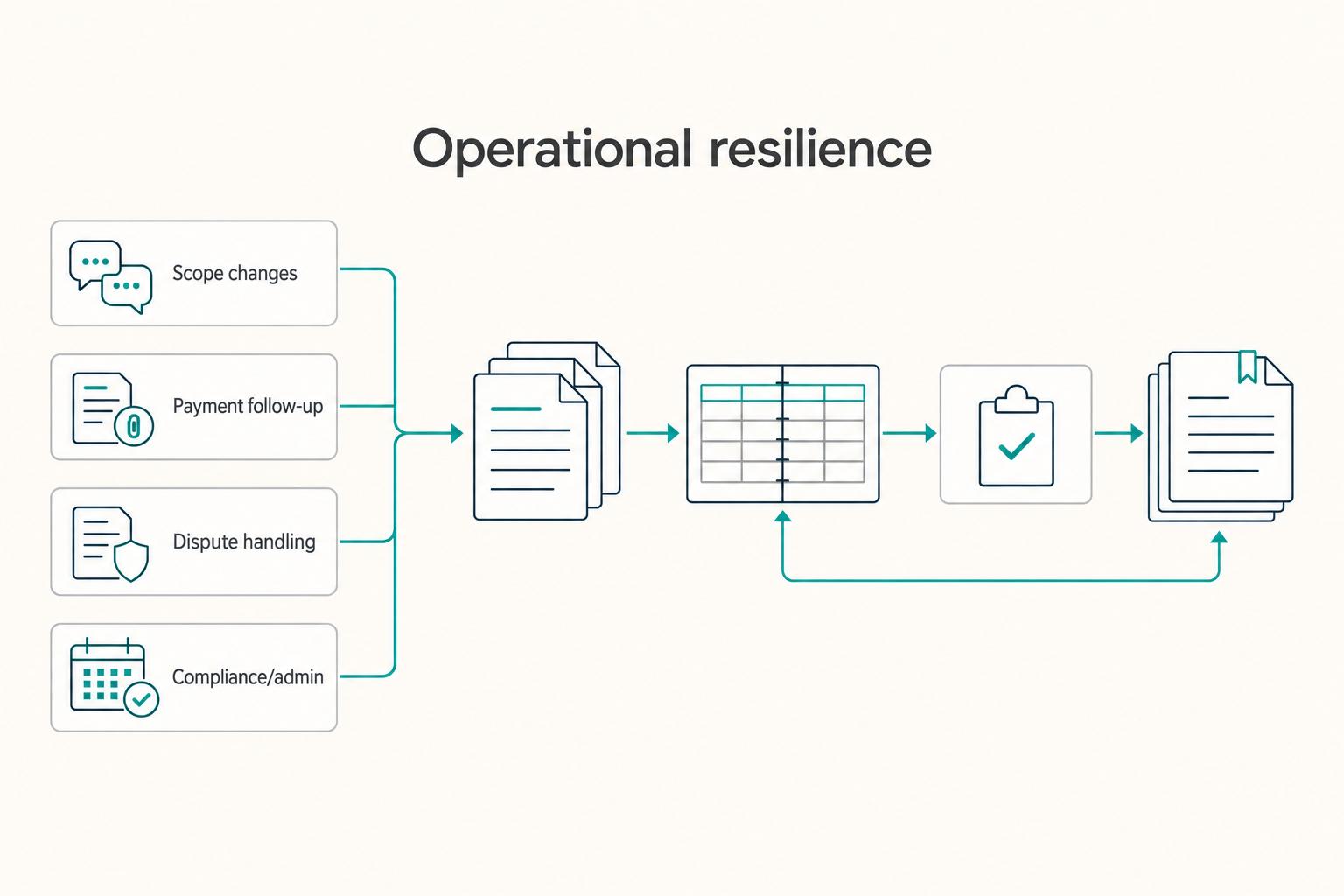
Operational resilience comes from clear handoffs, usable records, and a review rhythm you actually follow. You reduce anxiety when ownership is explicit, records are easy to find, and scope changes are approved before work continues.
Treat your contract like a risk control, not a formality#
Your contract is your first control point: it sets scope boundaries, payment triggers, change approval, and early-exit terms before pressure reshapes expectations. A signed agreement will not prevent every dispute, but it gives you a shared reference when memory and urgency conflict.
Before kickoff, make sure you have one signed version on file, one named client approver, and one place for delivery evidence. In one founder-reported workflow, signing the contract was the explicit handoff between parties, and a shared hours log was the delivery record. If scope shifts after signature, pause and log a change request before continuing work.
| Ad hoc operations | Systemized operations |
|---|---|
| Scope changes | Extra requests are handled in chat and absorbed quietly. |
| Payment follow-up | Invoices are sent inconsistently with limited support. |
| Dispute handling | You rely on memory and scattered messages. |
| Compliance/admin | Key obligations stay in your head. |
Make compliance and admin visible before they become urgent#
Use one lightweight dashboard so obligations show up before they become urgent. The goal is not legal certainty from a sheet; it is to stop relying on memory.
| Obligation | Owner | Trigger | Review cadence | Evidence kept |
|---|---|---|---|---|
| Signed contract on file | You | Before kickoff | Every new project | Signed PDF, version history, approval email |
| Change request log | You + client approver | Scope change requested | Weekly during delivery | Approved change note, revised estimate |
| Invoice and timesheet check | You or bookkeeper | Every week | Every week | Hours log, invoice copy, sent date, payment status |
| Filing or compliance item | You or advisor | Confirm current filing requirement with the relevant tax authority | Set your recurring cadence | Filed copy, receipt, notes |
| Archive and closeout | You | Project completion | Set your recurring cadence | Final files, acceptance email, final invoice |
Quick test: if someone else cannot understand current status from this table in five minutes, your process is still mostly in your head.
Automate repetitive admin first, keep judgment manual#
Automate repetitive admin first and keep judgment-heavy calls manual. Start with invoice creation, reminders, expense capture, and recurring status checks. Keep scope decisions, exceptions, and new workflow design under direct review.
| Workflow step | Handling |
|---|---|
| Invoice creation | Automate |
| Reminders | Automate |
| Expense capture | Automate |
| Recurring status checks | Automate |
| Scope decisions | Under direct review |
| Exceptions | Under direct review |
| New workflow design | Under direct review |
A founder-reported no-code stack reached about $100K GMV before a full web app, and that team still manually prototyped new ideas. Use that as an operating pattern: automate step by step, not all at once, and keep manual checks where context matters.
Set a recurring workflow review and ask: which repetitive step still consumes time, which automation failed quietly, and which manual check should stay manual. When a workflow breaks, retire or fix it quickly instead of trusting it because it worked before.
Clear operations give you bandwidth; strategy determines where you apply it.
If you want a deeper dive, read How to Deal with Imposter Syndrome as a Freelancer.
Strategic Grit: Can Your Business Survive Your Own Decisions?#
Your strategic edge is decision quality. You can choose your projects and schedule, but freelancing also comes with fewer guarantees. So before you say yes, run one triage question: if this goes badly, what is hard to undo?
| Signal | Qualify when | Disqualify when |
|---|---|---|
| Problem clarity | The problem is clear | The brief stays vague |
| Scope and process | Scope is understandable | Your process is resisted |
| Timeline and ownership | Timeline is workable | Urgency is high but ownership is unclear |
| Economics | Economics justify both delivery and admin | Pricing is the only discussion |
| Reputation and capacity | The project supports the reputation you want | The work would crowd out stronger-fit opportunities already in motion |
Use that lens to separate reversible tests, such as small, low-cost experiments, from hard-to-reverse commitments, such as calendar-heavy work, reputation-shaping work, or commitments that drain cash and attention for months. When a choice could steer your client mix or positioning, slow it down even if the short-term revenue looks good.
| Short-term revenue choice | Long-term strategic choice |
|---|---|
| Focus | Fills gaps fast |
| Risk exposure | Higher chance of rushed delivery and messy handoffs |
| Client quality | Often driven by urgency alone |
| Brand position | Can blur what you are known for |
Write your "strategic no" down so it is not just a mood. Qualify work when the problem is clear, scope is understandable, timeline is workable, economics justify both delivery and admin, and the project supports the reputation you want. Disqualify when the brief stays vague, pricing is the only discussion, your process is resisted, urgency is high but ownership is unclear, or the work would crowd out stronger-fit opportunities already in motion.
Your moat is practical, not abstract: specialization, repeatable process, relationship depth, and delivery reliability. Specialization helps the right clients remember you. A clear process helps clients buy with less friction. Deeper context improves judgment and execution. Reliable delivery compounds trust into repeat work.
The payoff is straightforward: fewer regret decisions, faster recovery when one goes wrong, and more control over the opportunities your business attracts next.
You might also find this useful: Ikigai for Freelancers Who Want Purpose Without Business Chaos.
Conclusion: You Are the Architect of Your Autonomy#
Your autonomy does not come from feeling tougher. It comes from doing a small set of repeatable actions often enough that bad weeks do not knock you off course. In practice, that usually means three things: be clear about the work you offer, run a simple execution routine, and keep relationships warm.
Keep the recap simple and operational:
- Service clarity reduces confusion. Be explicit about whether you are delivering defined freelance tasks or advising on broader consulting problems.
- Execution discipline reduces stalls. Keep your work moving with a basic routine: list, schedule, and obey.
- Relationship momentum creates opportunity. Keep showing up clearly and consistently, because one strong connection can open a wider network.
A useful checkpoint is whether you can verify each of those today with evidence, not vibes: a current task list, scheduled execution blocks, and at least one active follow-up with a past client or peer. A common failure mode is getting stuck in one of three places: starting, doing, or finishing. Pressure does not disappear, so make execution boring: list, schedule, and obey.
What to do this week:
- write a one-line positioning statement for the kind of work you want more of
- list your key tasks, schedule them, and follow the schedule
- choose one stalled task and finish it
- contact one past client or peer, because word of mouth often starts with one good relationship and clear presentation
Then keep going.
For a step-by-step walkthrough, see The 'Daily Stoic' for Freelancers: Applying Ancient Wisdom to Modern Work.
Try a related tool
Researched and edited by the Gruv editorial team. Gruv builds cross-border billing, payouts, and finance-operations software for global businesses.
Sources
Includes 2 external sources outside the trusted-domain allowlist.
- digitalcommons.csp.edu/cgi/viewcontent.cgitrusted
- digitalcommons.liberty.edu/cgi/viewcontent.cgitrusted
- healthvermont.gov/sites/default/files/DEPRIP.12321%202020%20Pr...trusted
- law.nyu.edu/sites/default/files/NYU_Law_Magazine_2016.pdftrusted
- snap.stanford.edu/na09/wordsEn.txttrusted
- ufdcimages.uflib.ufl.edu/AA/00/05/43/97/02937/2024-08-20.pdftrusted
- beafreelanceblogger.com/getting-shit-doneexternal
- donnfelker.com/freelancing-vs-consultingexternal
Educational content only. Not legal, tax, or financial advice.
Related Posts

GDPR Compliance Checklist for Freelancers Working With EU Clients
Start by separating the decisions you are actually making. For a workable **GDPR setup**, run three distinct tracks and record each one in writing before the first invoice goes out: VAT treatment, GDPR scope and role, and daily privacy operations.
How to Deal with Imposter Syndrome as a Freelancer
**Freelance impostor feelings can flare when your work lacks clear, documented boundaries-even when you *do* have talent.** You're the CEO of a business-of-one, and your job is to turn shaky moments into repeatable operations.

The Freelance Payment Penalty: A Modeled Audit of Platform Fees, FX Spreads, and Payout Delays
The money rarely disappears through a single, easy-to-spot fee. The real loss is stacked. A marketplace takes its commission, a processor adds a charge for international cards, a bank or payment company converts the currency at a spread, a platform holds the funds before release, and a wire sheds a little to intermediaries on the way in. Each layer looks defensible on its own, but the worker feels the combined result as a smaller deposit and a later payday.