
Quick Answer
Deliberate practice for freelancers means setting aside structured time to improve one weak business skill at a time instead of expecting client work to make you better automatically. Use three practice lanes: sharpen your craft, rehearse pricing and negotiation, and run compliance drills for travel, reporting, and security so your business gets stronger as complexity rises.
Your Business Isn't Your Craft—It's Your Product. It's Time You Practiced It.#
Let's be direct: as a six-figure freelancer, you have already achieved mastery in your craft. Your technical skills are sharp, your portfolio is impressive, and you deliver exceptional work. That expertise got you here. But it is not what will get you to the next level of security and control. The real ceiling on your income, the true source of that low-grade anxiety humming beneath the surface of a successful business, isn't your talent. It's your business acumen.
This is where a dangerous complacency sets in for even the best performers. We become so consumed by delivering for clients that we neglect the business itself, leading to skill stagnation. This isn't about your core skills becoming outdated overnight; it's a slower, more insidious risk. It’s the stagnation of your ability to negotiate, to market your value, to manage complex compliance, and to strategically plan your financial future. This is the root of the "compliance anxiety" that keeps high-performers awake at night—the nagging feeling that you're missing something, that a single unforeseen regulatory change or a shift in the market could undermine everything you've built. When your business skills fail to evolve, your entire operation becomes fragile.
It's time to reframe deliberate practice from a self-help cliché into a strategic business operating system. This isn't about aimlessly "hustling" or simply working more hours. True professional growth comes from a rigorous and systematic approach to improvement. The goal is to transform your Business-of-One from a fragile entity that merely survives shocks into one that is truly antifragile—a business that gets stronger when exposed to volatility and stressors. This framework is built to help you practice and master not just your craft, but the business around it, creating a more resilient and profitable enterprise.
Why "More Client Work" Is the Worst Way to Improve Your Business#
To build that resilient enterprise, we must first dismantle a deeply ingrained myth: that the path to business improvement is paved with more client work. This is a dangerous confusion between two distinct activities: performance and practice.
Client work is your performance zone. The stakes are high, deadlines are real, and your reputation is on the line. In this state, you instinctively deploy your most reliable, time-tested skills—your strengths. Practice, however, is your improvement zone. It is the dedicated, low-stakes environment where you intentionally confront and systematically eliminate your weaknesses. You don’t get better at negotiating by avoiding it on a client call; you get better by scripting and role-playing the scenarios that make you uncomfortable.
Relying solely on performance for growth leads directly to the Performance Plateau. After you've achieved a certain level of expertise, simply accumulating more hours of paid work yields sharply diminishing returns for skill development. You become incredibly efficient at doing the same things, in the same way, over and over. This repetition feels like progress, but it often just reinforces comfortable habits, including the inefficient ones. You're busy, but you're not getting fundamentally better at running your business.
This is where risk begins to creep back into your operation. For a forward-thinking professional, operating on a plateau is the equivalent of holding a depreciating asset. In a market that is constantly evolving with new technologies, shifting regulations, and more sophisticated competitors, a stagnant business skillset dramatically increases your long-term risk. The value you provide today will not be the same value the market demands tomorrow. Deliberate practice is the only reliable method to ensure your business acumen—your true product—compounds in value over time. It is the strategic hedge against future irrelevance. K. Anders Ericsson's foundational work on deliberate practice distinguishes between repeating familiar work and structured improvement with explicit goals, feedback, and increasing difficulty. True growth requires that more rigorous, intentional approach.
Practice the Craft, Commercial, and Compliance Engines of the Business#
Moving beyond naive practice requires more than just good intentions; it demands a system. That’s precisely why we need to stop thinking in terms of disconnected tips and instead install a dedicated "operating system" for strategic improvement. This isn't another to-do list. It's an integrated framework designed to break you off the Performance Plateau and systematically build a more valuable, resilient, and controllable Business-of-One. It’s the methodical approach that turns vague goals into concrete training tasks.
Most freelancers, when they think about skill development, fixate exclusively on their core craft. But your competitors are doing that, too. The real competitive advantage—and the key to mitigating the anxieties that keep you up at night—lies in practicing the business functions they ignore. This OS is built on three interconnected engines that address your entire operation, not just the part your clients see.
Here is the architecture of a truly antifragile freelance business:
- Module 1: The Craft Engine (Mastery): This is the foundation. Here, we systematize the continuous improvement of your core service delivery. We go beyond simply doing more work and implement rigorous processes for deconstructing skills, creating feedback loops, and ensuring you are always operating at the edge of your competence.
- Module 2: The Commercial Engine (Revenue): Your income is capped by your business skills, not your technical talent. This engine focuses on practicing the high-leverage activities that directly increase your revenue—from negotiation and value-based pricing to sales funnel optimization—treating each as a skill to be drilled, measured, and perfected.
- Module 3: The Compliance Engine (Resilience): This is the module your peers neglect, and it's your most powerful tool for building confidence and control. Instead of letting financial and legal complexities create constant anxiety, you will use practice to de-risk your business, turning compliance from a source of fear into a manageable set of routines.
This three-part system redefines practice not as a chore, but as the central strategic activity of your business. In the following sections, we will unpack each of these engines, providing you with concrete tactics to install this OS in your own enterprise. If your first constraint is calendar chaos rather than motivation, start by protecting the work blocks outlined in Deep Work for Freelancers Who Run a Business of One.
Module 1: The Craft Engine - Mastering Your Core Skillset#
Let's begin by installing the first and most foundational module of your Deliberate Practice OS. As a seasoned professional, you already know the core principles of deliberate practice: specific goals, intense focus, immediate feedback, and constantly operating at the edge of your competence. The objective here isn’t to learn these concepts; it's to build a reliable system that forces you to execute them, turning your craft from something you simply perform into something you relentlessly refine. This engine is designed to ensure your core value to the market doesn’t just persist—it compounds.
The first step is to dismantle ambiguity. Vague goals like "get better at Web App Development" are useless for practice. True mastery requires precision. To achieve this, we use a tool called The Deconstruction Matrix. This is a simple but powerful method for breaking a macro-skill into a granular tree of underlying micro-skills that can be individually practiced and improved. It transforms an abstract ambition into a concrete project plan for your own skill development.
Here’s how you might deconstruct "Web App Development":
| Macro-Skill | Component Skills | Micro-Skills (Practiceable Chunks) |
|---|---|---|
| Web App Development | Frontend Frameworks | Mastering React Hooks for state management |
| Backend Logic | Building secure API authentication protocols | |
| Database Management | Writing optimized SQL queries for large datasets | |
| User Experience (UX) | Improving user onboarding conversion flows |
With this clarity, you can isolate a micro-skill like "API authentication" and design a specific, focused practice session around it, rather than just doing more unfocused client work.
Solving the Freelancer's Feedback Loop#
The most significant challenge for any independent professional is the absence of built-in feedback. Unlike a traditional environment, you don't have a manager reviewing your work or a team to challenge your assumptions. Your OS must therefore artificially create these feedback mechanisms. Relying solely on a client’s final verdict is insufficient because it comes too late and is often too polite to be useful. Here is a three-tiered system to solve this:
- 1. Quantitative Feedback: You need objective, undeniable data. Instead of guessing which proposal headline is more effective, A/B test them and track the response rates. If you build landing pages, use analytics to measure which calls-to-action actually drive conversions. This is the market giving you direct, unbiased feedback on your commercial craft.
- 2. Peer "Red Teaming": Before you deliver a critical project, invite a trusted peer to actively try and break it. This is not a request for praise; it is a structured "red team" exercise with one goal: find the flaws. Provide your peer with a clear directive, such as, "Review this system architecture and identify the three most likely points of failure." This single practice builds immense resilience into your work and de-risks your client delivery.
- 3. The Post-Project Debrief Script: Most freelancers end a project with "Thanks for the opportunity!" and hope for a testimonial. A professional practicing their craft goes deeper. You need to elicit actionable criticism with precise questions. Stop asking, "Were you happy with the project?" Instead, ask targeted questions designed to uncover friction:
- "What was the single biggest moment of confusion or frustration in our process together?"
- "At what point did you feel the most risk or uncertainty about the project's direction?"
- "If we were to do this all over again, what is one thing you would have me do differently to make it a 10/10 experience?"
These questions replace ego-stroking with invaluable data, providing the high-quality feedback necessary for genuine growth. This is how you build a craft that is not just expert, but exceptionally robust.
Module 2: The Commercial Engine - Practicing the Skills That Drive Revenue#
While strong craft ensures you deliver exceptional value, it's your commercial skill that determines what that value is worth. Your income as a freelancer is ultimately capped not by your technical expertise, but by your ability to price, negotiate, and sell. This is often the most neglected area for practice because the stakes feel high and the feedback is often delayed or ambiguous. This module installs a system to change that, allowing you to practice the highest-leverage activities that directly fuel your revenue.
Negotiation Drills#
High-stakes client conversations are not the time for improvisation. To gain control over these interactions, you must practice them with the same intensity you apply to your craft. As former FBI lead international kidnapping negotiator Chris Voss famously stated, "When the pressure is on, you don’t rise to the occasion—you fall to your highest level of preparation." Reading a book on negotiation is passive; true skill development comes from live practice.
Start by scripting your responses to the three most common and uncomfortable scenarios you face. These might include defending your pricing, managing scope creep, or responding to a request for a discount.
For example, here is a clear, repeatable script for scope creep:
"That's a fantastic idea, and I can see how it would add significant value. It falls just outside the scope of our current agreement, but I would be happy to prepare a separate proposal outlining the timeline and investment for it. Would you like me to put that together for you?"
Write these scripts down. Then, find a trusted peer or a coach and role-play them. The goal isn't to memorize lines, but to internalize the logic and deliver it with calm authority until it becomes second nature. If pricing pushback is where you tend to freeze, pair this drill with How to Negotiate a Higher Rate with a New Client and rehearse both together. This is the essence of deliberate practice: turning a high-anxiety moment into a predictable, manageable process.
Value-Based Pricing Simulations#
Many professionals default to pricing their services based on hours or market rates, which immediately commoditizes their expertise. Shifting to a value-based model—where you price based on the return on investment (ROI) for the client—is the single most powerful lever for increasing your income. But it requires a different kind of thinking that must be practiced.
Here is your training exercise:
- Select three of your most successful projects from the past year.
- For each one, ignore what you charged. Instead, build a detailed, conservative estimate of the financial value your work generated for the client. Did you increase their revenue? Reduce their costs? Mitigate a significant risk? Quantify it.
- Based on that ROI, calculate a new price that represents a fraction (perhaps 10-20%) of the total value you created.
- Finally, write a one-page mock proposal for each, justifying the new price entirely on the basis of that projected client value.
This exercise costs you nothing but time, yet it builds the analytical and communication muscles required to stop selling your labor and start selling business outcomes.
The Proposal Conversion System#
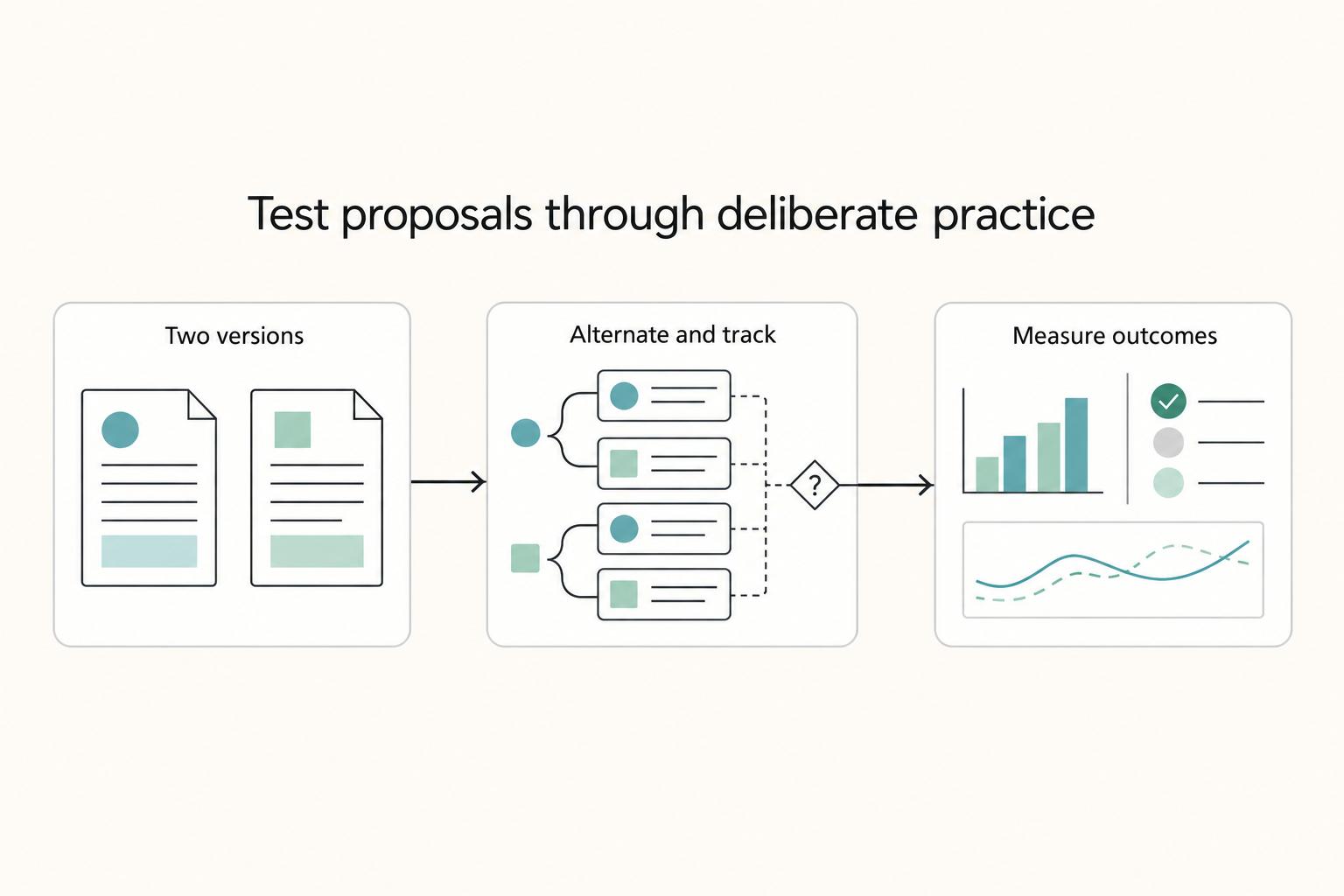
Your proposals are not just documents; they are a critical product in your sales pipeline. And like any product, they can be systematically improved. Stop sending proposals into a void and hoping for the best. Instead, build a feedback loop directly into your sales process.
For the next quarter, commit to this experiment:
- Create Two Versions: Develop two distinct proposal templates. Template A might be process-focused, detailing every step of your methodology. Template B could be ROI-focused, leading with the business case and keeping implementation details brief.
- Alternate and Track: Send Template A to your first prospect, Template B to the second, and so on.
- Measure Everything: Track the close rate for each template. Note which one generates more questions, which one leads to faster decisions, and which one converts higher-value clients.
After a few months, you will have hard data—not just a gut feeling—about what kind of argument resonates most with your ideal buyers. You will have transformed your sales approach from a guessing game into an engine for mastery that you can continually tune and refine.
Module 3: The Compliance Engine - Using Practice to Mitigate Catastrophic Risk#
A strong commercial engine increases revenue; a resilient compliance engine protects it. This final module addresses the primary source of ambient anxiety for the global professional: catastrophic risk. It's how you transform that nagging fear of "what if" into a quiet confidence that comes from being in complete control.
This is not about becoming a tax lawyer. It is about developing a rhythm of practice that turns complex, high-stakes variables into familiar, manageable inputs.
- Residency "Fire Drills" You cannot afford to manage your physical presence by gut feeling. Once a quarter, schedule 30 minutes to run "what-if" scenarios. Use the EU short-stay calculator to check Schengen exposure, and for U.S. professionals compare that travel against the IRS physical presence test. Ask practical questions: "A potential client wants me on-site in Lisbon for a three-week project in July. How does that affect my Schengen 90/180-day clock?" Or, "If I take that project, what does it do to my 330-day FEIE requirement?" This simple, proactive exercise detaches the anxiety from the calculation. By practicing the math when the stakes are zero, you build the muscle memory to make clear, data-driven decisions when a high-value opportunity lands in your inbox.
- Financial Threshold Modeling Compliance penalties rarely come from malice; they come from neglect. One of the most common tripwires for U.S. professionals abroad is the FBAR threshold, which requires reporting if the aggregate value of foreign financial accounts exceeds $10,000 at any point in the calendar year. Keep both Publication 54 and the IRS FBAR guide bookmarked, then practice proactive monitoring. Once a month, create a simple projection of your aggregate foreign balances for the next 60 days. This pairs well with the routines in Freelance Financial Management That Protects Cashflow First. You’ll see a threshold approaching weeks in advance, allowing you to manage your funds and prepare documentation calmly.
- The Annual "Tech Stack" Security Review
Your operational infrastructure—the collection of software, cloud services, and hardware you use—is a critical compliance surface. Your business doesn't just run on this tech stack; it is the tech stack. Treat its security and efficiency as a skill to be maintained. Use the NIST Cybersecurity Framework as your review baseline, and if your work depends on travel or untrusted networks, cross-check your setup against our Digital Nomad Cybersecurity Blueprint for Client-Trusted Remote Work. Schedule a recurring annual practice session to perform a full review.
- Vulnerability Check: Are all your software licenses current? Have you enabled multi-factor authentication on every critical service? When was your last password audit?
- Data Integrity Drill: Where is your client data and intellectual property stored? Is it backed up to at least two geographically separate locations? Run a test restore of a critical file to ensure your system actually works.
- Tool Efficiency Audit: Are you still using the most secure and efficient tools for invoicing, project management, and communication, or are you clinging to legacy software out of habit?
This scheduled review transforms operational security from a vague worry into a concrete set of actions. It’s the ultimate expression of professional growth: taking full ownership of not just the work you do, but the resilience of the system you use to do it.
Conclusion: From Freelancer to Antifragile Enterprise#
The power of this framework lies not in any single technique, but in its integration. The common thread connecting these modules is a fundamental shift from merely doing the work to systematically improving the business that delivers the work. This is where deliberate practice evolves from a simple tool for skill development into a powerful operating system for your entire Business-of-One.
The 3-Part OS—uniting your Craft, Commercial, and Compliance Engines—provides a holistic blueprint for this transformation.
- Mastery of your craft ensures you can deliver immense value.
- Practice on your commercial skills ensures you can capture that value.
- Drills on your compliance obligations ensure you can protect that value for the long term.
This integrated system is how you build a business that doesn't just withstand market shocks and uncertainty but is strengthened by them—becoming truly antifragile. It’s about creating a business that thrives on change rather than fearing it.
This ultimately architects a new relationship with your work. Stop being a reactive freelancer managed by the whims of your inbox and anxieties about risk. Start practicing as the strategic CEO of your own enterprise. This mindset shift requires you to think in terms of systems, not just projects, and to invest in your own capabilities as your most critical asset. The result isn't just more income or a more impressive portfolio. It is the profound peace of mind that comes from knowing you are in complete control, stewarding a resilient business you built with intention.
Frequently Asked Questions
How do freelancers measure the ROI of deliberate practice?
Measuring the return on this investment requires looking at both tangible and intangible gains. Tangible ROI includes higher proposal win rates, increased project fees from value-based pricing, and avoided compliance penalties. Intangible ROI includes steadier control over compliance risk, greater confidence in high-stakes negotiations, and the strategic growth that makes your business antifragile.
What are examples of deliberate practice for freelance consultants?
Consultants can practice diagnostic acumen by analyzing past project briefs to identify unstated client problems. They can perform objection-handling drills by recording and critiquing their responses to common pushbacks. They can also practice data synthesis by creating executive summaries of dense industry reports under a time limit to build the muscle for delivering clear, actionable insights.
How can a freelancer create their own feedback loop without a manager?
A freelancer can create feedback loops by assembling a 'Personal Board of Directors' of trusted peers for quarterly reviews, using self-generated feedback by recording and analyzing sales calls, and systematizing client feedback with structured post-project surveys that ask for specific, actionable insights rather than general satisfaction.
What is the difference between deliberate practice and client work?
Client work is performance, where you rely on your existing strengths to produce a result for a client. Deliberate practice is improvement, where you systematically target your weaknesses in a low-stakes environment to build new strengths. The goal of performance is a paid invoice; the goal of practice is a higher level of capability.
How much time should a freelancer dedicate to deliberate practice?
Consistency is more important than intensity. A realistic and sustainable approach is to dedicate 5-10% of your total work time to it. For a 40-hour work week, this means 2-4 hours of scheduled, structured improvement. Treat this time as a critical investment in the future value of your business, not as 'non-billable time'.
Can you apply deliberate practice to soft skills like client communication?
Yes, by deconstructing the 'soft' skill into concrete, measurable actions. For example, instead of practicing 'communication,' practice 'writing a weekly project update email that reduces client anxiety.' Set a specific goal (e.g., receive zero 'just checking in' emails) and establish a feedback loop by analyzing the results and iteratively improving your process.
Researched and edited by the Gruv editorial team. Gruv builds cross-border billing, payouts, and finance-operations software for global businesses.
Sources
Includes 1 external source outside the trusted-domain allowlist.
Educational content only. Not legal, tax, or financial advice.
Related Posts

GDPR Compliance Checklist for Freelancers Working With EU Clients
Start by separating the decisions you are actually making. For a workable **GDPR setup**, run three distinct tracks and record each one in writing before the first invoice goes out: VAT treatment, GDPR scope and role, and daily privacy operations.

Digital Nomad Health Insurance Comparison for Long-Stay Moves
Use focused time now to avoid expensive mistakes later. Start with a practical `digital nomad health insurance comparison`, then map your route in [Gruv's visa planner](/tools/visa-for-digital-nomads) so we anchor policy checks to your real plan before pricing pages pull you off course.

Invest in Your Freelance Business by Protecting Cashflow First
Start with payment reliability before you buy another growth tool. Courses, coaching, and software can help delivery, but they do not protect cashflow when payment is delayed, disputed, or never sent. A practical move is to make each engagement payable, traceable, and harder to derail from kickoff to settlement.