
Quick Answer
Treat crucial conversations for freelancers as formal decision points. When a client request changes deliverables, timing, or billing, tie the discussion to the current Statement of Work or a new Change Order, then confirm the result in writing before continuing. Use a short prep sequence: facts timeline, affected milestone or invoice, clause check, and one decision needed. This approach keeps scope and approvals from drifting into verbal assumptions.
Start with the freelancer reality, not corporate training#
For freelancers, the conversations that matter most are not abstract leadership exercises. They are the calls and messages where a client asks for more than the agreed scope, pays late, misses approvals, questions quality, or wants urgent work without changing the budget. That is the setting here. Not theory, but decisions that affect cash flow, delivery, and trust.
If you have looked into difficult-conversation advice before, you have probably seen corporate leadership frameworks. Those can be useful reference points, but freelancers need the client-facing version. The stakes are usually immediate and practical: whether work continues, whether an invoice gets paid, whether a deadline moves, and whether the relationship stays healthy enough to keep.
That difference matters because freelance pressure changes behavior. One firsthand account on Louder Than Ten puts it bluntly: "More often than not, we learn the hard way." The same piece ties scarce money to bad decisions: "We panic when money is scarce and make bad decisions." Another freelancer story is harsher still, describing mistakes that "led to me suing a client in small claims court." This guide starts from that reality. Working solo means managing client dialogue, time, money, and risk at the same time.
So the promise here is practical: clear language for what to say, when to say it, and what to document right after the call so the decision does not disappear into a vague verbal agreement. The goal is not to help you sound polished for its own sake. The goal is to help you leave the conversation with a usable outcome: a yes, a no, a reset, a written change, or a pause.
Just as important, this is not a review of course pricing, certification, or reported outcomes. The focus stays on what you can control: preparation, wording, boundaries, and records.
If you want one rule from the start, use this: whenever a client conversation could change the work, the timing, or the money, treat it as a business event, not casual chat. That mindset can cut down avoidable surprises. It also leaves you better protected if a disagreement later turns into a billing dispute, a stalled project, or something more formal.
Related: A guide to 'Bullet Journaling' for freelancers.
Define crucial conversations in freelancer terms#
For a solo operator, an important conversation is any client conversation that can change the work, the timeline, or the money. These are not routine check-ins; they need formal handling, not casual follow-up.
In practice, treat these as important conversations:
- Scope changes, added deliverables, or extra revision rounds
- Deadline shifts, approval delays, or priority resets
- Quality concerns that affect acceptance of work
- Payment exceptions, delayed payments, or term changes
This is different from feedback style alone. Radical Candor helps with how you deliver feedback; important conversations decide what each side is now committing to. If you want the feedback-side framework, see A guide to 'Radical Candor' for giving and receiving feedback.
Use one hard rule: if the discussion can change your Statement of Work or Payment Terms, treat it as a formal business event. Take notes, restate the decision in writing, and update the relevant agreement before you continue work.
You might also find this useful: A Guide to 'Deep Work' for Freelancers.
Map the conversations every freelancer must handle#
Map these moments upfront. If a client request touches your Statement of Work, timing, revision process, or Payment Terms, treat it as a formal business event and confirm decisions in writing before work continues.
| Conversation moment | Contract anchor | Trigger to act | Do not skip |
|---|---|---|---|
| Scope increase | Change Order | Work requested outside the Statement of Work | Get written sign-off on added work, fee, and timeline before starting it |
| Delayed client inputs | Scope of Work | First missed milestone, approval, content handoff, or asset delivery | Send a written reset of dependencies and dates before continuing on the old schedule |
| Payment delay | Payment Terms | Invoice passes the agreed due date and is overdue | Confirm amount due, invoice ID, and expected payment date in writing |
| Quality dispute | Revision Limit Clause | Feedback asks for extra rounds, new direction, or rework outside the agreed revision process | Restate the revision limit and acceptance criteria in writing before revising |
| Offboarding | Termination Clause | Either side wants to end or pause work under contract terms | Confirm the termination terms and remaining obligations in writing |
The risk in these moments is interpretation, not tone. "Small" add-ons can compound into substantial extra work, and undocumented decisions let both sides walk away with different versions of the deal.
Use one checkpoint after every call: confirm who approved what, which clause controls the next step, and what document changed. If there is no updated Change Order, Payment Terms, or written recap, you are still working from a verbal draft.
Need the full breakdown? Read Ikigai for Freelancers Who Want Purpose Without Business Chaos.
Prepare before the call so you do not negotiate from emotion#
Prepare a short evidence pack before the call so you can make decisions from facts, not pressure. Keep it in this order:
| Prep item | Details |
|---|---|
| Facts timeline | What was requested, approved, delivered, missed, or disputed, with dates |
| Affected deliverables | The exact milestone, asset, revision round, or invoice involved |
| Contract references | The relevant Scope of Work, Revision Limit Clause, and any payment or termination language already in force |
| Decision needed | One sentence on what must be decided on this call |
Set your outcomes before the conversation starts: your preferred result, acceptable fallback, and walk-away condition. That walk-away condition is your BATNA, and for client work it should connect to the Termination Clause or a pause until terms are reset in writing.
Script only your opening lines so they stay factual and non-accusatory. For example: "I want to confirm what changed since the original Scope of Work and decide whether we are updating scope, timeline, or both."
Before you end the call, confirm three checkpoints out loud: who approves, what changes today, and what gets documented by end of day. Then send the recap. If the updated written confirmation is missing, you are still operating on a verbal draft.
For a step-by-step walkthrough, see A Guide to Local SEO for Freelancers.
Handle scope change requests without giving away free work#
Treat any request that changes deliverables or adds effort beyond the Statement of Work as a scope change, not a favor. The working rule is simple: if scope or effort changes, pause and get a Change Order (or equivalent written scope update) approved before you start.
Scope creep often starts as a friendly ask, not an obvious conflict. The risk is not the tone. The risk is that a verbal "quick add-on" changes expectations while the written Scope of Work does not.
| Situation | When it fits | What you say | Documentation before work continues |
|---|---|---|---|
| Minor clarification, no fee change | Request stays inside the current deliverable and within agreed revision boundaries | "I can include that within the current scope because it clarifies the agreed deliverable." | Email recap confirming the clarification and that scope/timeline stay unchanged |
| Formal Change Order | Request changes deliverables, increases effort, or affects timeline beyond the Statement of Work | "This is outside the current scope. I can proceed once we approve a Change Order and update timing." | Written Change Order or updated Scope of Work with explicit approval |
| Out-of-scope rejection with alternatives | Request falls outside this engagement or this phase | "That is outside the current agreement, so I cannot include it in this phase. We can price it separately later, or keep current scope unchanged." | Written note confirming no change to the current Statement of Work |
Before you decide, check the ask against the exact contract items: deliverables, revision-round limits, and change-order language. If any of those change, formalize first, then continue work.
Keep the conversation calm and specific#
Use a simple sequence:
- Acknowledge the business need.
- Restate current scope.
- Present options.
- Ask for explicit written approval.
Example: "I understand why you want to add that. Under the current Scope of Work, we are delivering X within the agreed revision rounds. If you want to add Y, I can send a Change Order and adjust timeline, or we can keep scope as is. Please confirm in writing before I proceed."
This keeps trust intact while anchoring decisions to the agreement. The common failure mode is an agreeable call, resumed work, and no written scope update; later, one side treats the add-on as included and the other treats it as extra.
For long-term clients, a one-off small clarification can support goodwill. Repeating that exception creates precedent risk. If you make an exception, label it clearly: this one is included, future changes that alter deliverables or effort require a Change Order first.
We covered this in detail in Crossing the Chasm for Freelancers Without Operational Chaos.
Discuss rates and payment terms without damaging the relationship#
Money conversations stay productive when you treat them as contract maintenance, not personal conflict. Tie each rate, billing, or collection decision to your existing Payment Terms, and complete the matching admin update the same day.
Timing is the leverage point. Discuss rate increases before a renewal, extension, or new milestone starts, not after delivery. For deposits and milestone billing, align terms before kickoff or before the next phase begins so both sides can decide with clear expectations.
| Money conversation | Best timing | What you say | Operational follow-up |
|---|---|---|---|
| Rate increase | Before renewal or before the next milestone starts | "For the next phase, my rate will be updated. If you want to continue, I'll revise the quote and invoice terms before work begins." | Update the proposal or contract, revise the invoice amount, and get written approval before starting the new phase |
| Upfront deposit | Before project start or before restarting paused work | "I can begin once the deposit is paid under the updated Payment Terms." | Issue the deposit invoice, confirm the payment link works, and do not move status to active until payment is received |
| Milestone billing | Before work is split into phases | "To match delivery to payment, I suggest billing by milestone under revised Payment Terms." | Create milestone invoices, define due dates per milestone, and track each stage as sent, paid, or overdue |
| Overdue invoice | As soon as the invoice passes the agreed due date in the Payment Terms | "That invoice is now past the agreed payment date. Please confirm when payment will be made so we can keep the project on track." | Send the reminder in writing, log the commitment date, and pause or continue work based on what your terms allow |
After the call, confirm that your records match what was agreed. If you switched to milestone billing but the invoice still shows one final balance, the terms were not actually implemented. Also verify that the client received the correct invoice and that the payment link works.
Cross-border engagements need one extra check before you finalize terms. For EU VAT, do not assume every scheme applies: One Stop Shop (OSS) supports registration in one Member State for certain declarations and payments, cross-border B2C VAT e-commerce rules changed from 1 July 2021, the OSS page references a EUR 10 000 EU-wide threshold, and the cross-border SME scheme includes a EUR 100 000 turnover cap with a process that should not take longer than 35 working days when eligible. If VAT treatment is complex, VAT Cross Border Rulings (CBR) can be requested for planned transactions.
For privacy, confirm requirements in writing before signing or invoicing. This section's grounding does not define GDPR obligations, so treat GDPR points as items to verify with the client and your advisor, then document them in your terms. Use GDPR for Freelancers: A Step-by-Step Compliance Checklist for EU Clients if helpful, and see Thailand's Long-Term Resident (LTR) Visa for Professionals for broader cross-border planning context.
Resolve timeline slips and quality feedback with clear boundaries#
When timelines slip or feedback gets messy, set boundaries first: identify the cause, then reset delivery and quality on separate tracks.
Start by separating the issue before you propose a fix:
- Client-side delay: late assets, approvals, or other dependencies.
- Freelancer capacity issue: overcommitment or unrealistic scheduling.
- Requirement change outside the Scope of Work: new direction, new deliverable, or major rewrite.
Use a short factual record in your message or call notes: original milestones, input due dates vs. received dates, completed feedback rounds, and the relevant Scope of Work and Revision Limit Clause language. This keeps the discussion concrete instead of turning into vague blame.
Then run a two-track reset:
- Delivery reset: confirm new dates, dependencies, and owners in writing.
- Quality reset: define what "accepted" means for this milestone and align it to the Revision Limit Clause.
Make the boundary explicit: if feedback stays within the agreed revision boundary, handle it under the current agreement; if it goes beyond that boundary, convert it to a paid Change Order before doing extra work.
To prevent repeats, set one sign-off checkpoint per milestone: name who approves and what "accepted" means in writing. Clear scope, deliverables, and timelines are still the strongest defense against scope creep and project chaos.
Choose the right move and close the loop in writing#
After you separate delay, quality, and scope, choose one path based on trust and written commitments, not how the call felt. If the client will not accept a written reset, treat the relationship as unstable.
Trust is the filter. When communication is inconsistent, feedback keeps changing, or payment and replies only happen after reminders, the relationship is starting to crack.
Pick one of four exits#
| Option | Use when | Action |
|---|---|---|
| Push back | A request is outside the current Statement of Work, but the client is still responsive and acting in good faith | Restate agreed deliverables, decline the extra work as framed, and offer an in-scope path |
| Renegotiate | The project is still worth doing, but timeline or commercial terms no longer fit reality | Update the Statement of Work, issue a Change Order, or revise Payment Terms before more delivery |
| Pause work | Commitments are repeatedly broken, approvals drift, or reliability is slipping | Pause delivery until terms are re-confirmed if commitments keep being missed and no written reset is accepted |
| Trigger the Termination Clause | Trust is gone, revised terms are not honored, or risk now outweighs value | Follow the Termination Clause in your agreement instead of improvising an emotional exit |
Some small projects can become long relationships, even multi-decade ones. That upside usually comes from delighting reliable clients and building repeat business, not from absorbing disorder indefinitely.
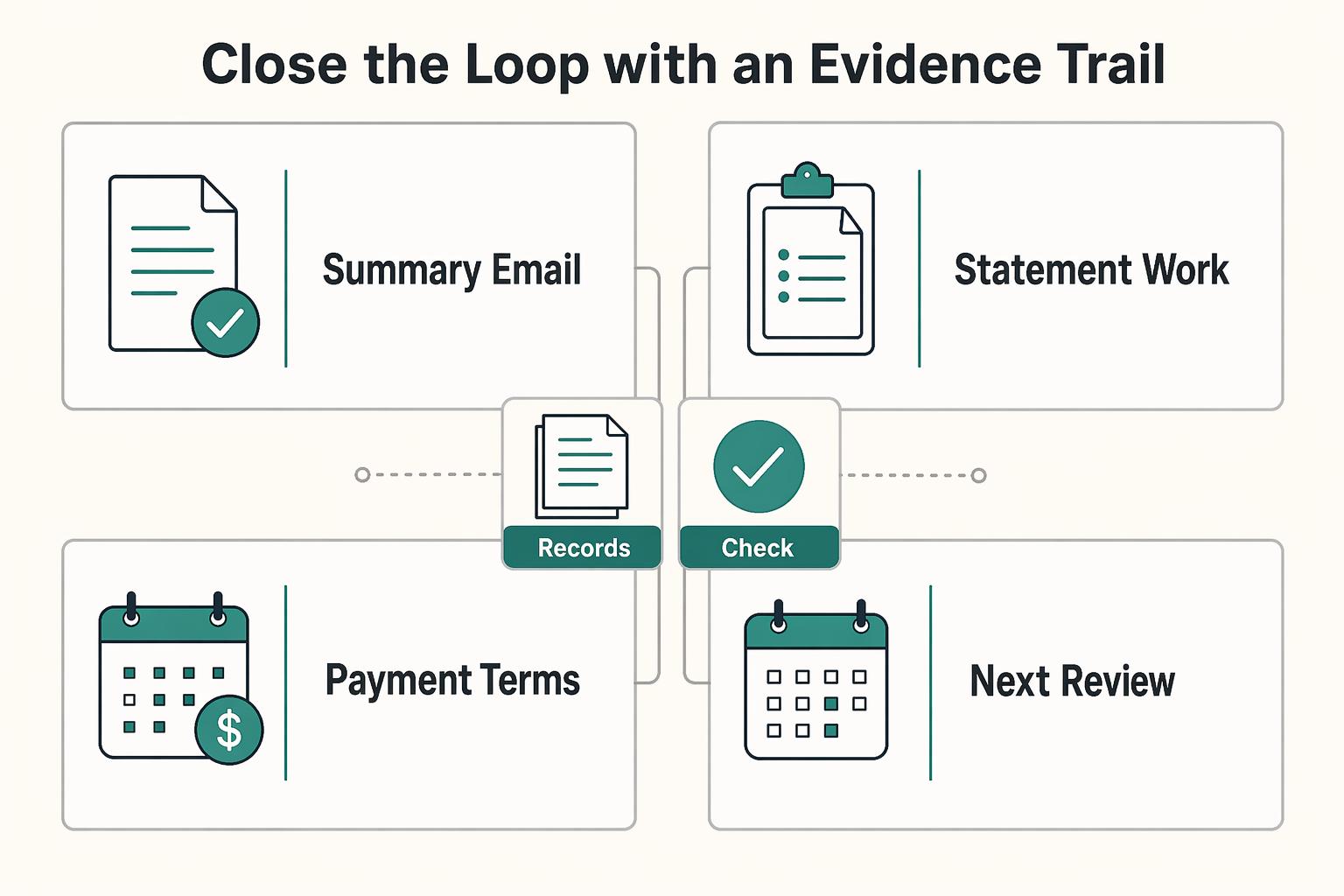
Close the loop with an evidence trail#
Send the paper trail the same day. Include:
| Record | Details |
|---|---|
| Summary email | What was decided, what was not decided, and who owns the next action |
| Statement of Work or Change Order | The updated Statement of Work or Change Order |
| Payment Terms | Any revised Payment Terms |
| Next review date | The next review date and the person authorized to approve it |
Your checkpoint is written confirmation in your contract or billing channel, not "we had a good call." Resuming work before documents are updated is a common path to invoice disputes.
Keep records traceable by matching the final email, contract update, invoice, and approval date. That helps with invoicing, compliance checks, and future disputes when client rules differ by country or program. If you work with EU clients, check whether your documentation also aligns with privacy obligations in this GDPR guide for freelancers.
This pairs well with our guide on Good Strategy Bad Strategy for Freelancers in a Three-Tier Operating System.
Use difficult conversations as an operating advantage#
Difficult client conversations are part of normal freelance practice, so use them as an operating tool, not a warning sign. The goal is to turn tension into a clear decision, an updated agreement, and cleaner execution.
When friction shows up, focus on controllable inputs. State the facts without blame, name the decision needed now, and confirm who does what next. If a call ends with only verbal alignment, the work is not finished.
Start with the next real conversation#
Pick one upcoming client conversation and prepare a minimal pack:
- the current agreement
- the affected deliverable, invoice, or timeline
- the one decision you need today
Then run a short check:
- What business fact can I state clearly?
- What decision or approval is required today?
- What is my boundary if the reset is not confirmed in writing?
Close the loop the same day#
Send a same-day written recap with the decision, open items, owner, and next review date. If the outcome changes a Statement of Work, Change Order, or Payment Terms, attach the update or say exactly when it will be issued.
Consistency beats perfect wording. You cannot control every client response, but you can control preparation, plain language, and documented decisions every time.
Related reading: The 'Daily Stoic' for Freelancers: Applying Ancient Wisdom to Modern Work.
Frequently Asked Questions
What are important conversations for freelancers in plain language?
They are client talks where boundaries, expectations, timelines, payment, or the working relationship are at risk. If the outcome could materially affect how you work together, treat it as a business conversation, not a casual check-in. Clear communication matters here because it helps protect both the relationship and your well-being.
When should a freelancer start a difficult client conversation instead of waiting?
Start when you can name a clear trigger and objective, even if you do not feel fully comfortable yet. A practical checkpoint is: you can state what changed, what you need, and what outcome you want. Waiting usually gives vague expectations more time to turn into misunderstandings.
How do you discuss scope creep without sounding defensive?
Use clear, respectful language and state your need without blame. A simple pattern is an "I" statement plus options: "I want to keep expectations clear. This request is outside the current scope, so we can either keep the original deliverables or agree on an updated scope." This is usually stronger than soft, vague phrasing.
How do you ask for late payment professionally while protecting the relationship?
Keep the message short, factual, and respectful. State what you need and ask for a specific update on timing, using "I" language instead of accusations. The goal is clarity, not confrontation.
Should freelancers take Important Conversations training or just use a lightweight process?
A lightweight process is enough to start: define your objective before the conversation, gather the key facts, decide your boundary, and communicate it clearly and respectfully. Formal training is optional; this section does not establish specific outcomes from any course.
What should be documented right after a difficult client call?
Capture the key points in writing so expectations stay clear. Keep it practical: what was agreed, what is still open, and what you need confirmed. The goal is to reduce ambiguity and prevent future misunderstandings.
How do I decide whether to renegotiate or end the engagement?
Renegotiate when both sides are willing to reset expectations and boundaries clearly. Consider ending the engagement when boundaries are repeatedly ignored after clear, respectful conversations. Use your objective to decide: if the core conditions you need are not realistic, it may be time to step away.
Try a related tool
Researched and edited by the Gruv editorial team. Gruv builds cross-border billing, payouts, and finance-operations software for global businesses.
Sources
- acquisition.gov/far/52.243-4trusted
- acquisition.gov/far/8.405-2trusted
- ecfr.gov/current/title-45/subtitle-A/subchapter-B/par...trusted
- irs.gov/irb/2026-01_IRBtrusted
- ofac.treasury.gov/faqs/updatedtrusted
- sme-vat-rules.ec.europa.eu/sme-scheme/cross-border-sme-scheme_entrusted
- taxation-customs.ec.europa.eu/archives/taxable-persons/vat-cross-border-ru...trusted
- unc.edu/about/accessibility/well-said-transcripts-2trusted
Educational content only. Not legal, tax, or financial advice.
Related Posts

GDPR Compliance Checklist for Freelancers Working With EU Clients
Start by separating the decisions you are actually making. For a workable **GDPR setup**, run three distinct tracks and record each one in writing before the first invoice goes out: VAT treatment, GDPR scope and role, and daily privacy operations.

Thailand's Long-Term Resident (LTR) Visa for Professionals
For a long stay in Thailand, the biggest avoidable risk is doing the right steps in the wrong order. Pick the LTR track first, build the evidence pack that matches it second, and verify live official checkpoints right before every submission or payment. That extra day of discipline usually saves far more time than it costs.
Radical Candor for Freelancers: Scope, Feedback, and Payment Conversations
If you treat [Radical Candor](https://www.radicalcandor.com/our-approach) as a personality label, you will use it inconsistently. Treat it as an operating choice instead, and you give yourself a clearer way to handle scope, payment conversations, trust, and the record of what was actually said. In practice, that means doing two things at once in client communication: **Care Personally** and **Challenge Directly**.