
Quick Answer
Start by replacing ad hoc delivery with a three-part operating system: de-risk your foundation, systematize your value, and market reliability with evidence. In crossing the chasm for freelancers, the core shift is from “I can do this” to “I can run this consistently.” Use the Practitioner’s Plateau as your warning sign, then tighten scope boundaries, standardize onboarding and invoice checks, and show a documented project trail that a cautious buyer can review without extra back-and-forth.
Why Your Biggest Challenge Isn't Finding Clients - It's Fortifying Your Success#
If clients already want your work, demand is not the main problem anymore. The bottleneck is whether your business can stay dependable as volume, stakes, and scrutiny rise. For many freelancers, this stage is really the shift from being impressive to being consistently low risk.
I use two plain labels for this stage. The Practitioner's Plateau is my shorthand for when more work stops feeling like pure progress because every new client adds admin drag, more coordination, and more chances for process friction.
Compliance Debt is the pile of loose ends you create when you solve those moments one by one instead of the same way every time. It is not an official accounting term here. It is a useful name for the risk that builds when records are scattered, approvals are informal, and obligations are handled late. Nothing looks dramatic on Tuesday afternoon. Then Friday arrives, cash is delayed, the audit trail is weak, and you are reconstructing decisions from memory.
That risk is not theoretical if you operate in a jurisdiction that actively enforces tax debt. In Australia, for example, the ATO was reported as seeking to claw back $52 billion in tax debt, with small businesses making up around 90 per cent of that debt book. Debt collection activity has accelerated, and the ATO was reported to have issued 18,343 director penalty notices relating to 13,454 company liabilities in the 2023-24 income year.
One failure mode is especially severe: garnishee notices can redirect customer payments to the ATO instead of to your company. Another practical checkpoint matters just as much. Businesses that engage early are described as being treated better than those that do not. If you operate in Australia, do not assume a payment plan works like a loan or that pandemic-era leniency still applies.
| Earlier growth stage | Second chasm stage |
|---|---|
| Buyers are mainly asking, "Can you do the work well?" | Buyers are often asking, "Can you do the work well without creating friction for finance, legal, or procurement?" |
| Rough edges are tolerated if your expertise is obvious | Rough edges are more likely to be read as risk, delay, or future cleanup |
| Winning depends on proof of talent | Winning depends more on proof of reliability, documentation, and repeatability |
| Problems stay local to the project | Problems can spread into payment timing, tax handling, and client trust |
Quick self-check#
You are probably in this second stage if two or more of these are true:
- You no longer worry much about getting interest, but you do worry about handling growth cleanly.
- Payment has been slowed by process gaps, unclear billing requirements, or a client review step you were not ready for.
- Small custom requests regularly blur what is included and what should be billed separately.
- When your accountant, bookkeeper, or a client asks for records, you have to piece them together from several places.
If that sounds familiar, the rest of this article is not a mindset pep talk. It is a three-module sequence for reducing risk: first shore up the foundation, then make delivery and scope more repeatable, then turn that operational reliability into a visible market advantage. Related: How to find your 'Blue Ocean' as a freelancer.
Module 1: De-Risk Your Foundation#
At this stage, your operational reliability is part of your whole product. Your buyer's finance and procurement teams need clean invoices, complete onboarding documents, and a record trail they can trust without extra follow-up.
Treat billing and paperwork as controlled checks, not one-off admin. Tie those checks to client jurisdiction and entity type so delivery stays smooth as complexity rises.
Build an invoice check before you send#
Use a fixed pre-invoice intake and one review step. Before drafting, capture client type, client jurisdiction, tax status, and payer path. Before sending, validate required fields, invoice language, and supporting evidence against a short checklist.
If local rules affect tax treatment or wording, do not guess; confirm the requirement with the relevant authority, your adviser, or the client's AP guidance before sending the invoice. Small misses can stall payment and force last-minute rework.
| Client/payment setup | What changes on the invoice | Validation before sending | Documentation to retain |
|---|---|---|---|
| Domestic client | Billing entity details, tax treatment, and required fields vary by jurisdiction; confirm the applicable requirement before sending. | Confirm legal entity name, billing contact, purchase order or vendor code if used, and local tax status | Signed proposal/SOW, client billing instructions, invoice copy, approval trail |
| Cross-border business client | Cross-border wording, tax handling, and identifiers may differ; confirm the applicable requirement before sending. | Verify client jurisdiction, business status, tax status, and whether extra wording or IDs are needed | Contract, client tax/business details provided during onboarding, invoice copy, jurisdiction notes |
| Marketplace or payer-mediated flow | Invoice language may need to match the actual payer or platform flow; confirm the applicable requirement before sending. | Confirm who pays you, who the end client is, and whether the platform issues its own remittance records | Platform agreement, remittance advice, payout statements, related client contract |
Prepare an onboarding packet before the client asks#
Build a compact onboarding packet and tailor it by client jurisdiction and your entity type. Include legal business details, bank details, a tax profile summary, insurance details if relevant, and any tax or vendor forms once the required form and version have been confirmed.
| Packet item | Qualifier |
|---|---|
| Legal business details | Include |
| Bank details | Include |
| Tax profile summary | Include |
| Insurance details | If relevant |
| Required tax or vendor forms | Pending until the required form and version are confirmed |
This gives you an evidence pack from day one. If a client changes payer entity or payment is paused, you can send the right documents quickly instead of reconstructing history from email.
Use financial controls, not more apps#
Controls matter more than tool count. Separate business and personal accounts, set a record-retention rule, and pick a reconciliation cadence you can sustain. Where legal thresholds or reporting triggers may apply, document each checkpoint, the source to check, and who confirms it before you act.
Before Module 2, complete this short setup checklist:
- Create a one-page invoice review checklist with fixed fields and one final approval step.
- Build an onboarding packet with fields for jurisdiction-specific forms and versions.
- Store contracts, invoices, approvals, and payout records in one consistent location.
- Add recurring calendar checks for reconciliation and compliance-trigger review.
If you want a deeper dive, read Digital Nomad Health Insurance: A Comparison of Top Providers.
Module 2: Systematize Your Value#
At this stage, your goal is simple: make your value predictable enough for a cautious buyer to approve, govern, and renew. Module 1 reduced finance friction; Module 2 reduces delivery ambiguity. If a client cannot see where work starts, where it stops, and how success is judged, you still look like a risky custom supplier.
You are not making your work generic. You are making it legible through repeatable patterns, clear handoffs, and explicit risk handling.
Package for self selection#
Start with a small set of clearly different offers so buyers can identify the right path without a custom proposal from scratch. Your comparison should show boundaries, ownership, decision fit, and what happens when requests expand.
| Offer shape | Scope boundaries | Ownership split | Decision criteria | Escalation path |
|---|---|---|---|---|
| Diagnostic | Problem framing, review, findings, recommendation. No implementation unless added separately. | You assess and synthesize; client provides access, context, and stakeholder input. | Use when the buyer needs clarity before committing to execution. | If findings reveal work outside brief, route to sponsor as a separate follow-on scope. |
| Implementation | Delivery against named assets, channels, or processes agreed in writing. No unrelated expansion. | You deliver defined work; client provides approvals, dependencies, and internal coordination. | Use when the problem is agreed and adoption ownership is clear. | New deliverables go to written impact review before work starts. |
| Advisory or retainer | Ongoing guidance within named themes/functions. No standing commitment to execute every request. | You advise and review; client executes unless a separate build item is approved. | Use when the client needs ongoing judgment, not a one-time project. | Requests needing hands-on delivery or exceeding an agreed benchmark move to a scoped add-on. |
If you cannot tell whether the buyer needs diagnosis, execution, or ongoing advisory support, pause and qualify before proposing.
Build the offer architecture once, then reuse it#
Use one offer architecture every time: core offer, add-ons, exclusions, and acceptance criteria. This keeps the center stable while letting you flex at the edges without rewriting everything.
Before sending a proposal, lock two discovery checkpoints:
- Client qualification: who owns the problem, who approves, and who is accountable for adoption.
- Financial upside framing: what business result or risk reduction this work is expected to support.
Then store the same decision trail each time: discovery notes, assumptions, outcome statement, exclusions, acceptance criteria, and signed scope. That record prevents avoidable "we thought this was included" disputes.
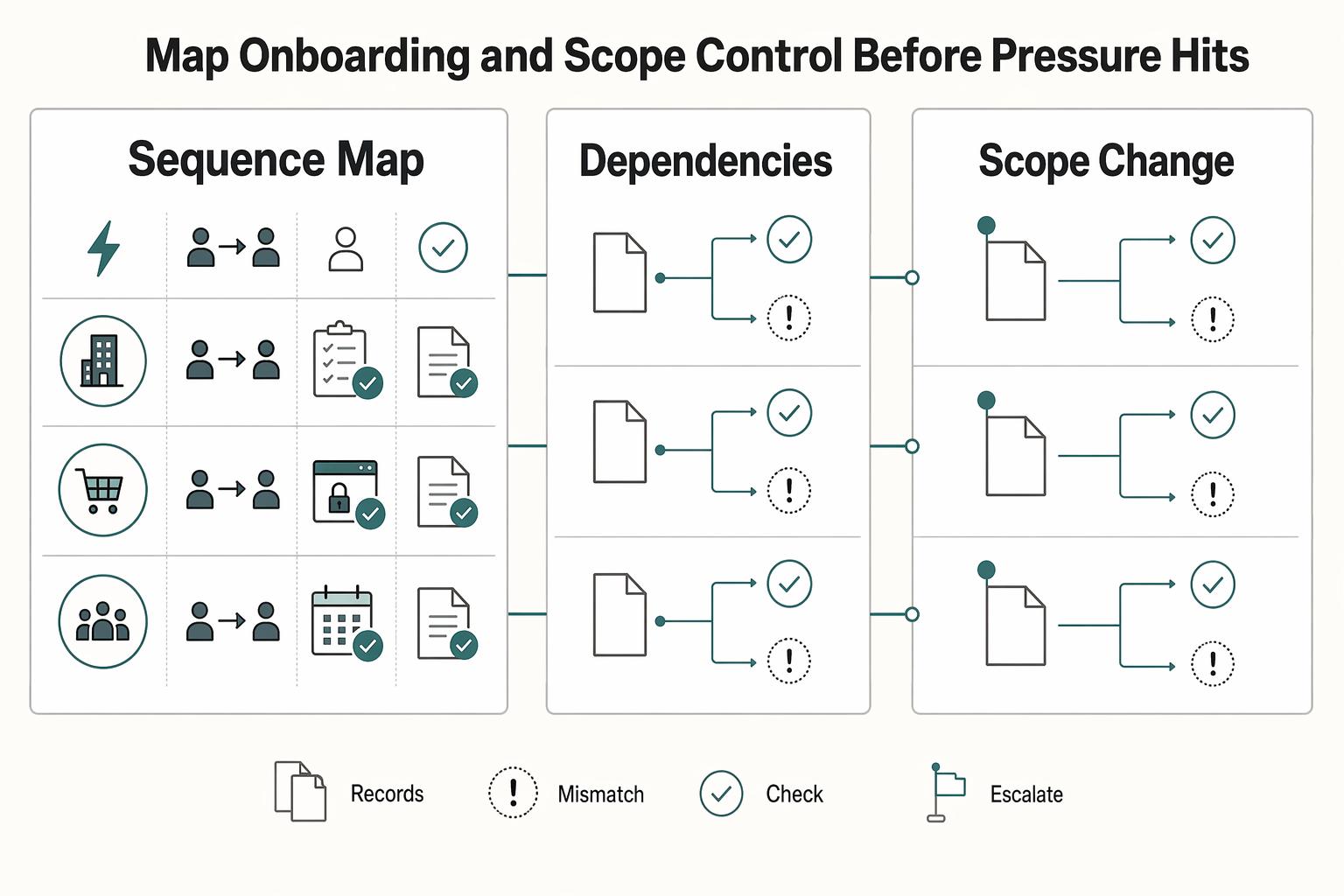
Map onboarding and scope control before pressure hits#
After signature, onboarding should show reliability to the sponsor, procurement, and day-to-day operators. Use a visible sequence map for each handoff: trigger, handoff, client action, proof of completion.
| Control area | Included items |
|---|---|
| Sequence map | Trigger, handoff, client action, proof of completion |
| Dependencies | Approvals, data access, third-party inputs |
| Scope change protocol | Intake request, impact review, written approval, re-baseline agreed scope |
Keep dependencies explicit early. If approvals, data access, or third-party inputs are unclear, delivery risk rises and accountability blurs.
For scope changes, use one lightweight protocol every time:
- Intake request
- Impact review (timing, cost, dependencies)
- Written approval
- Re-baseline agreed scope
Reusable language helps keep this calm and clear: "I can take that on. It sits outside the current agreed deliverables, so I'll send impact and next-step options for approval before work starts."
Before moving to Module 3, run this checklist:
- Define 2 to 3 offer shapes with clear boundaries, ownership, and escalation.
- Include core offer, add-ons, exclusions, and acceptance criteria in every proposal.
- Use an onboarding sequence map with proof of completion at each handoff.
- Save change requests, approvals, and revised scope summaries in one client record.
Once your packaging, onboarding, and change handling are this clear, your business looks dependable at scale, not just personally capable. We covered this in detail in A Guide to the Lifetime Learning Credit for Freelancers.
Module 3: Scale Your Authority#
Once your offers are bounded and your change path is real, make that discipline visible. Authority comes from reliability a buyer can explain, defend, and approve internally.
That matters because perception gaps can hide real capability. In adjacent accounting and bookkeeping research, 45% of respondents said the industry has an image problem, and 63% said the industry is not promoting the full scope and impact of the work. If your message only shows outputs, people fill in the blanks.
Turn reliability into buyer-facing language#
Use one consistent message on your site, proposals, and sales calls:
- Outcome promise: Name the decision or business result the client gets, not just deliverables.
- Risk controls: State how scope changes, dependencies, and documentation are handled.
- Process visibility: Show the sequence you actually run, for example: signed agreement, onboarding, access checklist, kickoff, review points, closeout.
- Stakeholder reassurance: Make it clear how approvals, paperwork, and handoffs are supported.
Audit each public promise against a real artifact. If you claim structured onboarding, keep a redacted onboarding asset ready. If you claim controlled change requests, keep a sample impact note or approval trail.
| Positioning style | What you foreground | Procurement signal | Finance signal | Operational signal |
|---|---|---|---|---|
| Portfolio first | Finished work, logos, outcomes | Capability is visible | Commercial controls may be less visible | Delivery method may need more clarification |
| Hybrid | Selected work plus delivery method | Capability plus governance are both visible | Better visibility into paperwork and change handling | Clearer picture of day-to-day collaboration |
| Process led | Onboarding, scope control, reporting, closeout, with supporting examples | Governance is visible early | Administrative and approval flow is easier to evaluate | Handoffs, ownership, and escalation are easier to plan |
Use the table as a positioning choice, not a rule to hide your portfolio. For multi-stakeholder deals, lead with operating clarity and support it with proof.
Use a process-driven case study template#
Structure case studies so buyers can see how your work runs, not just the final result:
| Section | What to show |
|---|---|
| Context | Who needed what, and why now |
| Constraints | Approvals, timing limits, missing inputs, dependencies, budget boundaries |
| Execution system | Sequence, ownership split, and what was documented |
| Decision moments | Where scope or priorities changed and how decisions were handled |
| Business outcome | Result plus closeout or handover |
Keep one redacted version where each claim maps to an artifact, for example, a kickoff agenda, decision log, revised scope summary, or final acceptance note.
For authority building, prefer named, structured programs over vague networking. Xero Mentor Match is a useful example: a defined mentoring program launched with foundation members.
Build your own partner map the same way: accountants, legal advisors, and implementation partners. For each partner, define:
- Give: What value you provide them.
- Get: What referrals or collaboration you want in return.
- Cadence: How often you check in.
- Handoff standard: Client permission, problem summary, current constraint, decision owner, and deadline.
- Compliance check: Confirm local confidentiality, conflict, and data-sharing requirements before handoff.
Before you move to the conclusion, publish assets buyers can inspect now: your four-part message, one process-led case study, one redacted onboarding or closeout artifact, and a one-page partner map with written handoff notes.
For a step-by-step walkthrough, see A Guide to the 'Net Investment Income Tax' (NIIT) for High-Earning Freelancers.
Make the Operating Shift Visible in Client-Facing Actions#
The chasm in a solo business is an operating shift: move from reactive, chaotic execution to an intentional, early, and effective way of working.
Use the technology adoption life cycle as a lens, not a strict script. Many methods are still in an early-adopter stage, so a few successful projects are not proof that your operating model is durable. And benchmarking yourself against larger tech organizations can distort what "normal" maturity looks like for your stage.
Keep the same three pillars, but make each one visible in client-facing actions:
- De-risk your foundation: keep current scope, onboarding, and invoice templates; keep approvals and closeout evidence in one place.
- Systematize your value: run a repeatable flow for discovery, kickoff, review cadence, change approval, and final acceptance.
- Market reliability: show how you work with redacted artifacts, not broad claims, such as an onboarding note, milestone plan, decision log, and acceptance note.
| Decision point | Practitioner move | CEO move |
|---|---|---|
| New inquiry | Build a proposal from scratch each time | Start from a standard scope summary, then edit only what is truly different |
| Mid-project change | Accept extra requests informally | Use written change approval and update scope, timeline, or fees |
| Project closeout | Deliver files and stop | Deliver a closeout pack with deliverables, approvals, and acceptance evidence |
Quick checkpoint: can you pull your current templates and one redacted project trail in under five minutes? If not, you are still operating too reactively. Use the modules as execution order: Module 1 hardens foundations, Module 2 makes delivery repeatable, and Module 3 turns that operating evidence into trust.
You might also find this useful: The 'Daily Stoic' for Freelancers: Applying Ancient Wisdom to Modern Work.
Frequently Asked Questions
Does *Crossing the Chasm* really apply to a solo freelancer?
It can, but use it as a decision tool, not as a law of nature. The framework is described as a book and framework for bringing disruptive tech products to market. For a freelancer, it is best used by analogy: pick a narrow market, standardize how you deliver, and make your reliability easy to inspect. If you want a checkpoint before going further, read the March 14, 2022 Brightvision interview transcript or listen to the linked episode and ask whether your current offer has a clear target segment.
What should I do first if my business still feels messy?
Start with the client-facing basics before doing more promotion. Clean up proposal boundaries, invoice details, onboarding documents, and one place to store approvals and closeout evidence. If compliance or privacy questions apply to your work, verify current requirements before promising anything. Use this deeper guide when needed: GDPR for Freelancers: A Step-by-Step Compliance Checklist for EU Clients.
How do I productize work that clients say is “custom”?
Keep the custom judgment, but standardize the repeatable parts around it. Your discovery questions, kickoff note, review points, reporting format, and change approval method should look familiar from project to project even if the final recommendation differs. The failure mode is calling everything custom and then rebuilding your process from scratch every time. | Handling style | What you keep fixed | What you vary | When to choose it | | --- | --- | --- | --- | | Custom service | Very little beyond contract basics | Scope, method, deliverables | Use only when the problem is genuinely novel and the buyer accepts ambiguity | | Productized core | Onboarding, milestones, approval steps, reporting, closeout | Recommendations or implementation depth | Use when a clear majority of the work repeats and you want cleaner sales and delivery | | Hybrid | Core process plus optional add-ons | Extra support, training, implementation help | Use when buyers need flexibility but still want predictable administration |
Do I need expensive software or a team to look credible?
No. You need evidence, not a big tool stack. A redacted welcome email, access checklist, decision log, and final acceptance note can do more for buyer confidence than a pile of subscriptions you barely use.
What is the practical difference between niching down and choosing a beachhead?
Niching is choosing where you focus. A beachhead is choosing the first segment where you want enough fit and proof that buyers can recognize you as the obvious option, which is closer to the original Crossing the Chasm idea. If your positioning is still broad, tighten the market before you add more marketing activity.
Can authority-building replace direct selling?
Not by itself. A common trap is using content activity to avoid direct selling. One freelancer comment put it bluntly: “I've built websites and used Linkedin and blogged to avoid selling.” Use authority assets to support sales calls and referrals, not to hide from them.
How do I know these changes are working?
Check whether a cautious buyer can move from inquiry to kickoff without improvisation from you. If you can produce your scope summary, onboarding note, review cadence, and closeout proof on demand, your foundation, delivery, and authority are starting to line up.
Try a related tool
Researched and edited by the Gruv editorial team. Gruv builds cross-border billing, payouts, and finance-operations software for global businesses.
Sources
Includes 3 external sources outside the trusted-domain allowlist.
- congress.gov/87/crecb/1962/08/20/GPO-CRECB-1962-pt13-1-2.pdftrusted
- foreign.senate.gov/imo/media/doc/071805_Transcript_Policy%20Opt...trusted
- gohsep.la.gov/media/training/E0101SM.pdftrusted
- hbs.edu/coursecatalog/print.htmltrusted
- medpac.gov/wp-content/uploads/import_data/scrape_files/...trusted
- accountantsdaily.com.au/navigating-business-debts-as-the-ato-ramps-u...external
- accountantsdaily.com.au/building-the-next-wave-of-leaders-in-the-acc...external
- agiledata.io/podcast/agiledata-podcast/patterns-for-being...external
Educational content only. Not legal, tax, or financial advice.
Related Posts

GDPR Compliance Checklist for Freelancers Working With EU Clients
Start by separating the decisions you are actually making. For a workable **GDPR setup**, run three distinct tracks and record each one in writing before the first invoice goes out: VAT treatment, GDPR scope and role, and daily privacy operations.

Digital Nomad Health Insurance Comparison for Long-Stay Moves
Use focused time now to avoid expensive mistakes later. Start with a practical `digital nomad health insurance comparison`, then map your route in [Gruv's visa planner](/tools/visa-for-digital-nomads) so we anchor policy checks to your real plan before pricing pages pull you off course.
How to Find Your Blue Ocean as a Freelancer Through Operational Clarity
For a practical **blue ocean strategy for freelancers**, start inside your own business. Your first uncontested market space is not a clever tagline. It is a client experience with fewer errors, fewer delays, and clearer proof that you did what you said you would do.