
Quick Answer
Start by confirming your judgment is enforceable, then send a formal demand letter with a firm deadline. If payment still does not arrive, use court-approved post-judgment discovery, such as a debtor’s exam or Information Subpoena, to locate assets before paying for enforcement steps. After that, match the remedy to verified facts, track costs against likely recovery, and verify domestication procedure first when the debtor is in another state.
Collecting on a Judgment Is a Separate Process Under Local Rules#
Winning the case is only part of the job. Getting paid is a separate enforcement process, and the court does not collect for you. At this point, you are the judgment creditor and the other side is the judgment debtor. Your next decisions are about cash flow, time, and risk.
Use this guide in three stages:
- Execute collection while the judgment is still enforceable.
- Analyze why the nonpayment made it to court.
- Rebuild your process to reduce the chance of the same dispute happening again.
This is operational guidance, not jurisdiction-specific legal advice. Local rules control key steps. That includes whether you can ask the court to order a debtor's examination, what property is exempt, how an execution is issued, what enforcement fees may apply, and how long your judgment remains collectible.
Before you spend money on enforcement, confirm your court's timeline rules. For example, California small-claims judgments expire after 10 years unless renewed, and renewal must be filed before 10 years and can be filed as early as 5 years. Maryland judgments last 12 years and can be renewed for another 12 years. Do not assume there is one national deadline.
Use the rest of this guide in a simple order. Start with the basic path your court supports, request voluntary payment, confirm what asset information you actually have, and then decide whether enforcement costs are justified. If you do not know where the debtor works, banks, or holds property, pause before paying officer fees and check whether your court allows a debtor's examination or a similar asset-discovery step.
Use a go or no-go check with counsel when the debtor is in another state or the amount at stake justifies unfamiliar filing work. State-to-state enforcement can require filing a certified copy of a foreign judgment before it is treated as a local judgment. At every stage, verify local procedure first, then act. Related: How to Get a Tax Residency Certificate as a Digital Nomad.
Stage 1: Turn the Judgment Into Payment in Five Steps#
Once your judgment is valid and enforceable, the goal is simple: turn it into payment without guessing. Use this five-step flow, and stop any time procedure, asset facts, or economics become unclear.
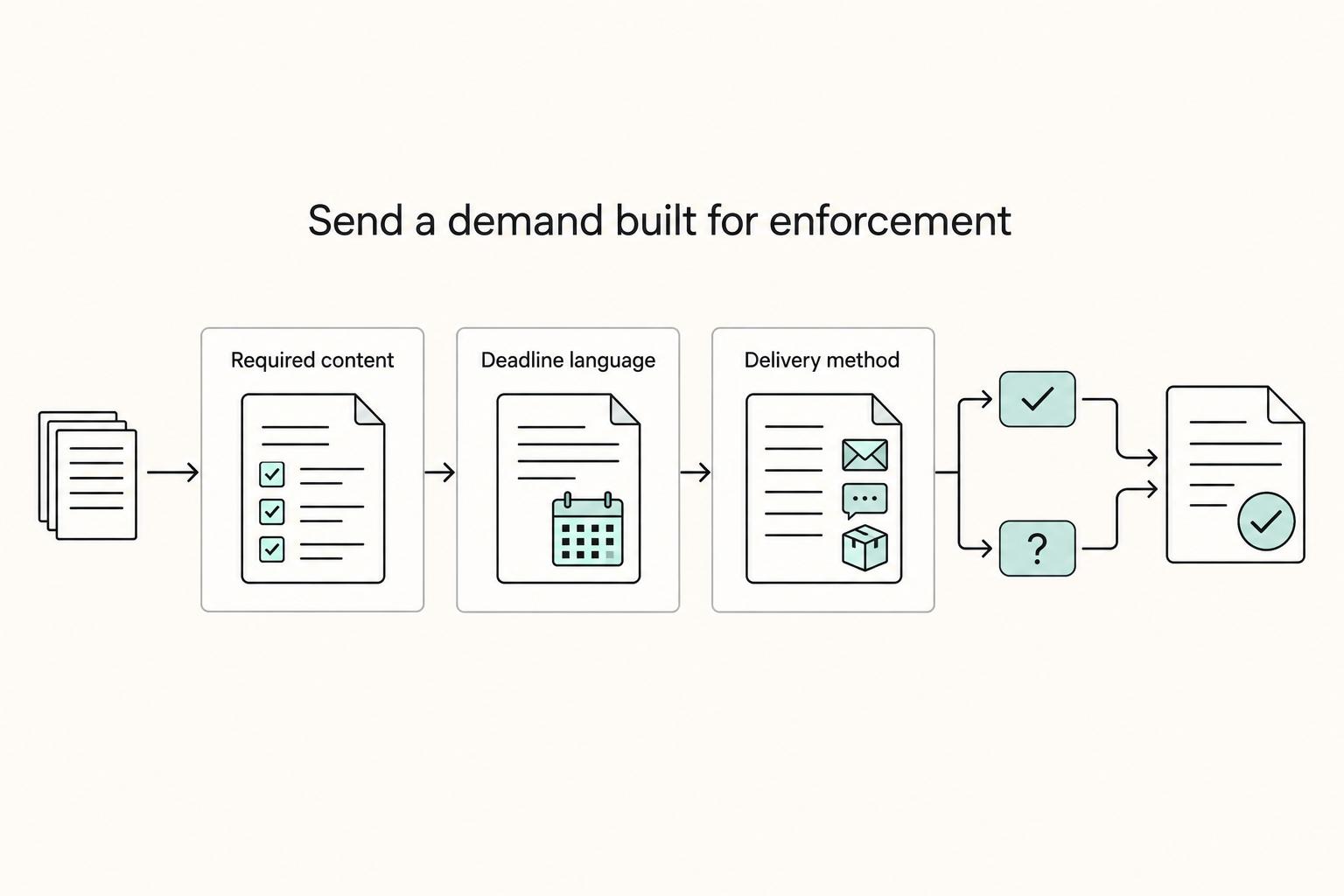
Step 1. Send a final demand that is built for enforcement#
Start with one short, formal demand that reads like the cover sheet for a case file. Then confirm local rules or counsel guidance before you send it.
| Demand item | What to confirm |
|---|---|
| Required content | Required content for your jurisdiction and court |
| Deadline language | Any deadline language before including it |
| Delivery or service method | Permitted delivery or service method before sending |
Use that checklist as a verification prompt, not as a set of universal legal requirements.
Step 2. Get asset facts before you file#
Do not spend enforcement money on assumptions. Use only tools your jurisdiction authorizes, and verify local process details before relying on any single step.
| Tool label you may see | What to verify before use |
|---|---|
| Debtor's Examination | Whether it is available for your case, what process applies, and what information you can lawfully request |
| Information Subpoena | Whether it is available for your case, what process applies, and what information you can lawfully request |
Before you move on, make sure your records are current and internally consistent.
Step 3. Match the remedy to the asset you can prove#
The right remedy is the one tied to an asset you can document. Do not rely on generic assumptions about timing or enforcement friction without local verification.
| Instrument | What to verify locally |
|---|---|
| Bank levy | Eligibility, process, and any limits or exemptions |
| Wage garnishment | Eligibility, process, and any limits or exemptions |
| Property lien | Recordability, process, and enforcement implications |
Step 4. Run a hard go/no-go check#
Before each filing, decide whether your next step is still worth it. If expected recovery, out-of-pocket cost, time burden, or enforceability confidence is mostly guesswork, pause and verify before you spend more.
Step 5. Escalate when jurisdiction complexity exceeds DIY#
Bring in counsel when procedure becomes uncertain or risk is rising.
If you are relying on online legal research for filing decisions, check whether the source is official. FederalRegister.gov says its pages are unofficial informational resources, and its XML text does not provide legal notice to the public or judicial notice to courts. It also says legal researchers should verify results against an official Federal Register edition, including the linked govinfo.gov PDF. Pages can also fail, including with a 500 error.
If you want a deeper dive, read The Silent Profit Killer: How to Stop Margin Erosion in Your Freelance Business.
Stage 2: The Post-Mortem: Auditing the System Failure#
Run this audit right after your collection attempt, while the documents and timeline are still clear. The point is to identify which control failed, mark each gap as Fix now or Monitor, and carry only verified lessons into the next client cycle.
Contract gaps#
Start with the signed contract, every SOW, and every approved change. You are checking whether the agreement gave you clear terms, clear assent, and usable enforcement leverage when payment failed.
| Gap check | What to inspect now | Status |
|---|---|---|
| Payment terms | Due date, invoice trigger, amount structure, and any late-payment language you actually used | Fix now if missing, vague, or inconsistent |
| Dispute forum | Governing law and forum-selection language naming dispute court or location | Fix now if absent or unclear |
| Enforcement language | Whether names, payment instructions, and required documentation were clear enough to support enforcement without reconstruction | Fix now if enforcement depended on reconstruction |
| Ownership leverage | Whether delivery, license, or ownership terms gave you lawful negotiating leverage before full payment, subject to governing law | Monitor if present but weak; Fix now if your model depends on it |
If legal names drifted across the contract, invoices, and court papers, treat that as a root-cause failure and fix it now.
Client vetting failures#
Do not treat every nonpayment problem as the same kind of problem. Classify the failure first, then update the matching gate:
| Risk class | How it showed up | Update before next client |
|---|---|---|
| Identity risk | You did not verify the legal entity, signer authority, or who actually owed payment | Use identity verification for who owes |
| Payment behavior risk | The client resisted deposits, delayed basic approvals, or treated invoice timing as optional | Use stronger deposit and milestone controls |
| Process risk | Work ran through informal channels, contacts kept changing, or scope was not managed in writing | Use a signed agreement plus a defined approval path |
Map each class to a gate before the next client starts: use identity verification for who owes, stronger deposit and milestone controls for payment behavior, and a signed agreement plus a defined approval path for process risk.
Scope breakdown#
In practice, a common payment-dispute chain is unclear scope, weak mutual assent, informal extra work, invoice mismatch, then delayed payment. If you want to prevent the next one, tighten the point where that chain started.
| Failure point | Preventive control |
|---|---|
| Deliverables were vague at kickoff | Define deliverables and acceptance criteria in writing before work starts |
| Extra work was approved informally | Require a written change order before out-of-scope work begins |
| Invoice did not map to agreed work | Tie each invoice line to contract terms or approved change records |
If your proof is mostly "we discussed it on a call," your scope controls were not strong enough.
Evidence audit#
Assume a stranger has to prove your claim from the file alone. That standard usually tells you very quickly whether the record is usable. Verify, in order:
- Signed agreement and scope or change records.
- Dated invoices with clear payment instructions.
- Delivery and acceptance records, plus the reminder timeline.
- Court-facing documents organized and ready to copy.
- Recordkeeping fields completed for your jurisdiction, including retention and any pre-escalation notice or service requirements that apply.
Your file should stand on its own without rebuilding the story from scattered messages. The handoff into Stage 3 should be concrete: a contract redline list, updated client-screening gates, one enforced change-order rule, and an evidence checklist with verified retention and applicable notice fields.
You might also find this useful: A freelancer's guide to 'Skin in the Game'.
Stage 3: Fortification: Building Your Anti-Judgment Prevention System#
This stage only works if you turn the lessons from Stage 2 into controls you use before onboarding and before every billing cycle. The aim is straightforward: verified identities, controlled scope, evidence-ready invoices, and early filtering of payment risk.
Contract controls you install before kickoff#
Your contract should work as a control set, not just a block of legal text. Each control should stop a known failure mode before the work starts.
| Contract control | Risk it prevents | What breaks if omitted |
|---|---|---|
| Scope control | Scope creep and invoice mismatch | You cannot cleanly tie billed work to agreed work or approved changes |
| Payment enforcement | Slow pay and avoidable delay | Due dates, follow-up, and escalation become negotiable |
| Termination protection | Mid-project stop with unpaid exposure | You absorb reserved time, partial work, and transition costs |
| IP leverage | Use of deliverables before payment clears | You lose negotiating leverage after delivery or transfer |
| Dispute routing | Forum or location fights before merits | You spend time and money arguing venue first |
Put these in plain language. Define deliverables, exclusions, approvals, and out-of-scope rules. Set invoice triggers, due dates, payment methods, and escalation steps. State termination outcomes and work-in-progress handling.
Where enforceability is local, keep unresolved items explicit in your template: overdue charge language pending local enforceability review, ownership or license transfer timing pending local-law verification, and governing law or forum wording pending local review.
If a counterparty may be a foreign state or a state-linked entity, do not drop in your default dispute clause without legal review. In the cited Ninth Circuit disposition (nonprecedential except as allowed by local rule), the court states that personal jurisdiction in U.S. civil actions involving a foreign state is governed by the Foreign Sovereign Immunities Act, and immunity applies unless an exception applies.
Vetting rules before you say yes#
Do not leave this to gut feel. Before kickoff, verify the exact legal entity, signer authority, and billing path, and keep proof of each check in your file.
| Risk tier | Criteria |
|---|---|
| Proceed | Entity verified, signer authority clear, billing details consistent, and the client accepts a deposit and written approvals |
| Proceed with safeguards | The client appears valid, but documentation is incomplete or unstable. Tighten milestones, require the deposit before scheduling, and require signed change records for extra work |
| Decline | You cannot verify who owes payment, legal identity stays unclear, contract signature is delayed, or basic payment controls are refused |
Use this risk tier in real time, not as a retrospective note.
For deposits, keep one operational rule. If the agreed upfront payment is not received, do not start work, reserve time, or deliver.
Invoicing that doubles as evidence#
Your invoice process should prove the debt as clearly as it requests payment. As an internal evidence standard, include core fields every time: your legal name, the client's legal name, invoice number, issue date, due date, contract-mapped line items, amount, currency, payment instructions, and any local wording you have verified as current.
For jurisdiction-specific wording, treat current requirements as pending until verified. Also verify legal and compliance text against official sources before you use it. eCFR is authoritative but unofficial, and FederalRegister.gov states its web edition is not the official legal edition. Where needed, confirm against official editions, including the page's View printed version (PDF) checkpoint.
Run reminders on schedule: before the due date, on the due date, and at defined overdue intervals. Log each contact with the timestamp, delivery method, and the exact invoice version sent. Preserve a complete evidence set: the sent PDF, transmission record, client acknowledgment, payment-status records, and any promise-to-pay messages.
Turn this into reusable operations now: a contract template with enforceability placeholders, an onboarding checklist with risk tiers, and an invoice and reminder logging SOP. Review outcomes quarterly and update the control that matches the failure pattern.
For a step-by-step walkthrough, see A Freelancer's Guide to Angel Investing and Venture Capital. Before you onboard your next client, turn your risk controls into usable paperwork with this freelance contract generator.
From Crisis to Control: Making This Your Last Collection Battle#
Treat this as one loop: enforce the current judgment, diagnose how the nonpayment happened, and harden the next client cycle before the same pattern repeats.
Start by closing the live matter with a complete file. Keep the judgment, docket or case number, demand letter, proof of service, invoice ledger, payment history, and client contact details together. Check service of process carefully, because it is the formal delivery point for legal notice. Even small errors like typos can break notification; if the defendant does not respond, the case can end in a default judgment.
Then run a direct post-mortem on the failure path. Compare the signed contract, invoiced entity, approving contact, and the notice address or email actually used. If those records do not line up, treat that mismatch as a likely root issue and fix it in intake and documentation.
| Prevention control | What risk it reduces | Implementation effort | Prioritize when |
|---|---|---|---|
| Contract terms | Scope disputes, unclear payment timing, unclear notice details | Medium | First, if obligations or approvals were unclear |
| Client vetting | Wrong entity, bad contact data, low-authority buyer | Low to medium | First, if you struggled to confirm who owes |
| Invoicing and payment ops | Late billing, missed reminders, weak paper trail | Low | First, if delivery was accepted but billing drifted |
What you do in the next client cycle matters more than the lesson you wrote down. Use these checkpoints:
- Confirm the client's legal name, billing contact, and notice address before work starts.
- Document verified notice and dispute terms for this client, and calendar your own follow-ups.
- Keep the contract, invoice, and reminders aligned to the same client identity details.
- Attach acceptance emails, change requests, and delivery proof to the invoice record.
- After each slow-pay file, update one control before you send the next proposal.
If you want a cleaner collect-to-payout workflow with traceable records and policy gates where supported, explore Gruv for freelancers.
Frequently Asked Questions
What is the first step to collect a judgment?
First, confirm your court’s enforcement timing and that no active appeal or motion is blocking collection. Then send a formal Demand Letter that requests payment, includes key judgment details, and sets a firm payment deadline. Best case, the debtor pays voluntarily. If not, you have a clean written record before you escalate.
How much does it cost to collect on a judgment?
Start by choosing the enforcement path you actually need, because a Writ of Execution, levy, lien filing, and out-of-state filing can each trigger different costs. Then check current court-clerk and enforcement-officer fees in your jurisdiction and record the filing cost and officer fee only after verification from official court or enforcement-office sources. The goal is a realistic budget before you spend more pursuing the debt. | Option | When it fits | Main tradeoff | Effort level | | --- | --- | --- | --- | | Self-managed enforcement | You already have asset details, local process is clear, and you can manage filings | Lower direct spend, but you own the paperwork, deadlines, and follow-up | High | | Collection agency | You want someone else to handle persistence and routine collection steps | Less day-to-day effort, but less control over pace and communications | Medium | | Attorney support | Procedure is contested, filings are complex, or enforcement is out of state | Higher direct cost, but stronger support on legal process and resistance | Low to medium |
Is it worth hiring a collection agency?
It depends on whether you can realistically run enforcement yourself. Compare agency or attorney support against the file you already have: judgment, docket, demand letter, asset leads, and payment history. A practical approach is to keep straightforward local enforcement in-house and hand off process-heavy or resisted matters.
How do you find a debtor's bank account for a levy?
Start with post-judgment discovery so you are not guessing where assets are held. Use a debtor’s exam or an Information Subpoena. In New York, the Information Subpoena is clerk-signed and requires a response within 7 days. Once you have account details, pair them with a Writ of Execution and the proper levying officer for a bank levy, since officer-run process may be required.
How long is a judgment valid?
Check the enforcement life and renewal rules for the court that issued your judgment first. If the debtor is in another state, confirm the deadlines again after domestication under that state’s foreign-judgment procedure, often tied to UEFJA-style statutes. Calendar the renewal window only after verifying it against court rules, official records, or local counsel.
Can I collect interest on a judgment?
First, confirm whether your judgment qualifies for post-judgment interest under the law that governs it. Then calculate from the judgment entry date using the applicable rule. For federal money judgments, 28 U.S.C. 1961 applies from entry. That keeps your payoff demand aligned with what is legally owed, not just the original principal.
Try a related tool
Researched and edited by the Gruv editorial team. Gruv builds cross-border billing, payouts, and finance-operations software for global businesses.
Sources
- ecfr.gov/current/title-7/subtitle-A/part-1trusted
- federalregister.gov/documents/2021/01/07/2020-29274/independent-...trusted
- federalregister.gov/documents/2017/02/24/2017-01288/procedural-r...trusted
- irs.gov/pub/irs-access/p2104_accessible.pdftrusted
- irs.gov/tax-professionals/eitc-central/recordkeepingtrusted
- mncourts.gov/help-topics/conciliation-court.aspxtrusted
- prdext3.cga.ct.gov/2025/pub/chap_928.htmtrusted
- selfhelp.courts.ca.gov/small-claims/after-trial/collect-money/bank-...trusted
Educational content only. Not legal, tax, or financial advice.
Related Posts

Stop Freelance Profit Margin Erosion Before It Hits Cashflow
Revenue can hold steady while the business underneath it gets weaker. What comes in matters, but what you keep after the work is delivered is the clearer signal of health.

How to Get a Tax Residency Certificate as a Digital Nomad
The lowest-stress path is a tax position you can prove, not a zero-tax narrative you cannot defend later. If you are a freelancer or consultant, choose one defensible tax home, document it clearly, and keep filings consistent across jurisdictions.

The Freelance Payment Penalty: A Modeled Audit of Platform Fees, FX Spreads, and Payout Delays
The money rarely disappears through a single, easy-to-spot fee. The real loss is stacked. A marketplace takes its commission, a processor adds a charge for international cards, a bank or payment company converts the currency at a spread, a platform holds the funds before release, and a wire sheds a little to intermediaries on the way in. Each layer looks defensible on its own, but the worker feels the combined result as a smaller deposit and a later payday.