
Quick Answer
Trace three recent projects from client approval to actual receipt using action, document, owner and status. Correct a documented bottleneck: unclear scope, an unsent invoice, missing billing details or an overdue follow-up. Keep tax forms and retention rules scoped to your status and jurisdiction, and record gross amounts, withholding and available cash separately. This audit may reduce recurring work friction; recurring stress alone does not establish cognitive dissonance or show that workflow repair is the only support needed.
Use Recurring Work Friction as a Prompt to Check the Process#
Cognitive dissonance describes discomfort from inconsistency between beliefs or between beliefs and actions. A freelancer might value clear boundaries yet repeatedly accept unpaid extra work. Recurring stress alone does not establish cognitive dissonance or a process failure: workload, health, caring responsibilities, client behavior and uncertainty can also matter. This guide uses a project-record audit to find practical friction you can change, alongside whatever personal support you need.
That gap usually shows up in ordinary places. A client says yes, but the proposal does not hand off cleanly to contract, kickoff, and invoice. You rewrite scope because the original assumptions were never captured. Billing slips a week because nobody owns the admin step, even if "nobody" is still you. Payment friction is common in small businesses, and late payment can strain liquidity. In U.S. federal contracting, FAR 32.905 ties payment to a "proper invoice," and the designated billing office generally returns a defective invoice within seven days with reasons, with shorter periods for specified food contracts. Your client work may not follow that rule, but the lesson still applies: incomplete documents slow cash.
| Response | Repeatability | Client experience | Risk of recurrence |
|---|---|---|---|
| Personal coping alongside work | Depends on the approach and circumstances | Can help you respond while a payment or scope issue is resolved | Does not by itself correct a missing invoice or unclear agreement |
| Process redesign | Higher because steps are written, owned, and checkable | More consistent handoff after approval | May reduce a repeat bottleneck when the identified cause is corrected |
| Stress-driven overwork | Looks productive, but depends on unsustainable effort | Fast at first, then delayed or sloppy when fatigue hits | WHO/ILO evidence associates working at least 55 hours/week with higher stroke and ischemic-heart-disease risk than 35–40 hours; not an individual diagnosis |
Use this checkpoint the next time an opportunity appears:
- Documented: Is the next step written down, including the exact document or template you will use?
- Owned: Is it clear who sends it, when, and what "done" looks like?
- Executable: Could you complete it today without inventing terms, hunting files, or asking for basics twice?
If an answer is no, record the missing step and its consequence. A process repair may help that friction; it does not explain every cause of distress.
If you want a deeper dive, read A freelancer's guide to Thinking.
Diagnosing Your 'Identity vs. Reality' Gap#
If stress recurs after client approval, check whether your stated operating standard matches the actual handoff. This is a practical audit, not a diagnosis. Record where contract, kickoff, invoice or payment follow-up gets delayed and what evidence explains it.
Audit the path from yes to paid#
Use your last three projects and trace each one from approval to payment. At each step, log only: repeatable action, document, owner, and status (working, missing, Current requirement pending verification).
| Step | What to capture (4 fields) | Output |
|---|---|---|
| Approval | How you record client yes, approval record, owner of next action, status | Friction log entry when scope/terms changed after yes |
| Contract + kickoff | Contract, kickoff checklist, required inputs, owner, status | Missing-document list with one named owner per gap |
| Invoice + tax setup | Invoice template, requested tax form response, owner, status | Exact gap list (for example: missing W-9, W-8 BEN, or payment term field) |
| Payment follow-up | Payment date rule/mechanism, reminder owner, payment confirmation, status | Next fix with date (for example: update contract payment clause or reminder timing) |
If it is not written, saved, and owned, mark it missing. If a requirement may apply but is unconfirmed, mark Current requirement pending verification so you do not guess.
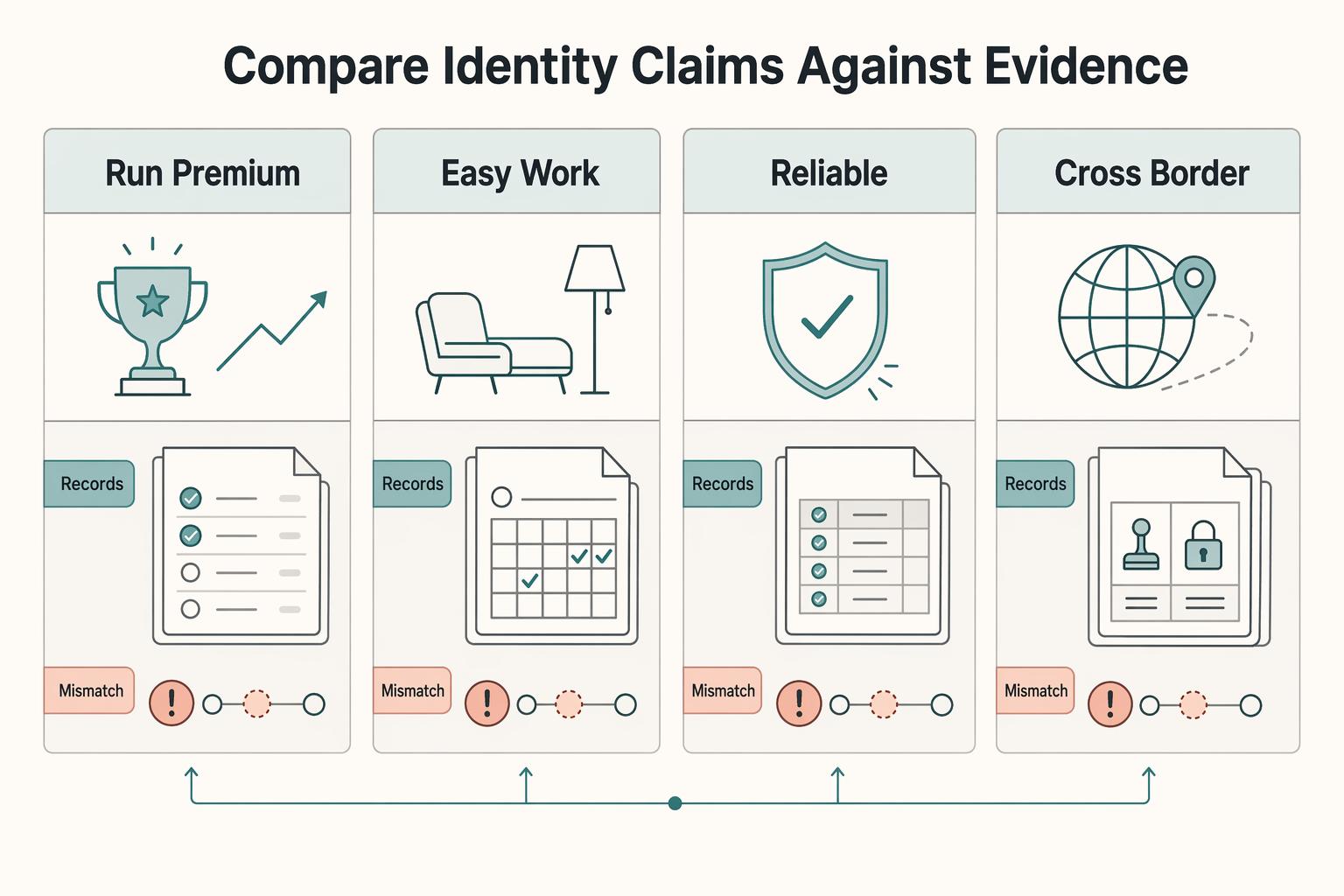
Compare identity claims against evidence#
| Identity claim | Evidence you can verify now | Business consequence when missing | Immediate correction |
|---|---|---|---|
| "I run a premium service." | Invoice and payment terms are ready before delivery starts | Payment friction and correction loops | Finalize invoice + payment terms in your standard pre-work packet |
| "I am easy to work with." | Same handoff order every time: contract, kickoff details, timeline, first invoice | Uneven client experience and avoidable follow-up | Lock one handoff sequence and reuse it |
| "I am reliable." | Scope, dates, and changes are retrievable from current records | Rework, disputes, and slower approvals | Store project decisions in one consistent location |
| "I am cross-border ready." | Correct tax form path and VAT handling are documented or flagged for verification | Withholding, invoicing delays, and compliance risk | Confirm payer request and document path before invoicing |
Two mismatch patterns to fix first#
The payment-experience gap is usually the fastest win. Late payment can harm liquidity, so if terms or invoice details are still being assembled after work starts, fix that sequence first. If New York Article 44-A applies to the engagement, verify the written contract includes a payment date or a mechanism to determine it; if timing is not specified, payment is due no later than 30 days after completion.
| Scenario | Article note |
|---|---|
| New York Article 44-A timing | Verify the written contract includes a payment date or a mechanism to determine it; if timing is not specified, payment is due no later than 30 days after completion. |
| Form W-9 | U.S. payees generally use W-9 to provide name/TIN when applicable information reporting requires it. |
| Foreign-payee documentation | W-8BEN generally documents an eligible foreign individual; entities may use W-8BEN-E and other payment situations require other forms. Confirm status and payment type. |
| Backup withholding | 24% backup withholding can apply to covered reportable payments for missing/incorrect TIN or other specified conditions; it is not a general cross-border fee. |
| EU B2B VAT | EU businesses selling ordinary services to business customers in another EU country generally use customer reverse charge, subject to service/customer/location exceptions. |
At intake, record client legal name, billing contact, entity/country details and any actual tax-document request. U.S. payees generally use W-9 for applicable reporting; a foreign individual may use W-8BEN, an entity W-8BEN-E, or a different form depending on the payment. Do not infer tax status from location alone or attach a sensitive form to every invoice. If 24% backup withholding applies to a hypothetical $1,000 covered payment, $240 is withheld and $760 paid before other adjustments; record gross income, withholding evidence and net receipt separately. For EU cross-border B2B services, verify the applicable reverse-charge treatment and exceptions before invoicing.
Mini-audit before you move to fixes#
- Trace three recent projects from yes to paid.
- Mark each step with
action,document,owner,status. - Save one proof pack: approval record, contract, invoice, tax form response, payment confirmation.
- Tag each gap as
operating standard,pricing/payment chain, orrisk/compliance control.
If you are tightening risk controls too, see The Best Antivirus and Malware Protection for Freelancers.
Three Pillars: Operating Standard, Pricing-to-Payment Chain, and Risk Controls#
After your audit, fix the gap by making your business easier to prove than to explain. Use three pillars: a written operating standard, one linked pricing-to-payment chain, and risk controls managed as rules plus repeatable habits.
| Pillar | Core idea | What the section says to do |
|---|---|---|
| Written operating standard | Standardize what happens after a client says yes | Document scope, boundaries, ownership, document location, and unresolved requirement notes. |
| One linked pricing-to-payment chain | Treat pricing, invoicing, and compliance as one chain | Tie pricing to written scope, use a standard invoice template, and collect payer entity details, tax-form requests, and jurisdiction notes at intake. |
| Risk controls managed as rules plus repeatable habits | Separate policy from procedure | Set review cadence, attach one habit per rule, and verify evidence exists. |
Pillar 1. Standardize what happens after a client says yes#
Standardize what happens after a client says yes. Recordkeeping is a core business obligation, and it only works if your system clearly shows income, expenses, and supporting documents.
Use this operating-standard checklist:
- Scope: document deliverables, assumptions, exclusions, and change-request handling before work starts.
- Boundaries: define response times, revision limits, dependencies, and pause conditions.
- Ownership: name who sends the contract, kickoff, invoice, and tax or billing responses.
- Document location: keep the current proposal, signed agreement, kickoff notes, invoice template, and client-specific requirements in one searchable location.
- Unresolved requirements: if a requirement depends on jurisdiction, payer status, or tax treatment, mark it
Current requirement pending payer, official, or counsel verification.
A payer’s request does not make an inappropriate tax form correct. Confirm your U.S./foreign tax status, individual/entity form and service/payment context before signing. Resolve unclear treatment with the payer or qualified tax adviser, record the decision, and send sensitive tax details through a protected channel separate from ordinary billing emails.
Pillar 2. Treat pricing, invoicing, and compliance as one chain#
Treat pricing, invoicing, and compliance as one chain. That is how your client experiences it.
| Trigger | Failure mode | Corrected process | Immediate client-facing result |
|---|---|---|---|
| Scope shifts after approval | Repricing happens in scattered email threads, so the invoice no longer matches approved terms | Tie pricing to written scope, assumptions, and change handling before delivery starts | The client sees one consistent line from approval to invoice |
| Work is delivered before invoice details are ready | Invoice is assembled from memory, required fields are missed, or sending is delayed | Use a standard template with business details, client billing details, terms, and a unique identification number where required | Faster invoice turnaround with fewer clarification emails |
| Tax or jurisdiction details are requested late | Payment pauses while you gather TIN details, W-9 data, or VAT treatment | Collect payer entity details, tax-form requests, and jurisdiction notes at intake; mark unknowns as Current requirement pending payer, official, or counsel verification | Faster, clearer compliance responses and fewer last-minute holds |
If these steps are split across disconnected tools or moments, pressure returns. One concrete risk: backup withholding at 24% on reportable nonemployee compensation when required TIN conditions are not met.
Pillar 3. Write the rule, attach a habit, verify the evidence#
Separate policy from procedure. Policy is the rule you commit to. Procedure is how you execute it. When a control is weak, check which part failed first: the rule, the habit, or the evidence.
| Jurisdiction example | Retention or limitation note |
|---|---|
| U.S. / IRS retention guidance | Often 3 years in ordinary cases, but refunds, omitted income, fraud/nonfiling, property and employment records can require different or longer retention. |
| UK self-employed | At least 5 years after the 31 January submission deadline for the relevant tax year; late returns and checks can alter retention. |
| Canada / CRA | Generally 6 years from the end of the last tax year the records relate to; exceptions and longer-lived records may require more. |
Start here:
- Write the rule: set review cadence for cash visibility, invoice follow-up, estimated-tax checks, record retention, and coverage decisions.
- Attach one habit per rule: review cash weekly and estimated-tax exposure monthly where relevant. U.S. individuals generally need estimated payments when expecting to owe at least $1,000 on filing, with withholding/credits and other rules affecting the result. A monthly review does not replace required payment-period deadlines. Save approvals, invoices and receipt evidence.
- Verify evidence exists: supporting documents should be available for purchases, sales, and other business transactions; if a document is missing, treat that control as weak.
Use the retention clock that fits the record and jurisdiction, not a universal three-year deletion rule. IRS guidance includes longer periods and indefinite retention in specified situations. UK self-employed records generally run at least five years after the relevant 31 January filing deadline, while CRA generally runs six years from the end of the last tax year the records relate to. Record the authority, start event, expiry and any exception or dispute hold.
Once you identify your weakest pillar, use the FAQ next to decide implementation order and review cadence. You might also find this useful: The Best Calendar and Scheduling Apps for Freelancers.
Keep the Next Workflow Change Small and Observable#
Use the audit to correct a documented work bottleneck without treating it as a personality verdict or a cure for stress. If payment, scope or compliance friction repeats, choose one small change and observe its effect. Your next move can differ by pillar:
- Standardize the handoff. On your next signed job, make sure the same four items are easy to find without digging through old email: signed terms, current scope, invoice draft, and payer details. If one is missing, fix that step before you change your offer or your rates.
- Close each job with an assumption log. Mark each item as confirmed, unresolved, or verified and dated. Use
Current threshold pending official or counsel verificationanywhere a numeric legal or tax trigger is still unknown instead of guessing or leaving the field blank. - Keep a real evidence pack. Save the documents that support what you billed, earned, paid, or deducted. If you work in the US, IRS record rules are one reason this matters: standard cases often point to 3 years, while employment tax records require at least 4 years, and retention varies by scenario.
For a proposed price change or delayed invoice, record the business evidence and the capacity or personal constraints behind the decision. An if-then rule can make follow-through easier: if a requirement is unclear, identify its owner, verify it, date the decision and act within the applicable deadline. Evidence supports judgment; it does not make uncertainty or personal needs disappear.
Keep the cadence simple: weekly, clear unsent invoices and unresolved tags; monthly, update templates and review risk items like tax set-asides; at project close, file the full record. If your unresolved list includes EU client data handling, see GDPR for Freelancers: A Step-by-Step Compliance Checklist for EU Clients.
For stress-management support alongside this workflow, see The Best Meditation and Mindfulness Apps for Freelancers.
Frequently Asked Questions
What should you fix first when everything feels misaligned?
Pick a documented bottleneck you can change, such as missing scope, billing details or the next payment action. Check whether the current agreement and invoice are easy to find, then make that handoff repeatable. Consider capacity and personal support alongside the workflow rather than assuming every feeling of misalignment has one operational cause.
Is cognitive dissonance for freelancers really just low confidence?
Low confidence and cognitive dissonance are different concepts, and this audit cannot determine why you feel stressed. Check a specific belief/action mismatch—for example, valuing paid changes while repeatedly doing extra work without a change order. Then examine the operating records and capacity. Better records can address a work bottleneck while personal or health needs may require a different response.
How do you handle pricing without turning it into a confidence test?
Start with capacity and cash, not self-belief. If reduced workload means reduced earnings, make that tradeoff explicit before you change pricing or commitments. Then align your written scope and billing steps so your plan stays consistent from agreement to payment.
What if invoicing is the step you keep avoiding?
Make the next action small: open the invoice template, enter verified billing details and identify any missing information. Send an accurate invoice through the agreed channel when ready; keep an incomplete document clearly labeled as a draft rather than treating it as a payment request. If a required detail is unclear, give that gap an owner and next action.
How much compliance work do you need to do upfront?
Do enough upfront to avoid preventable payment delays, and label unknowns instead of guessing. Collect required payer details early, confirm unclear requirements before finalizing, and keep Current requirement pending payer, official, or counsel verification where the answer is still uncertain.
What do you do when stress makes all of this harder to keep up with?
Protect capacity and fix one bottleneck at the same time. Add more buffer than feels necessary, because chaotic periods usually need more rescheduling room than you expect. Then choose one process to stabilize this week and run it consistently.
Do you need to take time off, or should you push through and stay billable?
Review available leave, savings, commitments and options to reduce or reschedule work, alongside your health and support needs. For example, $3,000 of available cash against $1,500 of monthly essential costs covers two months before tax, debt, other commitments or irregular expenses. An unpaid invoice is not available cash; show it separately with its expected receipt date and collection uncertainty. Do not treat this calculation as a reason to postpone necessary care.
How often should you review this so it actually sticks?
Use a cadence you can keep even during a rough month. Review the same few items each time: current commitments, cash pressure, unsent invoices, and any note marked Current requirement pending verification. This week, pick one weak pillar, update one document, and run it on the next client from start to payment.
Try a related tool
Researched and edited by the Gruv editorial team. Gruv builds cross-border billing, payouts, and finance-operations software for global businesses.
Sources
Includes 1 external source outside the trusted-domain allowlist.
- acquisition.gov/far/32.905trusted
- europa.eu/youreurope/business/finance-and-tax/vat/cros...trusted
- irs.gov/businesses/small-businesses-self-employed/re...trusted
- irs.gov/businesses/small-businesses-self-employed/es...trusted
- nysenate.gov/legislation/laws/GBS/1411trusted
- nysenate.gov/legislation/laws/GBS/1412trusted
- who.int/news-room/questions-and-answers/item/global-...trusted
- apa.org/ed/precollege/topss/lessons/social-psycholog...external
Educational content only. Not legal, tax, or financial advice.
Related Posts

GDPR Compliance Checklist for Freelancers Working With EU Clients
Start by separating the decisions you are actually making. For a workable **GDPR setup**, run three distinct tracks and record each one in writing before the first invoice goes out: VAT treatment, GDPR scope and role, and daily privacy operations.
Thinking, Fast and Slow for Freelancers Who Want Better Clients
Treat thought leadership as risk control for your business, not just a visibility tactic. The real shift is from fast, reactive client chasing to slower, deliberate asset building. You publish to reduce risk before the next dry month, pricing call, or bad-fit project shows up.

The Freelance Payment Penalty: A Modeled Audit of Platform Fees, FX Spreads, and Payout Delays
The money rarely disappears through a single, easy-to-spot fee. The real loss is stacked. A marketplace takes its commission, a processor adds a charge for international cards, a bank or payment company converts the currency at a spread, a platform holds the funds before release, and a wire sheds a little to intermediaries on the way in. Each layer looks defensible on its own, but the worker feels the combined result as a smaller deposit and a later payday.