
Quick Answer
Use on-page seo for writers as a client-fit system: target buyer-intent terms, align title link and headings to one page promise, and track a single GA4 key event tied to that URL. Review Search Console for query alignment, then confirm readers move toward service or contact pages. Keep slug and canonical stable during refreshes, and test one controlled change at a time so results are interpretable.
Introduction: Stop Chasing Traffic. Start Acquiring Clients.#
If you use on-page seo for writers to chase pageviews, you may publish a lot and still attract low-fit inquiries. A better move is simpler: build pages that match buyer intent, make the next step obvious, and give prospects enough proof to decide you are worth contacting.
| Preflight item | What to confirm | Article note |
|---|---|---|
| Search Console | Search Console is collecting query data | The default Performance view shows the past three months |
| GA4 key event | At least one business action is marked as a GA4 key event | Use a real business action to measure business progress |
| CMS hygiene | Title links, meta descriptions, and canonical preferences are not handled inconsistently | Check this especially if your platform limits direct HTML edits |
That is the useful definition of on-page SEO here. Google describes SEO as helping search engines understand your content and helping users make a decision. For a writer, that means your title link, headings, body copy, internal links, and meta description should do more than target a query. They should show fit, reduce ambiguity, and support a clear conversion path, such as booking a call, viewing services, or sending an inquiry.
Start with this expectation check:
- Vanity-metric focus: broad topics, vague calls to action, success measured by impressions and clicks alone.
- Qualified-lead focus: specific service intent, obvious next step, success checked against inquiry quality and GA4 key events.
This guide follows the second path in three phases. In Phase 1, you will choose keywords based on the client conversations you want, not volume alone. In Phase 2, you will tighten the page so the snippet promise, H1, proof, anchor text, and calls to action all point in the same direction. In Phase 3, you will review Search Console and GA4 together so you can tell the difference between visibility and business progress.
Before you publish, do a quick preflight check. Confirm Search Console is collecting query data, remember the default Performance view shows the past three months, and mark at least one business action as a GA4 key event. Check your CMS hygiene too, especially if your platform limits direct HTML edits, so title links, meta descriptions, and canonical preferences are not being handled inconsistently.
The common failure patterns are familiar: keyword-stuffed titles, duplicate pages competing with each other, and content updates judged too early. Google says changes can take a few hours to several months. If you want the broader client-acquisition angle before getting tactical, read How to Use SEO to Attract High-Quality Freelance Clients.
For a step-by-step walkthrough, see How to Conduct a Technical SEO Audit for a Client Website.
Phase 1: The Strategic Foundation - Pinpoint Your Most Profitable Keywords#
Prioritize only the keywords that map to a clear buyer stage, a page type you can realistically publish, and a specific next action you want the reader to take.
| Screening check | What to ask | Draft only if |
|---|---|---|
| Search intent | What is the searcher trying to do, and what page would satisfy that? | You can identify a page that satisfies the query |
| Business fit | Does that action connect to your offer? | The action connects to your offer |
| Offer relevance | Can you name the service angle, the proof the page needs, and the conversion path? | You can name the service angle, proof, and conversion path before drafting |
Use intent as the first filter, then qualify for business fit. Informational, navigational, commercial, and transactional labels help, but many queries overlap. The practical check is simpler: what is the searcher trying to do, what page would satisfy that, and does that action connect to your offer? If it does not, skip it even when traffic looks strong.
Run every candidate through three checks together: search intent, business fit, and offer relevance. If you cannot name the service angle, the proof the page needs, and the conversion path, do not draft yet.
| Decision point | Copy competitor angles | Fill unmet intent gaps |
|---|---|---|
| Best use | When current results already match your offer and page type | When current results miss buyer questions, proof, or a clear next step |
| Main upside | Faster alignment with existing expectations | Clearer differentiation and stronger fit signals |
| Main risk | You blend in | You misread intent and build the wrong page |
Use a keyword map you can execute:
| Field | What to define before drafting |
|---|---|
| Query | The exact search phrase you are targeting |
| Intent | The dominant intent, while noting overlaps if needed |
| Page angle | The promise this page will make |
| Primary entity | The main topic/service the page is about |
| Proof to include | The evidence that reduces buyer doubt |
| Conversion path | The next action (for example, inquiry or booking flow) |
Before you write, separate discovery metrics from lead-quality signals. In Search Console Performance, review query and page data across the default past three months using clicks, impressions, position, and CTR. CTR (clicks divided by impressions) helps you judge query-to-snippet match, not lead quality. For lead quality, use GA4 and mark a real business action, such as generate_lead, as a key event.
If you want help with the drafting stage, read How to Write SEO-Friendly Blog Posts.
Phase 2: Confirm Promise, Page, and Next Step Match Buyer Intent#
Use this pre-publish pass to confirm one thing: the search-result promise, on-page experience, and next step all match the same buyer intent. Run it in order, in one sitting, using CMS preview and one browser tab.
| Technical check | What to verify | Article note |
|---|---|---|
| URL stability | Keep slug and canonical unchanged unless you have a deliberate redirect plan | Treat URL stability as a refresh guardrail |
| Status code | Page returns HTTP 200 | Verify indexability and integrity |
| Noindex | No accidental noindex | noindex must be crawlable to work and is not supported in robots.txt |
| Canonical | Canonical points where intended | It is a strong hint, not a guarantee |
| Duplicate paths | No duplicate-path variants compete with the intended URL | Check for competing versions of the page |
| Links | Internal links work and use real <a href> links | Link purpose should be clear in context |
| Image links | Image links use useful alt text | Accessibility checks are part of QA |
| URL Inspection | Run URL Inspection for live refreshes or post-publish checks | Use it to validate live-page eligibility signals |
- Snippet
Check that the page has a defined <title> element. Then review the meta description as a promise statement, not a character-count exercise. Google may use page copy for the snippet when that is a better match, and may use your meta description when it is more accurate. Keep the wording specific enough to qualify likely buyers and honest enough to match what the page actually delivers.
- Structure
Compare the title link, H1, and H2s side by side. They should express the same intent and follow a clear heading hierarchy. If any section does not support the page goal or the single next step, remove it.
- Proof
Place trust cues where doubt appears:
- Put first-hand experience signals near the intro or early body. * Keep author background easy to find in the byline or author box. * Add relevant internal proof paths near key claims or just before the CTA, using descriptive anchor text.
- Technical QA
Treat URL stability as a refresh guardrail: keep slug and canonical unchanged unless you have a deliberate redirect plan. Then verify indexability and integrity:
- Page returns HTTP 200. * No accidental
noindex; remembernoindexmust be crawlable to work and is not supported inrobots.txt. * Canonical points where intended (a strong hint, not a guarantee). * No duplicate-path variants competing with the intended URL. * Internal links work and use real<a href>links. * Link purpose is clear in context; image links use useful alt text. * For live refreshes or post-publish checks, run URL Inspection to validate live-page eligibility signals.
Check the snippet like a buyer, not a marketer#
| Snippet approach | What it signals | Who it attracts | Publish decision |
|---|---|---|---|
| Broad educational: "On-Page SEO for Writers: Tips to Rank Higher" | Topic match, low commercial signal | DIY learners, early-stage researchers | Revise if your goal is qualified service leads |
| Mixed but soft: "On-Page SEO for Writers: Improve Your Website Content" | Relevant but vague buyer stage | Mixed-fit traffic | Revise unless the page supports multiple intent levels |
| Buyer-aware: "On-Page SEO for Writers: Pre-Publish Checks for Better-Fit Client Leads" | Clear task, business context, implied action | Prospects evaluating expertise or support | Ready if the page fulfills this exact promise |
If your offer is strategic or done-with-you support, say that plainly in the title or meta description so low-fit traffic self-selects out.
Publish-readiness matrix (pass/fail)#
| QA area | Ready | Revise |
|---|---|---|
| Snippet | Promise matches query and buyer intent; no bait wording | Generic copy attracts low-fit clicks |
| Structure | Title/H1/H2s align to one intent and one next step | Sections drift or compete with the CTA |
| Proof | Experience cues, author trust cues, and internal proof paths are visible where needed | Claims rely on assertion without supporting trust signals |
| Technical QA | Slug/canonical stable, indexability checks pass, links and accessibility checks are clean | Any canonical, crawl/index, duplicate-path, or link-purpose issue remains |
Phase 3: The Performance Dashboard - Measure What Matters (Leads, Not Likes)#
Judge each page by one outcome: does it bring the right reader closer to a real business step? Visibility matters only when it supports that outcome.
Use two views on purpose. In Google Search Console, check discovery (impressions, clicks, query fit). In GA4, check whether readers move from that page to one defined next step that signals buyer intent. Keep those views separate so you do not optimize for vanity metrics.
Build two views and one decision-ready conversion framework#
Pick one primary next step per page before you review performance. Keep it specific enough that you can clearly classify it as qualified or not.
Then verify the path before drawing conclusions:
- In Search Console, confirm the page is showing up for the query family you targeted.
- In GA4, confirm the page can be connected to the next step you defined.
- If those stories conflict, treat it as a data-quality issue first and pause optimization until tracking is trustworthy.
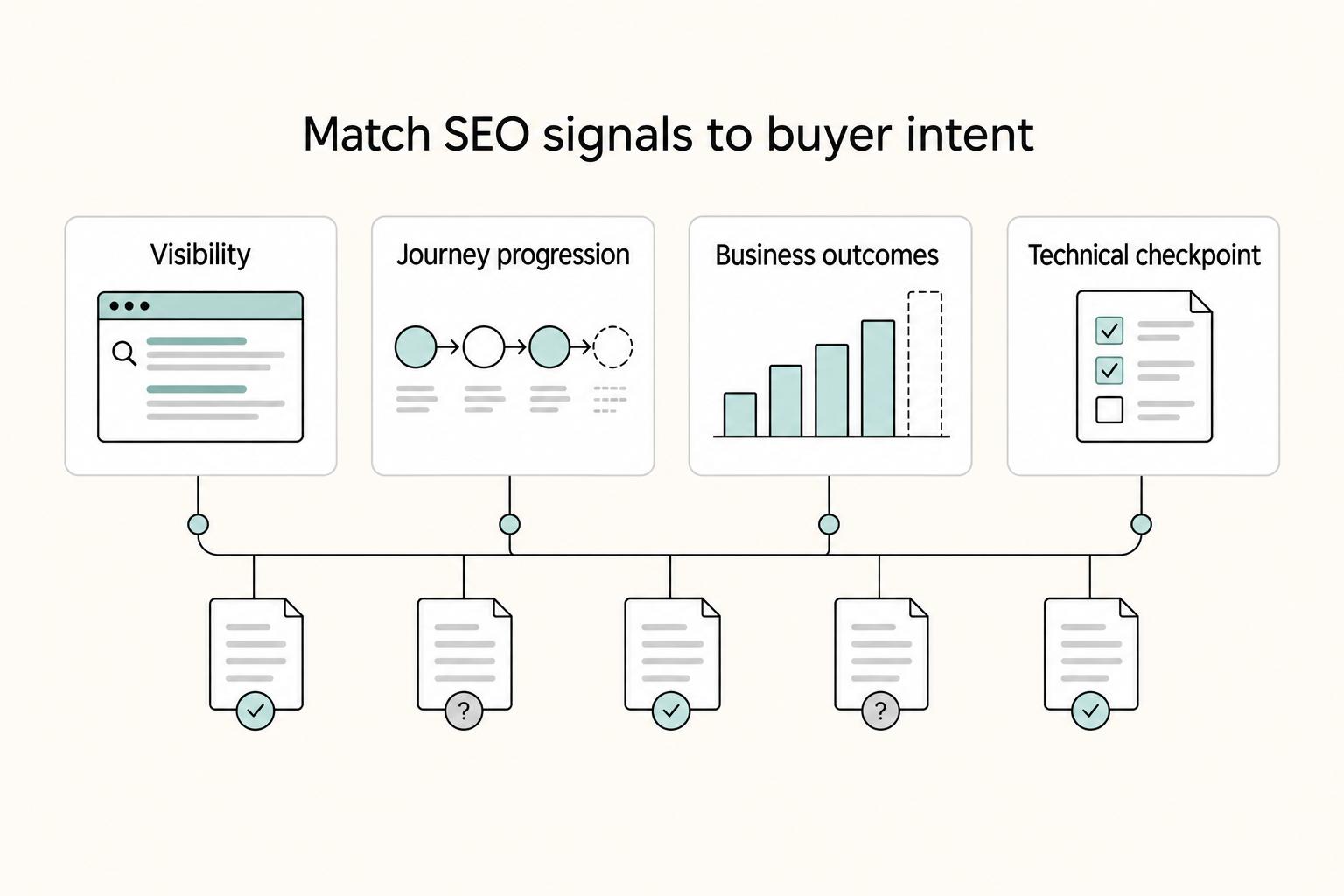
| Metric layer | Where to look | What it tells you | False positive to watch | Action to take |
|---|---|---|---|---|
| Visibility | Search Console impressions and clicks | Whether the page is being discovered for relevant searches | High impressions from low-fit queries | Tighten title, headings, and opening copy so the promise matches buyer intent |
| Journey progression | GA4 page path and next-step movement | Whether readers move from content into your offer path | Article-to-service clicks that do not continue | Reduce handoff friction: clarify CTA, check destination relevance, simplify next step |
| Business outcomes | GA4 key events tied to the page | Whether the page contributes to qualified pipeline movement | Conversion volume with poor-fit leads | Narrow the page promise and align CTA language to the client type you want |
| Technical checkpoint | Audit benchmark such as Semrush Site Health | Whether avoidable technical issues may suppress results | Chasing score gains with no business effect | Fix meaningful blockers, but do not treat one score as proof of lead quality |
An SEO report is not a scoreboard. It should make decisions clearer for performance, communication, and ROI discussions.
Run a data-quality check before every change#
Before you edit copy or structure, test the journey yourself and confirm the visit and next step appear where expected in GA4. If tracking is unclear, fix measurement first.
Watch for execution drift over time. A page can still sit on page three six months later while competitors take the target positions, and sitewide totals can hide that. Review performance per page, not only in aggregate.
Assign one action state per page#
Use this triage for each page and choose one state:
| What you see | Likely issue | Action state |
|---|---|---|
| Visibility is healthy, but qualified next steps are weak | Intent mismatch or weak proof signals | Refresh |
| Discovery is weak for the intended query family | Promise/query mismatch or weak on-page relevance | Refresh |
| Two pages target the same intent and split results | Cannibalized intent | Consolidate |
| Page supports current offer, earns relevant visibility, and drives qualified movement | No major issue | Keep |
| Page no longer fits your offer or remains stagnant after repeated review cycles | Strategic mismatch | Retire |
If Search Console is promising but GA4 remains flat, look at offer-path friction and proof strength before you chase more traffic. For related tactics, see How to Use SEO to Attract High-Quality Freelance Clients and How to Write SEO-Friendly Blog Posts.
Treat Each Page as a Business Asset Before You Invest Time#
Treat each page as a business asset: define its job, define the next step you want, and invest time only when that page can create clear value.
Use value articulation before you touch a draft: I'm doing this task because it should create this business value. If you cannot finish that sentence, pause. That usually means you are reacting to noise instead of making a business decision, and that gets expensive when budgets are tight.
| Trigger | Planning input | Publish gate | Review signal | Next action |
|---|---|---|---|---|
| Anxious tactician: ranking dip, tool alert, or panic | Anxious tactician: keyword first, then a blank doc | Anxious tactician: publish after light polish | Anxious tactician: traffic only | Anxious tactician: broad rewrites and constant tinkering |
| Confident CEO: visible business reason (buyer-intent visibility, weak next-step movement, outdated proof, or offer change) | Confident CEO: intent, client problem, supported offer, and intended action first | Confident CEO: publish only after human checks for intent match, proof quality, useful internal links, and conversion-path fit | Confident CEO: Search Console for visibility + GA4 for key actions or movement to service/contact pages | Confident CEO: one logged change, wait, then keep, refresh, consolidate, or retire |
AI is useful inside this workflow, not as the decider. Use it for keyword/cluster research, title options, meta descriptions, and rough drafting. Then do the human pass yourself: confirm intent match, strengthen proof, verify internal links, and make sure the conversion path fits the reader.
Run this short weekly operating checklist when capacity allows:
- Review pages getting buyer-intent visibility, not just raw traffic.
- Check whether those pages drive the GA4 action you care about or move readers to service/contact pages.
- Update one variable on one page (angle, proof, internal link, or CTA), not everything at once.
- Log the change so your next decision is based on evidence.
That is how this work becomes a repeatable business discipline. For deeper client-fit strategy, read How to Use SEO to Attract High-Quality Freelance Clients. For tighter execution, use How to Write SEO-Friendly Blog Posts.
Frequently Asked Questions
What is the most efficient workflow for a busy freelance writer?
Start in Search Console, not your draft doc. Check the page or query family in the Performance report, which defaults to the past three months, and review clicks, impressions, CTR, and position before you rewrite anything. Before you publish, verify the title link, heading structure, proof blocks, internal links, and the GA4 key event you want that page to drive.
How do I measure the business ROI of my SEO work?
Split discovery from business value. Search Console shows whether people saw and clicked the page, while GA4 shows whether they completed the action you marked as a key event. If you want query-to-behavior reporting, link Search Console to GA4, because GA4 alone does not give you full organic query diagnostics. | If you report on | You will learn | You may miss | |---|---|---| | Traffic only | Whether the page earns visibility | Whether the visitors are a fit | | Qualified next steps only | Whether the page contributes to leads | Early visibility gains that still need time | | Both together | Whether to keep or refresh | Less, because intent and outcomes are both visible |
How does on-page SEO help attract better clients?
It tends to work best when your page promise matches the searcher’s intent and the next step matches your offer. Use internal links to move readers from articles to the most relevant service or proof page, and make the anchor text concise and relevant to the destination. Then track that movement in GA4 instead of stopping at pageviews.
What matters most on a service page?
Make one offer obvious, back it up with specific proof, and give the reader one conversion path. Put proof near the top and again near the CTA: client examples, process detail, author background, or sourced claims are practical trust signals you can add today. A common failure mode is sending readers to three different actions and making none of them feel like the intended next step.
How often should I update old content?
Review pages because the evidence tells you to, not because a calendar says you must. If Search Console shows impressions and clicks but GA4 shows weak next-step movement, refresh the angle, proof, internal links, or CTA. After you edit, wait at least a few weeks before judging the result, and remember linked Search Console data can lag by about 48 hours and only spans up to 16 months in Analytics.
Can SEO help my portfolio or case studies rank?
It can, especially when each case study explains the client problem, your approach, and the outcome instead of acting like a gallery label. Put the strongest proof high on the page, link to the matching service page with clear anchor text, and give the reader one explicit next step. That can be a stronger trust signal than a screenshot carousel with no context.
What matters more, keyword placement or proof of expertise?
You need both, but proof often influences whether a qualified prospect trusts you enough to act. Put the main term where it improves clarity, especially in the title link and major headings, then support it with sourcing, real examples, author background, and one tracked next step. If the page is well optimized but still attracts poor-fit leads, your proof or page promise may be the problem.
Try a related tool
Researched and edited by the Gruv editorial team. Gruv builds cross-border billing, payouts, and finance-operations software for global businesses.
Sources
Includes 6 external sources outside the trusted-domain allowlist.
- anl.gov/sites/www/files/2023-06/AI4SESReport-2023-v6...trusted
- govinfo.gov/content/pkg/GPO-STYLEMANUAL-2016/pdf/GPO-STY...trusted
- ahrefs.com/blog/content-gap-analysisexternal
- americaneagle.com/insights/blog/post/how-to-generate-seo-reportsexternal
- developers.google.com/search/docs/fundamentals/seo-starter-guideexternal
- developers.google.com/search/docs/appearance/title-linkexternal
- monday.com/blog/marketing/seo-workflowexternal
- search.google.com/search-console/aboutexternal
Educational content only. Not legal, tax, or financial advice.
Related Posts

How to Use SEO to Attract High-Quality Freelance Clients
**Build your *seo for freelancers* around qualified leads, not raw traffic: tighten who you target, what you prove, and how you gate inquiries.** You're the CEO of a business-of-one. Your marketing job isn't "get more attention." It's "get the right work, predictably, without turning your calendar into a sorting machine."
How to Write SEO-Friendly Blog Posts
**Build SEO-friendly posts as repeatable assets: satisfy a real searcher fast, package the answer for search results, and route the reader to a clear CTA.** When you're staring at a blank page, you need a [workflow](https://reusser.com/insights/blog/5-practical-steps-to-write-seo-friendly-blog-posts) that removes guesswork and leaves an audit trail you can improve over time. Think of this as operations for on-page optimization and content writing, not "writing for an algorithm." If you run a business-of-one, you need your blog to behave like an asset you can run on a system.
The Best Coworking Retreats for Digital Nomads
A coworking retreat is only worth booking if it can support real work, real deadlines, and real compliance obligations. When a retreat gets the basics wrong, the cost shows up quickly in missed client delivery, compliance exposure, and admin drag that eats the week you meant to spend producing.