
Quick Answer
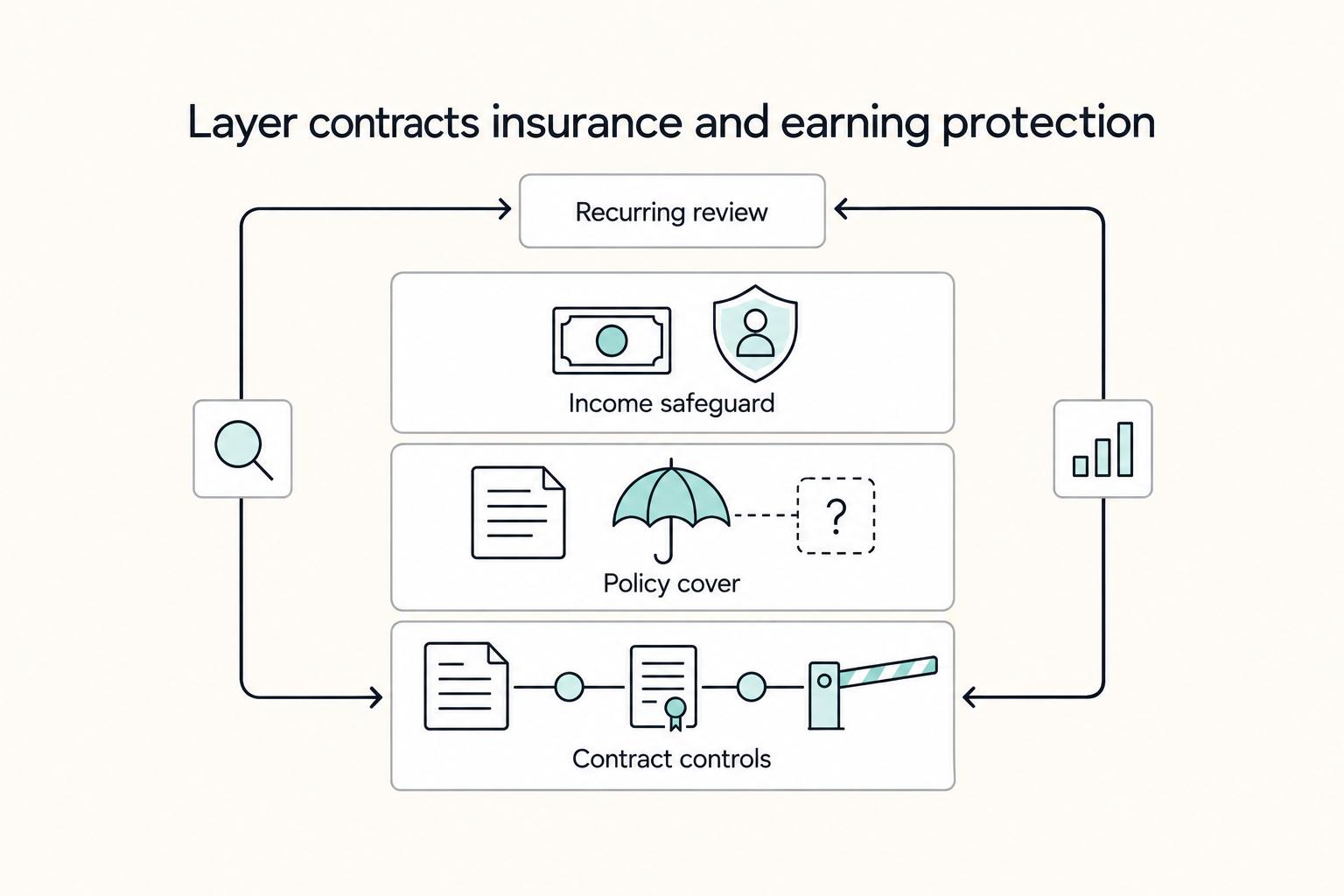
Map each disruption to the actual policy: physical damage, dependent property, cloud outage, professional-service allegation or personal inability to work. Check triggers, exclusions, waiting periods, limits and claim conditions. Review scope and staged billing alongside coverage, prepare evidence of lost net income and continuing expenses, and keep an authorized continuity backup.
Match IT Consulting Risks to Contracts, Coverage and Continuity#
Review contracts, insurance and continuity together. Scope, acceptance and billing controls can reduce avoidable disputes, while insurance responds only to covered events. Do not delay required coverage while improving contracts; prepare both before taking on an engagement that requires them.
That order matters in practice. A weak SOW, vague acceptance process, or loose billing structure can turn ordinary delivery friction into a collection problem. Insurance is usually not the place to fix that. When the contract package is clear, insurance becomes a backstop for defined loss scenarios rather than a substitute for day-to-day operating discipline.
Pillar 1. Use the contract and SOW as your first risk control#
Your contract package is your first risk control, and the SOW is the core operating document. Use it to stop scope drift, payment delays, and avoidable disputes before they turn into cash-flow stress. Use this checklist on every engagement:
- Define scope boundaries in plain language, including what is out of scope.
- Set acceptance criteria so both sides can verify that work conforms to contract requirements.
- Add change-control terms so extra requests become approved, priced changes.
- Include termination language covering work in progress, unpaid invoices, and transition support.
- Sequence payments through the project instead of relying on one final invoice.
- Track client concentration with an internal cap based on your pipeline strength, payment reliability, and cash buffer.
The value of this checklist is in using it before delivery pressure starts. Review it when you prepare the SOW, again before signature, and again when the project changes shape. If you wait until a disagreement appears, you are no longer designing the operating rules. You are arguing about what they were supposed to be.
For scope, push for wording that an outside reader could understand without a call. If the deliverable list is specific but the work description is broad, that broad language can still drive wider client expectations. For acceptance, make sure the criteria match what you are actually delivering, not a generic statement that leaves completion open to interpretation. For change control, tie the request to a defined approval step so "can you also" does not become unpaid work by momentum.
Termination language matters for more than the end of a bad project. It also governs a normal wind-down when priorities shift or budgets tighten. If the file does not clearly address work in progress, invoice timing, and handoff expectations, a routine exit can become an avoidable revenue shock.
There is no universal safe concentration percentage. If losing one client would force immediate pay cuts, missed premiums, or rushed bad-fit work, your concentration is too high for the way you operate today.
Use that concentration review as an operating signal, not a theoretical metric. If one client dominates your calendar, your receivables, or your renewal planning, ask what happens if they pause work, delay payment, or move procurement terms in a way that slows cash. If the answer is "everything else gets squeezed," that is not just a sales issue. It is a resilience issue.
| Area | Weak setup | Resilient setup | Why it matters |
|---|---|---|---|
| SOW | Broad promises, vague deliverables, no out-of-scope section | Specific tasks, defined deliverables, explicit exclusions | Fewer scope disputes and less unpaid expansion |
| Acceptance | "Client will review" | Written acceptance criteria tied to contract requirements | Clear completion point and less billing friction |
| Change + termination | Verbal changes, unclear exit | Written change approval and clear termination steps | Fewer mid-project revenue shocks |
| Payment | One large final invoice | Staged invoices tied to clear invoice requirements and confirmed performance | Better cash timing and lower collection risk |
| Client concentration | No internal cap | Internal cap plus periodic review | Lower single-client dependency risk |
| Coverage design | One generic package | Separate BI, CBI, Tech E&O, and cyber wording review | Fewer false assumptions about triggers |
Once the contract is doing its job, insurance can focus on the losses that still remain. That only works when you map each risk to the right policy wording. BI, CBI, Tech E&O, and cyber can lead to similar business pain, but they do not trigger the same way.
Pillar 2. Test each disruption scenario against the actual policy wording#
Business income coverage commonly requires covered physical loss or damage under the property policy. It can cover lost net income and continuing expenses during the defined period of restoration, subject to limits and conditions. Check the waiting period, restoration definition and maximum indemnity period separately. A civil-authority time limit or an extended-income endorsement is not a universal restoration period.
Contingent business interruption can address loss from covered damage at a dependent supplier or customer, subject to the form. Technology E&O concerns client allegations about errors in your professional technology services. Cyber coverage may address your incident costs and third-party liability. Confirm whether dependent-system coverage includes non-malicious outages, not only cyber attacks.
A practical way to review this is to start with the event, not the policy name. Write down what happened and who suffered the loss first. Then note whether there was physical damage, whether a client is alleging your services caused harm, and whether the problem sits in your own systems or with a vendor or platform. Test that scenario against the actual wording. Similar business outcomes do not mean the same coverage response.
That is where many consultants lose time during renewal or procurement review. The pain point sounds simple: "I could not work," "my client says I caused a loss," or "a vendor went down." But those are different trigger paths. If you collapse them into one insurance question, you get vague reassurance instead of usable answers.
| Scenario | Usually the first policy to review | Not safe to assume |
|---|---|---|
| Your insured workspace or property has covered physical damage and operations pause | BI (business income) | That BI covers non-physical digital outages by default |
| A dependent supplier or customer disruption cuts your income | CBI wording, if included | That CBI is automatically included or uniformly triggered |
| A client claims your services caused their loss | Tech E&O | That cyber automatically handles professional-service liability |
| Your business suffers a cyber incident and your own direct losses | First-party cyber | That Tech E&O covers your own incident costs |
| Others sue after a cyber event linked to your business | Third-party cyber | That first-party cyber handles third-party liability |
| Privacy or data-protection failure allegations | Cyber wording, plus Tech E&O exclusions check | That Tech E&O always covers privacy failures |
Estimate the income gap without treating sales as the claim amount#
In a hypothetical 10-day covered interruption, the consultant would have earned $10,000 of revenue, avoided $2,000 of variable delivery costs and still incurred $3,000 of fixed operating expenses. Expected net income was $5,000 ($10,000 − $2,000 − $3,000); net income plus continuing expenses is $8,000 ($5,000 + $3,000), not $10,000 of gross sales. A $1,000 temporary-workspace cost raises an extra-expense question under its own terms, not an automatic addition to the claim.
This is a planning illustration before waiting periods, limits, deductibles, mitigation and the policy’s loss definition. If an assumed waiting period leaves the first three days unfunded and costs arise evenly, the business needs its own cash for that interval; the remaining loss still needs insurer assessment. Keep prior invoices, recurring expenses, bookings, downtime records and avoided-cost evidence. Notify the insurer promptly and document reasonable mitigation rather than waiting until the calculation is complete.
Verify the wording before you buy#
Treat broker calls as policy review sessions, not product overviews. Ask for the exact wording on coverage territory, dependent business interruption, privacy and data exclusions, and duty-to-defend language.
| Coverage check | What to do |
|---|---|
| Coverage territory | Ask for the exact wording |
| Dependent business interruption | Ask for the exact wording |
| Privacy and data exclusions | Ask for the exact wording |
| Duty-to-defend language | Ask for the exact wording |
| Where work can be performed | Verify in writing |
| Where clients can be located | Verify in writing |
| Where claims must be filed | Verify in writing |
If a broker explains coverage in a way that sounds broader than the form, pause there and ask where that appears in the wording or endorsement. The useful question is not "does this cover my concern?" but "show me the part of the form you are relying on." That keeps the discussion anchored to a document you can review later. Then verify three points in writing:
- where work can be performed
- where clients can be located
- where claims must be filed
Watch for global-sounding language with venue limits. A form can allow worldwide work but still require claims to be filed only in specific jurisdictions.
Keep the written confirmations with the draft forms, endorsements, and your renewal notes. If your business changes during the policy term, revisit those same three points instead of assuming the original answer still fits. Cross-border facts, client mix, and service delivery can drift over time even when your policy labels stay the same.
Pillar 3. Income protection and a continuity plan someone else can run#
For a business of one, continuity planning is personal risk planning. If you cannot work, revenue can stall quickly even if your contracts and insurance are strong.
| Disability point | Article detail |
|---|---|
| Own occupation | Some policies pay if you cannot perform your own occupation |
| Any gainful work | Others require that you cannot perform any gainful work you are qualified for |
| Benefit amount | Verify insured self-employed earnings, benefit cap and offsets |
| Benefit start | Verify the actual elimination period and continuity funding |
Disability definitions, elimination periods and benefits differ by policy. Compare own-occupation and any-gainful-employment tests, partial disability, offsets and evidence of self-employed earnings. Ask for the actual benefit amount and start date; broad examples such as 60% income replacement or a six-month start do not establish your entitlement.
The continuity question is not only "what happens to the business?" It is also "what happens to the household and the recovery timeline?" If there is a long wait before benefits begin, you need an operating plan for invoices, subscriptions, premium payments, and client communication during that period. Otherwise a health event turns into a contract problem and then into a cash problem.
Build continuity into operations by documenting these basics:
- critical functions and minimum weekly obligations
- backup and restoration steps
- billing and collections responsibilities during disruption
- access to essential records and systems
Do this in a way someone else could follow under stress. A continuity document that only makes sense when you are healthy, available, and fully briefed is not really continuity planning. Keep file locations, account access process, client contact sequence, and billing actions clear enough that the business can keep moving even if you are temporarily out.
If you want a practical companion checklist, see creating a disaster recovery plan for your freelance business.
Before broker calls, prepare a short policy review packet so the discussion stays tied to your actual risks:
- current SOW and MSA templates
- key vendor and platform dependency list
- client geographies and likely claim venues
- plain-language summary of data you access, store, or transmit
- current personal income-protection policies, if any
This keeps the discussion concrete and makes coverage gaps easier to spot. It also helps you compare answers across brokers or renewal options, because you are testing the same fact pattern each time instead of relying on a high-level conversation.
Use the SOW generator to prepare scope and billing terms alongside the policy review. Check required coverage before work begins.
Review Contracts, Coverage and Continuity Together#
Review contract controls, policy wording, business continuity and personal income protection together. Keep the review current when the engagement, dependencies or location change.
Review contract controls alongside coverage#
Review the MSA, SOW, change approval, acceptance, invoicing, suspension and termination terms alongside the required insurance. For each engagement, identify where delivery can stall, which clause handles it and which covered loss would require insurer notification.
A useful review method is to trace the project from kickoff to final invoice. Where can scope expand without approval? Where can acceptance drag without a clear completion test? Where can a delayed decision block delivery while your costs continue? If you cannot point to the clause that handles each failure mode, the contract package probably needs tightening before you depend on it.
If a client, platform, or vendor is critical to delivery, record that dependency in the project file. Before you sign, also verify any insurance requirements tied to client procurement, lease terms, or lender demands, if applicable.
Verify coverage against real triggers#
Review the policy form, schedule and endorsements. NAIC guidance distinguishes property-based business income, extra expense, dependent-property and civil-authority cover. Their triggers and timing differ. Do not apply a civil-authority limit to ordinary business income coverage.
| BI review point | Article detail |
|---|---|
| Trigger | Covered event and affected property or system under the form |
| Waiting period | Actual hours/days in the schedule or wording |
| Period of restoration | Defined repair/recovery period and applicable maximum |
| Extended business income | Separate post-restoration terms, if included |
Read the coverage with your own operating facts in front of you. Match the policy to where you work, how you deliver services, which vendors you rely on, and where claims might arise. If a key concern only makes sense after several "probably" or "should" statements, treat that concern as unconfirmed until the wording resolves it.
Pressure-test the wording with one real scenario, such as an unusable workspace or a disruption at a direct supplier or customer property. Then verify exact triggers, exclusions, and contingent business interruption terms, including whether the damage type matches covered causes in your policy. Treat cloud or vendor downtime as unconfirmed until the written form supports it, and check communicable-disease exclusions explicitly.
Protect the person and the recovery path#
Protect your earning capacity with the same discipline. Policy definitions can differ, so verify whether disability eligibility is based on your own occupation or any gainful employment, then confirm waiting periods and benefit design.
Keep a practical readiness checklist so the basics stay usable under stress:
- Store offsite records for insurance policies, banking details, and key contacts.
- Compile and test a business continuity plan with IT disaster recovery steps.
- Re-check contracts, dependency records, and policy documents on a recurring basis and when clients, tools, location, or renewal terms change.
The goal is not a perfect binder of documents. It is a recovery path you can actually use when attention is limited and decisions need to happen quickly. Keep the materials current, keep access clear, and make sure the sequence of actions is obvious enough that you do not have to rebuild your plan during the disruption itself.
Review the contracts and coverage together when the work, client mix, location or dependencies change. For related liability questions, see liability insurance for freelance IT consultants. Keep the recovery plan, policy records and financial evidence accessible to an authorized backup person.
Frequently Asked Questions
Does business interruption insurance for an IT consultant cover a cloud or SaaS outage?
Not automatically. Property-based business income coverage commonly requires covered physical loss or damage. For a cloud or SaaS outage, examine dependent-system cyber or other interruption wording, including whether non-malicious failure is covered. The provider, event, waiting period and sublimit must fit the actual form.
What should you ask if your real worry is a key vendor or platform going down?
Ask whether the dependency is covered, whether it must be named, and whether the trigger includes the event you fear: physical damage, cyber attack or non-malicious system failure. Check waiting time, sublimits, geography, upstream providers and exclusions.
Do you need a BOP if you work remotely?
Remote work does not remove equipment, liability or interruption exposures. A BOP may combine property, general liability and business income protection, but suitability depends on the business, eligibility and exclusions. Home insurance may limit business property or activity.
What covers a client cancelling a contract or refusing to pay?
Ordinary cancellation or an unpaid invoice is not, by itself, a covered physical-loss interruption. Use the contract’s deposit, staged billing, suspension and termination terms to manage the exposure. Specific trade-credit or other specialist cover may respond to defined risks, but it is not a payment guarantee.
How are Tech E&O and cyber different in practice?
Technology E&O generally addresses third-party claims alleging loss from errors, omissions or negligence in technology products or services. Cyber can include first-party incident response, restoration and interrupted income, plus third-party privacy or security liability. Combined policies exist, and exclusions decide overlap.
Can you rely on articles, summaries, or research notes instead of the policy?
Not by themselves. A clear guardrail applies: always check claims against the original policy language or primary source documents rather than relying on summaries or articles alone.
Try a related tool
Researched and edited by the Gruv editorial team. Gruv builds cross-border billing, payouts, and finance-operations software for global businesses.
Sources
Includes 3 external sources outside the trusted-domain allowlist.
- ftc.gov/business-guidance/small-businesses/cybersecu...trusted
- ready.gov/business/emergency-plans/continuity-planningtrusted
- content.naic.org/article/small-business-insight-what-business...external
- content.naic.org/consumer/small-business.htmexternal
- travelers.com/resources/business-industries/technology/tec...external
Educational content only. Not legal, tax, or financial advice.
Related Posts
How to Create a Disaster Recovery Plan for Your Freelance Business
Build this as a baseline to create a freelance disaster recovery plan you can run under pressure: clear recovery targets, a restore order, client-ready messages, and one restore proof record. This helps reduce improvisation during an outage.

The Freelance Payment Penalty: A Modeled Audit of Platform Fees, FX Spreads, and Payout Delays
The money rarely disappears through a single, easy-to-spot fee. The real loss is stacked. A marketplace takes its commission, a processor adds a charge for international cards, a bank or payment company converts the currency at a spread, a platform holds the funds before release, and a wire sheds a little to intermediaries on the way in. Each layer looks defensible on its own, but the worker feels the combined result as a smaller deposit and a later payday.

How to Respond to a Subpoena for Business Records
Move fast, but do not produce records on instinct. If you need to **respond to a subpoena for business records**, your immediate job is to control deadlines, preserve records, and make any later production defensible.