
Quick Answer
Uruguay planning works best as three separate decisions: your migration route, your civil-year tax position, and how each income stream is categorized. Choose the lane that matches your expected stay, reassess before the 180-day migration checkpoint, and review tax residence before 183 days in the civil year. A temporary permit or HIP does not by itself determine tax residency or income treatment.
The Global Professional's Strategic Briefing on Uruguay#
If you're looking at the uruguay digital nomad visa, the bigger risk is often not entry itself. It is letting a short-stay setup drift forward without making separate decisions about migration timing, tax residence, and how different income is treated.
This works better as a sequence problem than as a single visa question. You are not just asking, "Can I arrive and file?" You are also asking whether the route you chose still fits once your stay stretches, whether your tax analysis is based on the civil year rather than your arrival date, and whether the type of income you earn is being sorted correctly instead of being grouped into one broad assumption about "foreign income."
A lot of confusion comes from mixing those questions too early. Someone can be on a temporary migration track while still needing a separate tax review. Someone else can be focused on tax residence and forget that a short migration lane still has its own limits and renewal logic. The practical fix is to stop treating Uruguay as one decision and start treating it as three linked but separate workstreams: your migration lane, your civil-year tax position, and your income-category analysis.
If you do that early, the process becomes much calmer. You can test a stay without pretending it is permanent. You can move into longer-term residence planning when the facts really justify it. And you can avoid building a story for migration purposes that no longer matches the way you actually live and work.
Pick the right lane#
Start with the lane that fits your likely timeline, not just your arrival story. Uruguay XXI ties the digital nomad permit rollout to Decree 238/022, a digital form, and an affidavit after tourist entry. Article 8 of Decree 394/009 is a different temporary route for under 180 days, with a Hoja de identidad provisoria and one renewal for another 180 days. If you already expect to stay beyond that window, Article 8 itself points you toward migration categories in Articles 4 and 7.
| Lane | Best fit | Mismatch signal |
|---|---|---|
| Digital nomad permit / temporary identity document for nomads | You are self-employed or employed abroad, will enter as a tourist, and plan an initial six-month stay | You already expect the stay to outgrow a short test period |
| Article 8 plus Hoja de identidad provisoria | You are processing temporary residence for under 180 days and one bounded extension is enough | You are using renewal only to postpone a longer-term residence decision |
| Articles 4 and 7 residence planning | Your timeline is long by design, or your intent has shifted from temporary stay to residence planning | You still call it temporary, but your facts now exceed the Article 8 window |
The key point is not that one lane is universally better. Each lane assumes a different planning story. Problems usually begin when the paperwork says "temporary" but your real-world behavior says "I am probably staying." That mismatch shows up in small ways before it becomes a filing problem: you stop thinking in weeks and start thinking in seasons, you begin solving for renewals instead of departure, or you delay longer-term planning because the short route still feels easier in the moment.
A good test is how you would answer a simple question: how long do you expect to remain if everything goes well? If the honest answer already goes beyond one short cycle, that matters. It does not force an immediate legal conclusion on its own, but it does tell you not to build your whole plan around a lane designed for a bounded temporary period.
This is where people lose time: they focus on what is available now instead of what they will need next. The result is a short route that is technically possible at the start but operationally inefficient because it simply delays the harder decision. That delay can drain attention even when it does not create a formal problem. You end up repeating document work, rechecking pages under time pressure, and trying to line up migration choices with tax review at the same time.
A better approach is to treat the first lane choice as a forecast, not just a filing event. Ask three practical questions:
- Is this truly a short test stay, or am I already designing a longer base?
- If I extend, am I extending because circumstances changed, or because I never intended to leave quickly?
- If the facts change in my favor and I want to stay, what is my next route and when do I need to start preparing for it?
Those questions do not require new legal analysis. They just force you to make your timeline explicit. Once you do that, the lane choice gets easier.
A simple rule works well here: if you already expect to outlast one temporary cycle, do not ask a short lane to carry a long plan. Match the route to your likely facts at the 180-day migration checkpoint.
That rule also helps when you need to explain your situation later. If you work with a local adviser, or even if you are only organizing your own notes, it is much easier to say, "I entered on a tourist basis, used the nomad process for an initial short stay, and then reassessed when my intent shifted," than to reconstruct a series of ad hoc extensions after the fact.
Build your file in dependency order#
A common way to lose time is to build around the form instead of the documents that can actually stall you. Delays can come from a foreign record requested too late, not just from the online step.
| File item | What to track | Why it matters |
|---|---|---|
| Lane lock-in | Legal basis, entry date, and next decision date | Gives continuity if you later renew or move into an Article 4 or 7 route |
| Residence-history map | Last five years by country, flagging stays of 6 months or more | Helps identify where to request documents from and what period each request may need to cover |
| Parallel document requests | Especially criminal-record certificates that may be needed for HIP renewal | A foreign certificate requested too late can create more delay than the submission itself |
| Official-page revalidation | Date-stamp each live page check; the HIP page showed Última actualización: 12/03/2026 when last reviewed here | Shows the difference between confirmed text and items that still need reverification |
| Submission history and verification notes | Form version, affidavit copy, screenshots, and exact wording used when replacing placeholders | Helps you explain what you filed, compare versions, or rebuild a missing document pack |
That is why dependency order matters. The visible filing step feels important because it is concrete, but the slower pieces often sit behind it. A foreign certificate, a reissued document, or a replacement copy can create more delay than the submission itself. If you wait to think about those dependencies until you are close to a deadline, you can make a simple route feel unstable.
Keep one tracking file, whether that is a sheet or a set of notes, and use it to hold the pieces that are easiest to lose across a renewal or route change:
- Lane lock-in: legal basis, entry date, and next decision date.
- Residence-history map: last five years by country, flagging stays of 6 months or more.
- Parallel document requests: especially criminal-record certificates that may be needed for HIP renewal.
- Official-page revalidation: date-stamp each live page check. The HIP page showed Última actualización: 12/03/2026 when last reviewed here. Recheck before filing.
- Submission history and verification notes: form version, affidavit copy, screenshots, and exact wording used when replacing placeholders.
That record gives you continuity if you later renew or move into an Article 4 or 7 route.
The easiest way to use that file is to build it as a timeline rather than as a pile of attachments. Put the lane you are using at the top. Under that, note the exact moment when you need to decide whether the current route still fits. Then work backward to the documents that can take longest to secure. This keeps you from treating every task as equally urgent when it is not.
For example, if a future renewal might require a foreign record tied to where you lived, your residence-history map should be ready long before you need the final pack. That map is not busywork. It helps you identify where to request documents from, what period each request may need to cover, and whether any place you lived should be flagged now rather than rediscovered later under time pressure.
The same logic applies to page verification. It is easy to check the official site once and then assume the answer is stable. A more reliable habit is to note the date you checked, save the page version or screenshot you relied on, and mark which placeholders in your working notes still need to be replaced before filing. That way, if you return to the process after a few weeks, you can immediately tell the difference between confirmed text and an instruction to reverify.
Your submission history matters for the same reason. If you save the affidavit version you used, the screenshots of the form, and the wording that replaced any placeholder, you are not just preserving evidence for the filing itself. You are creating continuity for yourself. If you later need to explain what you filed, compare versions, or rebuild a missing document pack, you will not be doing it from memory.
A useful way to think about the file is that it should answer four questions at a glance:
- What lane am I in now?
- What date forces the next decision?
- Which documents still depend on foreign action or live-page verification?
- What exactly did I already submit or rely on?
If your file can answer those four questions in under a minute, you are in good shape.
Another practical point: do not let your checklist become detached from the route you actually chose. A generic "Uruguay documents" note is where mistakes begin. Label the checklist by route and by stage. For example, keep one block for initial nomad filing, one block for possible HIP renewal support, and one block for later residence-route planning. The point is not to multiply paperwork. It is to stop route-specific requirements from getting blended into one vague list that is hard to use.
The same discipline helps with unresolved items. If your working notes include requirements or document rules that still need current verification, treat those as red flags, not as harmless notes. A placeholder that survives into your active filing pack can cause confusion because it hides exactly what still needs live confirmation. Before you move from planning to action, run one deliberate sweep through your file and replace every placeholder or mark it as unresolved.
If you only do one thing from this section, do this: set a next decision date now, then build your document requests backward from that date. That one habit usually prevents the rushed scramble that makes a temporary route feel more difficult than it is.
Separate residence tests from income buckets#
This split matters most: migration status, tax residence, and income treatment are related, but they are not the same decision. A nomad permit, HIP, or other migration status does not by itself determine tax residence.
That distinction matters because people often borrow certainty from the wrong category. They assume that because they are on a temporary migration route, their tax outcome must also be temporary or simple. Or they assume that because they have not crossed one day-count line yet, all income questions can wait. The core problem is that those are different tests, and they can move on different timelines.
Uruguay's tax-residence rules include more than 183 days in the civil year and a separate test based on where your main activities or economic/vital interests are centered. Those triggers can move on different timelines, so your civil-year tax checkpoint is not the same as your migration checkpoint.
That means the day you entered Uruguay is not the only date that matters. Your migration route may revolve around one set of deadlines, while your tax review should be tied to the civil year and to the substance of where your work and life are centered. Even if you do not cross the day-count trigger, you still need to pause and ask whether your practical center of activity has shifted.
Then make a second separation between residence status and income category. IRNR covers Uruguayan-source income for non-residents. The DGI-described IRNR/IRPF option is narrower. It applies exclusively to foreign movable capital returns, and once filed by sworn return, it cannot be changed. If that election matters to your plan, the current threshold and election details must be verified from official tax records or a qualified advisor before use.
The operational lesson here is simple: never analyze "tax" as one bucket. Sort your income before you sort your conclusions. The core categories to keep separate are active work income, Uruguayan-source income, and foreign movable capital returns. If those are blended together in your notes, you are much more likely to say something too broad and then build a plan around it.
A practical way to avoid that is to run a two-step review:
- First, ask whether you may be treated as tax resident or non-resident under the relevant tests.
- Then, for each income stream, ask what category it falls into before making assumptions about treatment.
Doing it in the opposite order usually creates confusion. For example, if you start with a broad statement like "my income is foreign," you may skip the category work that the rules actually require. If you start with the category work first, you are forced to be more precise.
This also reduces the risk of relying on shorthand from blog posts or social posts. Broad phrases travel well online because they sound simple. But they are exactly the kind of phrases that collapse important distinctions. Use this as a stop sign:
If you catch yourself saying, "Uruguay is tax-free for my foreign income," stop there and sort the income first. Active work income, Uruguayan-source income, and foreign movable capital returns may not be treated the same way.
It also helps to keep your tax worksheet separate from your migration worksheet. The migration sheet should focus on entry, route, timing, and documents. The tax sheet should focus on civil-year dates, day counting, your activity base, your economic or vital interests, and the categories of income you need to review. Keeping those workstreams in separate files or tabs may feel overly neat at first, but it prevents one of the most common planning errors: treating a migration status as if it automatically decides the tax answer.
The same caution applies to elections and options. Because the IRNR/IRPF option is narrow and, once filed by sworn return, it cannot be changed, slow down before electing, confirm live wording, and make sure you are reviewing only the income stream that the option actually addresses. A narrow election should never be used as a substitute for a full income map.
If you are discussing the plan with an adviser, or even explaining it to yourself in your notes, try to say it in this order: "Here is my migration route. Here is my likely tax-residence timing. Here are my income buckets." That order keeps the analysis from collapsing into one vague narrative.
Execute in sequence#
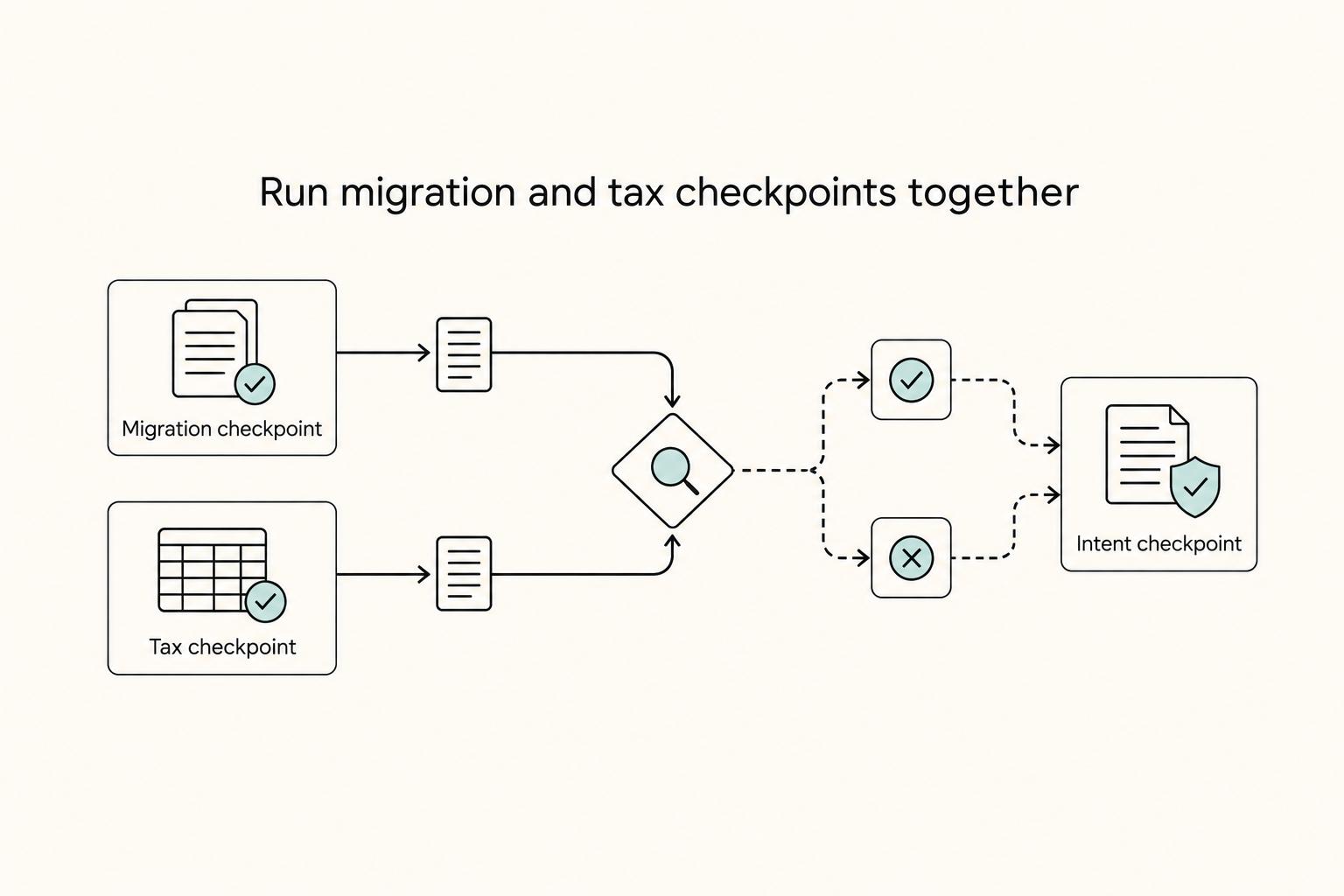
Once the lane is clear and your file is in order, keep each decision tied to its own checkpoint.
| Checkpoint | Timing | Review focus |
|---|---|---|
| Migration checkpoint | Before 180 days | Decide whether one HIP renewal still fits a genuinely temporary plan; if it does not, move into residence-route planning early |
| Civil-year tax checkpoint | Before 183 days in the civil year | Review your day count and whether your activity base or economic/vital interests now center in Uruguay |
| Intent-shift checkpoint | As soon as the facts change | Reassess even if you have not yet hit a day-count trigger |
Use three checkpoints:
- At the migration checkpoint before 180 days, decide whether one HIP renewal still fits a genuinely temporary plan. If it does not, move into residence-route planning early.
- At the civil-year tax checkpoint before 183 days in the civil year, review your day count and whether your activity base or economic/vital interests now center in Uruguay.
- At the intent-shift checkpoint, reassess as soon as the facts change, even if you have not yet hit a day-count trigger.
These checkpoints help because they replace vague anxiety with specific review moments. Instead of wondering all the time whether you should be doing something, you give each decision a home. Migration timing gets one checkpoint. Civil-year tax analysis gets another. A change in your real-world plan gets a third.
The migration checkpoint is not just a calendar reminder. It is a decision review. Ask yourself whether the current route still matches your actual intent. If you are now arranging your life around a longer stay, searching for continuity rather than a short test period, or relying on a renewal as a bridge to an undeclared long-term plan, that is your signal to stop treating the route as merely temporary.
The civil-year tax checkpoint deserves the same discipline. Count the days, yes, but do not stop there. Review whether your main activities are now centered in Uruguay and whether your economic or vital interests point in the same direction. The point is not to force a conclusion too early. It is to avoid reaching year-end and realizing you never performed the review that your own facts clearly required.
The intent-shift checkpoint is the one many people ignore because it is not driven by a single number. But it is often the most important. Intent shifts when your behavior shifts. Maybe you originally planned a trial period and then decided the stay was working. Maybe your work patterns changed and Uruguay became your practical base. Maybe you started making medium-term decisions that no longer fit a short-stop narrative. When that happens, do not wait for the next neat round number before revisiting the whole plan.
To make those checkpoints useful, tie each one to a short action list.
For the migration checkpoint, review:
- your current lane,
- the next filing or renewal date,
- whether any required evidence is already in process,
- and whether the route still matches a genuinely temporary story.
For the civil-year tax checkpoint, review:
- your day count for the civil year,
- where your main activities are actually performed,
- where your economic or vital interests are centered,
- and which income categories need separate treatment analysis.
For the intent-shift checkpoint, review:
- what changed,
- whether the old lane still fits,
- whether your tax assumptions were based on the earlier plan,
- and what needs to be reverified on live official pages.
The common failure mode is waiting until your temporary story no longer matches your real plan. When that happens, update the lane early instead of letting migration and tax issues collide at the same time.
That collision is what usually creates pressure. You are no longer just checking one point. You are suddenly trying to renew or transition, count days, sort income, verify official wording, and possibly seek advice all at once. None of those tasks is impossible by itself. They become difficult when compressed into the same week because you postponed the reassessment that the facts already required.
A cleaner sequence is easier to manage:
- choose the lane that fits now,
- build the file around the slowest dependencies,
- track the civil-year tax position separately,
- and reassess immediately when your intent shifts.
It is not a more complicated strategy. It just matches the way a stay like this can evolve.
If you want a deeper dive, read Hungary's White Card for Digital Nomads: A Complete Guide.
If you are choosing between a temporary lane and a longer-term path, map your checkpoints in the Tax Residency Tracker before you file.
Before you submit anything, run a final document pass with the Digital Nomad Visa Cheatsheet so your sequence and records stay aligned.
Frequently Asked Questions
Do you apply before you arrive?
No. The official flow is tourist entry first, then the online form and sworn statement after you are in Uruguay. Action checklist: confirm the current sequence (tourist entry, then online form and sworn statement) on the official page, save the page version you relied on, and keep copies of your signed sworn statement and submission screenshots. The operational mistake to avoid is planning as if pre-arrival approval were the whole process. The sequence matters: entry comes first, then filing. That means your planning should focus on two separate stages. Before travel, organize what you may need to complete the post-arrival step. After arrival, confirm the live filing sequence and submit based on the current official wording rather than on an older screenshot or a third-party summary. If you rely on saved instructions, mark them clearly as planning notes rather than final authority. Then, once you are in Uruguay, do one clean verification pass before filing. That way your file shows both what you prepared in advance and what you actually relied on at submission.
Do you need to prove a fixed minimum income?
Do not assume there is a fixed number unless a current official page says so. The official materials referenced here confirm a sworn statement requirement, not a confirmed public minimum income number. Action checklist: check the live wording and ignore unofficial blog figures presented as requirements. This is a good place to be strict with your own sources. If an unofficial article gives a neat number but the official wording you can verify does not, do not let the unofficial number migrate into your checklist as if it were settled. Keep your notes aligned with the language you can actually confirm. In practice, this means separating "what people online say" from "what the current official page says." If the live page frames the point around a sworn statement, keep your planning anchored there until you can verify anything more specific. That protects you from overbuilding a document pack around a requirement that may not exist in the form you expected.
Can you use the short temporary lane if you may stay longer?
Only if your facts still fit a genuinely temporary plan. Article 8 ties HIP to a bounded short-stay route under 180 days, allows one renewal for another 180 days, and points longer stays toward Articles 4 and 7. Action checklist: if your timeline is stretching, start transition planning now and request renewal evidence early, including criminal-record documents from countries where you lived in the last five years (for stays of six months or more). The useful distinction here is between a stay that unexpectedly becomes longer and a stay that was effectively long from the beginning. If your plans changed after arrival, that is one kind of case. If you were always designing for a longer stay but using the short lane to delay the next decision, that is another. You do not need to force a dramatic answer before the facts are clear. But once your own timeline begins to stretch, stop telling yourself that you will "figure it out later." That is the moment to prepare the next route, recheck the official pages, and start any supporting document requests that could slow you down.
Will staying below the day-count trigger always keep you out of tax residency?
No. The civil-year day-count test is one trigger, but Article 2-T7 also looks at where your main activities or economic/vital interests are centered. Action checklist: track days against the civil-year trigger (more than 183 days) and review where your work and life are actually based before year-end. This is one of the clearest examples of why the migration and tax analyses should not be collapsed into one. You can focus heavily on staying under a day-count threshold and still miss the separate review entirely. The analysis is not limited to counting days. So use day counting as a tool, not as a complete strategy. Keep a running civil-year count, but pair it with a reality check about where your work is centered and where your life is actually anchored. If those facts start to move, the tax review should move with them, even if the calendar count alone feels reassuring.
Should you treat migration status and tax treatment as one decision?
No. A permit, HIP, or residence process does not automatically determine how your income is taxed. Action checklist: run two tracks in parallel, one for migration status and one for income treatment, because IRPF, IRNR, and the Article 24-T7 option do not cover the same income categories. A simple way to keep this straight is to make sure each track has its own question. The migration track asks, "What status or route am I using, and does it still fit?" The tax track asks, "What is my likely tax position, and how are my income streams categorized?" If you cannot state both answers separately, you probably need to slow down and split your notes. This is especially important if you are relying on shorthand about "non-resident tax" or "foreign income." Those phrases can be useful starting points, but they are not the end of the analysis. The categories matter. When should you get local legal or tax advice? Get it before the timeline gets tight. Do not wait until renewal pressure, a likely lane change, or a possible civil-year tax trigger is close. Action checklist: book advice as soon as your facts move toward HIP time limits (short stay under 180 days, with only one 180-day renewal) or toward tax-residency triggers (more than 183 days in a civil year, or a Uruguay-centered base of activities/interests); if you are comparing destinations, use The 2025 Global Digital Nomad Visa Index: 50+ Countries Compared for next-step planning. The best time to ask for help is usually when your facts first stop fitting the easy version of your plan. That might be when a short stay begins to look like a base, when a renewal becomes likely, when your day count is no longer comfortably distant, or when you realize one income stream may need separate treatment. Advice is usually most useful when there is still time to act on it without compressing everything into a last-minute rush. Even if you are comfortable doing most of the organization yourself, there is value in getting a focused review before the checkpoints converge. It is much easier to clarify one route question now than to sort out route, timing, and tax treatment all at once later. Related: The Best Digital Nomad Cities in Latin America.
Try a related tool
Researched and edited by the Gruv editorial team. Gruv builds cross-border billing, payouts, and finance-operations software for global businesses.
Sources
Includes 4 external sources outside the trusted-domain allowlist.
Educational content only. Not legal, tax, or financial advice.
Related Posts

The 2026 Global Digital Nomad Visa Index for 50+ Countries
Start with legal fit, not lifestyle filters. The practical order is simple: choose a route you can actually document, then decide where you want to live. That single change cuts a lot of wasted comparison work and stops you from falling in love with places that were never a real filing option.

Hungary White Card Guide for Digital Nomads: Eligibility, Documents, Fees, and Timeline
Treat this like an audit, not a hope-and-pray submission. Your job is to decide whether your real-world setup fits the permit logic, pick the right filing route, then build one evidence pack that stays coherent even if someone reviews it line by line.

The Best Digital Nomad Cities in Latin America in 2026
You should leave this section with one primary city and one backup city, not a vague shortlist. If you want the clearest starting point, make **Mexico City** your primary base and choose one backup city, for example **Medellin**, then use a short trial stay to decide whether that order holds.