
Quick Answer
Apply the U.S.-Mexico tax treaty as a remote worker by confirming tax residency first, sourcing income to where the work was physically performed second, and testing permanent-establishment risk last. Use treaty tie-breakers only if both countries can treat you as resident, match foreign tax to the same income stream, and review whether Form 8833 disclosure is required for a treaty-based U.S. return position.
The Three-Pillar Framework for Mastering U.S.-Mexico Cross-Border Tax#
For U.S.-Mexico cross-border tax decisions, use this order: confirm residency, map income and relief, then test business-presence risk. The common failure is to reverse that order and file credits or treaty forms before your residency facts are coherent.
That sequence matters because each later step depends on the one before it. If you are unclear on residency, you will usually source income with the wrong assumptions. If income sourcing is still loose, any credit claim or treaty position rests on a weak factual base. And even when your personal return is clean, your client can still face permanent-establishment risk if your actual role on the ground has drifted beyond the contract.
Think of the framework as a file-building order, not just a legal order. First, you build the residency file. Then you build the income-and-relief file tied to real work location. Then you test whether your day-to-day conduct creates business-presence exposure. When those three files support each other, the overall position is easier to defend and much easier to revisit when facts change midyear.
Pillar 1. Decide residency on year-specific facts you can document#
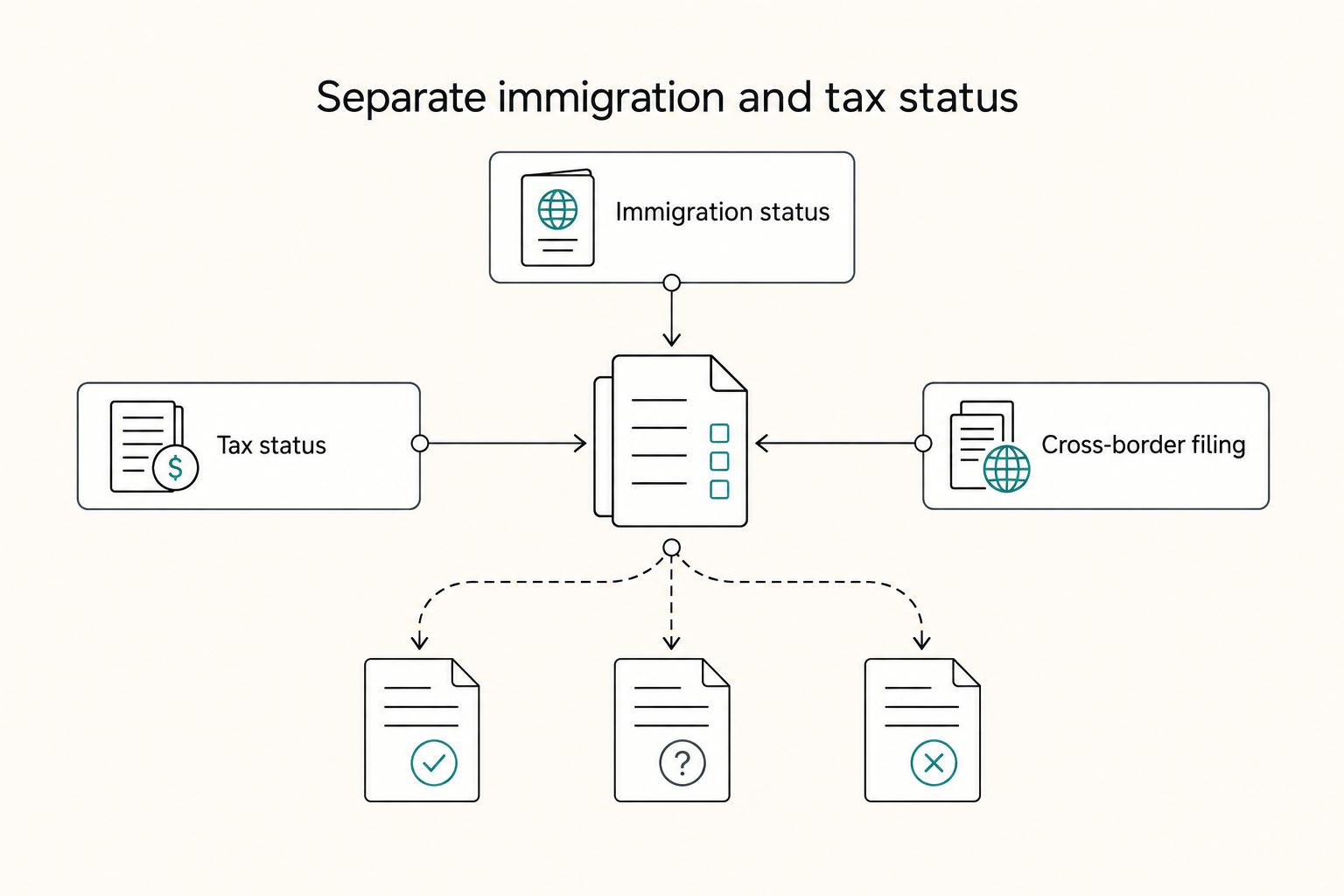
Start with residency, not visa status. Immigration permission and tax residence are separate. Short-stay permission can restrict paid activity without resolving tax residence.
| Step | When used | Focus |
|---|---|---|
| Domestic residence analysis in each country | Before treaty tie-breakers | Whether each country can treat you as resident |
| Permanent home | If both countries can plausibly treat you as resident | Whether a home was actually available during the period at issue |
| Center of vital interests | If permanent home is inconclusive | Whether personal and economic relations point the same way or in different directions |
| MAP | If the conflict still remains or taxation is not treaty-consistent | Competent-authority relief through MAP |
Run the domestic residence analysis in each country first. Use treaty tie-breakers only if both countries can plausibly treat you as resident. A common failure mode is story-first filing, where you pick the answer and then retrofit the facts. The safer default is to build a year-specific evidence file before you file.
In practice, that means you should assemble the record around the actual tax year, not around your memory of what the year felt like. Put your travel days in chronological order. Match those days against work calendars, invoices, and any filing records. Identify when a home was available to you, not just when you happened to sleep there. Note where close personal ties were centered during the relevant period. If your position depends in part on Mexican tax residence, keep the Mexican filing records and supporting documents with the rest of the file instead of treating them as a separate admin task.
The tie-breaker flow is straightforward. Permanent home is an early test. If that is inconclusive, center of vital interests (personal and economic relations) is a key factor. If the conflict still remains, or taxation is not treaty-consistent, competent-authority relief through MAP can be the next escalation step.
Straightforward does not mean casual. Each step works only if your evidence fits that step. For permanent home, the practical question is whether the home was actually available during the period at issue. For center of vital interests, the practical question is whether your personal and economic facts point the same way or in different directions. If they point in different directions, that is usually the moment to stop simplifying and start documenting more carefully.
Keep the practical evidence that supports the position you are taking. That includes travel logs matched to work calendars and invoices, records showing home availability, family-location facts for the relevant period, banking and spending patterns, and Mexican filing and payment records. If Mexican tax residence is part of your position, SAT's Constancia de Residencia can be useful support. For a deeper residency walkthrough, see Tax Residency in Mexico: Beyond the Temporary Resident Visa.
A useful discipline here is to make the file tell one continuous story from January through December. If your calendar says you were in one country, your invoices should not quietly suggest the opposite. If you say a home was no longer available, your spending and address usage should not keep pointing back to that location without explanation. If you rely on Mexican filing records, those records should sit in the file alongside the work timeline they relate to. Most residency disputes get harder because the evidence was collected by category instead of by timeline.
Another common failure is mixing a current-year filing position with stale facts from a prior year. Residency is year-specific. A pattern that was supportable in one year may not carry over cleanly after a move, a lease change, a family relocation, a new bank relationship, or a shift in where work was actually performed. The safer habit is to rebuild the file each year, even if the answer ends up being the same.
If your facts are close, write a short internal memo before filing. It does not need to be formal. It just needs to capture the sequence you followed, the facts you relied on, and any open questions you could not resolve from the documents alone. That memo helps you stay consistent across returns, disclosures, and later explanations. Once residency is reasonably pinned down, the next step is to source income correctly before you touch relief.
Pillar 2. Source income by work location, then choose the relief path#
Start with where the work was physically performed, then determine relief under the applicable rules. Client location, payer location, and bank location do not, by themselves, resolve cross-border sourcing questions, especially when one contract covers work performed in both countries.
That sounds simple until the work pattern gets messy. Cross-border remote work often produces one contract, one payment stream, and one client relationship, even though the services were actually delivered from more than one place. The mistake is treating the contract as if it had one tax location just because the commercial relationship felt like one project. For tax analysis, the operational question is narrower: where were you when the work was actually performed?
When one contract covers work done in both countries, break the file down to the level where the location can be supported. That can mean day-by-day work calendars, work-period allocations, or invoice support that shows how you separated the income. The goal is not to create complexity for its own sake. The goal is to avoid forcing one-country treatment onto a fact pattern that plainly spans both countries.
| Work pattern | Sourcing cue | Taxing-right starting point | Relief path | Records to keep |
|---|---|---|---|---|
| Services performed while physically in Mexico for a U.S. client | Where services were exercised | Test potential taxing rights in each country based on where work was performed and your residency position | Federal foreign tax credit review, plus treaty analysis when treaty treatment is claimed | Contract, invoices, travel log, Mexico return, SAT receipts, payment proof |
| Same contract, work split between Mexico and the U.S. | Separate by actual workdays or work periods | Allocate by where services were performed instead of forcing one-country treatment | Match foreign taxes paid to the same income stream before claiming relief | Day-by-day calendar, invoice allocation method, payment records, returns if filed |
| Services performed while physically in the U.S. for a Mexico client | Physical work location | Start with U.S. work-location facts, then test whether foreign withholding aligns with treaty and domestic rules | Review whether foreign tax was imposed and whether credit, refund, or MAP procedures apply | Contract, withholding statements, U.S. work-location proof, correspondence on withheld tax |
Use the table as a starting map, then pressure-test the records behind it. For example, if you split a contract between Mexico workdays and U.S. workdays, you need a repeatable allocation method that you can explain later. If you are relying on foreign taxes paid, make sure those payments tie to the same income stream and the same period. A weak file usually fails at the matching stage: the tax was paid, but the support does not show clearly which income it relates to.
For federal filing, treaty positions and credit claims are different tracks. If you take a treaty-based return position, Form 8833 is the disclosure checkpoint. Missing required treaty-based information can trigger a potential $1,000 penalty. If taxation is not treaty-consistent, escalate through MAP.
That distinction matters because people often blend treaty logic and credit logic into one vague argument about avoiding double taxation. A stronger approach is to decide in order. First, how the income is sourced. Second, whether tax was imposed on that same income stream. Third, whether the relief path is a credit analysis, a treaty position, or both at different points in the file. If you skip the sourcing step and go straight to relief, you make it much harder to explain why the relief was appropriate.
You should also reconcile the timing. If the work was performed in one period and the tax payment or withholding record shows up later, keep the supporting trail that connects them. Put contracts, invoices, returns, receipts, and payment proof in the same year folder and label them so the sequence is obvious. The file should let someone else see not just that money moved, but why that movement supports the position you claimed.
Do not assume the state result follows the federal one. Some states honor treaty provisions and some do not. Escalate when any of these apply:
- you kept an available home in a prior state and still used that address heavily
- your state day counts are incomplete or reconstructed from memory
- your federal filing claims treaty treatment or foreign tax relief, but the state filing assumes the same result without separate domicile or residency analysis
The practical takeaway is that you need a separate state workpaper whenever state exposure is real. Even if your federal position is well supported, a state return can still fail if the domicile facts or day counts were never reviewed on their own terms. The state file should answer a narrower question: what facts support your state position, and do those facts actually line up with the federal story? If the answer is only "we assumed they would," that is a warning sign.
A good self-check before filing is to ask whether you could explain the income path in one short sequence. Where was the work done? How was the income allocated if it was split? What tax was paid on that income? What relief was claimed? What records prove each step? If any link in that chain is missing, fix the file before you file the return.
After residency and income sourcing are in place, test the business side. This is where a clean personal tax file can still leave client risk exposed.
Pillar 3. Test permanent-establishment risk against your actual conduct#
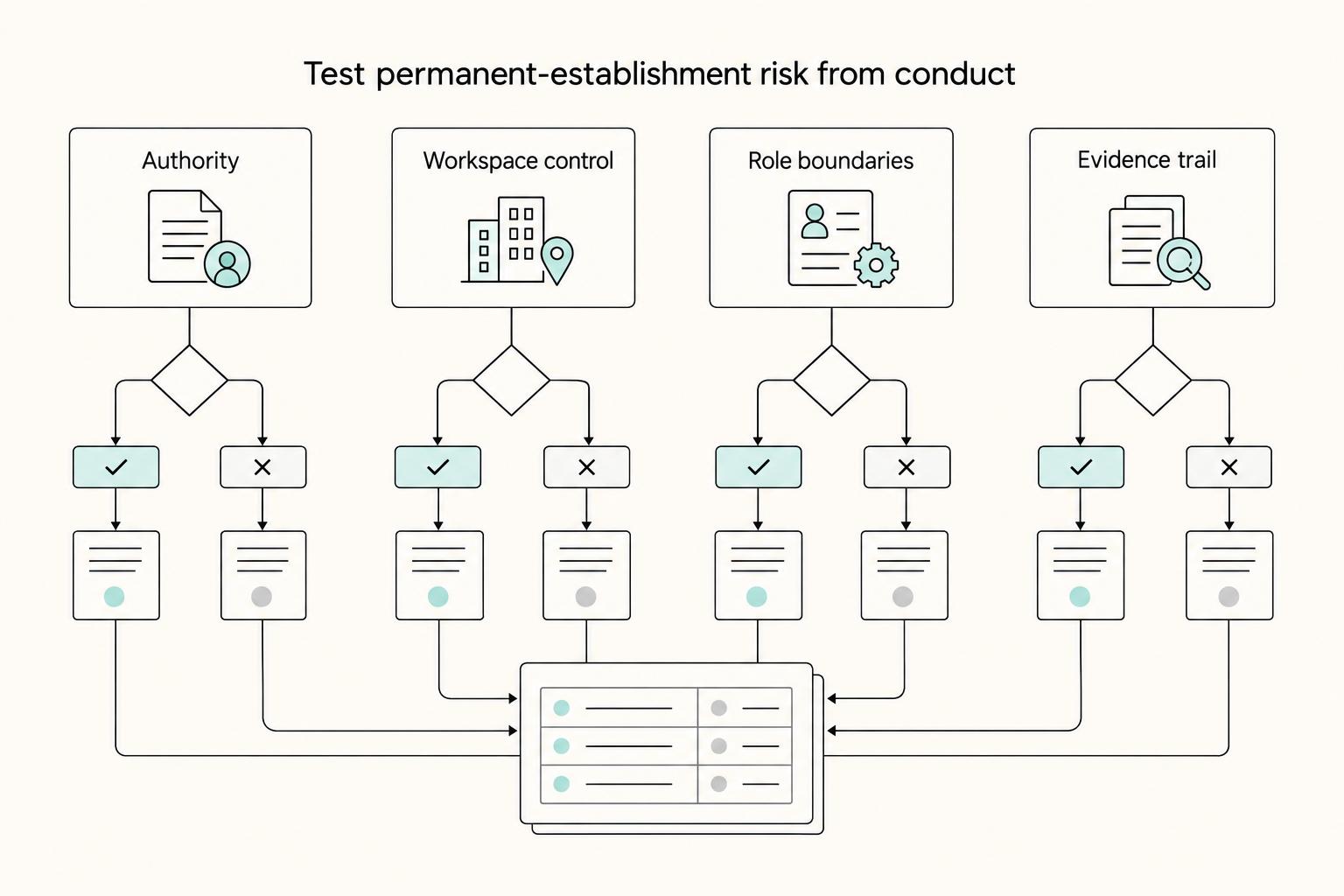
Permanent-establishment risk usually turns on authority and place. The common failure is relying on comforting contract language when day-to-day conduct points the other way.
| Checkpoint | Operational test | Records |
|---|---|---|
| Authority | You do not conclude contracts that bind the client; final commercial approval stays with the client's authorized signatory | Approval emails and records showing who made final decisions |
| Workspace control | You work from premises you control, not a dedicated client-controlled office that looks like the client's local place of business | Records showing you controlled your own workspace |
| Role boundaries | Your title, signature, org-chart position, and meeting role stay in advisory and delivery lanes, not local management or sales authority | Latest signed agreement and invoices that reflect the stated role |
| Evidence trail | Contract terms and actual conduct stay aligned | Signed agreements, approval emails, change orders, and invoices |
Run a contract-versus-conduct PE check. If the agreement says "independent contractor" but your actual behavior shows client-office control or authority to bind the enterprise, the label alone may not protect the position. The safer default is to keep contract terms and actual conduct aligned, with evidence to prove it.
This is where practical operations matter more than labels. A contract can say you are independent, advisory, or outside local management, but your title, signature block, approval role, meeting behavior, and workspace arrangement can quietly move in another direction. PE exposure often grows through normal business drift. You start by supporting delivery. Then you begin speaking as if you can commit the client. Then your workspace starts functioning like the client's local office. Each step can feel minor in isolation. Taken together, they can create a very different picture.
To keep that drift visible, use this operator checklist:
- Authority: you do not conclude contracts that bind the client; final commercial approval stays with the client's authorized signatory.
- Workspace control: you work from premises you control, not a dedicated client-controlled office that looks like the client's local place of business.
- Role boundaries: your title, signature, org-chart position, and meeting role stay in advisory and delivery lanes, not local management or sales authority.
- Evidence trail: keep signed agreements, approval emails, change orders, invoices, and records showing who made final decisions.
To make that checklist useful, test it against recent conduct rather than old assumptions. Look at who sent the final approval emails. Check whether your signature block or meeting introduction suggests decision-maker authority. Review whether you have a regular desk, room, or setup that appears to be the client's local operating space rather than your own workspace. If your role expanded during the year, compare the new responsibilities against the original agreement instead of assuming the contract still fits.
Review this whenever the facts change, especially at contract renewal, role expansion, or before year-end filing. PE exposure usually appears through gradual drift, not one obvious event.
A practical way to do this is to create a short quarterly check, even if the formal legal review happens less often. Ask three questions: Did my authority change? Did my workspace arrangement change? Did my outward role change? If the answer to any of those is yes, update the file immediately. Waiting until year-end is risky because the evidence of actual conduct is easier to gather while the facts are fresh.
The evidence trail matters because PE analysis is often shaped by how the relationship looks in practice. Keep the latest signed agreement, the approval chain that shows who had final authority, the invoices that reflect the stated role, and any records that show you controlled your own workspace. When the contract and conduct align, the file is much easier to defend. When they do not, the risk usually surfaces first in the documents you forgot would be read together.
If you want a deeper dive, read Digital Nomad Taxes in 2026 With a Defensible Filing Plan. If you want a cleaner residency evidence trail before filing, use the tax residency tracker to keep travel days and support records in one place.
Recheck Residency, Filing Choices, and Evidence Every Time Facts Change#
Use one repeatable process, not year-end guesswork: recheck residency facts, filing and disclosure choices, and client-risk boundaries every time your facts change.
| Step | Core task | Output |
|---|---|---|
| Review the facts | Confirm physical presence, work location, permanent home availability, and whether residency facts changed | A current-year residency memo and a short issue list covering dual residency, state exposure, and treaty questions |
| Set the filing path | Source income to where the work was physically performed, then match foreign tax paid to that same income stream | A filing checklist naming each return, form, and unresolved disclosure point |
| Archive the evidence | Keep contracts, approval emails, invoices, tax payment receipts, payment proof, bank records, and work-location records together by year | One audit-ready evidence folder per tax year |
Use a process instead of panic. Your travel log, contracts, invoices, tax filings, and day-to-day conduct should all tell the same story.
The goal is not to predict every possible issue in advance. The goal is to build a file that stays coherent as your life changes. Cross-border problems usually become expensive not because the first move was fatal, but because the records, filings, and business behavior stopped matching each other over time.
- Review the facts
Confirm where you were physically present, where services were performed, whether you had a permanent home available, and whether your residency facts changed. If both countries may treat you as resident, do not shortcut treaty analysis. Output: a current-year residency memo and a short issue list covering dual residency, state exposure, and treaty questions.
Do this as a timeline exercise, not a memory exercise. Put travel, work location, home availability, and major personal changes in one chronological view. Flag any period where your documents are incomplete, because those are the periods most likely to create later contradictions.
- Set the filing path
Source income to where the work was physically performed, then match foreign tax paid to that same income stream. If you are claiming a foreign tax credit, the U.S. filing path is often Form 1116. If you take a treaty-based return position that reduces U.S. tax, confirm whether Form 8833 disclosure is required. Output: a filing checklist naming each return, form, and unresolved disclosure point.
Keep federal and state questions separate on that checklist. If you are also dealing with foreign withholding, make sure the checklist shows whether the issue is a credit question, a treaty question, or a separate mismatch that still needs review. That one-page checklist is often the difference between a controlled filing season and a rushed one.
- Archive the evidence
Keep contracts, approval emails, invoices, tax payment receipts, payment proof, bank records, and work-location records together by year. Most failures come from a record gap, not intent. Output: one audit-ready evidence folder per tax year.
The folder should be easy to handle. Group by year, then by issue: residency, income sourcing, relief, state, and business-presence risk. If you split work between countries, include the allocation support with the invoices rather than in a separate folder no one will think to open later.
Rerun this process immediately after a move, visa change, new lease, marriage or family relocation, new U.S. state tie, client contract rewrite, or a role change that adds contract authority or a client-controlled office setup. For New York, rerun quickly if you may be near 184 days or more, because any part of a day counts. For California, rerun when your presence no longer looks temporary or transitory.
The important point is speed. When a fact changes, do not wait until the return is due to decide whether it mattered. Update the timeline, note the date of the change, and identify which part of the file it affects. A new lease may affect residency analysis. A new work arrangement may affect sourcing. A rewritten client contract may affect PE review. Handling those updates when they happen is much easier than reconstructing them later.
| Trigger | Why it matters | Escalate when |
|---|---|---|
| Residency conflict | Both countries may treat you as resident | Permanent-home facts and other residency facts point in different directions |
| Unresolved treaty position | Saving-clause or treaty-position effect on the U.S. return is unclear | You cannot tell whether treaty treatment changes the return or whether Form 8833 is needed |
| PE ambiguity | Treaty PE risk turns on authority and place | You habitually conclude contracts, act with decision-maker authority, or use a dedicated client office |
| State mismatch | Federal treaty outcomes do not control every state | California or New York facts still support resident treatment |
If any row fits your situation, escalate to a cross-border advisor before filing. Use MAP when taxation appears inconsistent with treaty terms. If your main uncertainty is residency, start with Tax Residency in Mexico: Beyond the Temporary Resident Visa. If the file still does not hold together, contact Gruv to map practical next steps. Related: the Tbilisi digital nomad guide.
If your residency signals or treaty position still conflict after this framework, contact Gruv to map practical next steps for your setup.
Frequently Asked Questions
Do days in Mexico or a temporary resident visa settle tax residency?
No. Time in Mexico and visa status can trigger a residency review, but they do not settle tax residency on their own. Keep a day-by-day travel log, home-availability records, family and spending facts, and any Mexican filing records so your position stays consistent for the full year. Escalate if your calendar was reconstructed later, your U.S. state ties stayed strong, or your visa facts and filing position point in different directions.
When should you use the treaty tie-breaker?
Use the tie-breaker only when both countries can treat you as resident under domestic rules. It resolves a dual-residency conflict and determines one treaty residence state, not an early shortcut. Document home facts, personal and economic ties, and travel days, and confirm whether Form 8833 is required if you take a treaty-based U.S. return position.
How do you claim double-tax relief without creating a weaker file?
Map each income stream first, then match foreign tax paid to that same income stream before claiming relief. For many individuals, the U.S. claim path is Form 1116, and foreign tax credits cannot be claimed on income excluded under the foreign earned income exclusion. Keep contracts, invoices, work calendars, Mexico returns, filing receipts, and payment proof aligned to the same period. Escalate if withholding records conflict, one contract covered work in both countries, or a federal position is being copied to California or New York without separate state analysis.
What remote work facts create permanent establishment risk for your client?
The key risks are authority and place. Permanent establishment can arise from a fixed place of business or from habitually exercising authority to conclude contracts in the enterprise's name, so contract language has to match real conduct. Keep final commercial approval with the client's authorized signatory, avoid a dedicated client-controlled office setup, and retain agreements, approval emails, invoices, and workspace records.
Does opening a Mexican bank account create separate U.S. reporting?
Yes, it can. If you are a U.S. person and aggregate foreign account value exceeds $10,000 at any point in the year, FBAR filing is generally required on FinCEN Form 114, due April 15 with an automatic extension to October 15, and it is filed with FinCEN rather than the IRS. Form 8938 is separate and does not replace FBAR, and the IRS states a baseline $50,000 threshold for certain U.S. taxpayers, with higher thresholds for joint filers and taxpayers living abroad. Keep account-opening records, statements, and an aggregate balance tracker.
Try a related tool
Researched and edited by the Gruv editorial team. Gruv builds cross-border billing, payouts, and finance-operations software for global businesses.
Sources
Educational content only. Not legal, tax, or financial advice.
Related Posts

Digital Nomad Taxes in 2026 With a Defensible Filing Plan
With digital nomad taxes, the first move is not optimization. It is figuring out where you may be taxable, where filings may be required, and what proof supports that position.

Tbilisi Digital Nomad Guide for 2026 Long Stays in Georgia
Start with sequence, not excitement. If your income depends on delivering work on schedule, secure your legal footing, assemble your documents, and keep month one reversible before you optimize comfort.
Tax Residency in Mexico for Nomads Beyond the Temporary Resident Visa
Start with one conservative call: are you likely becoming a Mexican tax resident this year, and what evidence supports that call today? That decision shapes the rest of your year. If you skip it, every later task turns reactive, from local tax planning to U.S. filing choices.