
Quick Answer
The US–Japan treaty does not provide a universal 183-day tax-free allowance for remote work. Employees and freelancers use different income rules. Establish treaty residence and the actual work category, then assess employment conditions or business-profits/PE facts. Visa permission, filing duties and social-insurance coverage remain separate.
Treat Treaty, Immigration, and Filing as Three Separate Decisions#
If you want to work remotely from Japan and stay compliant, make three decisions in parallel: treaty analysis, immigration permission, and domestic tax filing. The US-Japan treaty question is only one lane. It does not authorize work in Japan, and for U.S. citizens and resident aliens it does not remove U.S. filing obligations.
Start with treaty eligibility and the income category. The current convention and amendments distinguish business profits from employment income. A solo freelancer's service income generally belongs under Article 7; an employee's salary is analyzed under Article 14. The familiar 183-day exemption is an employment rule, not a universal remote-work allowance. For an eligible enterprise resident in the United States, Article 7 generally reserves taxation of its business profits to the United States unless it operates through a Japan PE; Japan may then tax the profits attributable to that PE. Other income categories and the treaty's saving clause require their own analysis.
| Decision lane | What it does | What it does not do | First checkpoint |
|---|---|---|---|
| US–Japan income-tax convention | Allocates taxing rights by residence and income category | Does not authorize work or automatically remove filing, state tax or social-insurance obligations | Confirm eligibility, then choose Article 7 business profits or Article 14 employment |
| Japan Digital Nomad status | Provides an immigration route for international remote work in Japan for up to 6 months (no extension), with at least 10 million yen annual income, and no employment with a Japanese organization | Does not confer tax exemption or permit every Japan-based client engagement | Confirm eligibility, income threshold, and fit with the 6-month cap |
| Domestic tax filing rules | Determine where and what you must file/pay under Japanese and U.S. law | Do not replace treaty analysis or visa status | Assess domicile/residence and Japan-source income; establish both countries' applicable filing duties |
Keep the lanes separate#
Treat each lane as its own control. Immigration status answers whether you can be in Japan doing international remote work. Treaty analysis addresses taxing rights and PE risk. Filing analysis determines what returns and disclosures are still required, including U.S. worldwide-income reporting for U.S. citizens and resident aliens abroad.
Do not treat one approval as the whole answer. A digital nomad approval is not treaty relief, and a treaty position is not work authorization.
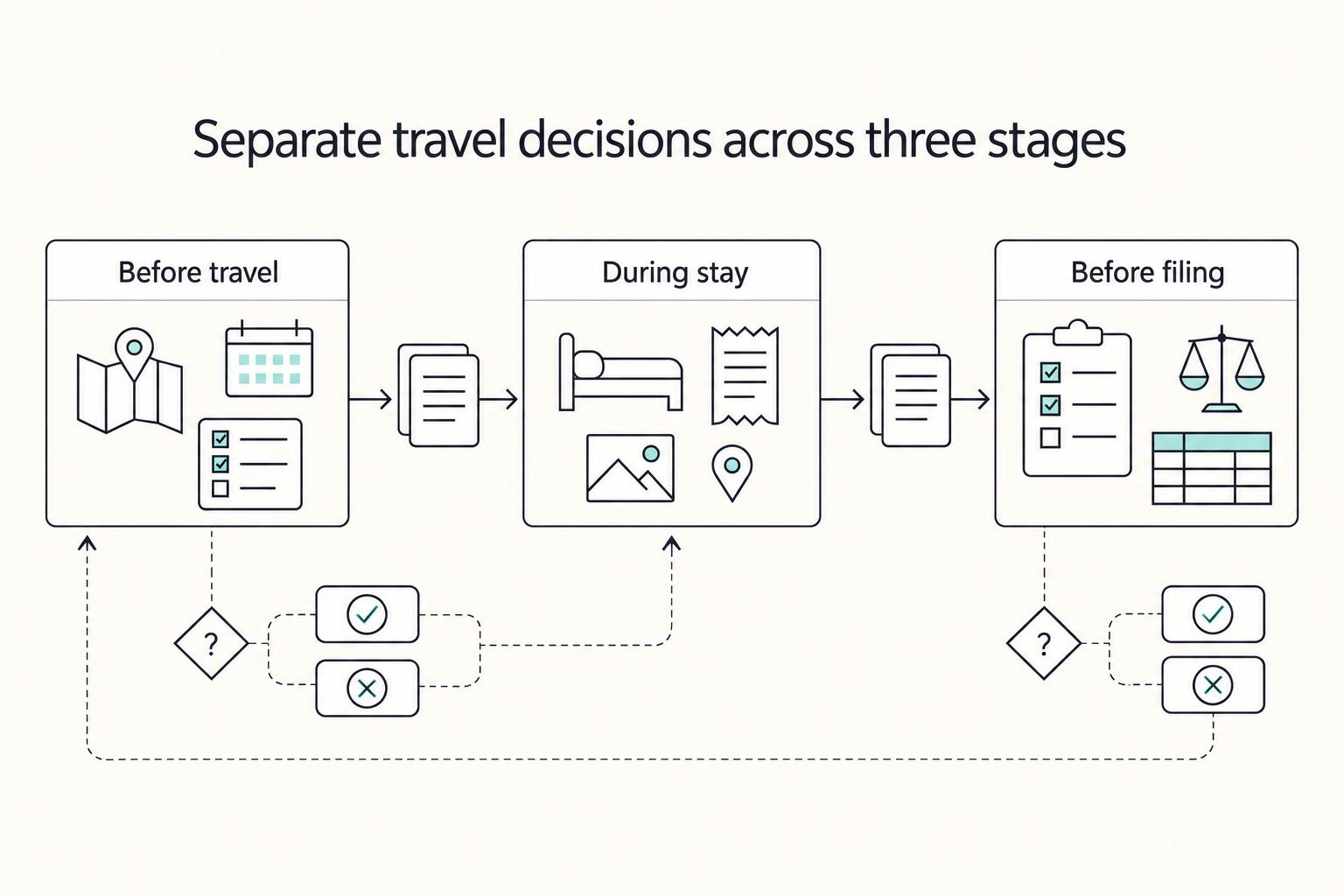
What you should decide before travel, during the stay, and before filing#
Before travel, confirm your immigration path matches your timeline and operating model. If you are using Japan's digital nomad status, plan around the 6-month non-extendable cap from day one.
| Stage | Main task | Details |
|---|---|---|
| Before travel | Confirm your immigration path matches your timeline and operating model | If you are using Japan's digital nomad status, plan around the 6-month non-extendable cap from day one |
| During the stay | Keep records for all three lanes in one place | Keep immigration documents, passport and travel records, engagement agreements, invoices, and payment records; escalate early if your work pattern in Japan becomes more fixed or longer-term than planned |
| Before filing | Shift from planning to evidence review | Establish actual returns, payment deadlines, departure requirements and treaty claim evidence; do not assume the annual filing window is your only deadline. |
During your stay, keep records for all three lanes in one place: immigration documents, passport and travel records, engagement agreements, invoices, and payment records. If your work pattern in Japan becomes more fixed or longer-term than planned, escalate early to a qualified cross-border tax adviser.
Before filing, identify which returns, treaty claims and payment deadlines apply. The NTA's 2025-income guide uses February 16 to March 16, 2026. For 2026 income, its departure guidance refers to February 16 to March 15, 2027. Departure can require action before leaving if you have not appointed a tax agent; do not wait automatically for the annual window.
The three-pillar roadmap#
The first section separates residence and the correct income article before day counting. The second examines actual PE facts, including why moving signatures abroad is insufficient for a freelancer's core work. The third brings immigration, tax filing and records into a usable travel checklist. For broader recordkeeping, see our digital nomad tax guide.
Choose the income rule before counting days#
A U.S. passport or a U.S. invoice is not enough to establish treaty residence. Article 4 contains a special test for U.S. citizens and green-card holders, including U.S. home, habitual-abode or substantial-presence connections and conditions concerning residence elsewhere. Establish the applicable residence rule before claiming benefits; a traveler permanently based in a third country may not qualify in the way they expect.
For a treaty-eligible U.S. resident employee working in Japan, Article 14(2) requires all three conditions: no more than 183 presence days in any relevant rolling twelve-month period beginning or ending in the taxable year; a non-Japan-resident employer; and pay not borne by that employer's Japan PE. This is not a calendar-year reset. Freelancers instead analyze business profits and PE; fewer than 183 days does not settle that question.
Compare the employee and freelancer routes#
Use this before travel and before filing as a quick screen, not a substitute for treaty text. If any row is unclear, treat your position as unverified.
| Test | What it checks | Common freelancer failure pattern | Safest default behavior |
|---|---|---|---|
| Freelancer business profits | Article 7 and Article 5 PE facts, after treaty eligibility | Using the employee 183-day/payroll tests for service invoices | Document the actual places, business activities and authority; obtain a fact-specific PE assessment |
| Employee presence | Article 14(2) rolling twelve-month 183-day condition | Counting only workdays or resetting on January 1 | Record physical-presence days, including arrival/departure and nonworking days; review exceptions against the technical explanation |
| Employee employer and cost-bearing | Non-Japan-resident employer and no remuneration borne by its Japan PE | Assuming a U.S. bank transfer proves both conditions | Record employment and recharge/cost-allocation facts; test all conditions together |
Build one log that can survive scrutiny#
Use one travel and work log. Include entry and exit dates, city/country, work activity, employer or business, actual payer, invoice/pay-period reference, and evidence links. For employees, add the Article 14 rolling-window total. For freelancers, use the same dates to support residence and PE analysis rather than inventing a 183-day safe harbor.
| Log field | What to record |
|---|---|
| Travel dates | Entry date and exit date |
| Location | City and country |
| Work context | Trip purpose and client or employer worked for |
| Payer details | Legal payer entity and invoice number or pay period |
| Support file | Supporting document links |
| Day-count tracking | Applicable physical-presence total for an employee; stay pattern and business-location evidence for a freelancer |
Keep the evidence with the log: passport records, boarding passes, flight confirmations, accommodation records, calendar entries, engagement agreements, invoices, and payment records. If your log shows time outside Japan, you should be able to prove it quickly.
Run a monthly reconciliation routine:
- Match travel entries to passport and travel confirmations.
- Tie work periods to invoices or calendar blocks.
- Update running totals and remaining days.
- Save a locked snapshot for your records.
Forecast before you book#
Check proposed bookings against the rule that actually applies:
- Map planned locations, activities, work status and actual immigration permission.
- For an employee claiming Article 14 relief, calculate every relevant rolling twelve-month total and confirm employer/cost-bearing facts.
- For a freelancer, reassess residence, business places, activity and PE facts; a low day total alone is not approval.
- Resolve a material unknown before relying on exemption; change itinerary or operating arrangements where necessary.
Illustrative employee calculation: an employee spends 90 countable days in Japan in late 2026 and plans 100 more in early 2027. If one relevant twelve-month window contains both stays, 90 + 100 = 190, so the 183-day condition fails despite each calendar-year total being lower. Passing the day condition would still leave employer and cost-bearing conditions. A freelancer with the same dates needs a different, Article 7 analysis.
Assess permanent-establishment facts rather than a paperwork shield#
For a freelancer, performing the paid service is the business itself. Calling coding, design or consulting 'support' does not necessarily make it preparatory or auxiliary. A short stay, a foreign mailing address or an overseas final signature can be useful evidence, but none by itself rules out a fixed-place PE.
Record actual conduct rather than building a paper description inconsistent with your work. Keep the location and duration of business activity, workspace availability, client meetings and authority visible in the fact file.
Read PE risk as a spectrum, not a slogan#
Article 5 uses a fixed place through which business is carried on and has a separate habitual contract-authority rule. Its preparatory/auxiliary exceptions are activity-specific. A coworking desk is not automatically a PE, and a hotel is not automatically exempt. The bilateral text governs; generic OECD commentary or another country's treaty cannot supply an automatic safe harbor.
Use the following as questions for a PE assessment, not a certified risk ranking. A workspace available for recurring core service delivery calls for different analysis from an occasional desk used during travel.
| Operational pattern | Question to assess | Records to retain | Practical response |
|---|---|---|---|
| Hotels or occasional flexible hot desks | What place is actually available to the business, for how long, and what work occurs there? | Travel, accommodation and desk-use records; actual service activity | Avoid claiming a blanket exemption based on the label 'hotel' or 'hot desk' |
| Recurring desk, private room or business address | Does the recurring place serve as a business location? | Workspace agreement, availability, duration, meetings and activities | Review the facts before extending or presenting the location as a business base |
| Concluding contracts for another enterprise | Is authority to conclude contracts habitually exercised in Japan? | Real negotiation and approval records, not just signature location | Review the employer/enterprise's exposure as well as your own salary treatment |
| Solo freelancer performing core paid work | Is the location used to carry on the business itself? | Service scope, work location, duration and client delivery | Do not classify the entire activity as auxiliary merely because the client is abroad |
A consistent file helps a reviewer evaluate the facts. Consistency does not cure a PE that actually exists or an incorrectly classified engagement.
Dependent-agent risk needs its own rulebook#
The bilateral Article 5(5) addresses a person acting for an enterprise who has and habitually exercises authority to conclude contracts in its name, subject to the treaty's exceptions. Review what the person actually does. For a solo operator, fixed-place analysis of their own business remains necessary even if a client signs acceptance abroad.
Research and internal recommendations may differ from concluding binding terms, but the labels are not decisive. Record who negotiated, approved and committed the enterprise and where those activities occurred. A formal signature elsewhere does not establish that all meaningful authority was exercised elsewhere.
Put a signing guardrail into a repeatable routine#
An employer or team can document genuine authority limits before travel. The process must reflect actual conduct and should accompany, rather than replace, the fixed-place and income-category analysis:
- Document who can approve prices, exceptions and contracts, and what the Japan-based person will actually do.
- Keep final authority with the person who genuinely exercises it; do not move only the signature to create a paper exemption.
- Retain negotiation, approval and execution records. Reassess if practice differs from the documented role.
Know when to stop self-managing#
Seek focused advice when any material issue arises. There is no rule that two warning signs must appear before one deserves attention.
| Escalate when | Article detail |
|---|---|
| Residence is uncertain | Domicile, long stay or third-country residence affects eligibility |
| Employee conditions may fail | Presence, employer residence or Japan cost-bearing is unresolved |
| Core work uses a recurring Japan place | Workspace and business activity require PE analysis |
| Authority or cost allocation changes | Contracts, role or remuneration no longer fit the prior assessment |
| Additional reporting may apply | Actual accounts or entity interests may trigger separate U.S. forms; travel alone does not require Forms 5471/8865 |
Ask for the rule, relevant facts, result and required filings in writing. The aim is a position that matches the real operation, with a plan for tax and deadlines if exemption is unavailable.
Pillar 3: Your Pre-Flight Compliance Checklist#
Before relying on a tax exemption, establish immigration permission and the appropriate tax analysis. An unfavorable tax result is not automatically a reason to cancel travel: it may call for registration, filing, payment or an adjusted arrangement.
Check your three readiness gates first#
| Readiness area | Pass if | Key threshold or rule | Pause if |
|---|---|---|---|
| Immigration readiness | Your status allows the exact work you plan to do in Japan, and your documents match that plan | Japan's Digital Nomad designated activity is for a stay not exceeding six months (no extension), requires at least 10 million yen annual income, and private medical travel insurance with at least 10 million yen compensation | Permission does not cover the actual activity, including an impermissible Japan client engagement under this status |
| Treaty-position readiness | Eligibility and the correct income article are established | Freelancer: Article 7/5; employee: Article 14, including all three short-stay conditions where claimed | Treaty residence is unresolved, or an employee test is being applied to freelancer income |
| PE-risk readiness | Actual business location and authority facts have been assessed, and any tax/filing consequence has a plan | A PE is a fixed place of business; for non-residents, business income attributable to a Japan PE can be taxed in Japan | You cannot show whether a fixed place of business exists in Japan, who had approval authority, where authority was exercised, or whether a Japan PE position could be argued |
Run this checklist as pass/fail controls#
Once those gates are green, work through each area as a pass-or-fail check and build the file as you go.
- Immigration fit check
Confirm the exact activity and nationality eligibility for your immigration status. The MOFA digital-nomad page states a six-month, nonextendable stay, annual income of at least JPY 10 million and medical-treatment cover of at least JPY 10 million. The Immigration Services Agency's FAQ says this status does not allow employment or contractor engagements with Japanese companies or individuals. Its guidance also states a six-month wait to reapply after the maximum stay. Retain the approval, policy and activity documents; another immigration category may have different permissions.
- Correct income-rule check
For freelancer service profits, document treaty eligibility and the Article 7/5 analysis. For employee salary, document the Article 14 test, including actual cost bearing. Keep contracts, location records and any employer recharge evidence. A client or employer based abroad does not, by itself, prove exemption.
- Audit file check
Build one file with identity and travel records; contracts, invoices and actual payer details; workspace/activity and authority evidence; and the written tax conclusion. Add returns, tax-payment evidence and treaty claim documents as they become due. A reviewer should be able to reconstruct your work rather than merely confirm that the documents use consistent labels.
Clarify your tax scenario before relying on treaty relief#
Japanese domestic residence is not a simple 183-day test: the NTA refers to domicile or continuous residence for at least one year. Domicile can matter sooner. A nonresident can still have taxable Japan-source income. Identify domestic treatment, then apply available treaty limits; do not conclude 'no Japan tax' solely from a temporary visa or foreign payer.
U.S. citizens generally continue worldwide-income reporting under the saving clause. Residents, including people with dual-residence or green-card issues, need their actual treaty status assessed. Foreign tax credits may relieve eligible double taxation, subject to limits. The foreign earned income exclusion has separate tax-home and residence/presence requirements; a six-month Japan visa does not establish eligibility. Do not credit taxes on the same income excluded under that provision.
Before you lock your travel plan, map your day-count and documentation trail in the Tax Residency Tracker.
Keep Your Log, Approvals, and Documentation Review-Ready#
Run this with controls, not instinct. Keep your day log current, keep decision authority and client approvals inside pre-set boundaries, and keep your documentation file review-ready.
| Area | Reactive posture | Controlled posture |
|---|---|---|
| Recordkeeping cadence | Rebuilds facts near filing time | Updates travel, contract, invoice, and payment records as work happens |
| Approval boundaries | Finalizes terms wherever convenient | Uses a defined approval path and keeps dated proof of who approved what |
| Documentation readiness | Collects files only when a problem appears | Maintains one current file with travel dates, payer details, contracts, invoices, and account records |
| Escalation habits | Waits for a dispute or deadline pressure | Treats changed facts as an immediate review trigger |
Income tax and social insurance are separate. The U.S.–Japan totalization agreement has its own coverage rules, including temporary-transfer treatment for qualifying self-employment. Establish the applicable system and certificate-of-coverage evidence; an income-tax treaty exemption or foreign earned income exclusion does not automatically eliminate U.S. self-employment tax.
Before any tax call, hand over a clean fact pack. Then ask decision questions:
- Bring your dated travel/work log, residence evidence, contracts, payer and cost-allocation records, workspace details and authority records.
- Ask which income article applies, whether you qualify for treaty benefits, and which facts determine Japan taxation.
- Ask which returns, departure procedures, relief claims and payment deadlines apply. Review U.S. treaty disclosure requirements and exceptions rather than assuming every overseas stay requires Form 8833.
- Review foreign-account/entity reporting only where your actual accounts, balances, ownership or control trigger it.
Use the fact file to get an explicit tax and filing conclusion, then revisit that conclusion when the work, residence or itinerary changes.
Frequently Asked Questions
How many days can I work in Japan without Japanese tax under the treaty?
For a qualifying employee, Article 14(2) uses no more than 183 days in any relevant rolling twelve-month period, plus non-Japan employer and no Japan-PE cost-bearing conditions. A freelancer's business profits generally follow Article 7 and PE analysis instead. There is no universal tax-free remote-work day allowance.
What PE behaviors matter most, including coworking space use?
The treaty defines fixed-place and habitual contract-authority PE routes. For a workspace, examine duration, availability and actual business use. For authority, examine real conduct for the enterprise. A hot desk is not automatically taxable, and overseas signing is not an automatic exemption. Core freelancer work is not automatically auxiliary.
Do I need immigration permission if the treaty protects me from tax?
Yes. Tax relief does not authorize work. Establish the immigration category and actual permitted activity separately. Japan's digital-nomad status has its own restrictions, including Japanese employment and contractor engagements.
What if I already have a status in Japan that changes the work-authorization analysis?
Use the permissions of your actual category. Do not import the six-month digital-nomad rules into another status or assume a tax result determines work authorization. Check planned employment, client engagements and any additional permission with the Immigration Services Agency.
As a U.S. freelancer, do I need to change how I invoice while I am physically in Japan?
Use invoices that accurately identify the contracting parties, service, work period and agreed currency. Changing an invoice address or receiving funds abroad does not change where the work happened or remove a PE. Assess any actual local registration, tax and invoicing obligation separately.
What happens if I stay longer than planned or my facts change mid-trip?
Reassess immigration permission, domestic and treaty residence, income category, PE, and the employee rolling-day/cost-bearing tests where applicable. Update the evidence and filing plan immediately. Do not assume a new calendar year resets the treaty presence test.
Can I rely on public telework guidance, treaty summaries, or forum posts?
Use current official treaty documents, their technical explanation, NTA guidance and immigration sources first. Summaries can help identify questions, but another treaty, generic telework guidance or a forum anecdote cannot determine this bilateral result.
Try a related tool
Researched and edited by the Gruv editorial team. Gruv builds cross-border billing, payouts, and finance-operations software for global businesses.
Sources
Includes 3 external sources outside the trusted-domain allowlist.
- home.treasury.gov/system/files/131/Treaty-Japan-11-6-2003.pdftrusted
- home.treasury.gov/system/files/131/Treaty-Japan-Pr2-1-24-2013.pdftrusted
- irs.gov/businesses/international-businesses/japan-ta...trusted
- irs.gov/pub/irs-trty/japante04.pdftrusted
- ssa.gov/international/Agreement_Pamphlets/japan.htmltrusted
- mofa.go.jp/ca/fna/pagewe_000001_00046.htmlexternal
- moj.go.jp/isa/content/001422249.pdfexternal
- nta.go.jp/english/taxes/individual/12006.htmexternal
Educational content only. Not legal, tax, or financial advice.
Related Posts

Digital Nomad Taxes in 2026 With a Defensible Filing Plan
With digital nomad taxes, the first move is not optimization. It is figuring out where you may be taxable, where filings may be required, and what proof supports that position.

The Freelance Payment Penalty: A Modeled Audit of Platform Fees, FX Spreads, and Payout Delays
The money rarely disappears through a single, easy-to-spot fee. The real loss is stacked. A marketplace takes its commission, a processor adds a charge for international cards, a bank or payment company converts the currency at a spread, a platform holds the funds before release, and a wire sheds a little to intermediaries on the way in. Each layer looks defensible on its own, but the worker feels the combined result as a smaller deposit and a later payday.

How to Respond to a Subpoena for Business Records
Move fast, but do not produce records on instinct. If you need to **respond to a subpoena for business records**, your immediate job is to control deadlines, preserve records, and make any later production defensible.