
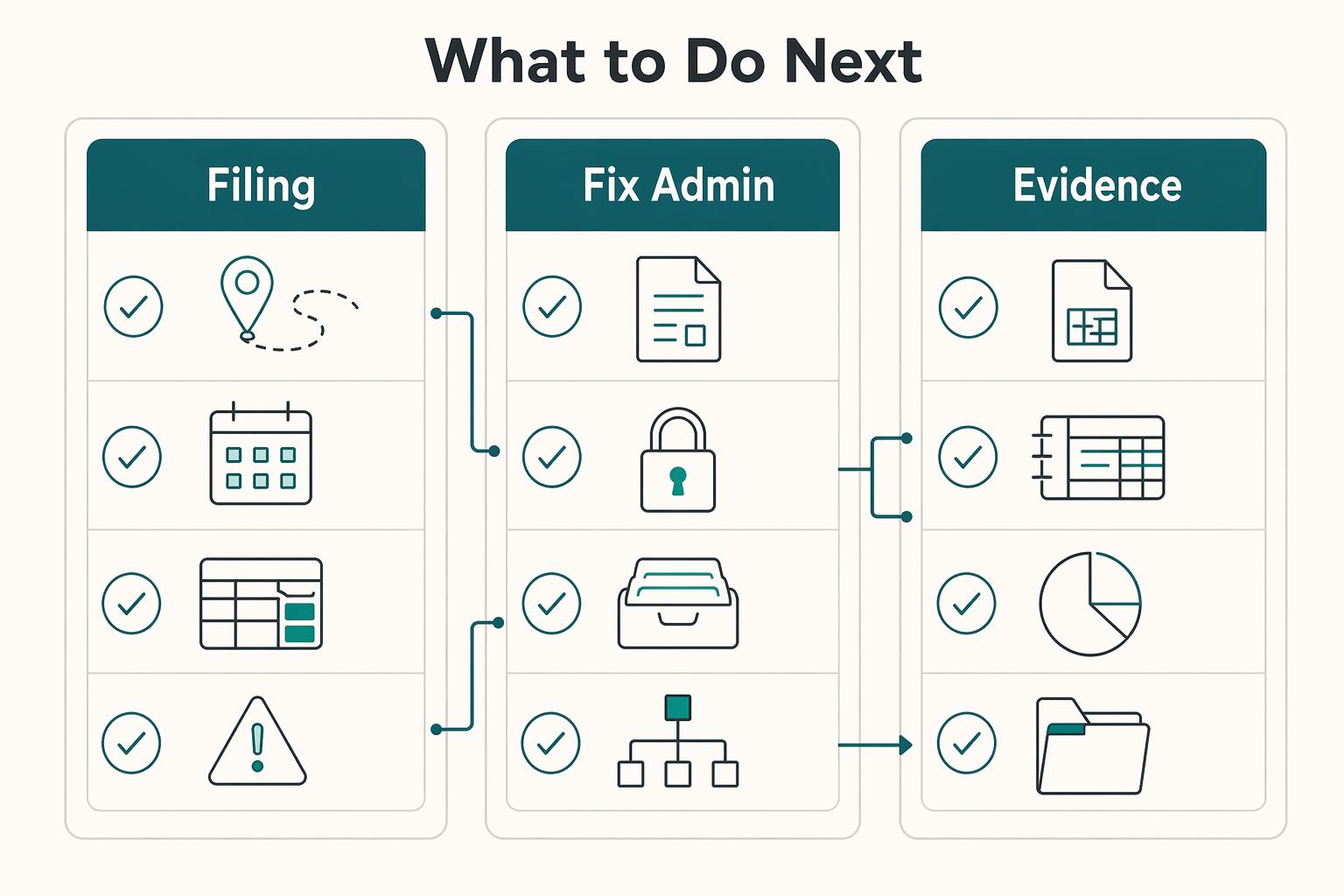
Quick Answer
This article does not confirm the current legal meaning of UK non-dom tax status. It says you should focus first on Self Assessment basics: check whether you need to file, register or reactivate your account, confirm the right filing channel, keep records such as bank statements or receipts, and verify any foreign income, gains, FIG, temporary repatriation, or Inheritance Tax points separately before filing.
Start with filing mechanics — confirm Self Assessment status and deadlines before working through domicile classification#
Start with filing mechanics, not tax jargon. You may still be unsure how labels like Domicile or the Remittance basis fit your history, but that does not pause your HM Revenue and Customs (HMRC) obligations around Self Assessment registration, account access, record-keeping, and filing.
If you need to complete a return for 6 April 2024 to 5 April 2025, HMRC says you must tell them by 5 October 2025. Missing that deadline can trigger a penalty. If you have filed before, check whether your Self Assessment account needs reactivation before you file, because HMRC says filing without reactivation may delay your return. Use this sequence first, then work through classification detail:
- Confirm whether you need Self Assessment.
- Make sure you can file. First-time filers must register, and returning filers should confirm account status and have their Unique Taxpayer Reference (UTR) ready.
- Build your records, such as bank statements or receipts, before you start drafting.
- File online on or after 6 April once the tax year ends, and plan for the 31 January payment deadline.
For freelancers, one early checkpoint is straightforward. If you are a sole trader and earn more than £1,000 in a tax year, the GOV.UK route is to register for Self Assessment. If your account access is broken, your records are incomplete, or your position depends on distinctions you cannot explain clearly, pause and get professional advice before you submit.
Lock in the terms before you make any tax decision#
Use terms to clarify decisions, not to stand in for them. If you are relying on phrases like UK non-dom tax status, non-domiciled resident, domicile, or remittance basis, treat them as labels until you can tie each one to an actual filing step for your facts and tax year.
| Check | What to verify |
|---|---|
| Need to send a return | Check if you need to send a tax return before registering. |
| First return | Register for Self Assessment before using the online service. |
| Lived abroad as a non-resident | Do not assume the standard online Self Assessment filing service is available. |
| Filed before | Confirm whether your account needs reactivation so you do not create avoidable delays. |
| Records | Keep records ready, such as bank statements or receipts, so your return is supported. |
A practical test is to ask what question the term is actually answering in plain English. Does it tell you whether you need to send a return, whether you need to register first, or whether you can use the online filing service? If you cannot connect the term to one of those steps, do not rely on it yet. If a checklist is easier, use this quick filter before moving on:
- Check if you need to send a tax return before registering.
- If this is your first return, register for Self Assessment before using the online service.
- If you lived abroad as a non-resident, do not assume the standard online Self Assessment filing service is available.
- If you filed before, confirm whether your account needs reactivation so you do not create avoidable delays.
- Keep records ready, such as bank statements or receipts, so your return is supported.
A common mistake is taking a familiar label into the wrong filing path. If the wording still feels slippery after that check, pause and get advice before you file.
What changed in practice after April 2025#
In the GOV.UK Self Assessment material used here, keep your focus on workflow as much as terminology. Terms like Domicile, Remittance basis, Residence-based tax regime, and other non-dom labels are prompts to verify your filing route, not answers on their own. Work through the steps in this order:
- Check whether you need to send a tax return before registering.
- If you need to file and you are new to Self Assessment or recently inactive, tell HMRC by 5 October 2025 for the tax year 6 April 2024 to 5 April 2025.
- If you filed before, confirm whether your Self Assessment account needs reactivation, because filing without reactivating can delay your return.
- Confirm the filing channel. Some people cannot use the standard online service, including people who lived abroad as a non-resident.
- If you are filing online, make sure you have your Unique Taxpayer Reference (UTR).
- Keep records, such as bank statements or receipts. If you file online, you can file on or after 6 April; doing it earlier means you will know what you owe sooner. Plan for the 31 January payment deadline.
For freelancers, start with the trigger before debating regime wording. If you are a sole trader and earn more than £1,000 in a tax year, that can require registration.
Compare old and current rules before you act#
Use the comparison below as a filing control, not a shortcut through tax mechanics. Based on the HMRC excerpts provided, you can act on Self Assessment process rules with confidence. You cannot confirm old non-dom or remittance mechanics, or current treatment of foreign income, foreign gains, or funds brought into the United Kingdom, from this material alone.
| Treatment area | Earlier non-dom / remittance-basis treatment | Current treatment | What the provided HMRC excerpts support |
|---|---|---|---|
| Foreign income | Not publicly documented | Not publicly documented | Confirm current treatment directly in live HMRC/GOV.UK guidance before filing. |
| Foreign gains | Not publicly documented | Not publicly documented | Charge, exemption, and reporting mechanics are not set here. |
| Bringing funds into the United Kingdom | Not publicly documented | Not publicly documented | Whether bringing funds into the UK changes treatment is not stated here. |
| Self Assessment tax return implications | Earlier reporting effects are not evidenced here. | Current filing-process rules are evidenced. | If you need to complete a return for the previous year and are new or recently inactive, tell HMRC by 5 October 2025 for 6 April 2024 to 5 April 2025. First-time filers must register before online filing. Online filing may require a UTR, and some people cannot use the standard online service. |
| What is known vs what must be confirmed | Older tax-mechanics detail is not confirmed. | Current foreign-income and foreign-gains mechanics are not confirmed. | Known: registration, reactivation risk, filing-channel limits, record-keeping, and timing. Confirm separately how any foreign income or gains should be reported. |
What you can do now#
Start with the parts you can control: registration status, filing route, access, and records.
- Check registration status first. If this is your first return, register for Self Assessment before using online filing. If your old account is inactive, reactivate it first.
- Confirm the filing route before deadline pressure builds. If the standard online service is unavailable, including in some non-resident cases, use commercial software or other forms.
- Prepare access and records early. If filing online, have your UTR ready and keep records such as bank statements or receipts.
- File as soon as practical after 6 April so you know what you owe sooner, and plan for the 31 January payment deadline.
If your conclusion depends on remittance treatment, foreign income or gains treatment, or transition mechanics, treat that point as unconfirmed until you verify current HMRC guidance.
If you want more background, read A Deep Dive into the Tax Implications of Moving from California to Texas.
Classify yourself first with a decision path#
Classify yourself provisionally, then verify. This guide supports a cautious, filing-first path, but it does not establish the legal tests for the Statutory Residence Test (SRT), Foreign Income and Gains relief/regime, or the Temporary repatriation facility.
Treat residence, FIG, and temporary repatriation as separate verification tracks while you keep HMRC filing admin moving. The table below is a working checklist, not proof of a legal outcome.
| Provisional lane | First question | What this evidence supports | What to do now |
|---|---|---|---|
| Foreign Income and Gains regime | Are you UK resident under the SRT, and do your facts justify checking FIG relief? | This evidence does not establish FIG eligibility rules or mechanics. | Keep this lane marked "verify separately" and gather records before taking a return position. |
| Temporary repatriation facility | Is there a specific historic offshore issue you need to review separately? | This evidence does not confirm qualification or operation. | Keep this lane open only if you have a concrete issue to investigate. |
| Standard UK Income Tax and Capital Gains Tax treatment | If no relief or transition route is confirmed yet, what is your working assumption for filing admin? | Detailed tax mechanics are not established. | Use this as a temporary working assumption while preparing documents and adviser questions. |
First checkpoint. Verify residence before lane decisions#
This section does not give SRT criteria, thresholds, or tie rules, so verify residence separately before you assign a lane. If needed, review Understanding the UK's Statutory Residence Test (SRT) before assigning a lane.
Second checkpoint. Treat FIG as a claim to prove, not a label to adopt#
FIG is a claim you need to prove, not a label to drop into your return. Who qualifies, what FIG covers, or how it changes the treatment of specific income or gains is not established.
Focus on documentation quality now. Keep Self Assessment records, such as bank statements or receipts, and clearly list which foreign items you think may need review.
Third checkpoint. Open the temporary repatriation lane only for a real legacy issue#
Do not build your filing plan around temporary repatriation unless you have a concrete historic issue to examine. Eligibility, rates, or mechanics are not confirmed.
Keep the filing controls moving while you assess that question. If you need to complete a return for the previous tax year and are a first-time filer or were previously inactive, tell HMRC by 5 October for that year (for example, 5 October 2025 for 6 April 2024 to 5 April 2025). First-time filers must register for Self Assessment before using online filing. Reactivate an inactive Self Assessment account before filing, and have your UTR ready for online filing.
The practical rule is simple: classify early, verify uncertain lanes separately, and do not let SRT, FIG, or temporary repatriation questions stall core filing admin.
Related reading: A Deep Dive into the UAE's Corporate Tax for Freelancers and LLCs.
Apply FIG rules without over-claiming#
Treat FIG as a claim that needs clear support, not a blanket outcome. If treatment is unclear from current guidance, keep the item in your ordinary tax analysis until you confirm the correct approach.
Use a three-step sequence#
- Confirm position before treatment
Check current GOV.UK/HMRC guidance first. If the boundary is still unclear, mark it as unresolved and verify it before you take a return position.
- Map items line by line
For each foreign item you are considering, record the date, amount, payer or asset, account, and supporting evidence. Keep the underlying tax records, such as bank statements or receipts.
- Document assumptions for HMRC and filing
Keep a short working note that separates items treated as FIG claims, items kept under ordinary rules, and unresolved items pending review. That makes your Self Assessment position easier to explain.
Main failure mode#
A common failure mode is claiming Foreign Income and Gains relief too broadly without enough evidence. The problem often appears later, when your Self Assessment tax return is prepared and the support file does not match the treatment used.
Keep filing mechanics in parallel#
While you test treatment, do not lose control of the filing process:
- First-time filers must register for Self Assessment before using the online filing service.
- You need your UTR to file online.
- If your account is inactive, reactivate it first, because filing without reactivation may delay the return.
- If you need to file for the previous tax year and are first-time or returning after a gap, notify HMRC by 5 October 2025 for 6 April 2024 to 5 April 2025.
- Do not assume the standard online service always applies in internationally mobile cases. GOV.UK lists situations where it cannot be used, including if someone lived abroad as a non-resident.
A sound default is to keep any item in ordinary treatment until you can clearly support a FIG claim.
Use the temporary repatriation route carefully#
Treat the Temporary repatriation facility as a verification question, not a default claim. Eligibility, rates, or timing for that route are not confirmed, so keep your filing position conservative unless you can support it with current guidance.
Who should evaluate it#
Use a simple filter here:
- Do not treat a clearly documented historic offshore pool, including amounts connected to older Remittance basis years, as automatic support for a temporary-route claim.
- If your records cannot clearly separate balances account by account, do not make a temporary-route claim until you have verified current HMRC guidance.
Before you test any transitional route, make sure your evidence file works account by account. HMRC expects records such as bank statements or receipts so returns can be completed correctly.
Keep the tradeoff in filing view#
If you are exploring a transitional position, keep the core filing controls in view inside your Self Assessment tax return cycle:
- First-time filers must register for Self Assessment before using the online service.
- You need your UTR to file online.
- If you had an existing account, you may need to reactivate it, because filing without reactivation may delay the return.
- For the 6 April 2024 to 5 April 2025 tax year, HMRC guidance said you had to notify HMRC by 5 October 2025 if you needed to file for the previous year, and payment is due by 31 January.
- Check the current year guidance before relying on those dates.
For a step-by-step walkthrough, see A Deep Dive into the 'Dividend' Article of the US-Germany Tax Treaty for LLC Owners.
Recheck estate exposure under the long-term residence test#
Treat estate exposure as a separate verification step, not something you infer from income-tax filing. This section does not establish the legal mechanics of any long-term residence test for Inheritance Tax, so any Inheritance Tax conclusion here should be treated as uncertain.
Why to separate this review#
This guide supports Self Assessment filing checkpoints, not Inheritance Tax rules. Do not use current-year UK Income Tax filing outcomes as a proxy for estate exposure.
This section does not provide long-term-residence thresholds, year counts, look-back periods, rates, bands, exemptions, or planning outcomes for Inheritance Tax.
What to check first#
Build a short compliance file before filing decisions are drafted, including:
- Whether you need to tell HMRC you must complete a tax return for the previous tax year, and whether that notification is made by 5 October.
- Whether an existing Self Assessment account needs reactivation before filing, since filing first can delay the return.
- Core tax records, such as bank statements or receipts, which HMRC expects you to keep so returns can be completed correctly.
- Your Unique Taxpayer Reference (UTR) and whether your filing route is appropriate, noting that the online Self Assessment service is not for a trust or for an estate.
If your residence position is still unclear, keep estate exposure marked as unknown in this section. If needed, revisit your facts against the Understanding the UK's Statutory Residence Test (SRT).
Keep filing mechanics in scope#
Do not assume routine return workflow covers estate-related matters. HMRC's online Self Assessment service is not for a trust or for an estate, so trust or estate-administration issues should sit in a separate workstream.
Use current HMRC guidance for filing obligations, and treat Inheritance Tax conclusions as out of scope for this section unless separately verified. Related: A Deep Dive into the UK's Statutory Residence Test for Nomads.
Build the evidence pack before filing season#
Build the evidence pack before you start drafting the return. If a number cannot be traced to a statement, receipt, prior return, or working note, it is not ready to file.
What belongs in the core pack#
Start with the records HMRC expects you to keep, such as bank statements and receipts, then add the working papers that support how you prepared this year's return.
- A tax-year timeline and factual notes used to prepare the return.
- Source records and working papers used to map income and gains in the return.
- Working notes for positions taken in the return, with assumptions clearly marked where rules are uncertain.
- Prior-year returns, calculations, and working papers where this year depends on earlier filings.
- Account-level records and transfer records where they support return figures.
- For specialist or cross-border positions, keep factual records only, for example accounts, balances, transfer dates, and contemporaneous notes, and mark tax treatment as pending confirmation rather than assuming eligibility or mechanics.
Add filing artifacts, not just source records#
Source documents are not enough on their own. Keep a filing layer so you can reconcile the submitted return back to the evidence.
| Filing artifact | Why it matters | What to check |
|---|---|---|
| Draft Self Assessment tax return | Shows first treatment decisions | Version date, assumptions, open items |
| Final submitted return copy | Formal filing record | Matches final draft |
| Supporting schedules/working papers | Bridges raw records to return figures | Totals agree to return entries |
| Prior returns from the online service | Supports year-to-year consistency | Same taxpayer details and carryover references |
| GOV.UK pages used | Shows basis for judgment calls | Title, URL, access date saved |
The online Self Assessment service lets you file online, view previous returns, and print calculations. Save the submitted return, calculation, and confirmation output alongside the underlying evidence.
Also confirm access early. You need your UTR to sign in, and if you were registered but did not file last year, you may need to reactivate your Self Assessment account. HMRC notes filing can be delayed if you do not reactivate first.
Verification checkpoints before submission#
Before you submit to HMRC, run a short reconciliation pass:
- Confirm your filing route is available for your case. Some cases cannot use the online service; if not, switch early to commercial software or other forms.
- Reconcile each return figure to a source document or named working paper.
- Check that your tax-year timeline notes match the treatment used in the return.
- Verify UTR, login access, and whether account reactivation is needed.
- Save the exact GOV.UK pages you relied on in case guidance changes.
- If you must notify HMRC that you need to file for the previous tax year, check the relevant October timing. The current GOV.UK example is 5 October 2025 for the year 6 April 2024 to 5 April 2025, with possible penalties for late notification.
- Plan timing. You can file on or after 6 April, and filing earlier gives earlier visibility of what you owe, while payment is due by 31 January.
Before you draft filing positions, map your tax-year facts in one place with the Tax Residency Tracker.
File in the right order and verify each checkpoint#
The safest order is to confirm filing requirements and access first, organize your records second, and complete the Self Assessment tax return last. That order reduces avoidable delays and last-minute errors.
Lock the filing route before tax logic#
Do not start with the return itself. First check whether you need to send a return before registering for Self Assessment. If you are filing online for the first time, register before using the service.
| Case | What the article says | Next step |
|---|---|---|
| Filing online for the first time | If you are filing online for the first time, register before using the service. | Register before using the service. |
| Registered before but did not file last year | If you registered before but did not file last year, reactivate your Self Assessment account before filing. | Reactivate before filing. |
| Partnerships, trusts and estates | HMRC says it cannot be used for some returns, including partnerships, trusts and estates. | Switch early to commercial software or other forms. |
| People who lived abroad as non-residents | HMRC says it cannot be used for some returns, including people who lived abroad as non-residents. | Switch early to commercial software or other forms. |
Clear access risks early. Confirm sign-in works, confirm your Unique Taxpayer Reference (UTR), and if you registered before but did not file last year, reactivate your Self Assessment account before filing. HMRC says filing without reactivation may delay your return.
Also confirm the online service is available for your case. HMRC says it cannot be used for some returns, including partnerships, trusts and estates, and people who lived abroad as non-residents. If that applies, switch early to commercial software or other forms.
Use a strict three-step order#
- Confirm whether you need to file and whether your account is ready. Check if a return is required, then register or reactivate as needed.
- Confirm the filing channel and organize records. Use the online service only if your case is eligible, and keep records, for example bank statements or receipts, so you can complete the return correctly.
- Complete the return last. Treat the return as the output of decisions you already made.
If a key assumption is still unresolved, stop and resolve it before submission.
Verify against current guidance, not memory#
Use current GOV.UK pages for registration, access, filing route, and record-keeping checks.
Save the page title, URL, and access date for the guidance you relied on so your position is easier to defend if that guidance changes later.
Add a one-page pre-submit control#
Before you submit, consider keeping a one-page summary of:
- Positions taken
- Assumptions used
- Unresolved items or judgment calls
- Documents supporting each material point
- Items to review with an adviser
After filing, store the submitted return, calculation, confirmation output, and evidence together. You can file online on or after 6 April following the end of the tax year, and payment is due by 31 January.
Red flags that mean you should pause and get specialist advice#
If your position is not settled before filing, stop. Your Self Assessment tax return should reflect decisions you have already made and documented, not live judgment calls.
Get specialist help before submission if any of these apply:
- your open questions are in areas not covered by the HMRC Self Assessment guidance in this section, for example Foreign Income and Gains regime versus standard Residence-based tax regime
- your Statutory Residence Test (SRT) facts are inconsistent across travel, work, and home records, and you cannot resolve them from the HMRC material you have
- you have unresolved questions on topics such as Temporary repatriation facility treatment or possible Inheritance Tax exposure under a Long-term residence test
- your numbers cannot be tied back to complete records, such as bank statements or receipts
Treat filing-process friction as a red flag too:
- you are filing for the first time and have not registered for Self Assessment
- you registered before but did not file last year and may need to reactivate your account
- you cannot confirm your Unique Taxpayer Reference (UTR)
- your case may not be eligible for HMRC's online service, including if you lived abroad as a non-resident
- you needed to tell HMRC by 5 October that you had to file for the previous tax year, but did not
These are not admin details to fix at the end. If the filing route, evidence, or core tax treatment is unclear, resolve that first so you are not forced into rushed decisions close to the 31 January payment deadline.
What to do next#
Treat this as a filing-control exercise: verify your position against current HMRC guidance, set up filing correctly, and build the evidence before you draft.
- Confirm filing status and route first.
Use current HMRC Self Assessment guidance to confirm whether you need to file and how to file. If your filing route is unclear, pause before drafting numbers.
- Fix admin setup before touching numbers.
If this is your first return, register for Self Assessment before using HMRC's online filing service. If you filed before, check whether your account needs reactivation, because filing without reactivation can delay your return. Have your UTR ready. If you are a sole trader, the cited trigger is earning more than £1,000 in a tax year.
- Work to the key dates and keep records first.
For 6 April 2024 to 5 April 2025, HMRC says you had to tell them by 5 October 2025 if you needed a return, and late notice could lead to a penalty. You can file on or after 6 April after year-end, and payment is due by 31 January. Keep records, such as bank statements or receipts, before drafting so every figure in the return is traceable.
- Use the correct filing route and confirm unclear points early.
If you lived abroad as a non-resident, HMRC says the standard online service is not available for that case type, so use commercial software or other forms. If any part of your case is unclear from current HMRC guidance, confirm the rules before filing.
If your case has cross-border complexity or unclear filing details, use this framework and then talk to Gruv for a practical next-step review.
Frequently Asked Questions
What does this section confirm about UK non-dom tax status?
This section does not settle the current legal meaning of UK non-dom tax status. It supports filing process points such as checking whether you need a return, registering or reactivating Self Assessment, keeping records, and verifying your filing route before submission.
Can UK residents still avoid UK tax on foreign income and gains?
There is no safe answer to that in the general case. If your filing position depends on foreign income or gains being outside UK tax, verify the current rule directly before you file.
Who can use the Foreign Income and Gains regime, and what should be checked first?
Who qualifies for the Foreign Income and Gains regime, and how it works, is not settled here. Check your records first, including bank statements or receipts, and do not take a FIG-based filing position until your evidence is complete.
What replaced domicile for Inheritance Tax decisions?
What replaced domicile for Inheritance Tax decisions is not something to assume here. Treat Inheritance Tax as a separate verification issue and do not infer it from income tax filing steps alone.
Is the temporary repatriation facility still relevant for freelancers with old offshore income?
Who can use the Temporary repatriation facility, and on what terms, is not settled here. If historic offshore amounts affect your return, document them clearly and get current confirmation before relying on any repatriation route.
What should I do first if I am newly UK resident and earn from foreign clients?
Start with filing setup and records. If this is your first return, register for Self Assessment before using HMRC's online filing service; if you already have an account, check whether it needs reactivation, confirm your UTR, and make sure your records are complete. If you are a sole trader, the cited trigger is earning more than £1,000 in a tax year.
What deadlines or filing checks matter most at the start?
For the cited year 6 April 2024 to 5 April 2025, HMRC guidance says you had to tell HMRC by 5 October 2025, and late notice could lead to a penalty. You can file on or after 6 April, payment is due by 31 January, and if you lived abroad as a non-resident the normal online filing service is not available.
Researched and edited by the Gruv editorial team. Gruv builds cross-border billing, payouts, and finance-operations software for global businesses.
Sources
Includes 2 external sources outside the trusted-domain allowlist.
Educational content only. Not legal, tax, or financial advice.
Related Posts

Digital Nomad Taxes in 2026 With a Defensible Filing Plan
With digital nomad taxes, the first move is not optimization. It is figuring out where you may be taxable, where filings may be required, and what proof supports that position.

Understanding the UK's Statutory Residence Test (SRT)
Treat SRT like ops, not folklore. You want a repeatable workflow you can run monthly so your tax-year answer is boring, documented, and easy to defend.

A Deep Dive into the UK's Statutory Residence Test for Nomads
If you get your residence status wrong, it is not a technical footnote. It can change whether the UK taxes only your UK income or normally taxes income from both the UK and abroad for that tax year.