
Quick Answer
Yes. Use a severability clause freelance approach only after testing whether the deal still works if one term drops out. If losing a clause changes payment timing, ownership rights, or liability allocation, move from template wording to custom language and exact section cross-references. Run a final survivability check before countersigning: would you still accept the remaining price, delivery burden, and dispute path? The article’s $500 project versus $50,000 lawsuit risk example is the practical warning against broad, unbounded survival text.
How to review a severability clause as a deal-survival test, not harmless boilerplate#
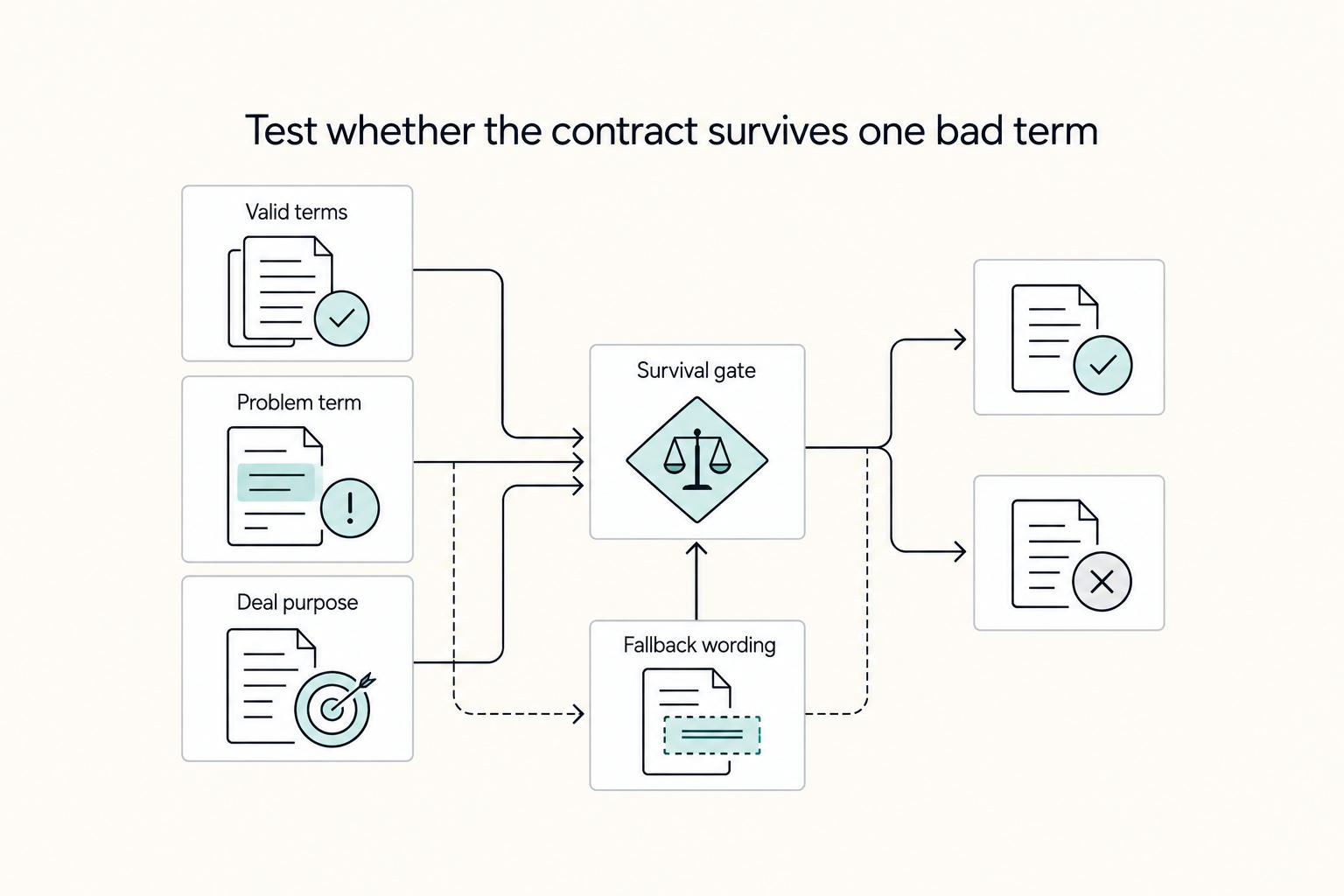
Treat severability as a contract-risk decision, not decorative legal wording. The real question is whether the agreement should keep working if one term is illegal or unenforceable, or whether losing that term breaks the deal you actually meant to sign.
In simple terms, a severability clause says one invalid term does not automatically void the rest of the contract. That can protect continuity. It can also leave you with a narrower agreement, so check whether the remaining terms still protect payment, deadlines, ownership rights, and liability exposure.
Use a contract-first sequence before you edit the clause. Get the written agreement in shape first. Scope of work, payment terms, deadlines, ownership rights, and the dispute-resolution method should already be clear. If those basics are missing, severability is not the first problem. Before you redline, use this checklist:
- Gather live inputs. Pull the current draft, plus scope, payment terms, deadlines, ownership language, and the dispute-resolution term, into one document.
- Ask the survival question. If one term disappears, would you still accept the remaining price, risk, and delivery burden?
- Mark the economic terms. Payment timing, ownership rights, and liability allocation often carry the core economics.
- Run a final plain-language check. Before signature, confirm the contract still clearly states the work, money, deadlines, rights, and dispute process.
One practical risk is broad severability paired with weak risk controls. The same liability-cap discussion that contrasts a $500 project with a $50,000 lawsuit risk is the warning. If the contract survives after one term fails, your remaining liability and dispute terms still need to protect you.
There is a practical tradeoff. For some smaller, one-time projects, a full-length agreement may not always be essential, but you still need the essentials in writing before work starts. The lighter the contract, the more deliberate you should be about what must survive and what should fail with a bad term.
That is the lens for the rest of this article. It is not just whether to include a severability clause, but what you want preserved and what should not be preserved if a term falls out.
For a step-by-step walkthrough, see A deep dive into the 'Waiver of Jury Trial' clause in contracts.
Start with the real job of a severability clause#
Start by deciding whether you want the Agreement to remain workable if one provision cannot be enforced. Do not assume standard wording guarantees a specific legal result. Treat this as a drafting and legal-review decision, not filler.
Separate the two outcomes early. Use these checkpoints before you accept standard wording:
- One term is removed, and the remaining deal still matches what you agreed to.
- One term is central to payment, ownership, or risk, so removing it changes the bargain.
- Open the full Agreement, not just this clause. Read it alongside scope, payment, ownership, and liability terms. If there is a Definitions section, confirm labels and references are consistent.
- Ask what changes economically if one term disappears. If it changes what you get paid, when you get paid, which rights transfer, or who carries risk, it is not minor.
- If losing that term would rewrite the deal, move beyond boilerplate now.
Practical rule: if removing one term changes the economic deal, customize this section before signature. Related: What is an 'Evergreen' Clause in a Retainer Agreement?.
Choose standard language or a customized clause#
Once you know what the clause needs to protect, the next decision is simple: use standard wording only when the deal still works if one provision fails. If losing a term would change compensation, ownership, or risk allocation, customize the clause before signature.
Make that call at the full-agreement level, not from boilerplate alone. Review your independent contractor agreement (freelance or retainer) against the core sections: scope, compensation, IP ownership, NDAs, and dispute resolution.
Fast decision tree#
| Checkpoint | What to assess | Direction |
|---|---|---|
| Deal complexity | Project is low-risk and the terms are standard across scope, compensation, IP ownership, and dispute resolution | Standard severability language may be enough |
| Term carrying the bargain | One clause is central to how the deal works in practice | Move to custom language |
| Outcome if that term is removed | Whether the agreement still reflects what you accepted | Keep it severable if it does; customize the clause and identify terms needing specific treatment if it does not |
- Start with deal complexity.
If the project is low-risk and the terms are standard across scope, compensation, IP ownership, and dispute resolution, standard severability language may be enough.
- Check for a term carrying the bargain.
If one clause is central to how the deal works in practice, move to custom language.
- Test the outcome if that term is removed.
If the agreement still reflects what you accepted, keep it severable. If it does not, customize the clause and identify terms that need specific treatment.
When to require stronger guardrails#
If the client is pushing one-sided terms, use tighter severability guardrails before you sign. The practical rule is simple: if risk is shifting toward you faster than price or protection, do not rely on broad generic wording. A strong contractor agreement is a core legal protection, and this is one place where that protection is either preserved or diluted.
Create a one-page clause strategy note#
Capture the decision in a short note before the draft gets crowded with redlines. Include:
- Agreement type: independent contractor agreement (freelance or retainer)
- Standard or custom: one sentence explaining why
- Severable terms: what can be removed without changing deal economics
- Sensitive terms for custom treatment: payment, ownership, or risk terms that could break the bargain if removed
Final check: make sure the labels in your note match the current draft section titles after redlines.
Draft the clause text in three blocks#
After you decide what must survive, one practical approach is to draft the clause in three separate blocks. That keeps each choice visible in redlines and makes later review easier.
| Block | Focus | Drafting note |
|---|---|---|
| Block 1 | Invalidity trigger and survival approach | Keep it tight; state how the remaining provisions should apply so the agreement can still function |
| Block 2 | Core commercial purpose | Use deal-specific language tied to the paid services relationship in the proposal and attached terms |
| Block 3 | Non-severable items | List them explicitly with exact cross-references to current section numbers and titles in the Freelance agreement |
Block 1. State the invalidity trigger and survival approach first. If one provision is found invalid or unenforceable, state how the remaining provisions should apply so the agreement can still function.
Keep this block tight. Identify the invalidity trigger, then confirm how the rest stays in force. Avoid automatic rewrites or speculative language about what the parties might have wanted unless you are negotiating that separately.
If your Freelance agreement is a signed proposal plus attached terms and conditions, draft this block to apply to that full binding package so cross-references stay aligned.
Block 2. Define the agreement's core commercial purpose in deal-specific language so the clause wording stays tied to the bargain.
Define that purpose with deal-specific language you can point to in the draft, such as the paid services relationship in the proposal and attached terms. Keep it concrete and negotiable, not abstract. If you cannot explain in one sentence what bargain this language protects, revise the wording.
Block 3. If you choose to identify non-severable items, list them explicitly, with exact cross-references to current section numbers and titles in the Freelance agreement.
Use live labels from the current draft, including any modular supplements or schedules, and recheck after redlines. Precision matters more than style here.
- Name each section number and title exactly as shown.
- Confirm each listed provision appears in the signed proposal, attached terms, or supplement cited.
- Re-verify numbering and titles in the final signature draft.
Verification checkpoint. Before signature, compare this clause line by line against the Governing law provision and your dispute-resolution section, including arbitration if used. If the governing-law language names a jurisdiction and excludes conflict or choice-of-law rules, keep related wording aligned across sections. Keep dispute-resolution wording consistent across sections to avoid ambiguity.
Keep a small drafting record: latest clean draft, redline log, and your clause strategy note. That gives you a clear rationale if this language is challenged later.
Decide which terms can never be severed#
This is where severability stops being abstract. Treat non-severability as a cautious drafting decision for terms that are central to the commercial bargain in your Freelance agreement. This is a drafting call, not a rule of law, and it helps keep redlines consistent.
Use a clause-check matrix before labeling terms non-severable#
Use a short internal checklist so key terms are reviewed consistently. The goal is consistency, not fake precision.
- Is this term central to the bargain? If removed, would the deal still reflect what both sides agreed to?
- Would changes materially alter risk or obligations? If yes, flag it for explicit review.
| Clause category | Why review it closely | Drafting recommendation |
|---|---|---|
| Compensation/payment terms | Compensation is a core contract element. | Document why the term is material in this deal and confirm treatment in legal review. |
| Termination clause | Termination is listed as a distinct contract-clause category. | Record the business reason before deciding final severability treatment. |
| Indemnification clause | Indemnification is listed as a distinct contract-clause category. | Record the business reason before deciding final severability treatment. |
| Other negotiated terms | With many terms in play, key details are easy to overlook. | Capture the rationale in writing instead of relying on template habit. |
Move flagged terms into an explicit internal review list and confirm final treatment in the draft agreement.
Adjust by deal shape#
The right list depends on the deal context. Keep the non-severable list limited to terms you can clearly justify as material for this specific agreement.
Keep an approved matrix in the file#
Create a one-page approved clause matrix for redlines: clause name, review outcome, recommended treatment, and a plain-English business reason. Recheck section numbers and titles against the latest clean draft before signature so the non-severable list matches the current document.
If you rely on public legal materials during negotiation, keep verification artifacts in the file. FederalRegister.gov states that it is not the official legal edition and does not provide legal or judicial notice, so verify against the official edition; keeping the printed PDF version in the file can be a concrete verification artifact when relevant.
Your working file should include the latest clean draft, redline log, and approved clause matrix. This keeps severability decisions tied to the actual bargain, not drafting habit.
Related reading: A Guide to the 'Right of First Refusal' in Contracts.
Lock clause alignment with Governing Law, Jurisdiction, and Dispute Resolution#
Read severability alongside Governing Law, Jurisdiction, and Dispute Resolution as a consistency check. If these clauses point in different directions, the draft can be harder to apply cleanly.
Run a single consistency check across all four clauses#
Use this order so the text stays coherent:
- No-conflicts pass: check these clauses together for obvious directional conflicts.
- Forum role: separate what belongs in Jurisdiction from what belongs in Dispute Resolution.
- Law fit: confirm your Choice of law provision and related defined terms are described consistently across the section set.
- Final pass control: after technical edits such as grammar, punctuation, style, and citation formatting, confirm section numbers and defined terms still point to the right places.
Compare your dispute path before signature#
Use this table as a review map, not a required drafting formula.
| Model | Align these provisions | Where severability wording may need care | Drafting conflict to flag |
|---|---|---|---|
| Court venue model | Governing Law + Jurisdiction + severability text | Court-focused severability language | Language elsewhere points to arbitration or another forum |
| Arbitration agreement model | Governing Law + arbitration terms + any court carve-out + severability text | Who handles severability-related issues | Severability wording points to court while disputes are routed to arbitration |
| Mixed model | Governing Law + arbitration for merits + court role for enforcement or interim relief | Clarity on the split | "All disputes" language conflicts with court-based carve-out wording |
Verify the authority trail in your file#
Keep verification artifacts in the deal file, not just in browser tabs.
For public legal materials, use official versions. FederalRegister.gov states it is "not an official legal edition" and "does not provide legal notice to the public or judicial notice to the courts." It also says legal research should be verified against an official edition. Because each entry links to the corresponding official govinfo PDF, keep that PDF with your latest clean draft, redline log, and clause matrix.
Run a cross-border enforceability check before signature#
If the deal crosses borders, do one more pass before signature. The goal is practical: catch hidden dependencies, then mark each core term as clear, unclear, or needs counsel review.
Start from the full live review set#
Review these together, not separately:
- Current draft
- Latest client redlines
- Scope and deliverables
- Payment and invoicing terms
- IP ownership, confidentiality, liability, termination, and tax language
Then confirm the contract still clearly covers deliverables, invoicing, termination, confidentiality, liability, taxes, and ownership of work. If those points are unclear, boundaries can break down even when the agreement looks complete.
Use this pre-signature check#
- Mark core terms. Identify payment structure, scope, IP ownership, termination, confidentiality, indemnification, liability, and invoicing triggers. If any are vague or missing, mark them for counsel review.
- Check operational completeness. Make sure the draft still gives clear rules for deliverables, invoicing, termination, confidentiality, liability, taxes, and ownership of work.
- Focus on practical risk signals. Unclear scope, payment terms, or IP rights can create day-to-day confusion even when the agreement appears complete.
- Prioritize trust-building clauses. Confirm milestones, confidentiality language, and indemnification details are explicit and usable.
Record a short sign/no-sign memo#
Keep a one-page memo or clause matrix in the deal file with the latest draft, redline log, and counsel comments.
| Term | Status | Why |
|---|---|---|
| Scope and deliverables | Clear or needs counsel review | Unclear scope creates boundary and delivery risk |
| Payment structure or invoicing trigger | Clear or needs counsel review | Unclear payment terms can lead to delays and disputes |
| IP ownership or license grant | Clear or needs counsel review | Ownership should be explicit before work begins |
| Confidentiality, indemnification, or liability terms | Clear or needs counsel review | Well-drafted agreements should make these protections concrete |
| Termination and tax responsibilities | Clear or needs counsel review | Exit terms and tax obligations should be explicit |
If you cannot explain each status in two to three sentences, pause before signing and escalate for review.
Spot red flags that keep a broken deal alive#
A practical red flag is broad rewrite language paired with vague or one-sided terms. If those issues stay in the draft, the deal can remain unclear instead of getting fixed up front.
Watch for silent rewrite language#
Treat broad rewrite wording as a red flag when it has no clear limits.
The risk is higher when core terms are still vague or incomplete. Check whether scope still points to a description that has not been filled in, and whether Fees still leave the rate type or payment cadence unresolved. Broad rewrite language plus vague deal terms is the combination to stop and fix.
Check for one-sided structure, not just boilerplate labels#
Do not stop at the label. If a clause creates escape hatches for one side or penalties for the other, treat it as a walk-away signal. Also treat negotiation behavior as evidence. How the other side handles these edits is often how they will handle the relationship later.
Use a mechanical pass on the live draft:
- Find rewrite wording that allows changes without clear limits.
- Compare that language directly against scope and Fees.
- Confirm key information is specific, not vague or missing.
- Flag one-sided escape hatches or penalties and fix them before signature.
Use case names as drafting prompts, not substitutes#
If someone cites a case name, use it as a drafting prompt, not a shortcut around draft quality. Clear wording in your actual agreement is what protects you.
Use fast redline scripts when clients push back#
When clients resist edits, speed matters. Use short redlines, not long debates. Keep the base severability language, propose narrow limits around your deal economics, and treat full rejection as a stop signal. These are negotiation guardrails, not claims about what any court will enforce. The legal effect of these specific severability tactics is not established.
Script 1. If you want to test a carve-out, accept the base severability clause and propose a narrow primary-intent carve-out tied to your actual deal terms. Keep it anchored to the exact sections that carry the bargain, such as scope, fees, and timing.
Example direction (negotiation language, not a claim of legal effect): if invalidity of a provision would defeat the parties' core commercial intent, that term should not be rewritten in a way that changes price, delivery, or ownership expectations. Define "core intent" by section reference so it is specific in the draft.
Script 2. If the client rejects the carve-out, you can make a smaller ask: a short non-severable list limited to the IP ownership clause and payment structure, identified by section number in the live draft. Whether that approach is enforceable is jurisdiction-specific and uncertain.
Then verify the final draft, not just the email agreement. Section references can break during later redlines.
Script 3. For a retainer agreement, offer reciprocal edits so the protection reads as balanced. If you ask to protect payment structure and ownership from rewrite-through-severance, you can offer matching clarity on client termination rights or approval obligations.
When to stop negotiating. If the client rejects all three approaches, escalate or walk before work starts.
Also treat source quality as a reliability check. A FederalRegister.gov page says it is "not an official legal edition" and says legal researchers should verify against an official edition. It also says its XML version does not provide legal notice to the public or judicial notice to courts, and points to the corresponding official PDF on govinfo.gov. Official CFR editions are described as judicially noticed and as prima facie evidence of Federal Register documents. If the client will not narrow the text and will not verify authority, that is a practical risk signal for the relationship.
Sanity checks before you sign or countersign#
At this point, shift from negotiation to traceability. Your final pass should make it easy to see exactly which authorities you relied on and where.
| Check | What to confirm | Example or detail |
|---|---|---|
| Reference map | List every section and authority you cross-reference in one note | Keep those labels consistent across versions |
| Cross-references | Re-check every cross-reference after the final redline | If a section number changed, update every reference; for any cited regulation, use full citation format such as 16 CFR 0.1 |
| Authority version | Record the version you relied on for any outside authority | Examples given: Revised as of January 1, 2025 or Dec. 10, 2024 |
| Evidence pack | Save the latest clean draft, final redline, and authority/version notes together | So you can show what changed and what you relied on |
- Check your reference map is complete. In one note, list every section and authority you cross-reference in your contract, and keep those labels consistent across versions.
- Re-check every cross-reference after the final redline. Exact numbering matters. If a section number changed, update every reference to match. For any cited regulation, use full citation format: title, part, and section, for example 16 CFR 0.1.
- Version-check any outside authority in your notes. The CFR is revised at least once each calendar year, so record the version you relied on, for example Revised as of January 1, 2025 or Dec. 10, 2024.
- Keep a simple evidence pack. Save the latest clean draft, final redline, and your authority/version notes together so you can show what changed and what you relied on.
Practical red flag: do not present materials as official government documents or misuse official NARA seals/logos. Improper use can trigger penalties under 18 U.S.C. 506, 701, and 1017.
Final test: explain in one minute which authority you relied on, which version or date applies, and where those references appear in the draft. If that is not clear yet, do not countersign.
Before countersigning, create a clean baseline agreement and run one final cross-reference and citation-format check using the Freelance Contract Generator.
Conclusion#
Treat severability as a risk-allocation decision, not boilerplate. Keep it when it preserves a workable deal, and push back when severance would keep a broken bargain alive.
Use one practical test before signing: if one provision falls away, do the remaining terms still give you clear obligations, workable payment terms, sensible duration, and a dispute path you would accept? If yes, preserving the rest can help. If no, severance is no longer protection.
Use these closing rules as a default on client contracts:
- Keep standard severability for low-risk terms. If a clause can fail without changing the core exchange, preserving the rest is usually reasonable.
- Recheck deal mechanics together. Review payment, duration, and dispute resolution as a set, not in isolation.
- Do not assume a bad clause can be fixed by trimming one sentence later. Some failures can void more than expected.
- Use the same checklist every time. A repeatable review process is a practical way to catch enforceability risks before disputes.
The key failure mode is simple: severability does not override a statute that already voids the term. The Ontario employment example in North v. Metaswitch Networks Corporation, 2017 ONCA 790 is a caution signal, not a universal freelance rule. In that context, Section 5(1) made severability inapplicable to the noncompliant termination clause, and the court rejected saving it by removing only the offending portion.
Final habit: keep a short enforceability check, and include clause-level alignment on payment, duration, and dispute resolution. That helps you spot gaps before signing.
If your contracts and payment operations need to stay aligned across borders, review the freelancer workflow options in Merchant of Record for Freelancers.
Frequently Asked Questions
Is a severability clause required in every freelance contract?
No supported source here says a severability clause is legally required in every freelance contract or every jurisdiction. Use it as a practical protection meant to keep the rest of the agreement valid if one provision becomes legally ineffective.
When should I make a clause explicitly non-severable?
This guide does not provide a legal test for when a term must be non-severable. If you are unsure whether removing a term would change what each side owes the other, treat it as a legal-review issue before signing.
Can a severability clause keep an unfair contract alive?
What is clear is that severability can preserve the rest of a contract if one provision fails. Whether severability would keep an unfair contract enforceable is not settled, so do not rely on severability alone for that risk.
What happens if a core term is invalidated after I start work?
Do not assume a single exact outcome; it can depend on the contract and applicable law. Keep your signed agreement organized, because signed contracts are framed as useful evidence if a payment dispute comes up later.
Does severability work the same across countries?
No supported source here says severability works the same way across countries. For cross-border work, treat jurisdiction-specific outcomes as uncertain and get legal advice before relying on a standard clause.
How should severability interact with Governing Law, Jurisdiction, and Dispute Resolution?
Read those clauses together, and if there is legal uncertainty, get legal advice rather than assuming boilerplate will resolve conflicts cleanly.
What is the fastest way to review severability before signing?
Use a quick three-step check: confirm the severability clause says the rest of the agreement can stay in effect if one provision fails, confirm payment terms include the total package cost and itemization when multiple deliverables are involved, and get signatures before work starts.
Try a related tool
Researched and edited by the Gruv editorial team. Gruv builds cross-border billing, payouts, and finance-operations software for global businesses.
Sources
- acf.gov/sites/default/files/documents/ocse/essential...trusted
- congress.gov/bill/116th-congress/house-bill/6379/texttrusted
- das.nebraska.gov/materiel/purchasing/contracts/pdfs/88771(o4)...trusted
- dfpi.ca.gov/wp-content/uploads/2024/05/PRO-01-21-Final-S...trusted
- federalregister.gov/documents/2024/01/10/2024-00067/employee-or-...trusted
- federalregister.gov/documents/2020/09/25/2020-20845/establishing...trusted
- govinfo.gov/content/pkg/CFR-2025-title16-vol1/xml/CFR-20...trusted
- govinfo.gov/content/pkg/CFR-2025-title16-vol1/html/CFR-2...trusted
Educational content only. Not legal, tax, or financial advice.
Related Posts

Germany Freelance Visa Application Path for Freiberufler and Gewerbe
Choose your track before you collect documents. That first decision determines what your file needs to prove and which label should appear everywhere: `Freiberufler` for liberal-profession services, or `Selbständiger/Gewerbetreibender` for business and trade activity.
What Is an 'Evergreen' Clause in a Retainer Agreement?
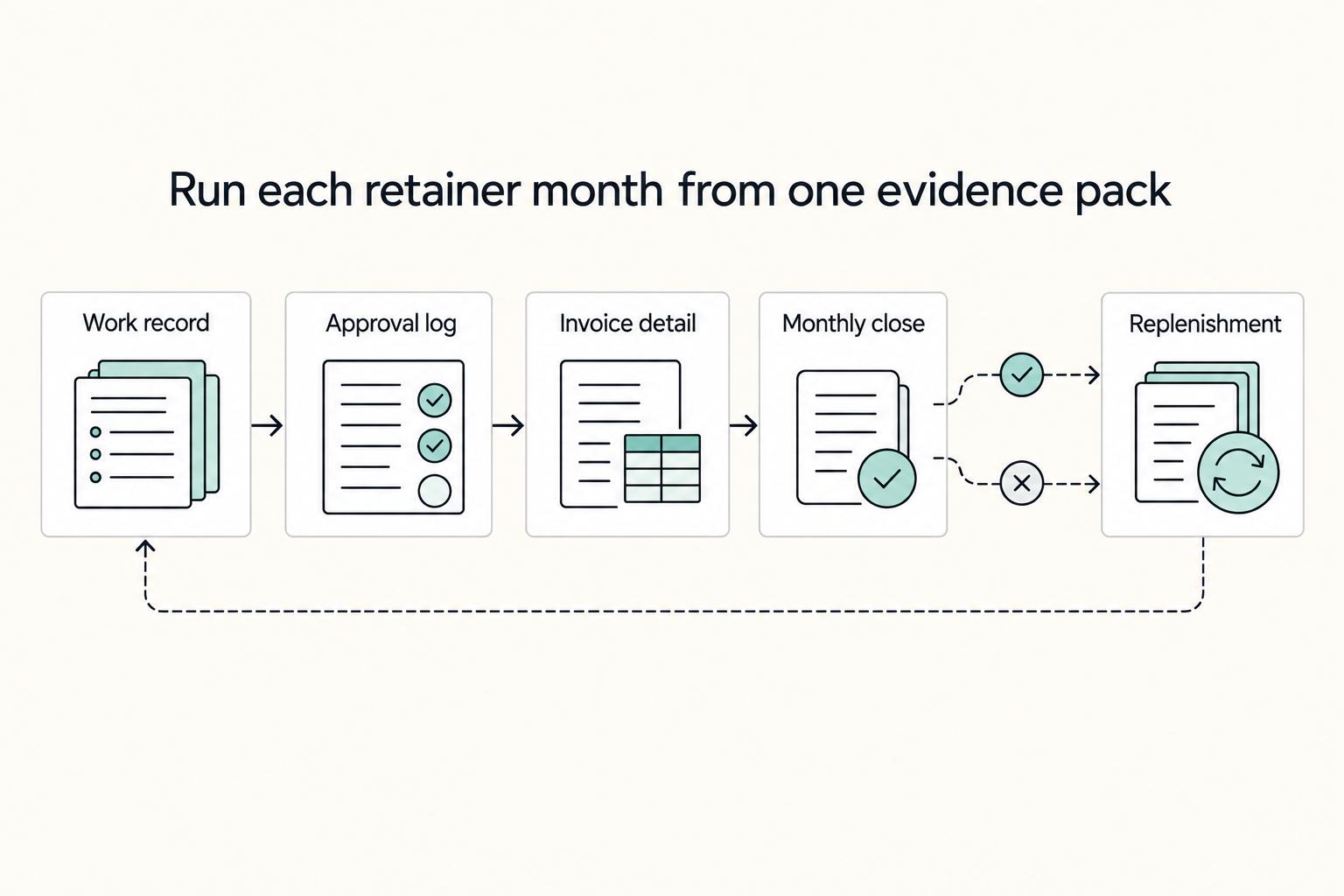
Steadier payment continuity starts with one clear rule: when the balance drops below the agreed floor, funding is restored to the target amount. That is the job of an evergreen clause in a retainer agreement, and it can keep payment expectations explicit before work gets ahead of cash.

The Freelance Payment Penalty: A Modeled Audit of Platform Fees, FX Spreads, and Payout Delays
The money rarely disappears through a single, easy-to-spot fee. The real loss is stacked. A marketplace takes its commission, a processor adds a charge for international cards, a bank or payment company converts the currency at a spread, a platform holds the funds before release, and a wire sheds a little to intermediaries on the way in. Each layer looks defensible on its own, but the worker feels the combined result as a smaller deposit and a later payday.