
Quick Answer
Nevada LLC legal protections work through three layers: the corporate veil, charging order protection, and operational discipline. The LLC can help keep business liabilities from reaching your personal assets when it is operated as a separate entity, and Nevada generally limits a personal creditor to a charging order against your LLC interest. Those protections have limits, so contracts, insurance, filings, records, and clean banking habits still matter.
Which Risks a Nevada LLC Reduces, and Which Stay With You#
If you work for yourself, the core legal risk is that a business dispute can spill into your personal life. A Nevada LLC can help create separation, but it is not a complete protection system. The practical question is which risk the LLC reduces and which risks still stay with you.
| Layer | Risk path | Article note |
|---|---|---|
| Corporate veil | Business liabilities reaching personal assets | Helps keep business liabilities from reaching your personal assets when the LLC is operated as a separate legal entity |
| Charging order protection | A judgment creditor pursuing a member's interest | Nevada statute states a charging order is the exclusive remedy, whether the LLC has one member or multiple members |
| Operational discipline | Filings, contracts, and compliance habits | These are what make the legal structure hold up in practice |
Nevada law sets a baseline: you are not personally liable for LLC debts solely because you are a member. But that baseline has limits. Personal negligence can still expose you, and LLC separateness questions under alter-ego law are decided by the court. Use this three-layer framework as you read the rest of the article:
- Corporate veil: helps keep business liabilities from reaching your personal assets when the LLC is operated as a separate legal entity.
- Charging order protection: Nevada statute states a charging order is the exclusive remedy for a judgment creditor pursuing a member's interest, whether the LLC has one member or multiple members.
- Operational discipline: filings, contracts, and compliance habits are what make the legal structure hold up in practice.
That third layer is where protection is often won or lost. Your Nevada annual list is due on or before the last day of your organization-anniversary month, and the cited statute lists a $150 annual-list fee. Keep filing confirmations, insurance records, and signed contracts organized so your operations show a real LLC, not a personal alias.
Entity structure works with contracts, insurance, and compliance habits, not instead of them. Start with Layer 1, which is about keeping business risk on the business side.
If you want a deeper dive, read Sole Proprietorship vs. LLC: The Definitive Guide for Global Freelancers.
Layer 1: The Outer Wall - Shielding Your Personal World from Business Risk#
The first job of the LLC is to create legal separation so the business, rather than you personally, is in the line of fire when work-related claims arise. In everyday terms, that is the corporate veil. The company and the owner are treated separately for rights and duties.
This matters because disputes often start in ordinary ways: a customer complaint, a contract breach, or a negligence allegation. If a claim escalates, opposing counsel may run an asset search to estimate recovery, and larger visible assets can increase settlement pressure.
| Structure | Legal separation | Asset-search picture | Risk compartmentalization |
|---|---|---|---|
| Assets kept in one pool | Separation is limited in practice | A larger visible pool can increase what a claimant seeks | Risk is concentrated in one place |
| Assets segregated across LLCs | Each LLC is a separate legal entity | Assets are isolated into multiple entities | Segregation is used to compartmentalize risk |
A practical example shows the point. If assets are all held in one place, an asset search can show a larger pool to pursue. If those assets are spread across separate LLC entities, the claim analysis stays tied to what sits in each entity.
Your checkpoint here is entity hygiene. If you use asset segregation, place assets in separate legal entities and keep those boundaries clear before any dispute. Its purpose is narrow: isolate operating risk by entity.
Once that outer wall is in place, the next question flips direction: what happens when the problem starts on your personal side and a creditor tries to reach your ownership interest? Related: The 'Profit First' Method Part 2: Setting Up Your Bank Accounts.
Layer 2: The Inner Sanctum - Why Nevada's Charging Order is an Unbreachable Defense#
This layer matters when the claim is against you personally, not the business. If a personal creditor wins a judgment against you, Nevada law generally limits that creditor to a charging order against your LLC interest. That is the second half of the protection picture: the debt may be personal, but the law can limit how far the creditor reaches into the company.
Under NRS 86.401, the charging order is the exclusive remedy against a member's interest. The statute says this applies whether your LLC has one member or more than one member.
What the creditor actually gets#
The short version: a charging order reaches your economic rights, not your control of the business. Nevada defines a member's interest in NRS 86.091 as economic interests like profits, losses, and distributions. NRS 86.401 says the creditor gets only assignee rights to that interest.
| Interest | Creditor position | Control impact |
|---|---|---|
| Profits | Part of the member's economic interest under NRS 86.091; creditor gets only assignee rights | No automatic management authority or day-to-day operating control |
| Losses | Part of the member's economic interest under NRS 86.091; creditor gets only assignee rights | No automatic management authority or day-to-day operating control |
| Distributions | Part of the member's economic interest; the creditor may receive distributions that would otherwise go to you, if and when distributions are made | No automatic management authority or day-to-day operating control |
In short, the creditor may receive distributions that would otherwise go to you, if and when distributions are made. The creditor does not automatically gain management authority or day-to-day operating control just because of the judgment.
For you, that can change leverage in negotiations. It does not erase the debt, and it does not guarantee a low settlement.
Where Nevada differs#
Nevada's statute says no other remedy is available, including foreclosure on the member's interest. Some states use broader statutory language, so verify state comparisons before you rely on them. If your filing decision depends on this difference, verify current law in each comparison state before relying on it.
| Jurisdiction | Creditor path against LLC interest | Can creditor move beyond distribution rights? | Note |
|---|---|---|---|
| Nevada | Charging order is the exclusive remedy under NRS 86.401 | No, statute text bars other remedies including foreclosure on the member's interest | Assignee-style economic rights only |
| California | Charging order framework that can include foreclosure and sale of the transferable interest | Potentially, yes | Verify the current rule before relying on it |
| Utah | Charging order framework that can include foreclosure and sale of the transferable interest | Potentially, yes | Verify the current rule before relying on it |
Solo owner check and edge cases#
If you run a single-member LLC, this still matters. Nevada expressly applies the exclusive-remedy rule to one-member companies too. That makes this a practical planning point for solo operators, not just multi-owner firms.
There is also an important limit. NRS 86.401 says it does not supersede a written creditor-member agreement that does not conflict with the LLC's governing documents. If you signed a pledge, guaranty, or similar creditor agreement, review it with your operating documents as one package before assuming the statute fully protects you. That leads straight to the third layer, because good statutes help most when your own paperwork does not undercut them.
You might also find this useful: Delaware vs. Nevada LLC: A Comparison for Asset Protection.
Layer 3: Keep Daily Operations Aligned With Your Operating Agreement#
State law governs formation and operation, so your records, money flow, and signatures should match how the company is set up. Use this checklist to reduce avoidable risk and keep day-to-day operations aligned with your operating agreement.
| Control area | Compliant behavior | Risky behavior | Likely consequence |
|---|---|---|---|
| Bank separation | Client income goes to the business account; business expenses are paid from it; owner transfers are labeled and tracked | Client payments go to your personal account; personal spending runs through business cards; reimbursements have no receipt trail | Creates avoidable documentation and account-tracking risk |
| Signature capacity | Contracts name the LLC as the party, and you sign with your title | You sign only your personal name, or the contract names you personally | Creates ambiguity about who is committing to the contract |
| Decision records | Major decisions are dated, saved, and tied to the LLC | You rely on memory, scattered texts, or inbox search | Leaves a weak governance trail if decisions are reviewed later |
| Capitalization | The LLC keeps enough funds, or committed support, for ordinary obligations | You sweep funds out immediately and leave routine bills uncovered | Can signal weak operating discipline for routine obligations |
Confirm Nevada maintenance filings, due dates, and related procedural steps before you rely on them.
Keep money in separate lanes#
Treat account separation as a basic control. Put client payments into the LLC account, pay business costs from that account, and move money to yourself as a labeled owner draw or documented reimbursement.
In practice, that means no personal purchases on the business card, no client payouts to personal checking, and receipts for reimbursements. A common mistake is letting "just this once" mixed spending become routine. The quick fix is to stop the mixed use, reclassify or reimburse with backup, and review statements monthly.
Sign for the company, not as yourself#
Your contracts should match your structure. If the LLC is the party, the signature block should clearly show that you are signing in company capacity.
In practice, agreements list the LLC, and you sign as "Name, Title, LLC." A common mistake is signing a prefilled document with only your personal name, or leaving your personal name as the contracting party. The quick fix is to ask for party and signature-block corrections before signing, and to treat any personal guaranty as a separate risk decision.
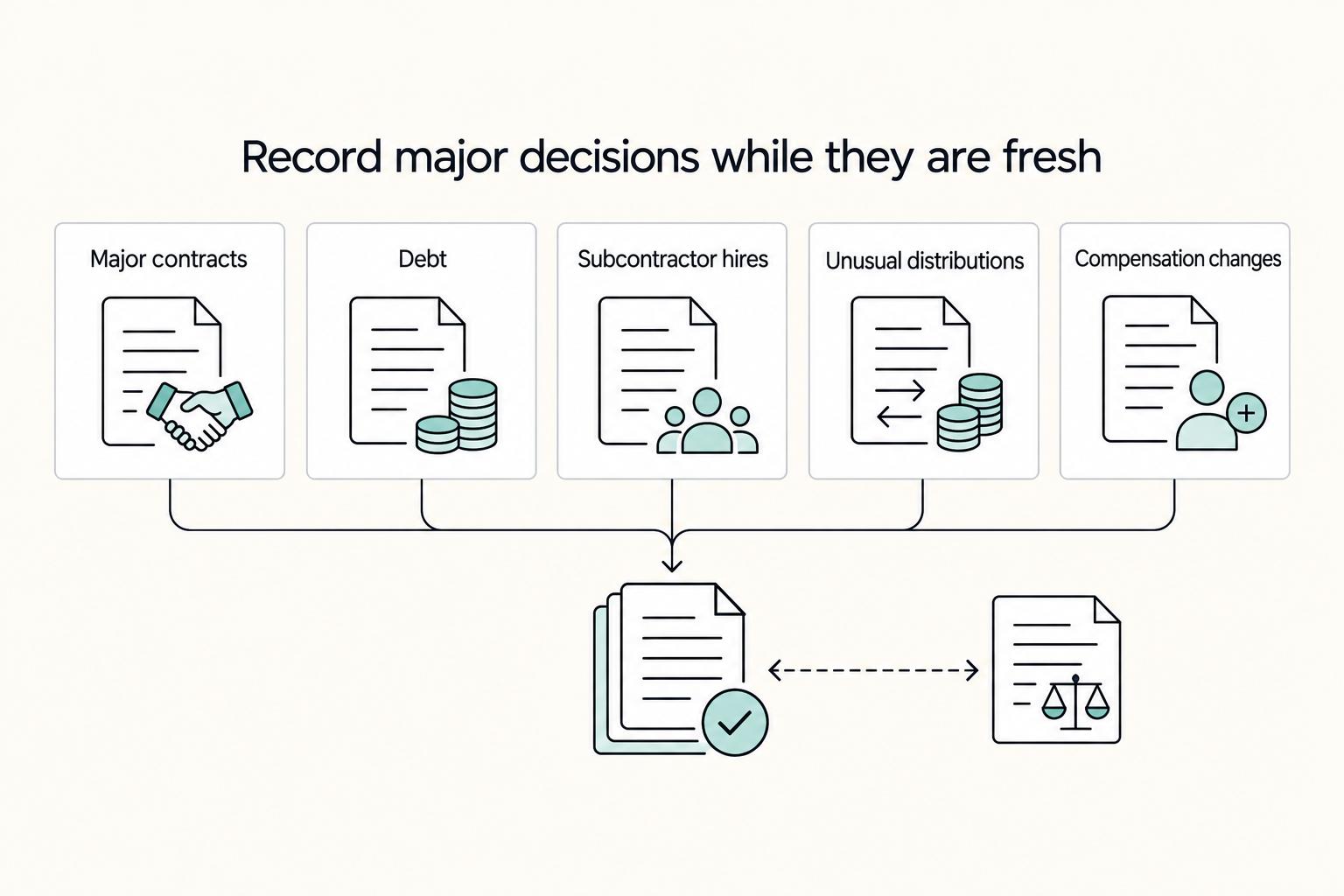
Record major decisions while they are fresh#
A simple record beats a perfect record you never create. State law governs formation and operation, and a well-drafted operating agreement is much more useful when your decision trail matches it.
| Decision type | Suggested record | Storage |
|---|---|---|
| Major contracts | Write a one-page same-day note | Store it with core LLC records |
| Debt | Write a one-page same-day note | Store it with core LLC records |
| Subcontractor hires | Write a one-page same-day note | Store it with core LLC records |
| Unusual distributions | Write a one-page same-day note | Store it with core LLC records |
| Compensation changes | Write a one-page same-day note | Store it with core LLC records |
In practice, save short decision notes for major contracts, debt, subcontractor hires, unusual distributions, or compensation changes. A common mistake is assuming invoices, email threads, or calendar events are enough on their own. The quick fix is to write a one-page same-day note, store it with core LLC records, and run a quarterly records check.
Fund the business like it is expected to operate#
Running the business without a practical operating cushion creates avoidable credibility and execution problems. You do not need a magic number, but you do need a practical operating cushion for ordinary, foreseeable obligations.
In practice, maintain working cash for recurring software, contractor invoices, refunds, taxes, and routine obligations. A common mistake is treating every incoming payment as immediately available for personal use. The quick fix is to set a floor balance, document owner transfers, and pause distributions when routine bills would be strained.
That is the operational side of keeping LLC records and routines consistent. The FAQ below covers related questions about keeping the shield credible, filing deadlines, and how to think about Nevada versus Wyoming. For a step-by-step walkthrough, see How LLC Owners Separate Business and Personal Finances.
After you lock in account separation and signature discipline, use this to standardize client terms and reduce avoidable disputes: Freelance Contract Generator.
A Foundation of Steel for a Life of Autonomy#
Use this as a maintenance plan, not a one-time shield. You are managing three layers that address different risk paths, and each one depends on current law, clean records, and consistent operations.
Corporate veil#
For business-claim risk, treat this as a separation layer to review with counsel based on the facts and Nevada law in effect at the time. It is not automatic, and it is not absolute.
Charging order protection#
For personal-claim risk, treat this as a fact-specific legal layer rather than a fixed outcome. The practical move is preparation: keep ownership, governance, and distribution records current so counsel can evaluate options under the law in effect when a dispute happens.
Operational discipline#
This is the layer you control every week, and it supports the other two. Apply that same maintenance mindset to insurance terms. Nevada's cited rule bars issuing or renewing liability policies that reduce liability limits by defense costs or otherwise limit defense-cost coverage. Policies already in force on October 1, 2023 were carved out until renewal. That can preserve limits for settlements or judgments, but it can also come with tradeoffs such as possible premium pressure or weaker early-settlement incentives.
How this works together#
You may face more than one claim path at once. How any protection applies depends on current law and case facts, and your documentation quality can matter in each path.
The practical takeaway is to treat protection as ongoing risk management, not a filing you finish once. Confirm current Nevada rules, insurance renewals, and your operating setup with counsel before relying on any protection.
If you want your legal structure matched with operational controls for collecting and paying globally, talk to Gruv.
Frequently Asked Questions
What does Nevada’s charging-order rule actually do for you?
Nevada generally limits a personal creditor to a charging order against your LLC interest, whether the company has one member or multiple members. The creditor gets assignee-level rights to your economic interest, not full member control rights. Verify the current statute and case law before relying on it in a negotiation or litigation plan.
Can a personal creditor take over your Nevada LLC or seize business assets?
Generally, a personal creditor is limited to assignee rights in your economic interest rather than full member control rights. That means the creditor may receive distributions that would otherwise go to you if and when distributions are made, but does not automatically gain day-to-day control. Outcomes still depend on your facts, your records, and any other claims in the case.
What is the difference between a claim against you and a claim against the LLC?
A business claim is generally against the LLC and its assets, while a personal claim is against you. Charging-order analysis can matter when the claim is personal rather than against the company. Member and manager nonliability for company debts by status alone does not end every liability question.
How do you keep the liability shield credible in real life?
Keep the liability shield credible by running the LLC as a separate entity. That means separate bank activity, company-capacity signatures, and records that match how you actually operate. Nevada also requires continuous record maintenance at the principal office in Nevada or with a custodian of records.
Which filing deadlines matter most if you do not want an avoidable compliance problem?
The main deadlines are Nevada's annual list, due by the last day of your anniversary month, and the annual state business license renewal. The annual list has a $150 fee, and the annual business license renewal is generally $200. If default continues long enough, the charter can be revoked and the right to transact business can be forfeited.
How should you think about Nevada versus Wyoming for protection and upkeep?
Think about Nevada versus Wyoming as a fit decision, not a slogan. Compare legal predictability, disclosure posture, admin cadence, and total cost for your use case, and verify current official statutes before relying on third-party code copies. Pick the schedule you can consistently maintain.
How private is a Nevada LLC, really?
A Nevada LLC provides entity separation, not invisibility. Annual-list rules require the names and titles of managers, or managing members if there is no manager, plus an address for each listed person. Plan around those required disclosure fields before you file.
Try a related tool
Researched and edited by the Gruv editorial team. Gruv builds cross-border billing, payouts, and finance-operations software for global businesses.
Sources
Includes 3 external sources outside the trusted-domain allowlist.
- energy.nv.gov/contentassets/111371297e354d1983c0e1fea8409d...trusted
- sba.gov/business-guide/manage-your-business/stay-leg...trusted
- sba.gov/business-guide/launch-your-business/get-busi...trusted
- sos.wyo.gov/Forms/Business/LLC/LLC-ArticlesOrganization.pdftrusted
- sos.wyo.gov/Business/docs/BusinessFees.pdftrusted
- hunton.com/hunton-insurance-recovery-blog/an-uncharted-...external
- law.justia.com/codes/nevada/chapter-86/statute-86-263external
- law.justia.com/codes/nevada/chapter-86/statute-86-401external
Educational content only. Not legal, tax, or financial advice.
Related Posts

Sole Proprietorship vs LLC for Global Freelancers in 2026
For most freelancers in 2026, the practical default is still simple: use the simplest structure you can run cleanly, then formalize when risk actually rises. If your work is still in validation mode and the downside is contained, a sole proprietorship is often the practical starting point. When contract exposure, delivery stakes, or dispute risk starts climbing, forming an LLC deserves earlier attention.
The 'Profit First' Method Part 2: Setting Up Your Bank Accounts
Most freelancers who try Profit First open a few extra bank accounts and call it done. That's the wrong move.
Delaware vs Nevada LLC for Asset Protection Decisions
If you are a solo professional, stop treating **delaware vs nevada llc** like a brand choice. Much of the noise around this topic comes from corporate law, and that does not automatically translate into a better LLC setup in your day-to-day business.