
Quick Answer
Use the uk habitual residence test for support and housing eligibility, and use the Statutory Residence Test for HMRC tax-year residence status. For many means-tested routes such as Universal Credit, the process can involve both habitual residence in fact and a right to reside check. A practical first step is to identify the decision-maker, then prepare one consistent evidence file with dates, address history, and living-pattern records.
Introduction for globally mobile freelancers#
If you are a freelancer moving to, returning to, or splitting time with the UK, start with a simple distinction: the UK Habitual Residence Test (HRT) is usually a benefits or housing gate, not a full tax-residence ruling. If your immediate issue is Universal Credit or a local authority housing application, you are in HRT territory. If your issue is whether you are UK resident for a tax year, HMRC points you to the Statutory Residence Test (SRT) instead.
That distinction matters because the two tests answer different legal questions. In benefits guidance, the focus is whether you are "habitually resident in fact", and Citizens Advice notes that the check can also look at whether you have a right to reside. In tax guidance, HMRC says you need to use the Statutory Residence Test to work out whether you are resident in the UK. Treating those as interchangeable can lead you to send the wrong information to the wrong body, especially when your work, home base, and travel pattern do not line up neatly.
The practical rule is simple: start with the decision you actually need to make, then use the test that belongs to that decision. For benefits and housing, that often means a fact-based residence review, including housing guidance used by local authorities in Annex 1 on the habitual residence test. For tax, it means a separate residence analysis for the relevant tax year. If you need to answer both questions, keep them in two separate lanes from day one.
A good checkpoint before you file anything is to name the authority and the outcome you want. If the decision-maker is a local authority or a benefits body, you are likely dealing with the Habitual Residence Test and possibly a right to reside question as well. If the decision-maker is HMRC and the issue is filing position, UK tax status, or cross-border income treatment, move to the SRT. If helpful, read Understanding the UK's Statutory Residence Test (SRT).
There is also a timing trap here. DWP guidance says the Habitual Residence Test was introduced in 1994, and that a second element, the need to have a right to reside, was added in 2004. So if you are relying on old assumptions, forum answers, or advice from someone thinking only about tax residence, you can end up sending the wrong facts to the wrong body.
The aim here is practical. You should leave with a decision sequence for choosing the right test, an evidence checklist built around residence facts rather than vague intent, and clear escalation points for mixed cases. If your benefits or housing story and your tax story do not line up on dates, address, or where you are actually living, stop and fix that before you apply or file.
For a related cross-border context, see A Deep Dive into the Netherlands' 30% Ruling for Skilled Migrants.
What the Habitual Residence Test actually decides#
Use the Habitual Residence Test when your immediate decision is benefits or housing after arriving in, or returning to, the UK. If your decision is UK tax residence for a tax year, use the Statutory Residence Test instead.
In practice, HRT is a support-eligibility gate across housing and benefits pathways. The core question is whether you are habitually resident, meaning your main home is in the UK, Ireland, the Channel Islands, or the Isle of Man, so your home base is within the Common Travel Area.
If you have recently moved or returned, expect this to be checked. For housing, local-authority guidance says habitual residence is investigated for people who have arrived or returned to live in the UK, including cases where they were not habitually resident during the 2 years before applying. Citizens Advice gives the same practical signal for people who moved or returned in the last 2 years.
Do not assume every scheme uses one identical test. For some means-tested benefits, you may need both habitual residence in fact and a right to reside. Keep benefits and housing decisions in one lane and tax-residence decisions in another. If you want a deeper dive, read the digital nomad tax guide.
Habitual residence and tax residence are different decisions#
Use a two-lane check: the Habitual Residence Test and the Statutory Residence Test answer different legal questions, and treating them as one test creates avoidable risk.
The material in Annex 1: The habitual residence test is housing-focused guidance, not a tax-residence code. It is a fact-sensitive assessment that looks at the fact and nature of residence in each case, which is why it is used in housing and benefits contexts, including cases where being "habitually resident in fact" is relevant.
By contrast, the Statutory Residence Test (SRT) is the framework for deciding UK residence status for a tax year for relevant tax purposes, including income tax and capital gains tax. It has applied since 6 April 2013.
For freelancers, keep the split explicit:
- Lane one: benefits and housing. Use habitual-residence guidance when the decision is about support or housing access.
- Lane two: tax positioning. Use the SRT when the decision is your UK tax-year residence status and tax treatment.
A practical check: if your note relies on Annex 1 or benefits guidance, keep it in lane one; if it relies on SRT rules for a tax year, keep it in lane two. Do not paste one generic "UK residence" paragraph into both files.
If you want a fuller tax-side contrast, read A Deep Dive into the UK's Statutory Residence Test for Nomads.
Who is likely to be checked after you move or return#
If you arrived or returned to live in the UK within the last 2 years, treat a habitual residence check as likely when you apply for housing help, even if you are a British citizen.
Under Annex 1 of the Homelessness Code of Guidance for Local Authorities, if you arrived or returned to live in the UK during the 2 year period before the application, local authorities should make further enquiries to decide whether you are habitually resident. In practice, that makes recent movers and returners a core screening group.
Citizens Advice frames it the same way for applicants: if you moved or returned to the UK in the last 2 years, you usually need to show habitual residence for housing support, including as a British citizen. So the trigger is your recent move or return facts, not your passport alone.
Geography also matters. In this guidance, habitual residence is considered across the Common Travel Area: the UK, Channel Islands, Isle of Man, and Republic of Ireland.
If you are in that recent-move window, prepare your evidence before you submit:
- a clear timeline of when you left, returned, and resumed living in the UK
- proof of your current living arrangements and continuity of residence
- consistent dates and facts across your application materials
Use one checkpoint before filing: did you arrive or return to live in the UK within the 2 years before your application date? If yes, expect further enquiries and make sure your timeline is complete before submission.
This pairs well with our guide on A Deep Dive into the UAE's Corporate Tax for Freelancers and LLCs.
How decision-makers assess habitually resident in fact#
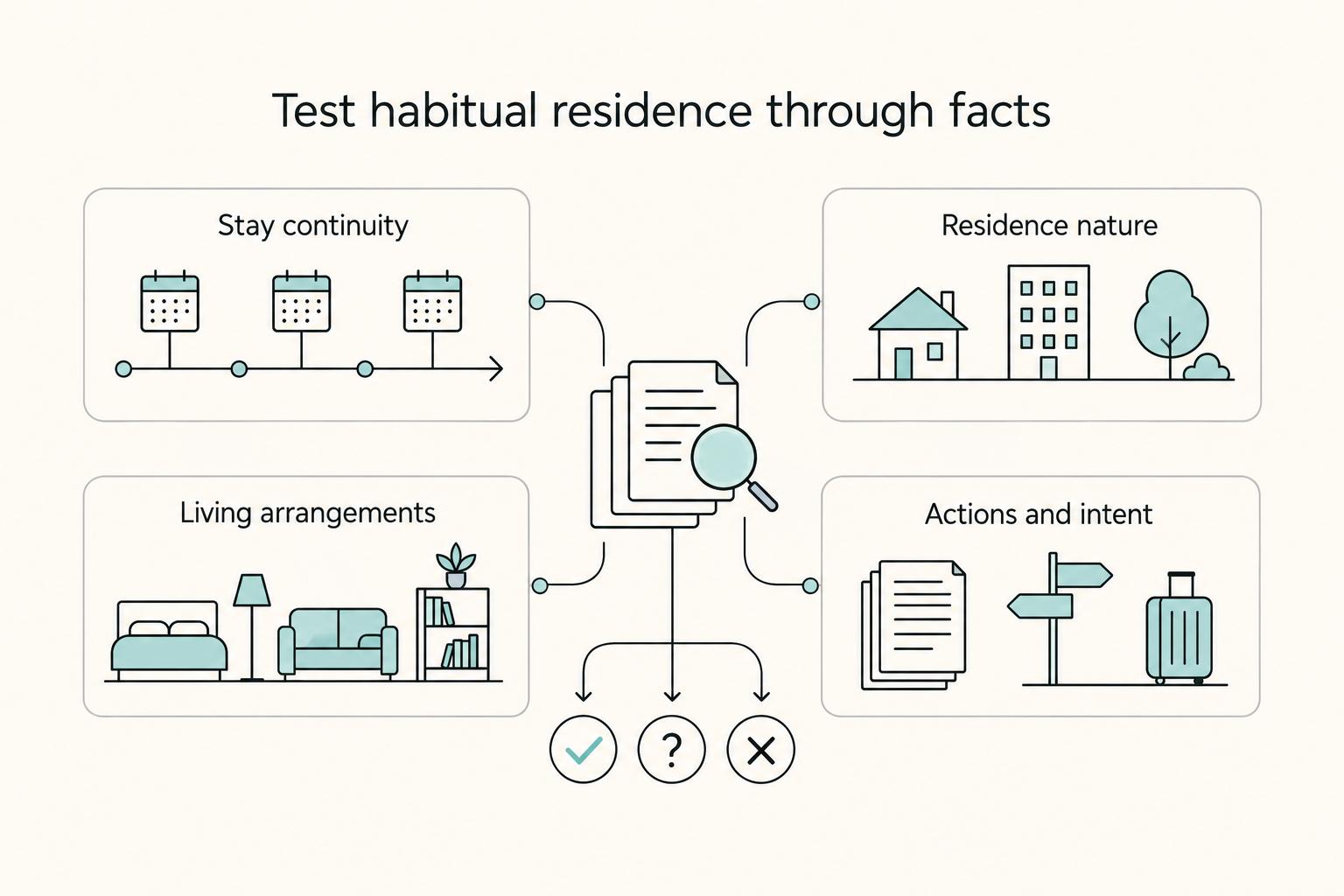
For habitual residence, the first judgment is whether you are habitually resident in fact: a settled, real pattern of living, not just temporary physical presence. Annex 1 says there is no statutory definition, so decision-makers assess all case facts in a common-sense way.
In practice, they usually weight what your file shows more heavily than what you say you plan to do. GOV.UK highlights the length, continuity, and general nature of actual residence, plus the practicality of your living arrangements. It also states that intention must be consistent with your actions.
| Factor | What supports your case | What weakens your case | What to document |
|---|---|---|---|
| Length and continuity of residence | A clear, dated pattern of residence in the UK or wider Common Travel Area | Patchy dates, unexplained absences, or conflicting timelines | Dated timeline, address history, and continuity records |
| General nature of residence | Facts showing your residence is real and settled, not just temporary presence | Evidence that your stay is still a stopgap | Records that consistently show your current base |
| Practical living arrangements | Workable arrangements that look like actual home-making | Arrangements that look temporary or unclear on paper | Proof of where you are living now and the basis for living there |
| Intention matched by action | Your stated plan to settle aligns with your conduct | Intention statements with little objective support | Evidence that your actions match your stated move or return |
Where cases usually go wrong#
The common failure mode is relying on intention statements alone. Annex 1 is explicit: intention by itself is not enough unless your actions support it.
The second failure mode is weak practical evidence. You can have a settled purpose without planning to stay indefinitely, but your arrangements still need to look real and coherent.
Before you submit, run one check: can a decision-maker quickly see, in date order, where you live now, how your residence has continued, and why your arrangements look settled? If not, tighten the pack so dates and facts align across your housing forms, benefits paperwork, and any separate move notes, including periods across the Common Travel Area.
Benefits map where right to reside and habitual residence both matter#
Here the key point is simple: some benefit routes check both habitually resident in fact and right to reside, while others here are listed under habitual-residence requirements. If you apply the wrong test mix, you create avoidable delay.
| Benefit or program | Group from excerpts | Test combination indicated in excerpts | Operator note |
|---|---|---|---|
| Universal Credit | Income-related benefits | Both habitually resident in fact and right to reside | Regulation 9 links treatment to having a right to reside in the Common Travel Area. |
| Pension Credit | Income-related benefits | Both habitually resident in fact and right to reside | Do not assume age-linked routes avoid right-to-reside checks. |
| Housing Benefit | Income-related benefits | Both habitually resident in fact and right to reside | From 21 October 2025, local authorities no longer duplicate HRT for claimants already receiving Universal Credit. |
| Council Tax Support | Income-related benefits | Both habitually resident in fact and right to reside | Keep timeline and address history clear, especially for local administration. |
| Income-related Employment and Support Allowance | Income-related benefits | Both habitually resident in fact and right to reside | Incapacity-related routes can still include the right-to-reside layer. |
| Attendance Allowance | Disability and carer routes | Listed under habitually resident in fact requirements | Confirm with the relevant authority whether this benefit falls under the combined-test group. |
| Disability Living Allowance | Disability and carer routes | Listed under habitually resident in fact requirements | Verify current route details on the per-benefit table before filing. |
| Carer's Allowance | Disability and carer routes | Listed under habitually resident in fact requirements | Do not assume every carer route uses the same test mix. |
| Adult Disability Payment | Disability and carer routes | Listed under habitually resident in fact requirements | Scotland-specific route. |
| Child Disability Payment | Disability and carer routes | Listed under habitually resident in fact requirements | Scotland-specific route. |
| Best Start Grant | Disability and carer routes | Listed under habitually resident in fact requirements | Scotland-specific route. |
| Best Start Foods | Disability and carer routes | Listed under habitually resident in fact requirements | Scotland-specific route. |
| Carer Support Payment | Disability and carer routes | Listed under habitually resident in fact requirements | Scotland-specific route. |
| Caveat on exemptions | Cross-cutting | Exempt categories are mentioned but not fully detailed here. | Do not self-classify as exempt from summary material alone. |
The verification step that saves rework#
Before you apply, check the exact benefit on the Turn2us per-benefit residence table, then cross-check GOV.UK for the same route. If timing is part of your case, treat Turn2us' 1 to 3 months in many cases as a usual range, not a fixed rule.
Where applicants usually trip up#
A common mistake is assuming one residency answer applies to every benefit. Another is assuming Housing Benefit will always repeat every residence check even when Universal Credit is already in payment, despite the 21 October 2025 change.
If the route is unclear, do not guess. Confirm the exact test combination on Turn2us and GOV.UK, then match your evidence to that route.
You might also find this useful: The Bona Fide Residence Test: A Deep Dive for US Expats.
Build your evidence pack before you apply#
Build your file in decision order so your claim is easier to assess and harder to challenge on inconsistencies.
Work in decision order#
- Identify the exact benefit or housing route, because the residence test depends on the scheme.
- Confirm whether that route also requires a right to reside check.
- Map your evidence to habitual residence in fact: your main home and your actual pattern of residence.
- Submit only after your timeline is consistent across the full pack.
If right to reside is in scope, do not treat it as implied by residence alone. Keep the residence facts and your status basis clearly documented.
Checklist for a fact-based file#
Use one dated pack that shows settled living patterns clearly:
| Evidence item | Detail from article |
|---|---|
| Address history | Include move-in dates |
| Main-home proof | Show where your main home is |
| Continuity records | Show continuity of day-to-day life |
| Travel records | Include arrivals, departures, and gaps |
| Work or self-employment records | Tie them to where you were living |
| Status/immigration documents | Include where right to reside applies |
| Short timeline | Keep it date-ordered and matching all submitted forms |
Verification before submission#
Run one final cross-check against GOV.UK decision factors and Citizens Advice practical guidance for your route. Focus on overall circumstances, not a single "magic" document. Your pack should show a main home in the UK, Ireland, the Isle of Man, or the Channel Islands, and evidence across an appreciable period, often 1 to 3 months, depending on circumstances.
If you freelance, keep date-stamped, auditable records so your housing or benefit applications and tax files tell the same timeline. That record discipline reduces follow-up queries and avoids later reconstruction work.
Need the full breakdown? Read A Deep Dive into the US-Ireland Tax Treaty for Tech Consultants.
Red flags that mean you should talk to a professional#
Escalate before you submit if your outcome depends on an exemption, post-2021 right-to-reside detail, a mixed Common Travel Area timeline, or a mismatch between your benefits or housing story and your tax story.
- Exemption-dependent case: If your position relies on an exemption, treat that as a red flag. Exemption rules are not uniform and can vary by scheme and by nation, including differences between England, Wales, and Scotland, so do not rely on a generic summary.
- Cross-border CTA pattern: Habitual residence is assessed across the full Common Travel Area (UK, Republic of Ireland, Channel Islands, and Isle of Man). If your residence and work pattern spans that map, get a professional sense-check before filing.
- Benefits or housing vs tax inconsistency: The Statutory Residence Test is for tax-year residence status, while habitual residence decisions in benefits and housing are made in a different legal context. If your timelines point in different directions across those systems, resolve that before submission.
- Date-sensitive rule changes: If your case turns on post-2021 right-to-reside detail or decisions made on or after 18 July 2025, do not rely on older summaries.
Safe default: use one dated timeline across all applications and files, and do not submit conflicting versions with a plan to "fix later."
For a step-by-step walkthrough, see A Deep Dive into the German Trade Tax ('Gewerbesteuer') for Freelancers.
Conclusion and your next move#
The cleanest way to avoid mistakes here is to treat this as two separate decisions with one shared requirement: evidence. The Habitual Residence Test is an evidence-led process for benefits and housing decisions, while the Statutory Residence Test is the tax rule HMRC uses to work out residence status for a tax year.
Your next move should be a simple two-lane check, in this order if you have a live application or filing deadline:
- Benefits or housing lane
If you are claiming listed means-tested support, start with the Habitual Residence Test and check whether the right to reside test also applies. Turn2us is clear that for listed means-tested benefits you must be habitually resident in fact and also satisfy right to reside, so do not assume one answer settles both parts.
- Tax lane
If your real question is where you stand for UK tax, switch to the Statutory Residence Test, introduced in Finance Act 2013. HMRC frames this as the test that lets you work out residence status for a tax year, so keep it separate from any benefits or housing narrative. If you need a refresher on that side, see Understanding the UK's Statutory Residence Test (SRT).
The practical discipline is to build one dated fact file and then use the right parts of it for the right decision. A good checkpoint is whether your dates, addresses, travel pattern, and main-home story line up across your application forms and your tax records. A common failure mode is mixing purposes: using a tax residence conclusion as if it proves the benefits answer, or submitting a housing or benefits timeline that clashes with what you later say to HMRC.
If you are applying soon, do not send bare assertions. Keep a small evidence pack that shows your living pattern and continuity of residence, and keep it in date order so the story is easy to follow when questions come back. That matters because official guidance frames the test as evidence gathered through questions, not as a box-ticking exercise.
Finally, escalate early when the facts are messy. Public guidance is explicit that you should talk to an adviser if you have a sponsor or are not sure about your immigration status. The same caution applies if you are relying on an exemption not clearly covered in public material, or if your benefit and tax timelines point in different directions. In a recent Housing Benefit context, returning UK citizens would ordinarily be subject to the test, which is exactly why getting the scope and evidence right at the start saves trouble later.
Related reading: A Deep Dive into the US-Japan Tax Treaty for Remote Workers.
Frequently Asked Questions
What is the uk habitual residence test in one sentence?
It is a fact-based check used mainly in benefits and housing to decide whether you are habitually resident, and in some benefits cases whether you also have a right to reside. It is not a full tax residence ruling.
Who may need to pass it, including returning British citizens?
People who have newly arrived or returned to live in the UK may be asked to show habitual residence when claiming certain support. That can include returning British citizens, because Citizens Advice is clear that you may still have to show you are habitually resident even if you are a British citizen. Citizenship alone does not end the enquiry.
Is the Habitual Residence Test the same as the Statutory Residence Test?
No. The Statutory Residence Test is HMRC’s test for working out residence status for a tax year, under rules introduced in Finance Act 2013. The habitual residence side is a different decision used in benefits and housing, so do not use your tax answer as proof that the benefits or housing answer is settled. If you need the tax side, see Understanding the UK's Statutory Residence Test (SRT).
What does “habitually resident in fact” mean in practice?
In practice, it points to where your main home really is across the UK, Ireland, the Channel Islands, or the Isle of Man, not just where you are staying briefly. Public guidance also says the term is not defined in legislation, which is why decision-makers look closely at the facts of your actual living pattern. A useful checkpoint is whether your application tells one consistent main-home story from start to finish.
When do local authorities investigate habitual residence for housing applications?
The Homelessness Code of Guidance says it is usually only necessary to investigate habitual residence if you arrived or returned to live in the UK during the previous 2 year period. That 2 year window can be a practical trigger in housing cases. If your move back is recent, expect questions rather than assuming it will be waved through.
Do you always need both habitual residence and a right to reside test for benefits?
Not as a blanket rule across every scheme. For listed means-tested benefits, Turn2us says you must be "habitually resident in fact" and also satisfy the right to reside test, and Universal Credit is specifically named in DWP guidance as requiring both. The right move is to verify the exact benefit before you apply rather than assuming one test or the other is enough.
What details are still case-dependent or unclear from public summaries, and when should you seek advice?
Exemptions and similar edge cases are not areas to guess from short public summaries. Citizens Advice explicitly says to talk to an adviser if you have a sponsor or are not sure about your immigration status. You should also get advice if your facts span the Common Travel Area or if your benefits and tax timelines point in different directions.
Try a related tool
Researched and edited by the Gruv editorial team. Gruv builds cross-border billing, payouts, and finance-operations software for global businesses.
Sources
Includes 6 external sources outside the trusted-domain allowlist.
- legislation.gov.uk/ukpga/2013/29/schedule/45trusted
- legislation.gov.uk/uksi/2013/376/regulation/9trusted
- citizensadvice.org.uk/housing/if-youve-recently-moved-to-the-uk/ch...external
- citizensadvice.org.uk/benefits/getting-benefits-if-youve-recently-...external
- data.parliament.uk/DepositedPapers/Files/DEP2025-0364/078._Habi...external
- england.shelter.org.uk/professional_resources/legal/benefits/univer...external
- gov.uk/guidance/homelessness-code-of-guidance-for-l...external
- gov.uk/government/publications/rdr3-statutory-resid...external
Educational content only. Not legal, tax, or financial advice.
Related Posts

Digital Nomad Taxes in 2026 With a Defensible Filing Plan
With digital nomad taxes, the first move is not optimization. It is figuring out where you may be taxable, where filings may be required, and what proof supports that position.

Understanding the UK's Statutory Residence Test (SRT)
Treat SRT like ops, not folklore. You want a repeatable workflow you can run monthly so your tax-year answer is boring, documented, and easy to defend.

A Deep Dive into the UK's Statutory Residence Test for Nomads
If you get your residence status wrong, it is not a technical footnote. It can change whether the UK taxes only your UK income or normally taxes income from both the UK and abroad for that tax year.