
Quick Answer
Use a standalone NDA when sensitive details must be shared before a services contract exists, and use confidentiality language in your MSA when the relationship is already active. In confidentiality vs non-disclosure decisions, structure should follow context: pick unilateral terms if one side discloses, mutual terms if both sides do, then confirm definition, permitted purpose, exclusions, and duration before signing.
Choose the Document Form, Then the Terms Inside It#
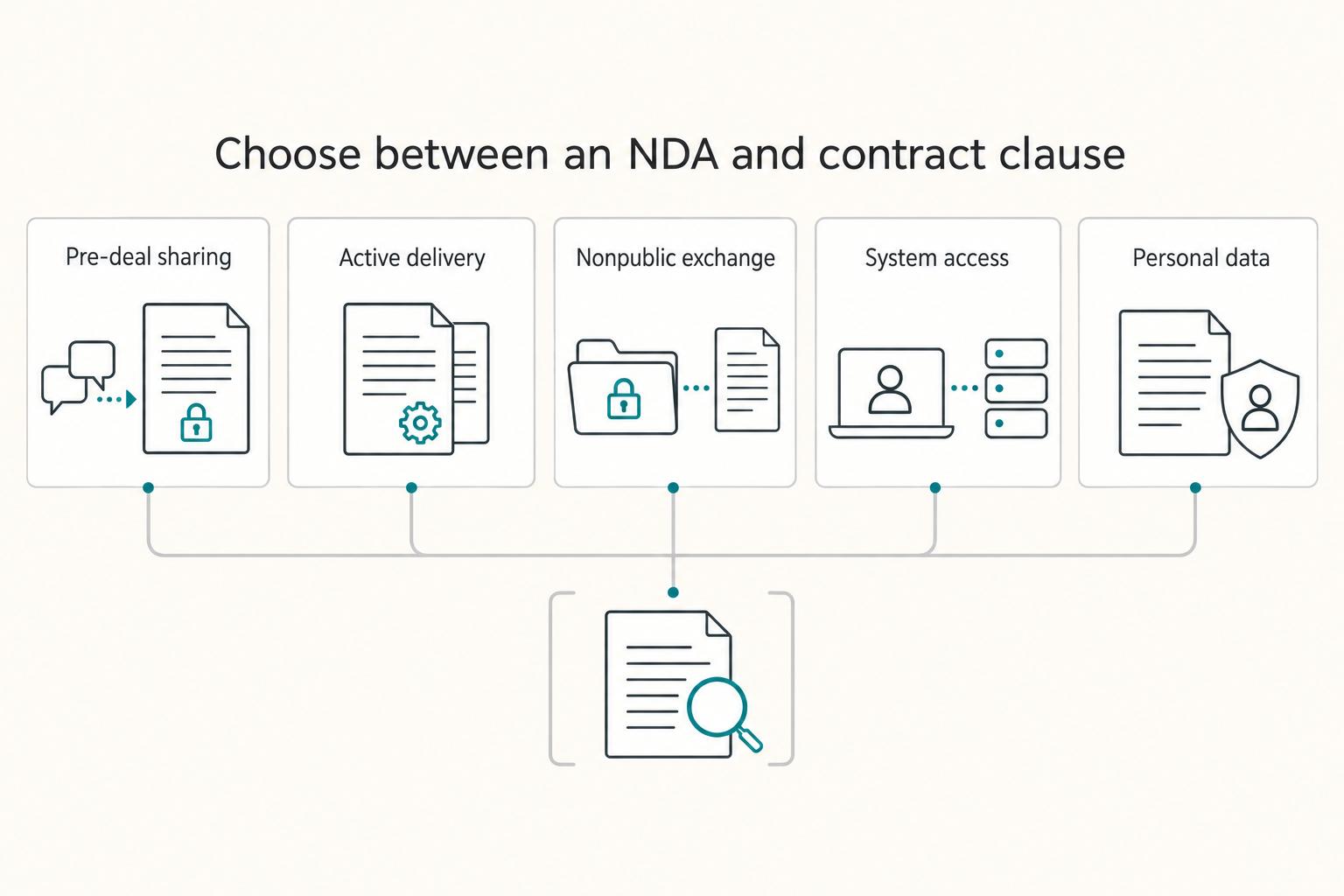
Use a standalone NDA when you need to share sensitive information before the main services contract exists, or when the exchange is narrow and specific. Use a confidentiality clause inside the main contract when confidentiality is one obligation within an ongoing relationship. That choice shapes risk allocation and negotiation flow early in the deal.
Confidentiality agreement and non-disclosure agreement are often names for the same kind of contract. Georgia Tech’s Office of General Counsel uses them as synonymous terms. The useful choice here is structural: a standalone agreement for an information exchange, or confidentiality duties inside the services contract. Read the terms rather than assuming the label gives different protection.
Practical chooser#
| Use case | Who is protected | Document form | Negotiation friction | Typical drafting focus |
|---|---|---|---|---|
| Ongoing client services where confidentiality sits alongside payment, IP, and scope | Often both parties if both share information | Clause in the MSA, services agreement, or SOW-linked contract | Usually reviewed with the main contract; comments may be bundled with IP/liability terms | Relationship-wide confidentiality duty, use limits tied to services, consistency with the rest of the contract |
| Client shares materials so you can evaluate a project, quote, or proposal | Mainly the client as disclosing party | Standalone unilateral NDA | Separate early-stage review, then later reconciliation with the main agreement if needed | Definition of confidential information, permitted purpose, use limits, exclusions |
| Collaboration, partnership, joint pitch, or subcontractor discussion with two-way sharing | Both sides, since each party discloses and receives | Standalone mutual NDA | Can involve more line-by-line negotiation because symmetry matters | Balanced two-way restrictions, matched exclusions, clear use limits, aligned governing law and jurisdiction |
Use timing and disclosure pattern as your quick rule. If the talks are exploratory, a standalone NDA can keep protection tied to that exchange. If the relationship is already being documented in a services contract, putting confidentiality there keeps the obligations in one place.
Terms that actually do the work#
The form matters, but most of the protection lives in a small set of terms. In either format, focus on five parts: disclosing party, receiving party, confidential information, permitted purpose, and exclusions.
| Term | Function | Key note |
|---|---|---|
| Disclosing party | Shares information | One of the five parts to focus on in either format |
| Receiving party | Gets information under restrictions | One of the five parts to focus on in either format |
| Confidential information | The information covered by the agreement | It should be defined with enough specificity to work in practice |
| Permitted purpose | States why the information is being shared and how it can be used | Also make sure the draft restricts use, not just disclosure |
| Exclusions | Identify what should not be restricted | If exclusions are missing, the agreement may end up restricting knowledge you already had |
Review exclusions for information already known, public through no breach, independently developed without using protected information, or lawfully received from another source without a confidentiality restriction. Agree how the recipient can demonstrate an exclusion without collecting unnecessary copies. These are drafting points to review in context, not a universal statutory checklist.
Use this quick check: can you state the permitted purpose in one sentence? "To evaluate the proposed analytics project" is clear. "For business discussions" is broad and much easier to fight about later. Also make sure the draft restricts use, not just disclosure.
Reconcile a pre-sales NDA with the later MSA before signing. Compare definitions, permitted purpose, protection periods and which terms control earlier disclosures. Do not assume the MSA automatically cancels the NDA. A clear supersession or precedence provision should identify what continues and what is replaced.
Directionality and cross-border caution#
Choose directionality based on who is actually disclosing. If only one side is sharing sensitive information, use a unilateral NDA. If both sides will share, use a mutual NDA.
| Item | What it does | Practical note |
|---|---|---|
| Unilateral NDA | Used if only one side is sharing sensitive information | Do not accept mutual terms by default when only one side is really disclosing |
| Mutual NDA | Used if both sides will share | If you expect to share your own methods, proposal details, or other sensitive material, a one-way form may leave you exposed |
| Governing law clause | Selects which country's law applies to contract interpretation and effect | Where possible, keep it aligned with the main contract |
| Jurisdiction clause | Selects which courts hear disputes | Review it together with governing law and keep both aligned with the main contract where possible |
Do not accept mutual terms by default when only one side is really disclosing. That can expand your obligations. But if you expect to share your own methods, proposal details, or other sensitive material, a one-way form may leave you exposed.
Cross-border deals need one extra check. Review the governing law clause and jurisdiction clause together. Governing law selects which country's law applies to contract interpretation and effect. Jurisdiction selects which courts hear disputes. Where possible, keep both aligned with the main contract.
Name the intended legal system and dispute forum precisely, and review whether jurisdiction is exclusive or non-exclusive. Do not treat governing law and the court forum as interchangeable. If the NDA precedes the services agreement, record both choices so the later documents can be reconciled.
The practical sequence is simple: choose the form based on timing, choose the direction based on disclosure flow, then verify that purpose, exclusions, and dispute terms line up. With that framework in place, the next step is reviewing the paper in front of you.
Review a client’s NDA against your actual work#
Treat a client NDA as a real negotiation, not as admin. Sign quickly only when the scope is clear, the obligations fit how you actually work, and the restrictions still make sense six months from now.
An NDA is a formal promise to prevent leaks or misuse, and skipping one can make recourse after a leak harder and more expensive. But that does not mean you should accept terms you cannot realistically follow in day-to-day delivery.
| Checklist item | Risk if ignored | Negotiation priority | Fallback clause to request |
|---|---|---|---|
| Definition of confidential information | Ordinary business context or your own know-how gets swept in | High | Narrow the definition to the engagement and document any agreed exclusions in writing |
| Permitted use and obligations | You accept controls your workflow cannot meet, creating breach risk | High | Terms that clearly match your current tools/process and can be enforced in practice |
| Duration | Restrictions continue longer than the business case supports | Medium to high | An explicit term and scope the client can justify in writing |
| Residuals and reuse rights | Client later challenges your reuse of generalized skills and methods | Medium | Case-specific reuse language reviewed by counsel (not a universally established NDA standard) |
1. Definition of confidential information#
Start here, because this term sets the boundary for everything else. If the definition is broad and open-ended, ask for language tied to the actual project and make sure key boundaries are spelled out.
Check required-disclosure handling separately from ordinary sharing. The contract should address what happens when disclosure is legally required, including notice only where legally permitted and practicable and limiting disclosure to the required scope. Do not promise to obtain client permission before complying with a legal obligation. Have counsel check that restrictions preserve legally protected reporting and cooperation rights.
2. Permitted use and obligations#
This is where a lot of practical breach risk shows up: contract duties and day-to-day delivery can drift apart.
Check the NDA against your real workflow, tools, backups, and team structure. Your legal obligations should match what your systems can enforce. If they do not, ask for terms aligned to your current security process and list approved tools or providers in writing.
3. Duration#
No default NDA duration benchmark is established here, so treat duration as a business-fit and legal-review question.
Separate the period during which information may be exchanged from how long received information must be protected. A project ending does not necessarily end confidentiality duties. Ask when the protection clock starts, which information has continuing protection, and what return or deletion terms allow for lawful retention and inaccessible backups.
4. Residuals and reuse rights#
A residuals clause may permit use of information retained in memory, which can reduce the discloser’s protection. It is different from preserving your pre-existing tools, general skills or independently developed work. Check the actual wording and its interaction with IP terms rather than treating remembered client information as automatically reusable.
If reuse rights matter to your business model, raise them before signature and get legal review. If the client refuses reuse language, tighten definitions and make boundaries explicit in writing before work starts.
You might also find this useful: Confidentiality vs. NDA: What's the Difference for Freelancers?. If you want a clean draft to redline against client terms, start with a structured baseline in the NDA Generator.
Protect disclosures before sending detailed materials#
Propose your NDA before you share sensitive information. If you rely on existing contract terms, confirm they clearly cover the specific disclosure and who can access it.
| Scenario | Send your NDA first, or rely on existing terms? | NDA type | Who discloses | What you are protecting | Primary drafting focus |
|---|---|---|---|---|---|
| Partnership or collaboration talks | Send first when both sides will share nonpublic plans, pricing, client details, or strategy | Mutual | Both parties | Two-way business-sensitive information | Define what is and is not confidential, limit use to the stated purpose, and include lawful-disclosure exceptions |
| Subcontractor on client work | Send first when you will share client or project information, unless equivalent confidentiality terms are already in place | Unilateral | You (including client information you handle) | Client information and project materials | Flow down the same duties you owe upstream, set access on a need-to-know basis, restrict onward sharing, and set end-of-engagement handling terms if you want them covered |
| Pre-sales disclosure of your process | Use a risk-based approach: keep early talks high-level and send terms before sharing deeper method detail | Unilateral | You | Your proprietary process, materials, and know-how | Tie disclosure to evaluation, define protected material clearly, and include lawful-disclosure exceptions where appropriate |
In partnership discussions, mutual NDAs usually fit because both sides are disclosing and receiving. Before you send one, verify that the draft clearly defines the protected information and access rules. Sloppy drafting at this stage can weaken the protection you were trying to create.
Before sharing client information with a subcontractor, confirm that the client contract permits that access and obtain any required authorization. A downstream NDA does not itself give you permission to disclose. Then flow down the applicable duties, restrict access to necessary people and agree end-of-engagement handling.
For your own proprietary process, decide in advance how much detail you will share before signed terms are in place. A practical approach is to keep early conversations at an overview level, then move to detailed walkthroughs once confidentiality terms are agreed. If a deal touches Massachusetts, check the context-specific limits instead of assuming one NDA approach applies in every setting. Use short scripts to keep momentum:
- "Happy to keep this moving. Before I share detailed materials, I send a short NDA so the information-sharing ground rules are clear."
- "If signing now is premature, we can stay at overview level and revisit detailed process discussion once confidentiality terms are in place."
Once you know when to send your own paper, the next call is whether confidentiality should stay separate or move into the main contract.
Put confidentiality into the master contract when it fits#
For repeat client work, an integrated confidentiality clause in your Master Service Agreement (MSA) is often the right baseline. If disclosures happen before that baseline is in place, or one deal is unusually sensitive, a standalone NDA can still be appropriate.
An MSA is built to set baseline terms before project-specific work starts. If you expect multiple statements of work, embedding confidentiality can reduce repeated negotiation and keep protection tied to scope, payment, and other core terms in the same governing document.
When the integrated clause is the better tool#
The main advantage is operational clarity. Your client reviews one core agreement, your team follows one governing contract, and you reduce conflicts between separate NDA language and services language.
It also links confidentiality to the rest of the deal. If information is misused, you can read the confidentiality terms alongside IP, payment, subcontracting, and dispute provisions without guessing which document controls.
The enforcement path can be cleaner too. Not automatically stronger in every case, but often easier to operate when the relationship runs under one governing agreement.
Decision table#
| Relationship stage | Sensitivity of information | Negotiation speed | Better choice | Why |
|---|---|---|---|---|
| Early sales or partnership talks before any MSA baseline is in place | Moderate to high | Fast | Standalone NDA | Covers disclosures while broader services terms are still being finalized |
| One-off project with limited future work expected | High | Medium | Standalone NDA, or focused confidentiality terms in the services contract | Keeps obligations clear when the relationship is narrow |
| Ongoing client relationship with repeat SOWs | Moderate to high | Faster after onboarding | Integrated clause in MSA | Reduces repeated negotiation and aligns confidentiality with scope, payment, and related contract terms |
| Ongoing relationship, but one deal involves unusually sensitive material | Very high | Medium | MSA clause plus deal-specific addendum, and separate NDA if needed | Preserves baseline terms while increasing protection for that project |
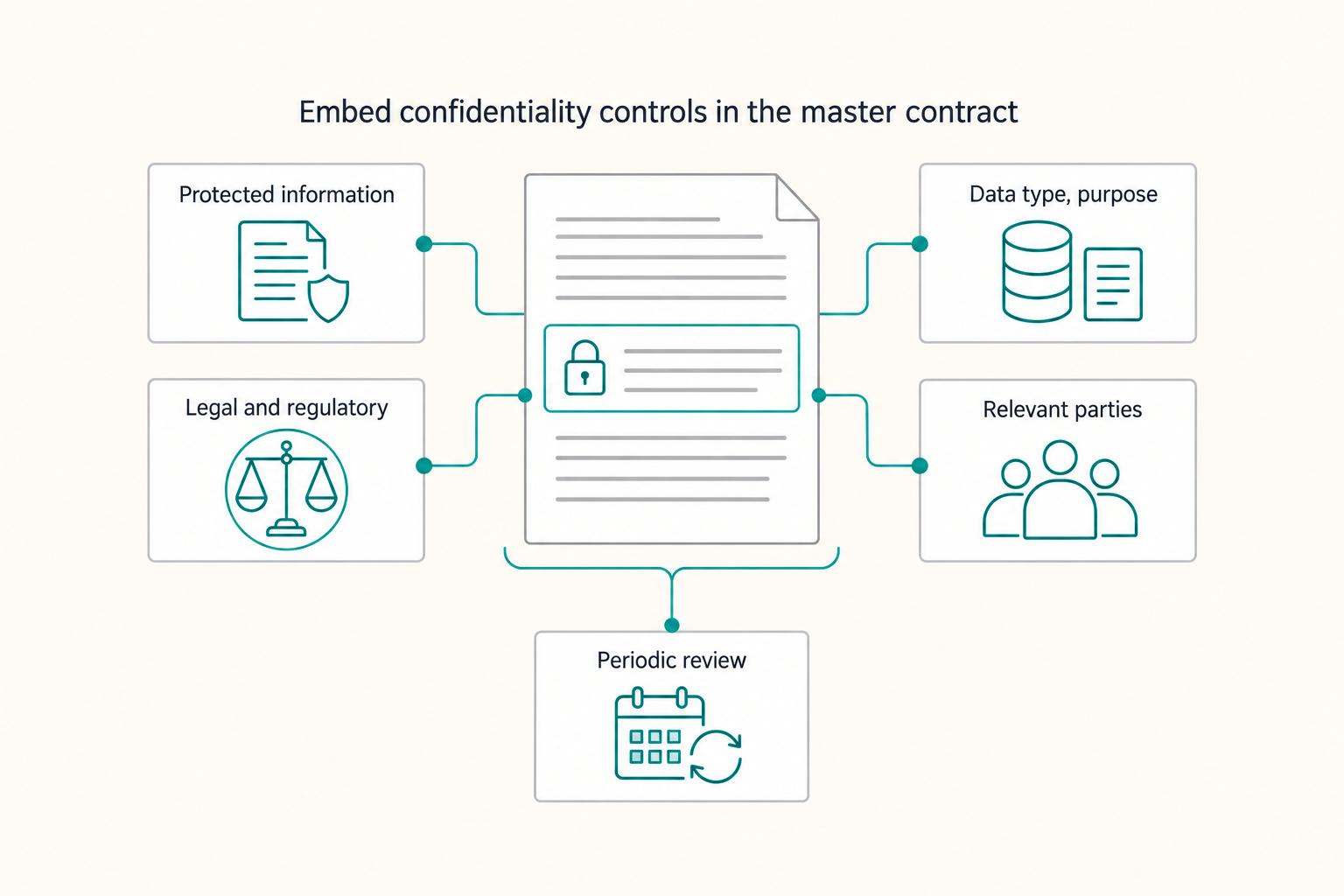
Clause design checklist#
Inside the MSA, make the confidentiality clause cover these points clearly so the baseline terms match how you actually deliver work:
| Point | What the clause should cover |
|---|---|
| Protected information | Define what information is protected |
| Data type, purpose, and risk | Tailor terms to the data type, purpose, and risk in the relationship |
| Legal and regulatory environment | Align terms with the applicable legal and regulatory environment, especially for cross-border data handling |
| Relevant parties | Keep coverage in place for all relevant parties |
| Periodic review | Review the clause periodically so it stays enforceable as risks and laws change |
Grant access to sensitive client data only after the applicable confidentiality terms and any separate access permissions are in place. Keep the signed agreement, authorized recipients and disclosure purpose together. An NDA does not replace security controls or any required data-processing or transfer arrangements.
Cross-border note#
For cross-border work, align confidentiality language with the legal and regulatory environment tied to the relationship, and keep it consistent with the rest of your contract stack. Even a well-drafted clause can create risk if contract documents conflict.
Use the MSA as your confidentiality baseline for repeat clients. Review it periodically as risks and laws change. Attach a short addendum when a specific deal is more sensitive than usual. That keeps coverage consistent across relevant parties without forcing every engagement into a separate NDA.
Match the Document to the Moment, Then Verify the Terms#
On confidentiality vs non-disclosure, the practical rule is simple: match the document to the moment so you protect sensitive information without slowing the deal.
| Strategic play | Trigger | Your role | Immediate next action |
|---|---|---|---|
| Defensive | A client sends you their NDA before you receive sensitive project details | You review their paper | Check whether confidential information is clearly defined, recipient use/protection duties are explicit, and breach consequences are stated; then mark up unclear terms before signing |
| Offensive | You need to share sensitive information before the main services agreement is signed | You issue the paper | Choose one-way or mutual based on who will disclose, then send your NDA before disclosure with clear scope, recipient obligations, and breach consequences |
| Integrated | The relationship is ongoing and you are deciding whether existing contract terms are enough | You verify current terms | Confirm the agreement clearly defines confidential information and recipient obligations; if those points are unclear, use an NDA before sharing sensitive details |
Here is the fast way to choose. If a client sends paper, review it carefully. If you need to disclose first, send your own. If ongoing work is already under a main agreement, verify that confidentiality terms are explicit before relying on them.
Your most important checkpoint is still the definition. If the agreement does not clearly define confidential information, you create ambiguity about what is protected later. Next, verify the recipient obligations. The document should say how the information must be protected and how it can be used.
Also check duration instead of assuming a default. NDA terms can vary, and the right term depends on the nature of the information.
Many confidentiality failures come from process, not theory: sharing too much too early, sharing with the wrong party, or signing unclear terms. Use the same review checkpoints each time, and get attorney review when the terms are unclear or the risk is high.
For a step-by-step walkthrough, see A Guide to Non-Disclosure Agreements (NDAs) for M&A.
When you are ready to make confidentiality language part of your standard workflow, build your reusable base in the Freelance Contract Generator.
Frequently Asked Questions
When should you use a standalone NDA instead of an embedded clause?
A standalone NDA is often used when you need protection before the full services contract is in place. Confidentiality terms in the main agreement are often used once that agreement already governs the relationship. The right choice depends on timing, disclosure pattern, and whether one contract already controls the work.
What should you check before signing either one?
Prioritize clause-level review in either format. Start with how confidential information is defined and how exclusions are handled. Then check duration, permitted use, required-disclosure handling, and what happens if terms are breached. Finally, review for conflicts elsewhere in the contract stack.
If you issue your own NDA, what should it cover?
Include core items such as the parties, disclosure purpose, protected information, who can access it, and end-of-use handling. Choose unilateral or mutual terms based on who is disclosing information. Before sending, confirm the legal entity names and signer authority.
Is a clause inside a contract weaker than a separate NDA?
Not by default. A separate NDA can be useful when timing forces early disclosure, while confidentiality terms in the main agreement can work once that agreement is active and governs delivery. Strength comes from fit and clear drafting, not from the document label alone.
What records should you keep, and when should you get legal help?
Keep the signed terms, amendments and a proportionate disclosure log: what was shared, with whom, when and for which purpose. Retain recordings or copies only where permitted and needed, and protect the log itself. Seek legal review for unclear obligations, conflicting agreements, required disclosure or protected reporting; a detailed archive does not cure an unauthorized disclosure.
Try a related tool
Researched and edited by the Gruv editorial team. Gruv builds cross-border billing, payouts, and finance-operations software for global businesses.
Sources
Includes 3 external sources outside the trusted-domain allowlist.
- generalcounsel.gatech.edu/legal-affairs/non-disclosure-agreements-ndastrusted
- osha.gov/fom/chapter-16trusted
- ashurstperkinscoie.com/en/insights/quickguide-governing-law-clausesexternal
- bostonbar.org/journal/status-of-nondisclosure-agreements-n...external
- concord.app/blog/master-service-agreementexternal
Educational content only. Not legal, tax, or financial advice.
Related Posts

Germany Freelance Visa Application Path for Freiberufler and Gewerbe
Choose your track before you collect documents. That first decision determines what your file needs to prove and which label should appear everywhere: `Freiberufler` for liberal-profession services, or `Selbständiger/Gewerbetreibender` for business and trade activity.

Limitation of Liability Clause for Freelance Software Developers
A liability clause sets which losses can be recovered and how much can be claimed. For a freelance developer, the useful starting point is the project risk: a failed acceptance test, an IP complaint, a data incident, or an unpaid invoice. Agree which risks the contract covers before choosing a cap number.
Confidentiality vs. NDA: What's the Difference for Freelancers?
A client wants to send unreleased product screens before you have agreed the project. A standalone NDA can cover that exchange. Once a services agreement exists, its confidentiality clause can govern handling during delivery. The useful choice is which signed terms cover each disclosure, rather than which document has the better label.