
Quick Answer
Use capitalization for purchases with multi-year business use, and expense costs consumed in the current period. In capitalization vs expensing, the main effect is timing across net income, retained earnings, and cash flow presentation. Book treatment first, then test tax elections like Section 179 or the de minimis safe harbor. For non-trivial items, keep invoice support, a business-purpose note, and a useful-life rationale before you post.
Why capitalization versus expensing changes net income timing, not just tax vocabulary#
Capitalization vs expensing is not a vocabulary quiz. It changes net income timing, what stays on your balance sheet, and how your treatment holds up under review. For a business of one, that makes it more than a bookkeeping preference.
The practical line is simple to start with. If a purchase is expected to provide economic benefit for more than one year, you are usually in long-lived asset territory and should ask whether it belongs on the balance sheet first. If the cost is consumed now, or mainly supports the current period, immediate expense treatment is often the cleaner answer. The harder part is that both treatments can be acceptable when the facts fit, so the real work is not memorizing labels. It is applying the same logic to similar purchases over time.
That consistency point matters more than many solo operators realize. Equipment and other purchases you expect to use for years can affect future revenue in a way that points toward capitalization. Short-life tools, recurring services, or clearly current-period costs usually point the other way. If your treatment changes across periods, document why. Before you book the entry, do a quick check: confirm the business purpose, expected useful life, and whether you handled similar items the same way before.
This article is written for freelancers, consultants, and other business-of-one operators who want conservative, repeatable calls rather than aggressive one-offs. Where the facts get technical or conflicting, basic guidance may not be enough. More specific technical guidance should control. That is when you stop forcing a neat answer and consult a qualified expert.
You will leave with three practical artifacts you can reuse:
- a side-by-side comparison table showing what each treatment does to the income statement, balance sheet, and cash flow presentation
- a decision sequence you can run before booking any non-trivial purchase
- a documentation checklist that tells you what to save, what to note, and when to escalate
The through-line is conservative and straightforward: classify based on real economic use, stay consistent, and document enough that your position still makes sense months later. To make that concrete, the next section puts the two treatments side by side so you can see where the differences actually hit your numbers.
Capitalization vs expensing at a glance#
Start with useful life: if the cost supports the business over multiple years, treat it as a capitalization candidate; if it is consumed now or shortly after, treat it as an expense candidate. That single choice changes current profit, balance-sheet presentation, cash flow classification, and the amount of consistency work you may face later.
| Decision point | Capital expenditure | Operating expense |
|---|---|---|
| Income statement | The full cost is not recognized immediately; it is recorded as an asset first, then recognized through depreciation over time. | The cost is recognized in the current period, which reduces current profit. |
| Balance sheet | The cost is recorded as an asset on the balance sheet until it is depreciated or otherwise reduced. | The cost is recognized currently, so no long-lived asset is created from that spend. |
| Statement of cash flows | The purchase is shown as an investing cash outflow when incurred. Reported cash flow from operations can look higher in the current period because the full spend is not immediately treated as operating expense. | The payment generally stays in operating cash flow, so the current-period effect appears in cash flow from operations rather than investing. |
| Audit burden | Usually higher: you need a clear useful-life basis and consistent depreciation treatment. | Usually lower for ordinary current-period costs, but only if you apply the same logic across similar items and periods. |
| Best use case | Long-use business assets expected to stay productive over a longer period. | Short-life tools, recurring services, and costs consumed in the current period or shortly after. |
| Risk if misapplied | Early profit and retained earnings can look overstated if ordinary operating costs are pushed into assets. Inconsistent GAAP treatment across similar items also hurts comparability. | Early profit can look understated if a long-use asset is fully expensed at once. If that flows through your records and filings, cleanup may require schedule corrections and possibly an amended return. |
The line is not fully objective under GAAP, so judgment matters, but consistency matters more. Before you book a non-trivial item, confirm business purpose, expected useful life, and whether similar purchases were treated the same way in prior periods.
A final check on cash flow: capitalization does not mean less cash out today. It means the cash is shown in investing, which can make operations appear stronger than immediate expensing would.
Use the asset column for clearly long-use assets, the expense column for current-period consumption, and treat borderline cases as documentation-first decisions.
What qualifies for capitalization and what should be expensed#
Use this default: capitalize costs tied to a probable future business benefit, and expense costs tied to benefits already received or consumed soon.
| Path | What it does | Key checks |
|---|---|---|
| Economic treatment first | Decide the economic treatment first | Confirm business purpose, expected useful life, and whether similar purchases were treated the same way in prior periods |
| Section 179 | Can allow immediate expensing of qualifying Section 179 property instead of depreciation | For tax years beginning in 2026, maximum deduction is $2,560,000; reduced when Section 179 property placed in service exceeds $4,090,000; not available for trusts, estates, and certain noncorporate lessors |
| De minimis safe harbor | Can allow immediate deduction for smaller purchases | Up to $2,500 per invoice or item when requirements are met; applies across qualifying expenditures in the taxable year; excludes inventory and land |
| Decision test | Usually points to capitalize | Usually points to expense |
|---|---|---|
| Nature of benefit | Future business benefit beyond the current period | Benefit already received or consumed in the current period |
| IRS starting point | Costs to acquire, produce, or improve tangible property generally must be capitalized under IRC Section 263(a) | Ordinary and necessary costs like materials, supplies, repairs, and maintenance are generally deductible under IRC Section 162 |
| What to document | Why the item creates ongoing value or improves property | Why the cost is routine, current-period, and not creating or improving a long-lived asset |
| Common error | Moving ordinary costs into assets to avoid a current-period hit | Writing off long-use items without support for immediate deduction |
GAAP does not give you a universal one-year bright-line test. Judgment is allowed, but your policy has to stay consistent across similar purchases and periods so reporting remains comparable.
Tax treatment can differ from book treatment. Section 179 can allow immediate expensing of qualifying Section 179 property instead of depreciation, but it is not universal: for tax years beginning in 2026, the maximum deduction is $2,560,000, reduced when Section 179 property placed in service exceeds $4,090,000, and the election is not available for trusts, estates, and certain noncorporate lessors.
The de minimis safe harbor is often useful for smaller purchases. It can allow immediate deduction up to $2,500 per invoice or item when requirements are met, applies across qualifying expenditures in the taxable year, and excludes inventory and land.
Practical sequence: decide the economic treatment first, then check whether a tax election changes the tax result. Before relying on Section 179 or de minimis treatment, verify your local filing jurisdiction, your entity/return type, and any election or filing constraints that apply to that return.
For a step-by-step walkthrough, see A Deep Dive into the 'At-Risk' Rules for S-Corp Losses.
The decision sequence to use before you book any asset cost#
Use the same order every time: economics first, consistency second, tax elections third, then a quick two-period and cash-flow check. If the facts are unclear, especially with mixed personal and business use, avoid forcing capitalization just to improve current-period optics.
| Step | What to check | Book only when | Red flag |
|---|---|---|---|
| 1. Business purpose and useful life | Current-period consumption vs future benefit and added service potential | You can clearly explain whether the benefit is consumed now or over later periods | You are booking from the invoice amount alone, with no business-purpose note |
| 2. GAAP consistency | This purchase vs similar prior purchases and policy choice | Treatment is consistent across similar facts and periods, or you have a short memo explaining the change | Similar purchase, different treatment, no documented reason |
| 3. Tax election paths | Book treatment vs tax treatment under Section 179 or the de minimis safe harbor | You confirmed eligibility before assuming immediate deduction | You used a tax election as a shortcut without checking limits or mixed-use facts |
| 4. Two-period effect | Current and next period net income, retained earnings, and shareholders' equity | You understand the timing effect before posting | The entry materially changes this period and you did not check the next one |
| 5. Cash-flow presentation | Operating cash outflow vs investing cash outflow | Cash-flow classification matches the accounting treatment | You track operating cash closely but did not verify classification |
The first test carries the most weight. Under GAAP, future benefit is the starting point: if a cost creates future benefit or additional service potential beyond the initial estimated useful life, capitalization is generally the direction. Before posting, write one sentence: what business purpose does this serve, and is that benefit used up now or over later periods?
Then check comparability, not just whether the treatment is technically possible. Interperiod comparability can be materially affected by changes in accounting principles. A practical control is simple: pull a similar prior purchase and compare vendor, item type, and intended use. If you change treatment, keep a dated memo explaining why.
Only then move to tax elections. Section 179 can allow immediate expensing, but eligibility still has to be confirmed. For mixed-use property, confirm business use is more than 50% in the taxable year before relying on Section 179. The de minimis safe harbor can be operationally easier, but it still depends on invoice-level substantiation and item-level treatment.
Run the two-period check before you post#
Run a quick timing check for this period and the next. Immediate expensing tends to reduce year-one profitability and then ease later periods; capitalization tends to shift more burden into later periods through depreciation. That timing also flows through retained earnings and, absent other changes, shareholders' equity.
Verify where the cash lands#
Confirm cash-flow classification before you post. If you expense now, the payment is an operating cash outflow in-period. If you capitalize, the payment is generally presented as an investing cash outflow, aligned with ASC 230 investing-activity concepts for acquiring productive assets.
Book the accounting answer first, then test whether tax law changes only the tax result. If business use is mixed, useful life is debatable, or the entry would materially move profit or operating cash metrics, take a conservative interim position and escalate before filing instead of stretching into treatment you cannot defend.
Scenario choices for globally mobile freelancers and consultants#
Use these scenarios to sort durable, multi-period purchases from variable operating spend before you post anything.
Freelance work is often run as a variable cost model, so a practical default is to avoid pushing ordinary recurring spend onto the balance sheet just to smooth one period.
| Scenario | Starting direction | What decides it | What to verify before posting |
|---|---|---|---|
| A. Laptop and core production equipment | Start with the capitalization path, then test alternatives | Whether the purchase clearly supports work across multiple periods and is treated consistently with similar prior purchases | Business-purpose note, useful-life reasoning, prior similar treatment, and a separate check of any tax election (including Section 179) |
| B. Recurring software, short-term services, education | Start with current-period operating spend | Whether the cost is consumed as you work versus creating a durable asset under your policy | Contract term, service period, renewal pattern, and policy fit (for example, your "Capitalization Threshold" and "Items Generally Not Capitalized" sections) |
| C. Travel-heavy and mixed-use setup | Start with a split view, not an all-or-nothing label | How well the business portion is supported by your records | Dated itinerary, client purpose, invoices, and a short note explaining the allocation logic |
| D. Cash-tight year | Keep cash pressure separate from classification | Tradeoff between current-period relief and multi-period comparability | Quick two-period check on profit and balance-sheet effects before finalizing |
Scenario A is usually the judgment-heavy case. If core gear is central to delivery and expected to support multiple projects, document that logic first, then keep treatment consistent with similar past buys. If a tax election is later confirmed, treat that as a separate tax-path decision, not a shortcut for book policy.
Scenarios B and C are where discipline matters most in day-to-day operations. Recurring tools and services are easier to defend when your policy classifies them clearly, while mixed-use travel or tools depend on whether your file can support the split. Weak records are the main risk signal here.
Scenario D is about consistency under pressure. If cash is tight, still run the same sequence so this period's stress does not rewrite your policy.
How each treatment changes your numbers over two periods#
Over two periods, the main difference is timing: immediate expensing takes the full hit in period 1, while capitalization recognizes the cost over later periods.
| Criterion | Requirement | If not met |
|---|---|---|
| Use in operations | Acquired for use in operations | Expense it in the year incurred |
| Useful life | At least one year | Expense it in the year incurred |
| Threshold | Relevant materiality threshold | Expense it in the year incurred |
Use this only after the item clears your capitalization gate. A practical policy example requires all criteria to be met: acquired for use in operations, useful life of at least one year, and the relevant materiality threshold. If any criterion is not met, expense it in the year incurred.
The table below is a timing illustration only.
| Treatment | Period 1 net income effect | End of Period 1 retained earnings effect | End of Period 1 asset balance | Period 2 net income effect | End of Period 2 retained earnings effect | End of Period 2 asset balance |
|---|---|---|---|---|---|---|
| Expense immediately | $(12,000) | $(12,000) | $0 | $0 | $(12,000) | $0 |
| Capitalize, then recognize $4,000 in each period (illustrative) | $(4,000) | $(4,000) | $8,000 | $(4,000) | $(8,000) | $4,000 |
In this example, period 1 looks stronger under capitalization because less of the purchase is recognized immediately. That is a presentation-timing effect across periods, not a different purchase amount.
Comparability warning
Use one policy consistently across similar purchases. If treatment changes from one similar item to the next, your period-to-period comparisons become less reliable and harder to defend.
Harvard policy examples include thresholds such as $10,000 per unit for certain furnishings/equipment categories, $300,000 for buildings, and $500,000 for internally developed software. Treat these as institutional examples, not universal legal thresholds.
Related: Do I Have to Pay State Taxes While Living Abroad as a Digital Nomad?.
The documentation checklist that keeps your treatment defensible#
Your treatment is easiest to defend when each asset file shows what you bought, why you bought it, how long you expect it to serve the business, and why you chose that treatment at the time.
For each non-trivial purchase, keep the invoice, a short business-purpose note, a useful-life rationale, and the chosen treatment. Keep the useful-life note plain: state why the item should benefit the business for more than one year, or why it should not. A capital asset is commonly defined as real or personal property with an estimated life greater than one year, and a capitalized asset is one that also meets the threshold set for that asset type.
| Record to keep | If you capitalize it | If you expense it | What to verify |
|---|---|---|---|
| Vendor invoice or receipt | Supports asset cost and acquisition date | Supports period expense and date incurred | Amount matches what hit the books |
| Business purpose note | Shows the item is used in operations | Shows the spend relates to current business activity | Business use is clear, especially for mixed-use items |
| Useful-life rationale | Explains why it belongs on the balance sheet | Explains why no long-term asset was recognized | Logic is consistent with similar past purchases |
| Treatment memo | States the policy basis used for the decision | States the policy basis used for the decision | Reviewer and date included |
| Tie-out sheet | Links purchase to the balance sheet entry and depreciation schedule | Links purchase to the income statement line | Entry agrees to the ledger |
Log the rule you relied on when you decided#
Do not keep only the receipt. Log the policy reference you used when you made the call, include any tax-election assumption you relied on, and record reviewer/date. The goal is a clear decision trail created at booking time, not a reconstructed story at filing time.
If an item has partial business or investment use, keep allocation support in the same file. IRS depreciation guidance addresses property used in business or income-producing activity, including partial business or investment use, so a simple business-use percentage note is better than none.
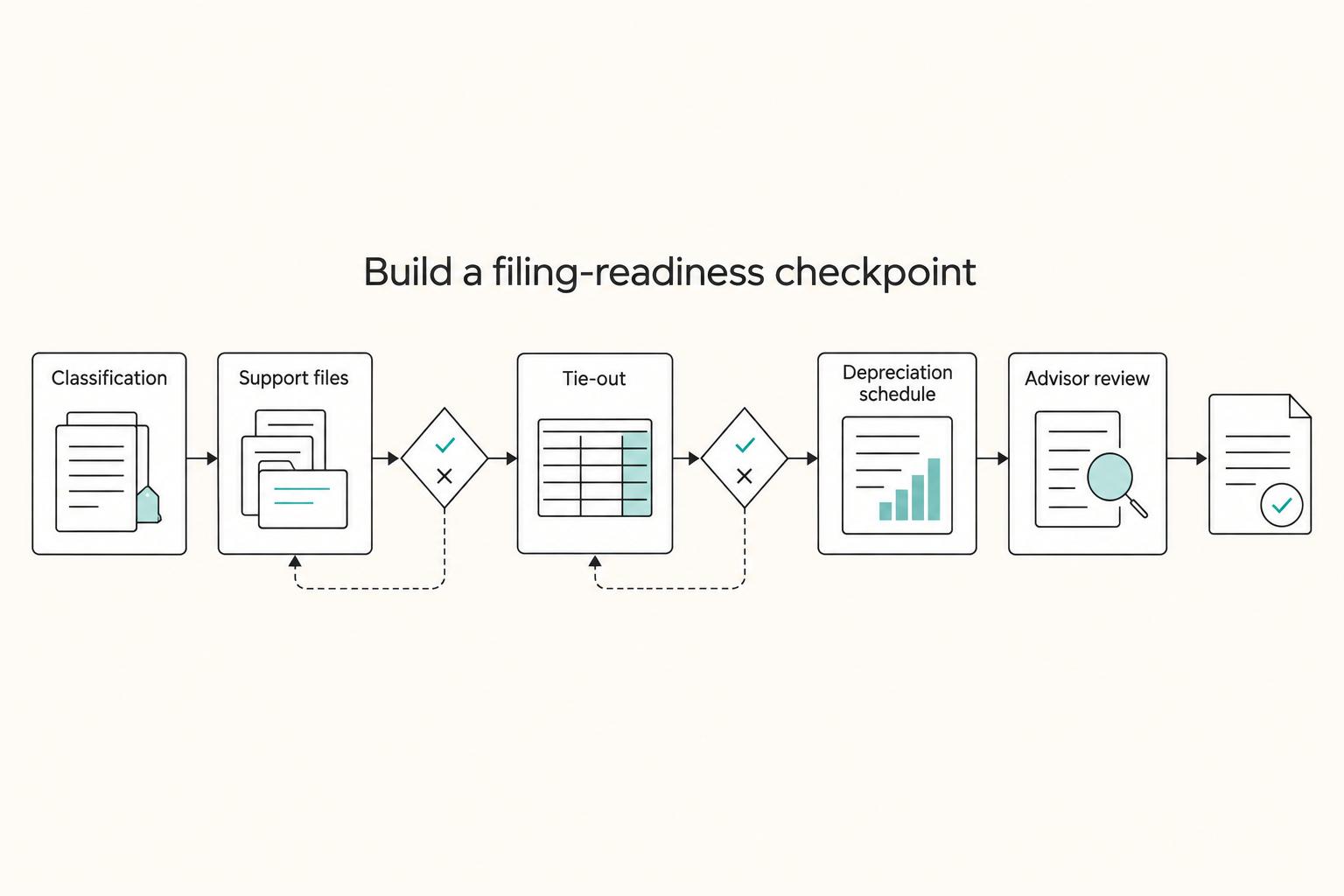
Build a filing-readiness checkpoint#
Before close or filing, run this short checklist:
| Checkpoint | Issue |
|---|---|
| Classification status | Unresolved classification items |
| Support files | Missing invoice or missing business-use support |
| Tie-out | No tie-out to the income statement or balance sheet |
| Depreciation schedule | No depreciation schedule for capitalized items |
| Advisor review | Anything needing advisor confirmation |
The common failure is having the invoice but not the reasoning. If any checkpoint fails, keep the item flagged as unresolved and escalate before filing.
Red flags that mean you should escalate to a tax professional#
If a classification decision is high-impact, inconsistent, weakly supported, or hard to explain quickly, you should escalate it before filing.
| Red flag | Why it needs escalation | What to hand your advisor |
|---|---|---|
| Similar purchases are treated differently across years | Inconsistent treatment without a documented reason can look outcome-driven and be hard to defend | Prior-year entries, current invoice, policy note, short explanation of what changed |
| One item materially changes net income or cash flow from operations | A weak classification can distort financial presentation and increase review risk | Impact estimate, useful-life note, draft journal entry |
| You plan to use Section 179 or de minimis safe harbor but cannot support it | The tax result may depend on eligibility and election handling you have not substantiated | Asset list, draft tax position, election-assumption memo, purchase records |
| Cross-border facts, local-rule conflicts, or mixed personal and business use | Book treatment may look straightforward while tax treatment is still uncertain | Business-use allocation support, timeline/location details, ownership records, any local advice already received |
Two situations deserve extra caution. If the spend may be an improvement to tangible property, 26 CFR § 1.263(a)-3 is a signal that this may not be a simple capitalize-or-expense call, and coordination with other Code provisions may matter.
Mixed-use assets also need care. IRS Publication 946 explicitly includes partial business or investment use, so your allocation support should be documented at the time of treatment, not reconstructed later.
Conclusion#
The durable rule is simple: classify the cost based on what it actually does for the business, not on which answer gives you the prettiest year one result. If it is an ordinary and necessary current expense under IRC §162, deduct it. If it is the cost of acquiring, producing, or improving tangible property under IRC §263(a), capitalize it. That is the real boundary here, and it is much easier to defend than a preferred tax outcome.
Once you pick the treatment, stay consistent. The IRS position is clear that each taxpayer must use a consistent accounting method, so the same kind of purchase should not bounce between expense and capital treatment just because cash is tight or profit is high this year. A practical internal control is to document your capitalization approach in a short written policy. It does not need to be fancy. It should explain how you classify common purchases and what records you keep with each decision.
Use the checklist every time a non-trivial purchase comes in. A good checkpoint is this: can you pull the invoice, proof of payment, business purpose note, and the exact tie-out to the income statement or balance sheet entry without hunting through old email? If the answer is no, your position is weaker than you think, even if the classification itself may be right. Records are not a nice extra here. They are what support the items you report on the return.
The failure mode to avoid is ad hoc switching. If you start treating similar costs differently from year to year, you may not have a simple booking cleanup problem. You may have an accounting method issue. If a real change in treatment is needed, that is the point to pause and ask whether Form 3115 is part of the fix instead of just changing the line item and hoping no one notices.
So the final recommendation is conservative and boring in the best way: classify by rule, document the facts, and escalate before filing when the uncertainty is material. If the amount is large, the asset has mixed use, state or cross-border treatment may differ, or you are unsure how an election was handled, escalate to a qualified tax advisor before the return goes out. A paid preparer can help, but the return is still your responsibility, and post-filing corrections are usually harder than getting the decision right up front.
Frequently Asked Questions
What is the difference between capitalization and expensing in one sentence?
Capitalization means you treat the cost as part of the basis of property and recover it over time, usually through depreciation, while expensing means you deduct the cost in the current period. The key difference is timing.
How does capitalization vs expensing affect profit in year one versus later years?
Expensing usually reduces year one profit more because the full cost hits the income statement immediately. Capitalizing usually keeps year one profit higher, then reduces later periods as depreciation is recorded. For a long-use asset, that timing difference is the main reason your profit trend can look smoother.
Why can capitalizing a cost increase reported cash flow from operations?
On the statement of cash flows, cash paid to buy long-term assets is generally shown as an investing cash outflow, not an operating one. Under the indirect method, depreciation is added back to net income because it is non-cash, so reported cash flow from operations can look higher than if you had taken the full hit as an expense. The cash did not improve, only the presentation changed.
Does capitalization always improve business performance, or just reported timing?
Usually it changes reported timing, not the underlying economics of the business. Your bank balance is the same when the cash goes out. If a treatment choice makes performance look much better on paper, that is a cue to check whether you improved the business or only changed classification.
What minimum records should a solo consultant keep to justify capitalization decisions?
At minimum, keep supporting documents such as invoices, receipts, paid bills, and canceled checks or other proof of payment.
How do Section 179 and de minimis safe harbor fit into this decision?
Section 179 is a tax election that may let you recover all or part of the cost of qualifying property immediately, but it is subject to limits. For tax years beginning in 2026, the maximum Section 179 deduction is $2,560,000. It starts phasing down when the cost of section 179 property placed in service exceeds $4,090,000, and it is also limited by taxable income from active trades or businesses. The de minimis safe harbor can allow expensing up to $2,500 per invoice or item for taxpayers without applicable financial statements, but it is not automatic, so do not use it unless you also handle the required statement with a timely original federal return.
What details are impossible to finalize without jurisdiction-specific tax advice?
Federal rules do not settle every return. State conformity can differ, and California expressly notes differences between California and federal tax law, so a federal answer may not carry over to your state filing. Details that depend on state-specific rules or filing mechanics should be finalized with jurisdiction-specific tax advice.
Try a related tool
Researched and edited by the Gruv editorial team. Gruv builds cross-border billing, payouts, and finance-operations software for global businesses.
Sources
- apps.irs.gov/app/vita/content/09s/09_06_013.jsptrusted
- boe.ca.gov/proptaxes/pdf/ah501.pdftrusted
- ecfr.gov/current/title-26/chapter-I/subchapter-A/part...trusted
- ecfr.gov/current/title-42/chapter-IV/subchapter-B/par...trusted
- energy.gov/documents/chapter-101-accounting-property-pl...trusted
- federalreserve.gov/aboutthefed/chapter-3-property-and-equipment...trusted
- fmx.cpa.texas.gov/fmx/pubs/spaproc/ch1/index.phptrusted
- ftb.ca.gov/tax-pros/law/conformity.htmltrusted
Educational content only. Not legal, tax, or financial advice.
Related Posts

Digital Nomad Taxes in 2026 With a Defensible Filing Plan
With digital nomad taxes, the first move is not optimization. It is figuring out where you may be taxable, where filings may be required, and what proof supports that position.

Do I Have to Pay State Taxes While Living Abroad as a Digital Nomad?
Living abroad does not end `state income tax` exposure by itself. The first decision is practical: choose a filing position your facts can support, then build records that support the same story all year.
How to Calculate Depreciation on a Foreign Rental Property
Control of a foreign real estate investment starts at acquisition, not when you file a tax return. Your choices on basis, land versus building allocation, and placed-in-service support shape annual reporting and sale math. Handle the full lifecycle from purchase to operation to sale, and tax management becomes part of running the asset well instead of a filing-season scramble.