
Quick Answer
Subpart F can require a U.S. shareholder of a controlled foreign corporation to include a pro rata share of certain CFC income on a U.S. return before any cash is distributed. It applies only after you confirm both ownership gates and then classify the income, often focusing on passive income, related-party sales income, and related-party services performed outside the CFC's country.
The Subpart F Gauntlet: Is Your Global Business on the IRS Watchlist?#
If you are a U.S. shareholder of a foreign corporation that meets the CFC rules, Subpart F is an anti-deferral rule that can pull income into your U.S. return before you receive cash.
Start with the two core gates. A U.S. shareholder is generally a U.S. person that owns 10% or more of the foreign corporation by vote or value. A controlled foreign corporation (CFC) is generally a foreign corporation where U.S. shareholders own more than 50% of vote or value. When those gates are met, section 951 can require a deemed inclusion of your pro rata share in current U.S. gross income, whether or not the CFC distributes cash.
In practice, this changes timing. Traditional foreign-corporation planning often relied on deferral until distribution. Subpart F overrides that for listed categories of CFC income under IRC section 952, including foreign base company income, by requiring current inclusion under section 951.
| Issue | Deferral scenario | Subpart F scenario |
|---|---|---|
| U.S. tax timing | Often waits until an actual distribution | Current inclusion under section 951 in the shareholder tax year that includes the relevant last day of the CFC year |
| Cash required to trigger U.S. tax | Usually yes | No, a cash distribution is not required |
| What you need to verify | Distribution history and earnings | U.S. shareholder status, CFC status, and whether the income falls into a covered category |
Read this in order. Checkpoint 1 is ownership, then checkpoint 2 is income classification. Verify vote and value ownership, including who owned what on the last relevant day of the CFC tax year, then classify the income. If ownership is not met, Subpart F generally does not apply. If it is met, income type is the next decision point.
If you want a deeper dive, read A Guide to the Global Intangible Low-Taxed Income (GILTI) Regime.
Checkpoint 1: The Ownership Test - Are You Driving a 'Controlled Foreign Corporation' (CFC)?#
You can only answer this checkpoint from verified ownership facts, not assumptions. Confirm whether the company meets the current CFC ownership definition and whether you meet the current U.S. shareholder definition before you analyze any income.
If entities, trusts, nominees, or attribution questions are in the picture, do not force a yes/no ownership conclusion from a summary alone. Use this sequence to keep the ownership test grounded in facts:
- Identify every owner in the chain, including direct holders, nominees, entities, and trusts.
- Verify each holder's legal and economic rights from underlying documents before deciding who may count under current law.
- Resolve open ownership-classification questions with qualified cross-border tax advice before moving on.
If ownership facts are unclear, especially with entities, trusts, nominees, or attribution questions, treat checkpoint 1 as unresolved rather than forcing a conclusion. Once ownership is confirmed under current law, move to checkpoint 2, income classification.
You might also find this useful: How to Report Foreign Rental Income on a U.S. Tax Return.
Checkpoint 2: The Income Test - Identifying High-Risk Revenue#
Once checkpoint 1 confirms a CFC, classification becomes the real work. Review income stream by stream before filing. For each item, run three tests: what happened, who the counterparty was, and where the property was used or where the services were performed.
| Income bucket | Core test | Examples or cues |
|---|---|---|
| FPHCI | Passive-type items; if income is tied to holding assets rather than delivering your core service, test it under FPHCI first | Dividends, interest, rents, royalties, annuities |
| Foreign base company sales income | Whether property is bought from or sold to a related person and then sold for use, consumption, or disposition outside the CFC's country | Related-party personal-property chains, including profits, commissions, and fees |
| Foreign base company services income | Services are performed for, or on behalf of, a related person and performed outside the country where the CFC is created or organized | Paid, reimbursed, or otherwise financially benefits from a related person; substantial assistance |
This is usually where exposure shows up. Sort income into three buckets: foreign personal holding company income (FPHCI), foreign base company sales income, and foreign base company services income. Then map items to Form 5471 Schedule I, including line 1a, line 14, and line 15, based on that classification.
Start with a stream-by-stream sort#
Do not test the business as one lump. Break out interest, royalties, rents, resale margins, commissions, service fees, reimbursements, and related-party charges.
A small service firm can have low-risk third-party fees and higher-risk related-party income in the same period. If your ledger does not clearly show payer, relationship, and location facts, fix the records before return prep.
Begin with FPHCI for passive-type income#
Start here for passive-type items, including dividends, interest, rents, royalties, and annuities. If income is tied to holding assets rather than delivering your core service, test it under FPHCI first.
Examples include interest on retained cash, royalties from licensed content or software, or rental income. Confirm what asset generated the payment and why it was paid.
Foreign base company sales income in related-party property chains#
This category turns on related-party personal-property chains, including profits, commissions, and fees. The core trigger to test is whether property is bought from or sold to a related person and then sold for use, consumption, or disposition outside the CFC's country.
For small firms, this can show up in reseller or commission structures between related entities across borders. Do not assume every related-party product flow qualifies, but flag these transactions early and classify them carefully.
Foreign base company services income for related-party delivery outside the CFC country#
For consultants and other service firms, this can be a primary risk test. The core trigger is that services are performed for, or on behalf of, a related person and performed outside the country where the CFC is created or organized.
A common failure mode is the billing chain. If your CFC is paid, reimbursed, or otherwise financially benefits from a related person, test it carefully. Also flag situations where a related person provides substantial assistance in performing the services.
| Income pattern | Why it may be Subpart F income | Typical risk level | Records to review |
|---|---|---|---|
| Interest, dividends, rents, royalties, annuities | Passive-type items can fall into FPHCI | High | Records showing payer, payment type, and income-producing asset |
| CFC buys or sells personal property through a related-party chain, including commissions or fees | Can fall into foreign base company sales income when property is sold for use outside the CFC country | High | Records showing related-person status, transaction chain, and where property was sold for use |
| CFC provides services for or on behalf of a related person outside the CFC country | Can fall into foreign base company services income | High | Records showing who paid, reimbursed, or benefited and where services were performed |
| CFC bills an unrelated client directly and services are performed inside the CFC country | Related-person and outside-country triggers may not be met | Lower | Records showing the counterparty is unrelated and the service location |
| CFC holds the contract, but a related entity materially supports delivery | Related-party substantial assistance can pull services income into scope | Medium to high | Records showing who actually performed the work and what related-party support was provided |
Section 954 threshold mechanics can change the entity-level result after classification. That includes the de minimis test, less than 5% of gross income or $1,000,000, and the 70% gross-income trigger. Use those only after you classify the streams.
Before you complete Form 5471 Schedule I, do four things so your classification is documented and easier to defend:
- Split your P&L into passive items, related-party sales-chain items, and service items.
- Mark each payer or counterparty as related or unrelated.
- Note where property was sold for use and where services were performed.
- Gather support records before you file.
If related-party status is unclear, facts are mixed between goods and services, or characterization is uncertain, consider escalating to a cross-border tax advisor before filing.
Related: How to Make the 'Section 962 Election' for Individual CFC Shareholders.
Reduce the facts that create exposure and keep supporting records#
The goal is simple: reduce the facts that create exposure and keep records that support your treatment if it is reviewed. Use this as a practical this-quarter execution plan.
Build substance around the income that matters#
Substance only helps when it matches how the business actually operates. Start with the income streams you already flagged as higher risk, then document the business reality around them. Show who the customer was, who did the work, where value was delivered, and why your entity earned the income.
This matters when your entity is operating as a real business with clear delivery activity. It does not help if the entity mainly functions as a holding or routing vehicle with limited operating evidence.
Verify the high-tax exception from operative text, not summaries#
If you may rely on a high-tax exception, treat it as a technical position that must be verified from operative materials. Confirm the currently operative test from authoritative text, then tie your analysis to the specific income stream being tested.
| Source | How to use it | Caution |
|---|---|---|
| IRS bulletin synopses | Reader aids | Not authoritative interpretations |
| eCFR text | Treat as authoritative but unofficial | May be modified by Federal Register updates |
| Historical versions view | Use as a version-control checkpoint | Save the version you relied on |
Keep one source-quality rule in mind. IRS bulletin synopses are reader aids, not authoritative interpretations. eCFR text is labeled authoritative but unofficial and may be modified by Federal Register updates. Use the historical versions view as a version-control checkpoint, and save the version you relied on.
This matters when you are evaluating whether a high-tax position may apply to a specific income stream. It is not a shortcut when the threshold, text version, or income-to-tax linkage is unclear.
Put hard edges around related-party flows#
If you have related-party transactions, tighten the documentation before year-end. Use written agreements, consistent pricing logic, separate invoicing, and clean ledger tags for related and unrelated counterparties.
This is most important when any related party is in the billing, reimbursement, service, or payment chain. It is less central when revenue comes directly from unrelated customers and the delivery facts are already clean.
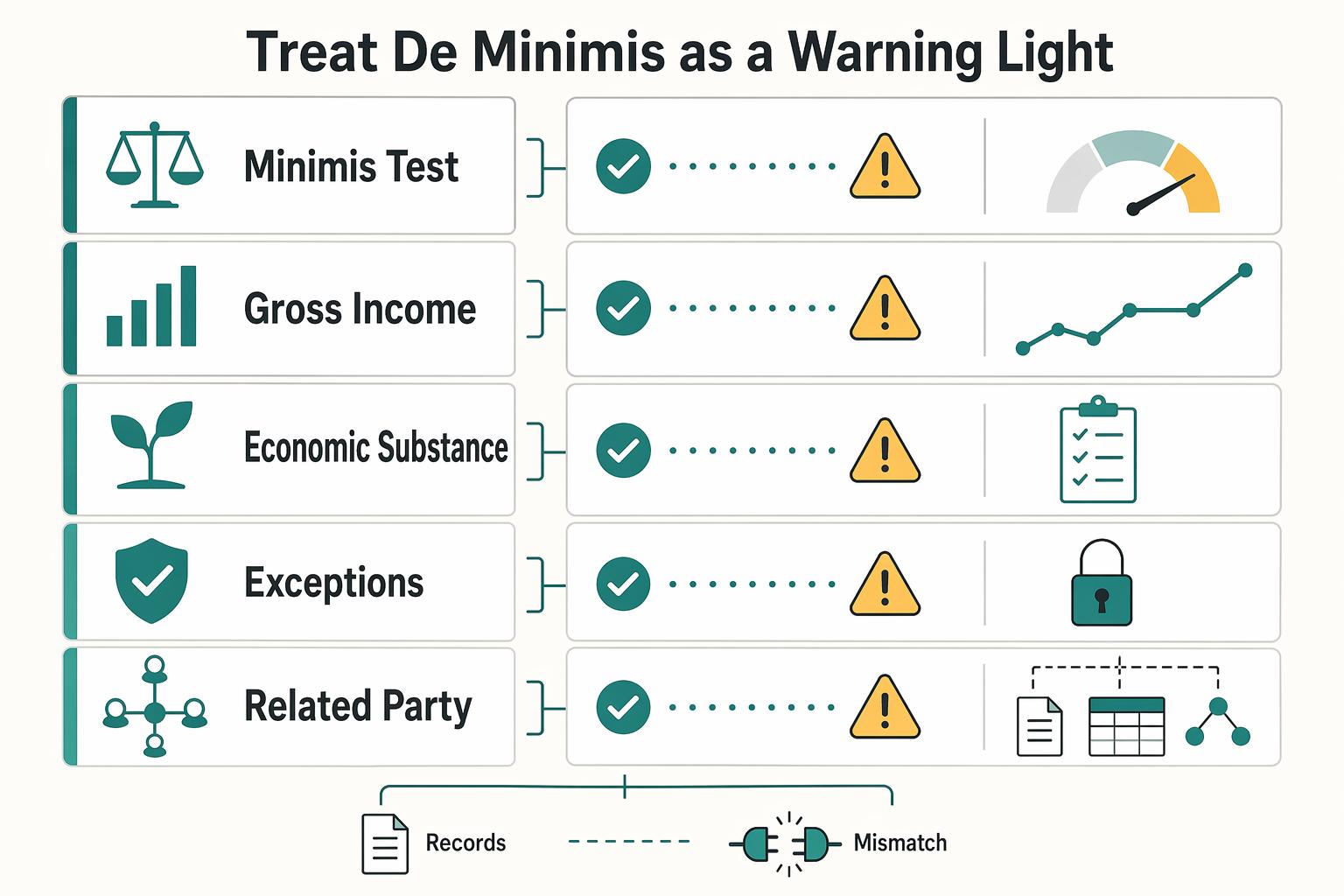
Treat de minimis as a warning light, not a plan#
Use de minimis as a monitoring checkpoint, not as a design strategy. Track potentially exposed income against gross income during the year using the currently operative de minimis test from authoritative text.
| Mechanic | Threshold mentioned | Timing note |
|---|---|---|
| De minimis test | Less than 5% of gross income | Use only after you classify the streams |
| De minimis test | $1,000,000 | Use only after you classify the streams |
| Gross-income trigger | 70% | Use only after you classify the streams |
This helps when exposure appears small and you are actively measuring it. It does not help when records are incomplete or a single transaction could materially change the result.
| Strategy | Best fit scenario | Primary compliance burden | Failure mode if misapplied | Records to keep |
|---|---|---|---|---|
| Economic substance | Entity operates as a real business with clear delivery activity | Proving who earned income and how value was created | Entity appears to be a shell or payment hub | Customer agreements, invoices, delivery records, personnel or work allocation records |
| High-tax exception | You may rely on foreign tax treatment for a specific stream | Verifying current operative threshold and text, then mapping tax to income | Reliance on summaries, stale versions, or mismatched income and tax analysis | Tax filings and payment support, technical memo, dated source snapshots or version notes |
| Related-party discipline | Related entities are part of the transaction chain | Maintaining formal agreements, pricing support, and clean transaction tagging | Informal intercompany behavior and unclear transaction characterization | Intercompany agreements, pricing support, ledger mapping, approval trail |
| De minimis awareness | Potential exposure is small and tracked throughout the year | Ongoing measurement and classification controls | Late-year threshold surprise due to weak tracking | Monthly rollforward, gross income summary, classification workpapers |
Bring in a cross-border tax professional before year-end planning or filing if any of these fit your facts:
- You may rely on a high-tax exception but have not verified the current threshold and operative text.
- Related-party transactions are a meaningful part of revenue or margin.
- Different income streams are mixed and hard to classify consistently.
- Your records do not clearly show payer, relationship, and where work was performed.
- One transaction could materially change the entity-level result.
For a step-by-step walkthrough, see A Deep Dive into South Africa's Section 10(1)(o)(ii) Exemption for Foreign Employment Income.
Before you lock your structure, map how funds move between clients, entities, and your own payouts using Gruv Payouts so your tax review is based on a traceable operating flow.
Confirm the facts, classify the income, choose your response#
The process is manageable if you work it in order. Confirm your current facts, classify each material income stream into the most likely treatment category, and choose the response your facts can support. That keeps you ahead of the issue during the year instead of reactive at filing time. The three-part recap is simple:
- Confirm whether your current records still support your planned position, not last year's assumptions.
- Classify income by contract, counterparty, and where the activity or payment sits economically, so unlike items are not grouped under one label.
- Choose the response that matches the record you can actually defend.
For your next compliance cycle, keep one working file and update it as transactions happen so you are not rebuilding the record at filing time:
- Documentation: current org chart, ownership records by date, key contracts, invoices, bank support, and a short memo on material changes.
- Transaction review: new income streams, unusual one-off payments, year-end restructures, and deals where legal form and business reality do not align cleanly.
- Advisor prep notes: one page with open questions, your proposed treatment, the authority reviewed, and the facts that could change the answer.
Keep your authority checks disciplined. Start update checks with the Internal Revenue Bulletin, which the IRS publishes weekly and uses to announce official rulings and procedures. Record the issue date you relied on.
Do not rely on IRB synopses alone, because those highlights are reader aids and not authoritative interpretations. If you review regulations in the eCFR, note the version date and treat it as authoritative but unofficial, then confirm the primary text when judgment calls are close. Also plan for the possibility that published IRS rulings apply retroactively unless stated otherwise, so review updates before return prep starts.
Escalate early when your records are incomplete, your facts changed during the year, your sources conflict, or your conclusion depends on assumptions you cannot document. If you verify the facts, document the authority, and surface open points before filing season, this becomes a managed compliance process instead of a scramble.
We covered this in detail in How to handle 'royalty income' on your US tax return.
If you want a simpler cross-border setup as a business-of-one, review Merchant of Record for freelancers and confirm coverage for your market and program before rollout.
Frequently Asked Questions
What is subpart f income in simple terms?
It is a current U.S. inclusion rule for certain CFC income even when no cash is distributed. Common categories discussed here include passive-type items such as dividends, interest, rents, royalties, and annuities, along with other foreign base company income. If a contract mixes several income types, the classification should be reviewed carefully before filing.
When does Subpart F apply to your business?
It applies only if both ownership gates are met: the foreign company is a CFC and you are a U.S. shareholder. In practice, that means testing whether U.S. shareholders own more than 50% and whether your ownership is 10% or more. If ownership details or transfers are unclear, resolve that before filing.
What is an example of Subpart F income for a consultant?
A common consultant fact pattern is a foreign corporation providing services for or on behalf of a related person outside the CFC's country of organization. That can fall into foreign base company services income if the related-person and location tests are met. The key records are agreements, invoices, and work logs showing the real customer relationship and where services were performed.
How can you reduce the risk?
Reduce risk by tightening the facts first and then testing exceptions from current statute and regulation text. Keep related-party flows formal, separate income streams clearly, and monitor potential exposure against the de minimis tests of less than 5% of gross income or $1,000,000, and the 70% trigger. Before year-end, check whether one late transaction could change the result.
Is it taxed as capital gains?
No. A Subpart F inclusion is not the same mechanism as a stock-sale capital gain. It is a current inclusion in gross income of your pro rata share for the shareholder year that includes the last relevant CFC ownership day.
Does it apply to a foreign branch?
No for CFC purposes. Subpart F applies to controlled foreign corporations, not foreign branch structures. Form scope often differs by structure, with Form 8858 often used for certain foreign branch situations and Form 5471 for certain foreign corporation filers.
Try a related tool
Researched and edited by the Gruv editorial team. Gruv builds cross-border billing, payouts, and finance-operations software for global businesses.
Sources
- acquisition.gov/far/subpart-52.2trusted
- ecfr.gov/current/title-26/chapter-I/subchapter-A/part...trusted
- ecfr.gov/current/title-12/chapter-II/subchapter-A/par...trusted
- irs.gov/pub/fatca/int_practice_units/FEN9433_01_03R.pdftrusted
- irs.gov/pub/fatca/int_practice_units/FEN9433_01_09R.pdftrusted
- revisor.mn.gov/bills/94/2025/0/HF/2435/versions/2trusted
- ssa.gov/OP_Home/cfr20/404/404-app-p02.htmtrusted
- uscode.house.gov/view.xhtmltrusted
Educational content only. Not legal, tax, or financial advice.
Related Posts

Digital Nomad Taxes in 2026 With a Defensible Filing Plan
With digital nomad taxes, the first move is not optimization. It is figuring out where you may be taxable, where filings may be required, and what proof supports that position.
What Is a Controlled Foreign Corporation (CFC) for a U.S. Shareholder?
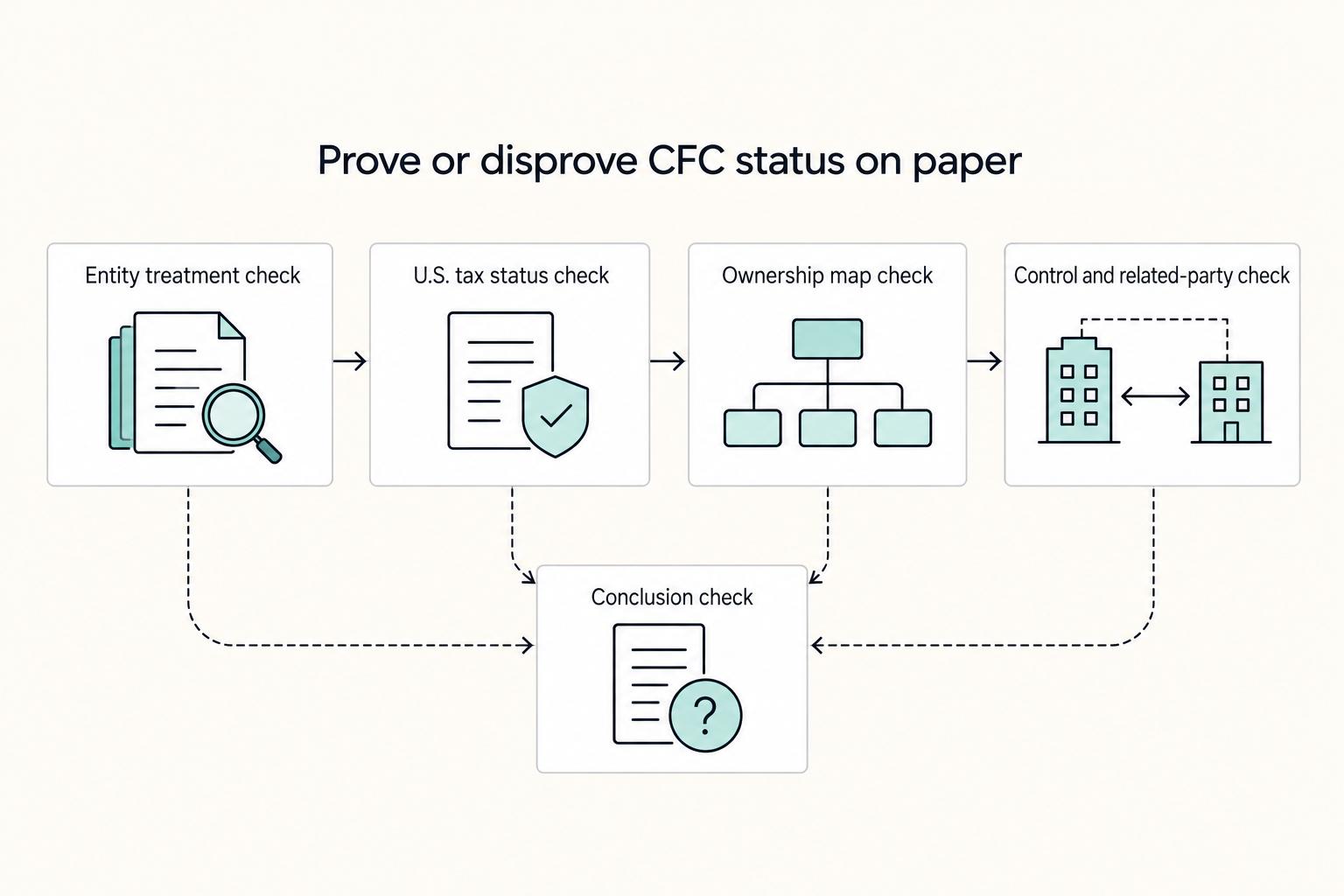
**If your foreign company might raise a CFC question for U.S. tax purposes, do not guess.** Get to a documented yes or no with a qualified advisor. In practice, that means confirming three things in order: how the entity is being treated for the U.S. tax review, how ownership and control are being analyzed, and what compliance or filing steps, if any, apply this year. Keep those frameworks separate, too. NYSE "[controlled company](https://www.sec.gov/Archives/edgar/data/1977102/000119312523254724/d507917d424b4.htm)" language in SEC materials is not the same as U.S. tax CFC analysis, and mixing them creates false confidence fast.

The Freelance Payment Penalty: A Modeled Audit of Platform Fees, FX Spreads, and Payout Delays
The money rarely disappears through a single, easy-to-spot fee. The real loss is stacked. A marketplace takes its commission, a processor adds a charge for international cards, a bank or payment company converts the currency at a spread, a platform holds the funds before release, and a wire sheds a little to intermediaries on the way in. Each layer looks defensible on its own, but the worker feels the combined result as a smaller deposit and a later payday.