
Quick Answer
Use spain autonomo tarifa plana as a launch-control phase, not a spending cushion. During the reduced period, set prices against the later social-security range (€230 to €530/month), not only the roughly €80 entry fee. File Tax Office registration (Modelo 036/037) and RETA with matching identity and activity data, then issue invoices only after those records align. Lock your VAT route before billing EU work, and verify unresolved items like eligibility and Cuota Cero mechanics with current guidance.
Deep Dive: How Spain Autonomo Tarifa Plana Works for New Freelancers#
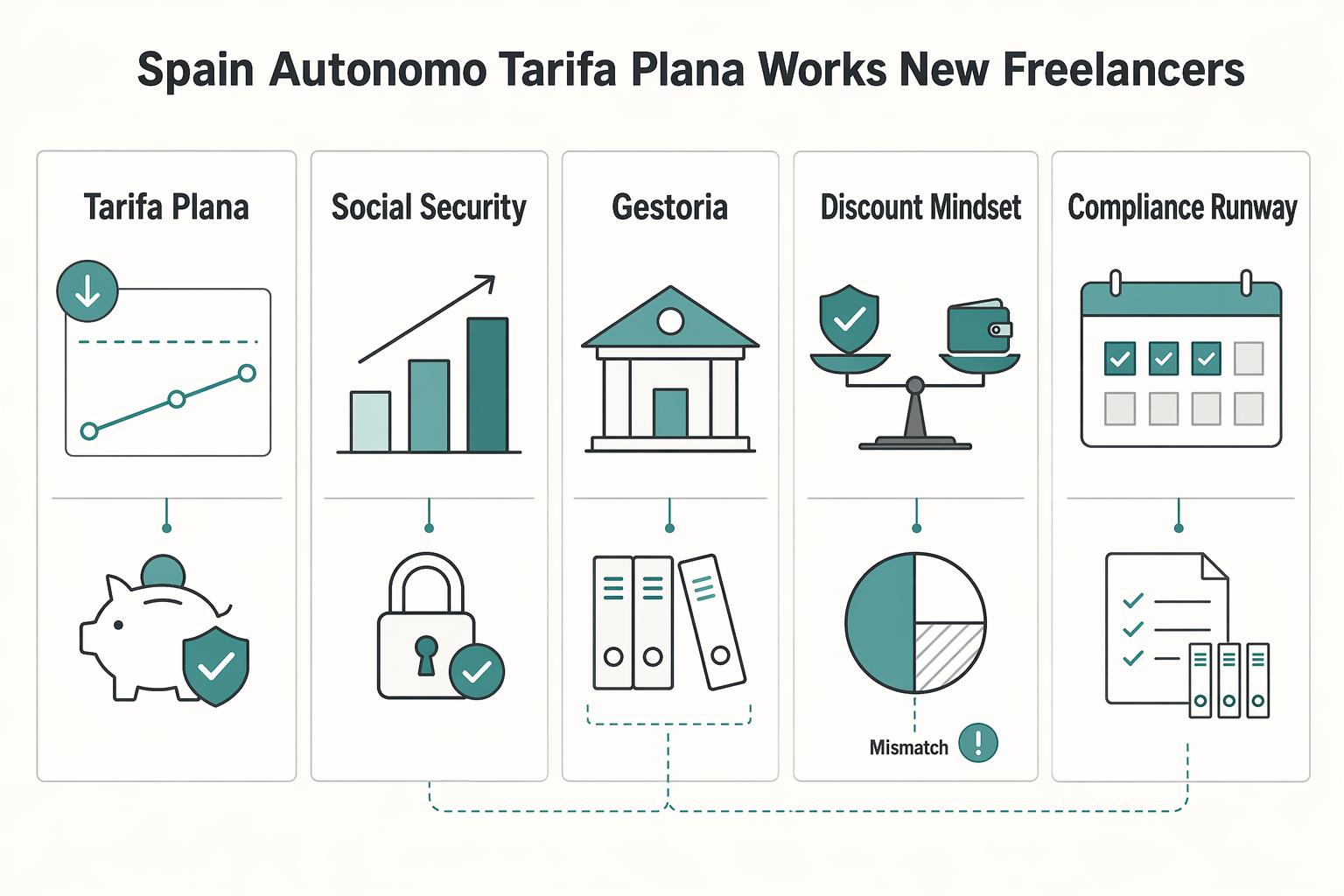
Use the tarifa plana to buy compliance control, not lifestyle drift. The discounted phase, often around €80/month, gives you room to set up the unglamorous parts properly. That matters because your social security cost later moves into a more normal €230 to €530/month range.
| Cost item | Amount | Context |
|---|---|---|
| Tarifa Plana phase | around €80/month | Discounted phase |
| Social security after discount | €230 to €530/month | More normal range later |
| Gestoria | €50 to €150/month | Common monthly admin support |
The decision rule is simple: ring-fence your startup admin budget first, then decide what is left for personal spending. In practice, that usually means protecting money for a gestoria, which commonly runs €50 to €150/month, and giving yourself time to clean up your invoicing and filing calendar. A common first-year mistake is pricing your services as if the discounted contribution is your real long-term cost. It is not.
Use a single source of truth across Seguridad Social, Hacienda, and your invoice setup. Keep the same registration date, tax IDs, legal name, and activity description everywhere. The checkpoint is boring but effective: before you send your first invoice, compare those details side by side against your registration confirmations and invoice draft. Early friction often starts with mismatched dates or inconsistent activity wording.
| Mindset | Immediate behavior | Likely friction | Mitigation |
|---|---|---|---|
| Discount mindset | Spend the gap as extra living cash | Underpriced work, cashflow stress when monthly and quarterly obligations hit | Budget using post-discount costs, not the temporary fee |
| Compliance-runway mindset | Fund admin setup early | Upfront admin spend feels annoying | Use the runway to lock in calendar, records, and advisor support |
| Cadence mindset | Plan for monthly and quarterly obligations even with uneven revenue | Cashflow pressure during low-revenue periods | Set aside funds monthly and review deadlines quarterly with your gestoria |
Before you invoice, have a small readiness pack ready: registration confirmations, tax ID details, a draft invoice with consistent identity data, your monthly and quarterly compliance calendar, and one folder for records and approvals. With that in place, the next decision is not speed but sequence. If you want a deeper dive, read Digital Nomad Taxes in 2026 With a Defensible Filing Plan.
What to Set Up Before You Issue Invoice One#
Treat this launch as a consistency job, not a speed test. Every registration and your first invoice should match the same source record.
| Step | Key check | Failure mode |
|---|---|---|
| Validate eligibility before filing | Resolve open eligibility points before submission | Filing on assumptions |
| Create one source-of-truth record | Use the same IDs, activity description, start date, and receipts across systems and invoice setup | Mismatched dates or activity wording |
| Set filing calendar and evidence folder | Keep confirmations, receipts, invoice draft, client billing details, VAT notes, and running sales/expense records in one place | Invoicing first and rebuilding evidence later |
| Choose VAT route before billing | Separate domestic Spain, intra-EU B2B, intra-EU B2C, and cross-border SME path decisions up front | Treating OSS as mandatory or as a replacement for domestic VAT filing |
| Budget for the operating process | Cover admin time, documentation discipline, advisor support, and timing gaps | Using the discount window as spare cash |
- Resolve open eligibility points before you file.
Confirm the current eligibility and waiting-period conditions before submission. If you file on assumptions, you can find out later that your chosen path does not match the current rule set.
- Create one source-of-truth record and use it for Hacienda and RETA.
Use one shared record so your IDs, activity description, start date, and submission receipts stay aligned across both systems and your invoice setup. The failure mode is simple: mismatched dates or activity wording across portals, then friction when you issue your first invoice or need to confirm your start of activity.
- Set your filing calendar and evidence folder before invoice one.
Build the operating rhythm before you bill. Keep confirmations, receipts, your invoice draft, client billing details, VAT notes, and running sales and expense records in one place. Otherwise you end up invoicing first and rebuilding evidence later from scattered emails, PDFs, and bank lines. Add the current filing windows to this folder as soon as you verify them.
- Choose your VAT route before billing, lane by lane.
Separate domestic Spain treatment, intra-EU B2B, intra-EU B2C, and cross-border SME path decisions up front, then document the route for each sale. For certain cross-border B2C e-commerce contexts, the EU-wide threshold referenced is EUR 10 000. If OSS is relevant, remember that it is optional, it uses one Member State of identification, OSS returns are additional to domestic VAT returns, and supplies under the chosen OSS scheme must be declared via that scheme. Union and non-Union OSS returns are quarterly; import-scheme returns are monthly. Confirm current eligibility criteria before filing any cross-border setup. The usual failure modes are treating OSS as mandatory, treating it as a replacement for domestic VAT filing, or applying one route to every transaction type. Escalate early to a Spain-qualified advisor when facts are mixed, classification is unclear, or a complex cross-border case may need a VAT Cross-border Ruling.
- Budget for the operating process, not just the reduced monthly fee.
Plan launch cash around admin time, documentation discipline, advisor support where needed, and the timing gaps between work delivered, invoicing, payment, and filings. The failure mode is using the discount window as spare cash, then getting squeezed when compliance tasks and payment delays collide.
| Launch style | Admin effort | Error risk | Cash-flow predictability |
|---|---|---|---|
| No-system launch | High: data is split across portals, drafts, and inboxes | Higher: IDs, dates, and VAT routing drift | Low: obligations become visible late |
| Managed launch | Lower: one record feeds registrations and invoices | Lower: checks happen before billing | Higher: duties and evidence are mapped early |
If your IDs align, receipts are archived, and VAT routing is documented before invoice one, you are ready for the next structure decision: stay autónomo or move to S.L./S.L.U. For another country comparison, see Tax Guide for Digital Nomads in Thailand.
Autónomo vs. Sociedad Limitada: When a Company Structure Solves a Real Problem#
Stay autónomo until a company structure solves a real operating problem you already have. An S.L. or S.L.U. can improve liability separation and contracting posture, but it also adds stricter cash rules and more administrative load.
This is an operating-model decision, not just a tax-rate comparison. You are deciding whether your business activity stays legally tied to you, or moves into a separate legal entity with different day-to-day discipline.
What changes in practice#
As an autónomo, you operate personally under the Estatuto del trabajo autónomo (Ley 20/2007). With an S.L. (or one-owner S.L.U.), the company is legally separate from you, which is the core structural change.
The biggest practical shift is cash handling. After incorporation, company money is no longer personal spending money, so using the company account for personal expenses creates compliance and bookkeeping risk.
Also, incorporation does not always remove self-employed obligations. In the cited S.L.U. path, you may still be an autónomo societario, with quarterly filing duties and social-security obligations still in play. Verify that against your facts before you switch.
| Decision dimension | Stay autónomo when | Review S.L. or S.L.U. when |
|---|---|---|
| Liability exposure | Your personal exposure is still manageable | Contract value or claims risk makes liability separation more important |
| Tax/admin complexity | You want lower ongoing admin complexity | You are prepared for formal company accounting and compliance |
| Cash-handling discipline | You need simpler personal-business cash flow | You can keep strict separation between company and personal money |
| Client procurement fit | Clients can contract with you as an individual | Procurement or counterparties prefer a company entity |
| Reinvestment flexibility | You mostly withdraw earnings personally | You want to retain profit inside the company |
You will see €40,000 to €60,000 quoted as a switch point. Treat that only as a review prompt, not a legal threshold. Use verified current inputs for personal tax treatment, company tax treatment, and your switch criteria.
Switch-review signals and guardrails#
Run a formal switch review when several of these are true at once:
| Review signal | Grounded detail |
|---|---|
| Revenue stability | Revenue is stable enough for annual comparison, not one strong quarter |
| Liability exposure | Contracts or delivery model create meaningful liability exposure |
| Retaining profit | You want to retain profit in the business instead of drawing most cash personally |
| Client onboarding | Client onboarding is materially easier with a company counterparty |
Before you decide, prepare a short evidence pack for a Spain-qualified advisor.
Advisor prep pack#
- Last 12 months of revenue and expense summaries
- Core contract types plus liability and insurance concerns
- Monthly personal cash needs and procurement feedback from clients
- Any cross-border facts that can change tax or social-security treatment
Plan the setup with neutral assumptions, not marketing claims. Confirm the current setup timeline and setup-cost range before you file. Formation can still involve in-person steps, for example notary and bank account setup. If your case includes cross-border income, procurement friction, higher liability exposure, or unclear autónomo societario status, get Spain-qualified advice before you file anything. You might also find this useful: A Guide to Local SEO for Freelancers.
Bottom Line: Run Year One as a Control System#
Run year one as a control system, not a memory test. Keep one current, audit-ready operating file so your NIE, tax office records, social security records, and current structure (autónomo or S.L.) stay consistent.
Monthly control routine#
- Reconcile issued invoices, expenses, and payment movements in one running log
- Archive notices and submission receipts in the same folder
- You and your advisor can spot classification or VAT issues before quarter-end
At minimum, keep identity and registration records, issued invoices, expense invoices, and official notices in one place. If cross-border social security is in scope, keep coverage evidence in the same control layer. Where a Totalization Agreement applies, the core proof is a Certificate of Coverage; without it, dual social security taxation on the same earnings is a real risk.
| Cadence | What you review | What you archive | Decision you make | Risk it prevents |
|---|---|---|---|---|
| Monthly | Invoices, payment movements, expenses, open notices | Final invoice set and backup by client/month | Whether any classification, record, or invoice detail needs correction now | Missing evidence and late error detection |
| Quarterly | Whether current activity still matches your registrations and operating setup | Updated registration proof and key authority/accountant correspondence | Whether to escalate VAT, cross-border income, or status-change questions | Running on stale assumptions |
| Annual | Full-year file and whether autónomo still fits versus S.L. | Year pack: IDs, registrations, invoices, expenses, notices, coverage records (if relevant) | Whether to keep or change structure for year two | Year-end scramble and carrying forward the wrong setup |
Use the reduced-contribution period as execution time: harden your invoicing workflow, make evidence storage routine, and lock review dates on your calendar. If you need a Certificate of Coverage, use the SSA online process carefully; it includes data-verification checks before transmission and offers email confirmation for approved requests, both useful for your records.
Escalate to a Spain-qualified advisor early when cross-border income appears, VAT treatment is unclear, residence/work status changes, or autónomo vs S.L. fit becomes uncertain. Your year-one target is straightforward: complete file, fixed review cadence, and early escalation before uncertainty turns into a filing problem. For a step-by-step walkthrough, see Spain Autonomo System for Freelancers Who Want Compliance Control.
Frequently Asked Questions
Am I eligible for the tarifa plana?
Check the current rule before you register. Eligibility can depend on prior status and timing. Rules on the lookback period and the amount can conflict across sources, so confirm your own eligibility conditions with current official guidance before you register.
Is Cuota Cero automatic, and is it a waiver or a reimbursement?
Verify the current process, timing, and evidence requirements for Cuota Cero before you rely on it.
Can you invoice before registration is complete?
No. Complete your Tax Office registration with Modelo 036 or 037 and your Social Security registration in RETA before you issue invoices or start operating. One cited sequence is Hacienda first, then Seguridad Social within the following month. Do not rely on fixing it later, because late registration can trigger fines.
Do Spain filings replace your non-Spain tax obligations?
Treat Spain compliance and your home-country or other cross-border filing duties as separate until a qualified advisor confirms how they interact.
What is the minimum readiness document pack before you start?
Keep a practical file ready. That should include a draft Modelo 036/037 that correctly states your activity and VAT position, and your RETA enrollment details for Social Security registration. Also keep issued and received invoices, plus supporting invoices for business expenses, because those records are part of the filing trail from day one.
What should you budget for the first year?
Budget for more than the reduced social security fee. Your checklist should include the verified current contribution range, quarterly filing support, possible Modelo 303 if your activity is VAT-subject, possible Modelo 130 if income-tax advances apply, and the reality that one source describes monthly obligations even with zero income. Filing mistakes matter too: late or incorrect quarterly filings can be fined even if you do not owe tax.
What if your income grows faster than expected?
Recheck early, before the discounted period ends. Verify the current extension condition, then review whether your revenue is now stable enough, whether client contracts carry more liability, and whether you want to retain profit rather than draw everything personally. If several of those changed at once, escalate to a Spain-qualified advisor instead of guessing from an old setup.
Any easy-to-miss compliance points?
Yes. Do not assume the basic contribution includes unemployment protection, because one cited source says the basic cotización does not include the premium for paro. If your activity is VAT-subject, decide invoice treatment before the first bill goes out, not when quarter-end arrives.
Try a related tool
Researched and edited by the Gruv editorial team. Gruv builds cross-border billing, payouts, and finance-operations software for global businesses.
Sources
Includes 1 external source outside the trusted-domain allowlist.
- ssa.gov/international/CoC_link.htmltrusted
- taxation-customs.ec.europa.eu/archives/taxable-persons/vat-cross-border-ru...trusted
- vat-one-stop-shop.ec.europa.eu/one-stop-shop_entrusted
- vat-one-stop-shop.ec.europa.eu/one-stop-shop/register-oss_entrusted
- limitconsulting.com/2024/12/formalities-and-obligations-of-auton...external
Educational content only. Not legal, tax, or financial advice.
Related Posts

Digital Nomad Taxes in 2026 With a Defensible Filing Plan
With digital nomad taxes, the first move is not optimization. It is figuring out where you may be taxable, where filings may be required, and what proof supports that position.

Thailand Tax for Digital Nomads Without Residency Mistakes
The most expensive mistakes here happen before anyone opens a tax return. People pick a visa, assume the tax answer comes with it, then try to rebuild the year from scraps after the fact. By then, the damage is usually not one dramatic error. It is a pile of small gaps: an unverified day count, a transfer with no clear purpose note, invoices that do not line up cleanly with payments, and assumptions nobody wrote down when the facts were still fresh.
A Guide to Local SEO for Freelancers
Run local SEO for freelancers like an operator: build one defensible local entity across Google Business Profile, your website, and your proof, then tighten it over time instead of spraying tactics. As the CEO of a business-of-one, you are not collecting "marketing tasks." You are building an asset you can maintain and defend. The goal is stable visibility and trust, not constant fiddling.