
Quick Answer
Start with manager verification and legal fit before anything else: the portugal golden visa fund route works only when the vehicle matches ARI conditions and your risk profile. Confirm CMVM status, review binding fund documents for fee layers and liquidity limits, and complete independent counsel review before wiring capital. For U.S.-linked investors, treat FBAR, Form 8938, and PFIC analysis as parallel workstreams, not afterthoughts.
Why Your Golden Visa is a Strategic Capital Allocation, Not a Purchase#
Treat this as underwriting a EUR500,000 fund allocation first and a residency benefit second. If you start with the visa outcome alone, you can miss the risks you actually own: manager quality, vehicle structure, costs, liquidity constraints, and whether the fund fits ARI rules.
That lens matters because the legal route for new applicants is narrower than many older guides suggest. The post-2023 legal text says new ARI applications are not admitted for certain legacy sub-lines, while the fund route is framed around non-real-estate collective investment vehicles. In that route, the statutory wording includes a EUR500,000 capital-transfer threshold, at least five years of maturity at investment, and a 60% allocation condition. The practical question is what exposure you are willing to hold while staying inside ARI requirements administered by AIMA.
Pick your objective before you pick a fund#
Choose your objective first. Each path carries a different tradeoff.
If your priority is capital preservation, you are optimizing for downside control, not maximum upside. That usually means closer scrutiny of concentration, valuation approach, reporting quality, and evidence that the manager has handled difficult periods and exits.
If your priority is growth, you are accepting wider outcome dispersion. The residency wrapper does not reduce market or execution risk, so concentrated bets and longer exit uncertainty need to be explicit in your decision.
If you want a balanced profile, you are usually trying to avoid both extremes. You accept moderate volatility for broader opportunity, with diversification and disciplined execution doing more work than a single thematic bet.
| Underwriting lens | Who it fits | Risk ownership | Liquidity constraints | Cost stack focus | Operational burden | Diversification lens | What to check first |
|---|---|---|---|---|---|---|---|
| Capital preservation | You prioritize limiting losses while meeting ARI criteria | You still hold manager and market risk, with the focus on limiting concentration and execution risk | Liquidity can be limited until fund terms allow exits | Validate total charges and ongoing-cost disclosures, including TEC when disclosed | Higher front-end diligence on governance, valuation, and reporting process | Prefer broader exposure over concentrated single-theme risk | CMVM-filed documents, concentration profile, reporting frequency, manager execution history |
| Balanced profile | You want residency plus a credible investment case without one big bet | You accept moderate volatility and uncertainty | Similar liquidity constraints often apply, depending on fund terms | Compare total fees, not just the headline management fee | Moderate ongoing monitoring of updates and exits | A mix across assets or strategies is usually central | Track record across cycles, diversification approach, cost stack, exit discipline |
| Growth oriented | You can tolerate meaningful drawdown and dispersion | You are taking more sector and execution risk in exchange for potential upside | Liquidity risk can be higher when outcomes depend on realizations and timing | Incentive structure and total fees matter more when outcomes vary widely | Requires higher tolerance for monitoring and delayed realizations | Often more concentrated by design | Realized outcomes, not only paper marks, manager incentives, downside cases if exits slip |
If you cannot state your objective in one sentence, you are not ready to choose a fund.
Structure and oversight are part of the investment case#
Vehicle structure is part of your downside protection. A Portuguese OIC is a pooled patrimony without legal personality, so investor protection depends heavily on the manager entity and the governing documents.
That makes the SGOIC central. Under Portugal's asset-management regime, management is a responsibility-based activity, so the manager's approach to valuation, portfolio construction, reporting, conflicts, and exits is a core underwriting variable.
Regulation helps, but it is not a guarantee. CMVM's framework targets investor protection and market efficiency, and AIFMD reporting requires managers to report specific fund data to competent authorities. But CMVM-hosted documentation also says authorization is not a guarantee or a statement about the sufficiency or quality of the information provided. "CMVM regulated" is a checkpoint, not an investment conclusion.
What this means for your first pass#
Before you compare themes, confirm legal fit. You need evidence that the vehicle is intended for ARI use. Confirm that maturity at investment is at least five years, and that the manager can explain compliance with the statutory conditions, including the 60% component in the law text.
| Check | What to confirm | Note |
|---|---|---|
| ARI fit | Evidence that the vehicle is intended for ARI use | Confirm legal fit before you compare themes |
| Maturity | At least five years at investment | Confirm that maturity at investment is at least five years |
| 60% component | Manager can explain compliance with the 60% component in the law text | Part of the statutory conditions cited in the article |
| Manager quality | Test manager quality with the same rigor you apply to strategy | Do not treat manager execution as secondary |
| Total charges / TEC | Test total charges; TEC is one practical checkpoint when available | CMVM ties fund review to both risk and associated costs |
Then test manager quality and costs with the same rigor you apply to strategy. A common failure mode is to focus on the sector story and treat manager execution and total charges as secondary. CMVM's own comparison framing ties fund review to both risk and associated costs, and TEC is one practical checkpoint when available.
Do not start with "Which fund sounds exciting?" Start with a narrower question: which manager, structure, and document set give you the clearest evidence of competent capital handling while remaining ARI-compliant? The next section turns that into a due-diligence process. Related: A Freelancer's Guide to Angel Investing and Venture Capital.
Verify the Manager, Compare the Terms, Then Run Legal Checks#
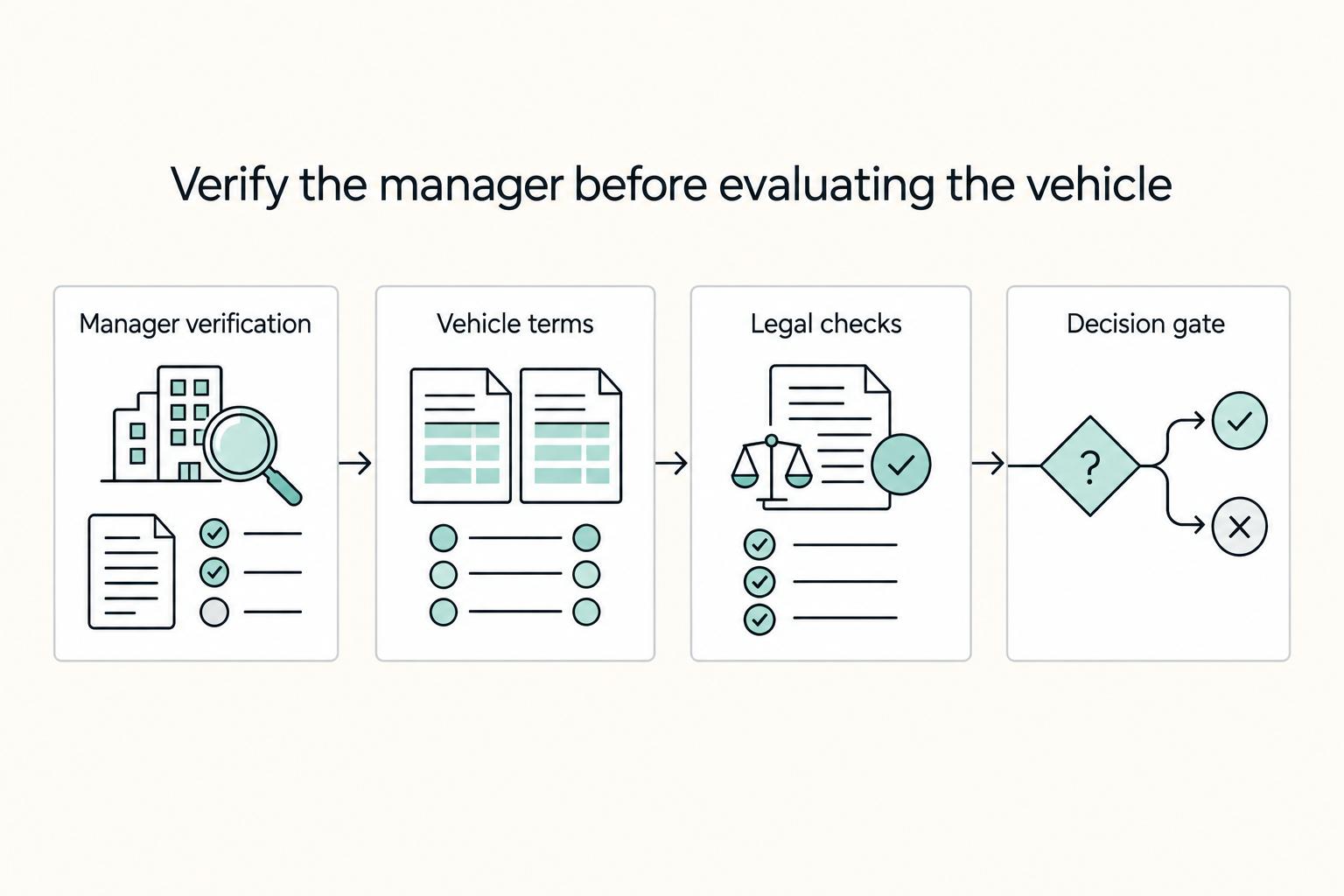
Use a pass/fail process before you commit capital: verify the manager, compare terms side by side, then run legal and operational checks in writing.
That discipline matters in a fast-moving market. One advisory source notes 395 new funds and 31 new fund managers in 2 years and warns that rapid growth can raise risk for investors who move too quickly.
Phase I. Verify the manager first#
Start with evidence of execution, not pitch quality. Ask for prior-fund history and any track-record material the manager can provide. If you get only projections, selected anecdotes, or paper marks, pause.
Then test team and sector fit. If the strategy is sector-specific, ask for clear evidence that the decision-makers have relevant investing or operating experience in that sector across different market conditions.
Finally, have counsel run independent legal status checks on the parties involved, using records relevant to your case. Treat this as pass/fail. If identity, status, or track-record claims cannot be independently verified, do not proceed.
Phase II. Compare the vehicle terms in one table#
Once the manager passes, force a like-for-like comparison. A side-by-side table is a practical way to screen options and surface unknowns quickly.
| Checkpoint | What you need in writing | Why it matters | Your verified entry |
|---|---|---|---|
| Fee mechanics | Management fee basis, performance fee terms, admin/subscription/exit charges, and whether GV and non-GV investors have identical economics | Net outcomes can diverge materially after full costs, so do not assume GV and non-GV investors see identical returns | [verify] |
| Liquidity terms | Fund term, extension rights, redemption/transfer rules, and expected distribution timing | You need a realistic view of how long capital may be tied up and who controls extensions | [verify] |
| Diversification approach | Target number of positions, concentration guardrails, and exposure mix | Concentration can amplify downside if exits are delayed or underperform | [verify] |
| Valuation discipline | Who values assets, valuation cadence, methodology, and treatment of hard-to-price positions | Valuation process affects how reliably interim performance reflects reality | [verify] |
If a term matters, it must be documented. Marketing phrases like "competitive fees" or "diversified" are not enough without matching legal documents.
Also treat any buyback-style promise as a high-alert item. An advisory source explicitly warns about misleading buyback guarantees, so escalate these claims to counsel and confirm what is legally enforceable versus what is only promotional language.
Phase III. Run legal and execution checks in order#
Once the economics and terms make sense, keep the process operational so nothing critical gets missed. Run the steps in order:
- Review deck and term sheet for initial fit.
- Review subscription package and investor questionnaires.
- Review governing documents and fee annexes or side letters.
- Get independent counsel's written review on role clarity, conflicts, and process requirements.
- Build your application cost map and funding plan before signing.
For the cost map, capture every expected outlay in writing: fund charges, legal work, transfer and banking costs, and application-related items in your own process. On execution, confirm exit mechanics and map currency touchpoints at entry and distribution so FX exposure is planned, not improvised.
Decision gate#
Proceed only if all three are true: manager claims are independently verifiable, key terms are clear in binding documents, and counsel has not flagged unresolved conflicts or process gaps. Pause when issues are specific, documented, and time-bound. Walk away when verification fails, fees stay opaque, or protection claims rely on language the documents do not support.
| Outcome | When it applies | Article cue |
|---|---|---|
| Proceed | Manager claims are independently verifiable, key terms are clear in binding documents, and counsel has not flagged unresolved conflicts or process gaps | Proceed only if all three are true |
| Pause | Issues are specific, documented, and time-bound | Pause when issues are specific, documented, and time-bound |
| Walk away | Verification fails, fees stay opaque, or protection claims rely on language the documents do not support | Walk away when verification fails, fees stay opaque, or protection claims rely on unsupported language |
With that core review done, pressure-test borderline files with a simple red-flag screen.
For a different visa context, see A Deep Dive into the UK's 'High Potential Individual' Visa.
Five Red Flags to Treat as Pass/Fail Before You Commit#
If the file still feels borderline, treat that as a risk signal, not a confidence problem. Use these five flags as pass/fail tests before you commit. Apply them during calls and document review. When the pitch gets stronger while the paperwork stays weak, stop and verify before moving forward.
| Red flag | What they say | What it usually means | Your next step |
|---|---|---|---|
| Guaranteed return claims | "Capital protected," "buyback assured," or "fixed return" | Private-market risk is being presented as certainty | Hard stop. Ask where this is enforceable in signed fund documents. If it appears only in marketing, walk away |
| Fee opacity | "Standard market fees" or "all in the deck" | Total investor-borne cost is not fully disclosed | Request a full written cost schedule, including direct and indirect charges, plus the KID if available |
| Authorization status unclear | "We're fully compliant" without verifiable registry details | Authorization to provide investment services has not been verified | Verify CMVM status and check the authorised financial intermediaries list before proceeding |
| Vague strategy | "High-growth opportunities" without specifics | Required pre-investment disclosure is thin or incomplete | Request the full pre-investment disclosure set and verify strategy and risk details |
| Missing audited history | "Unrealized gains" or "audit pending" | You are being asked to trust marketing over audited reporting | Request annual reports, audit status, and delivery dates. Verify relevant records before proceeding |
Guaranteed return language#
Treat any "guaranteed" or "assured" return language as a no-go until proven otherwise. Investments carry risk, and private-market vehicles are no exception. Ask for enforceable wording in signed documents. If the claim lives only in a deck, stop.
Fees you cannot reconstruct on one page#
If you cannot rebuild total cost from the documents, you do not have enough information to invest. Ask for management, performance, admin, subscription, exit, and other investor-borne charges in one written schedule. The KID, if available, should align with that schedule on costs and risk.
Authorization status you cannot verify#
For Portugal-facing offers, treat unverified authorization status as a core risk signal. Investment services activity depends on prior CMVM authorization, so verify CMVM status and check the authorised financial intermediaries list before you proceed. If you cannot confirm authorization, stop until it is clarified.
A strategy that stays vague after questions#
A serious fund should move from slogans to specifics when asked. If strategy details remain unclear after follow-up, treat it as a disclosure failure, not a presentation style issue. Do not proceed until the pre-investment disclosure set clearly states strategy, risk, and key investment limits.
No audited history, or audit timing that slips#
Audited reporting is a baseline control, not a bonus. Ask for the latest annual report, audit opinion, and prior audited reports if a track record is claimed. Check whether reporting timing is consistent with the six-month post-year-end standard.
For status checks, verify CMVM status and the authorised financial intermediaries list. Have counsel reconfirm current legal thresholds against the latest consolidated text, especially figures such as €500,000 and minimum maturity terms.
Use this checklist to reject weak files early. Then evaluate the survivors in the broader tax, liquidity, and cross-border planning context.
You might also find this useful: A Guide to Getting a Golden Visa in Greece.
Before you commit, map your cross-border tax residency exposure so your legal and tax advisors can pressure-test assumptions with the Tax Residency Tracker.
Beyond the Visa: Integrating Your Fund into Your Global Financial Life#
Your next risk is operational, not promotional. If you do not integrate this investment into your reporting, cash planning, and estate setup early, a strong file can still turn into avoidable compliance and admin problems. Treat this investment as a long-life cross-border asset from day one.
Reporting & Tax#
Start by building a complete compliance file immediately after subscription, then run a repeatable annual process with your advisors. Keep signed subscription documents, wire confirmations, account or reference details, annual statements, distribution notices, and every tax pack from the manager.
For U.S. persons, work in this order:
- Confirm whether the holding is reportable for FBAR and what related foreign-asset reporting analysis applies to your facts.
- Confirm current filing rules before year-end rather than relying on old summaries.
- File early enough to fix rejects, because FinCEN e-filing specs indicate submissions can be rejected when required elements are missing.
For most FBAR filers in this context, plan to the standard due date of April 15, 2026 unless your advisor confirms you are in a specific extension cohort. The cited extension is narrow. It covers certain individuals with signature authority but no financial interest. The further date of April 15, 2027 applies only to people already covered by the prior notice chain.
If you still have U.S. state ties, confirm residency status before filing season. California shows why this matters. Part-year residents are taxed on worldwide income while resident, and nonresidents are taxed on California-source income, generally on Form 540NR. Workday sourcing may use CA Workdays / Total Workdays = % Ratio.
| Obligation | Trigger event | Owner | Documents to retain |
|---|---|---|---|
| FBAR determination and filing, if required | Annual filing cycle after you hold the asset | You + U.S. tax preparer | Subscription pack, account details, statements, e-file confirmation |
| Foreign-asset return review | Year-end holding, distribution, sale, or restructuring | You + U.S. tax preparer | Manager tax pack, statements, distribution records, advisor memos |
| State residency allocation review, if applicable | Move into or out of a state | You + state tax advisor | Move timeline, travel and workday records, income support, Form 540NR workpapers where relevant |
| Home-country tax residency check | Residency change or first distribution | You + local cross-border advisor | Residency certificate, prior returns, distribution statements, written advisor analysis |
| Record retention and audit trail | Every filing cycle | You | Filed returns, workpapers, advisor correspondence, payment proof |
Residency & Legacy#
Outside the U.S., tax treatment can depend on your residency status and local rules, so confirm your treatment path with local advisors before major cash events and keep that guidance in writing.
| Checkpoint | Action | Detail |
|---|---|---|
| Liquidity for ongoing costs | Keep dedicated liquidity for legal, renewal, and tax costs during the holding period | Applies during the holding period |
| Currency exposure | Track currency exposure if your investment or distributions and your spending obligations are in different currencies | Covers investment or distributions versus spending obligations |
| Estate documents | Update your will, trust, powers of attorney, and beneficiary instructions so they clearly cover the fund interest and related accounts | Covers the fund interest and related accounts |
| Advisor handoffs | Run advisor handoffs at fixed moments | After subscription, after the first annual statement, and after major life or residency changes |
Then turn those checkpoints into actions you actually schedule:
- Hold a dedicated liquidity buffer for legal, renewal, and tax costs during the holding period.
- Track any currency mismatch between the investment or distributions and your spending obligations.
- Make sure your will, trust, powers of attorney, and beneficiary instructions clearly cover the fund interest and related accounts.
- Schedule advisor handoffs after subscription, after the first annual statement, and after major life or residency changes.
If you want a deeper dive, read the 2026 Global Digital Nomad Visa Index.
Conclusion: Make the Go, No-Go, or Pause Call on Evidence#
You are not buying immediate citizenship. You are making a capital allocation of at least €500,000 into a regulated fund managed by a licensed management company. The decision is operational: go, no-go, or pause based on evidence, not narrative.
For the fund route, verify the risk drivers before you commit:
- Manager track record quality: confirm what is documented, audited, and relevant to this strategy.
- Strategy fit: confirm the mandate matches your risk tolerance, concentration limits, and time horizon.
- Fee transparency: confirm all fees and layers are clearly documented before you commit.
- Liquidity constraints: confirm terms against the reality that the holding period is at least five years.
- Legal and tax ownership: confirm independent legal and tax review is complete for your facts.
Keep the program context straight while you assess the fund. ARI is residency-by-investment, not immediate citizenship, and the fund pathway is presented as the main route after the real-estate route suspension in October 2023. That is why unresolved points should be treated as decision blockers, not cleanup items.
Choose a partner, not a product, by controlling governance before money moves: document review, independent advisors, written follow-ups, and explicit red-flag disqualification.
Your next step:
- Compile your evidence pack, including core fund documents and written Q&A.
- Mark unresolved items that require live verification:
[ARI eligibility],[current thresholds/rules],[fund-specific terms]. - Make the go or no-go decision only after those items are cleared. Otherwise, pause.
Disciplined process protects your capital better than optimism.
For a step-by-step walkthrough, see A Guide to Getting a Golden Visa in Spain.
If this move changes how you invoice clients and receive money across borders, confirm corridor and compliance coverage for your setup by contacting Gruv.
Frequently Asked Questions
Is the Portugal Golden Visa fund route still a fit for me?
It is only a fit if you confirm live ARI eligibility before committing capital. In this regime context, ARI is administered by AIMA, and the official ARI page references an eligible-activities list dated Fevereiro 2026. Before wiring funds, verify the current category and threshold, and confirm whether you are applying personally or through a qualifying company with stable establishment in Portugal.
What should I verify before choosing a fund?
Start with the primary documents: CMVM registration or authorization status where required, the prospectus, the latest annual and semi-annual reports, and the full subscription pack. Treat CMVM oversight as a regulatory check, not a quality guarantee, because prospectus language can state that CMVM supervision does not imply endorsement.
How do the main ARI paths compare at decision level?
Use this as a first-pass filter, then confirm route-specific legal details with counsel before you act. | Option | Control | Liquidity profile | Operational burden | Compliance complexity | | --- | --- | --- | --- | --- | | Fund route | Set by the fund mandate (confirm in the prospectus) | Confirm lock-up, redemption, and exit terms in prospectus and subscription docs | Varies by fund | Confirm ARI eligibility separately from CMVM status | | Cultural ARI route | Depends on project structure | Not fund-like. Confirm cash-flow and exit mechanics directly | Varies by project | Official ARI page references €250,000 for this route | | Real-estate ARI route | Not a current new-filing path under prior subclauses | Not applicable for new filings under prior real-estate investment subclauses | Not applicable for new filings under prior subclauses | Law 56/2023 states new ARI requests under prior real-estate investment subclauses are not admitted |
How should I assess risk, liquidity, and fees?
Assess these using the prospectus and subscription documents, not pitch decks. You need valuation policy, fee layers, redemption restrictions, and investor rights in writing before subscribing. If those points stay vague after follow-up questions, treat that as a disqualifying signal.
What timeline should I plan for?
Plan conservatively and do not rely on unofficial processing timelines. Confirm the current AIMA process steps, required documents, and renewal workflow with counsel using live sources, then build buffer time into your plan. For the broader process map, see A Guide to Getting a Golden Visa in Portugal.
I am U.S.-linked. What should I handle first?
Treat U.S. reporting as a core workstream from day one. Depending on your facts, you may need PFIC analysis and Form 8621, FBAR if aggregate foreign accounts exceed $10,000, and Form 8938. The IRS also states that Form 8938 does not replace FinCEN Form 114, so confirm your exact filing set and tax-treatment implications with cross-border counsel before year-end.
Try a related tool
Researched and edited by the Gruv editorial team. Gruv builds cross-border billing, payouts, and finance-operations software for global businesses.
Sources
Includes 1 external source outside the trusted-domain allowlist.
- fincen.gov/report-foreign-bank-and-financial-accountstrusted
- investor.gov/protect-your-investments/fraud/how-avoid-fra...trusted
- irs.gov/businesses/corporations/do-i-need-to-file-fo...trusted
- irs.gov/businesses/small-businesses-self-employed/re...trusted
- diariodarepublica.pt/dr/detalhe/lei/-222477692-222515924external
Educational content only. Not legal, tax, or financial advice.
Related Posts

The 2026 Global Digital Nomad Visa Index for 50+ Countries
Start with legal fit, not lifestyle filters. The practical order is simple: choose a route you can actually document, then decide where you want to live. That single change cuts a lot of wasted comparison work and stops you from falling in love with places that were never a real filing option.
Portugal Golden Visa in 2026 for Remote Professionals
Choose the Golden Visa if you want residency flexibility with limited time in Portugal. Choose D7 or D8 if you plan to relocate and use Portugal as your primary base.
A Freelancer's Guide to Angel Investing and Venture Capital
**Build a decision system that protects your operating cash first, then treat angel investing as an optional use of true surplus.** If you are considering angel investing as part of broader wealth building, you need controls that keep "startup investing" from quietly raiding rent, taxes, or payroll. Knowledge feels productive, but constraints keep you solvent. As the CEO of a business-of-one, your job is to protect the operating cash that keeps the machine running.