
Quick Answer
Yes, the labuan offshore financial center can fit a solo firm when you can sustain ongoing compliance and document real activity, not just formation paperwork. The workable path is a Labuan company set up through an approved intermediary, with tax treatment checked under the Labuan Business Activity Tax Act 1990 and then cross-checked against your personal filing exposure. If your records, audit trail, and adviser-reviewed home-country position are weak, pause and use a simpler structure.
The Decision Frame: Fit, Obligations, and Execution Risk#
You are not choosing Labuan on marketing alone. You are deciding whether it can hold up under client due diligence, your tax exposure, banking friction, and the compliance workload you can realistically sustain while running paid work. This playbook helps you decide whether a Labuan setup fits your business now.
It will not resolve your home-country tax position, and it does not replace advice from a qualified tax adviser or lawyer.
Use this article if#
- you invoice across borders and want an entity that looks credible, not improvised
- you are weighing company-level tax treatment against personal tax and CFC risk
- you care about clean operations, including reporting and document trails
- you want to see where Labuan helps, where it adds overhead, and where it does not fit
Keep this decision frame in mind as you read.
- Fit
Does your business model match a Labuan company, including how your income is classified and where your clients are?
- Obligations
Can you meet the real compliance load under the Labuan Business Activity Tax Act 1990, including Economic Substance Requirements in effect since 1 January 2019? Staffing and spending thresholds should remain pending official or licensed-provider verification unless current gazetted text is confirmed.
- Execution risk
Can you operate within the practical constraints? Incorporation must go through a Labuan trust company, approval can be as fast as 24 hours only after complete lodgement, payment, and due-diligence clearance, and business transactions must be in currencies other than Malaysian Ringgit.
The rest of this article walks through those checkpoints. That includes Labuan FSA's regulatory role, the conditions behind the 3% tax on audited net profits for trading activity and 0% for non-trading activity (subject to substantial activity compliance), and the option to elect taxation under Malaysia's Income Tax Act 1967.
Home-country rules may still apply. Do not assume foreign-company tax treatment overrides personal reporting obligations. U.S. persons may have Form 5471 filing duties, and other countries may impose CFC or overseas-company disclosure requirements.
Before you rely on any summary, verify the current law and regulator guidance directly. Public pages currently show a conflict on the Labuan Companies Act year, and the online updated LBATA text itself says it is not an authentic legal text.
For related reading, see How to Write a Professional Bio That Attracts Clients.
Is Labuan a Secret Tax Haven or a Legitimate Corporate Hub?#
Use a simple test: treat Labuan as legitimate only if you can verify regulation, ownership transparency, and auditable operations in your own file.
Labuan is a Malaysian federal territory with special status as an International Business and Financial Centre (IBFC). It was initially framed as an international offshore financial center in the 1990s and then rebranded as an IBFC in 2008. That history gives context, but it is not proof. What matters is what you can document today.
| Label | Regulatory posture | Substance expectation | Reputational risk |
|---|---|---|---|
| Classic tax haven | Often associated with opacity and lighter-touch oversight | Often perceived as easier to support on paper than through auditable operations | Often faces higher scrutiny from banks, enterprise clients, and tax authorities |
| Midshore-style jurisdiction | Lower-tax positioning with visible regulation and reporting | Expected to show genuine activity, control, and records | Typically lower than opaque setups, but still sensitive |
| Labuan IBFC | Overseen by Labuan Financial Services Authority (Labuan FSA); company-law updates include beneficial-ownership reporting | Confirm current substance requirements through official guidance or a licensed provider; do not assume paper presence is enough | Conditional on clean, current, auditable records |
What you should verify first#
Before you focus on tax treatment, verify the basics that determine whether the structure is defensible at all.
| Area | Article fact | What to verify |
|---|---|---|
| Regulator traceability | Labuan setups sit within Labuan FSA rules and processes. | Confirm your setup and filings map to Labuan FSA rules and processes. |
| Ownership transparency | The Labuan Companies Act 1990 was amended on 9 June 2022, and Labuan companies are legally required to identify, keep records of, and report beneficial owners. | Check beneficial-owner identification, recordkeeping, and reporting. |
| Response to scrutiny | A 2009 OECD progress-report categorization flagged commitment concerns, and later materials describe reinforced exchange-of-information commitments. | Verify what framework status applies now and what commitments are currently in force. |
What legitimacy looks like in practice#
Legitimacy is not a label you claim. It shows up in records that are complete, current, and easy to review.
- Beneficial-owner records and core company registers are complete and current.
- Contracts, invoices, and payment trails match the activity you claim.
- Management decisions are documented and attributable.
- Accounting records are organized for bank, audit, and adviser review without reconstruction.
That status is conditional, not permanent. It depends on ongoing substance, accurate reporting, and auditability. Any tax outcome is provisional until you verify current treatment, not something you assume from marketing claims.
For a step-by-step walkthrough, see Anguilla vs Seychelles Offshore for Independent Professionals.
The Labuan Company: Your 'Corporate Shield' Explained#
A Labuan company can be useful, but only in a narrow, practical sense. It can separate business liabilities and give you cleaner operations if you run it with disciplined records and clear boundaries.
What the shield actually protects#
The core protection is limited liability at member level. Under the Labuan Companies Act 1990, member liability is limited, subject to the Act, to any unpaid amount on shares. In practice, that allows the company to contract, invoice, hold assets, and keep records in its own name instead of yours.
That separation works only if you treat the company as its own operating unit. Use contracts in the company name, issue invoices from the company, make sure receipts match invoices, and record management decisions as company decisions. If you use the entity like a personal wallet, the shield becomes harder to rely on.
Documentation quality matters. Many counterparties may ask for more than incorporation papers, including beneficial ownership information and clear documentation of business activity.
Start with one practical constraint. Incorporation must go through a licensed Labuan trust company, not directly by founders. Your first diligence check should be whether your provider can clearly show filing steps, register maintenance, and post-incorporation obligations.
Tax paths that matter in practice#
Your first tax decision is structural: LBATA treatment or a Section 3A election into Malaysia's domestic Income Tax Act 1967. Do not treat them as interchangeable.
| Path | Typical fit | Main trade-off | What to verify now |
|---|---|---|---|
| LBATA trading activity taxed at 3% of net audited profits | Operating businesses with qualifying Labuan trading activity and audited accounts | Preferential treatment depends on economic substance and is not automatic | Confirm current substance conditions in the latest gazettes and Labuan FSA guidance |
| LBATA non-trading activity at 0% | Investment-holding activity undertaken on the entity's own behalf | Misclassification risk if the activity is actually operational or trading | Confirm activity matches the non-trading definition and is documented consistently |
| Section 3A election into domestic Malaysian tax treatment (generally 24% reference rate) | Cases where domestic treatment or broader planning makes this route preferable | Election is described as irrevocable | Confirm whether a Section 3A election exists and how current domestic rules apply |
The common failure point is not the headline rate. It is classification, outdated references, and inconsistent documentation. Some materials still point to 2018 requirements, while 2021 regulations expressly revoked the 2018 version, so rely on current gazettes and Labuan FSA tax material.
Privacy is conditional, not absolute#
Labuan can offer controlled visibility, not anonymity. There is public company-search access for registered entities, and beneficial ownership reporting obligations exist under explicit legal hooks, including Section 108E of the Labuan Companies Act 1990.
The key distinction is public visibility versus regulated and counterparty visibility. Regulators, your licensed intermediary, banks, and many counterparties may still require ownership and control details. The beneficial ownership framework uses an ownership-and-control approach, so control arrangements matter, not only named shareholding.
Treaties and payment flows#
Treaty access and payment efficiency matter only if they survive legal and operational checks in each country involved.
| Decision point | Potential upside | Common limitation | What you should check |
|---|---|---|---|
| Treaty claim on foreign-source income or withholding tax | Reduced withholding or clearer taxing-right allocation | Some treaties specifically exclude Labuan entities | Confirm current treaty scope and country practice |
| Cross-border collections and payouts | More liberal FX environment because Labuan entities are treated as non-resident for Malaysian FX administration | Banks and payment providers still require documentary evidence and due diligence | Keep contract, invoice, counterparty, and payment-purpose records ready |
| Home-country tax treatment | Better coordination when entity and personal planning are aligned | Home-country CFC, PE, or personal tax rules can override expected outcomes | Validate treatment with home-country advisers before relying on treaty or deferral assumptions |
You can route international billing and payouts through the entity, but banking is still evidence-driven. If a bank cannot trace the commercial story from contract to invoice to receipt, transactions can stall.
Before you rely on this structure, confirm:
- the entity was incorporated through a licensed Labuan trust company and registers are current
- your banking route is feasible, with due-diligence documents prepared before the first payment
- your tax treatment is aligned across LBATA status, any Section 3A election, and home-country rules
- your documentation discipline is strong enough to produce contracts, invoices, BO records, and management records without reconstruction
See also A Guide to the Malaysian Digital Nomad Visa (DE Rantau).
The Compliance Minefield: Navigating Labuan's Real-World Requirements#
If you want this structure to hold up, treat compliance as an ongoing operating task, not a setup formality. The core job is simple: verify current rules, keep a complete document trail, and clear your home-country tax reporting position before revenue scales.
Prove substance with evidence, not intent#
Start by confirming current substance requirements through official guidance and your licensed provider, then build them into your internal checklist. Keep unresolved thresholds in your controls until verified: Required employees: current threshold pending official or licensed-provider verification and Required annual local spend: current threshold pending official or licensed-provider verification.
| Evidence area | Records to keep | Note |
|---|---|---|
| Management and control | dated resolutions, minutes, approvals, and decision records | Show how the company is actually run. |
| Local operations | office and service records, plus activity evidence that shows real operations | Confirm current substance requirements through official guidance and your licensed provider. |
| Staffing | contracts, payroll, role descriptions, and work records aligned to actual activity | Confirm the current required-employee threshold from the official source or your licensed provider. |
| Spend | invoices, payment proof, and accounting entries tied to operations | Confirm the current required annual local-spend threshold from the official source or your licensed provider. |
| Records and reporting | accounts, ledger, bank statements, material contracts, tax workpapers, and beneficial ownership records kept current and retrievable | If those records conflict with your narrative, the structure starts to look like a paper company. |
What matters is whether you can prove how the company is actually run.
Use a home-country tax screen before relying on outcomes#
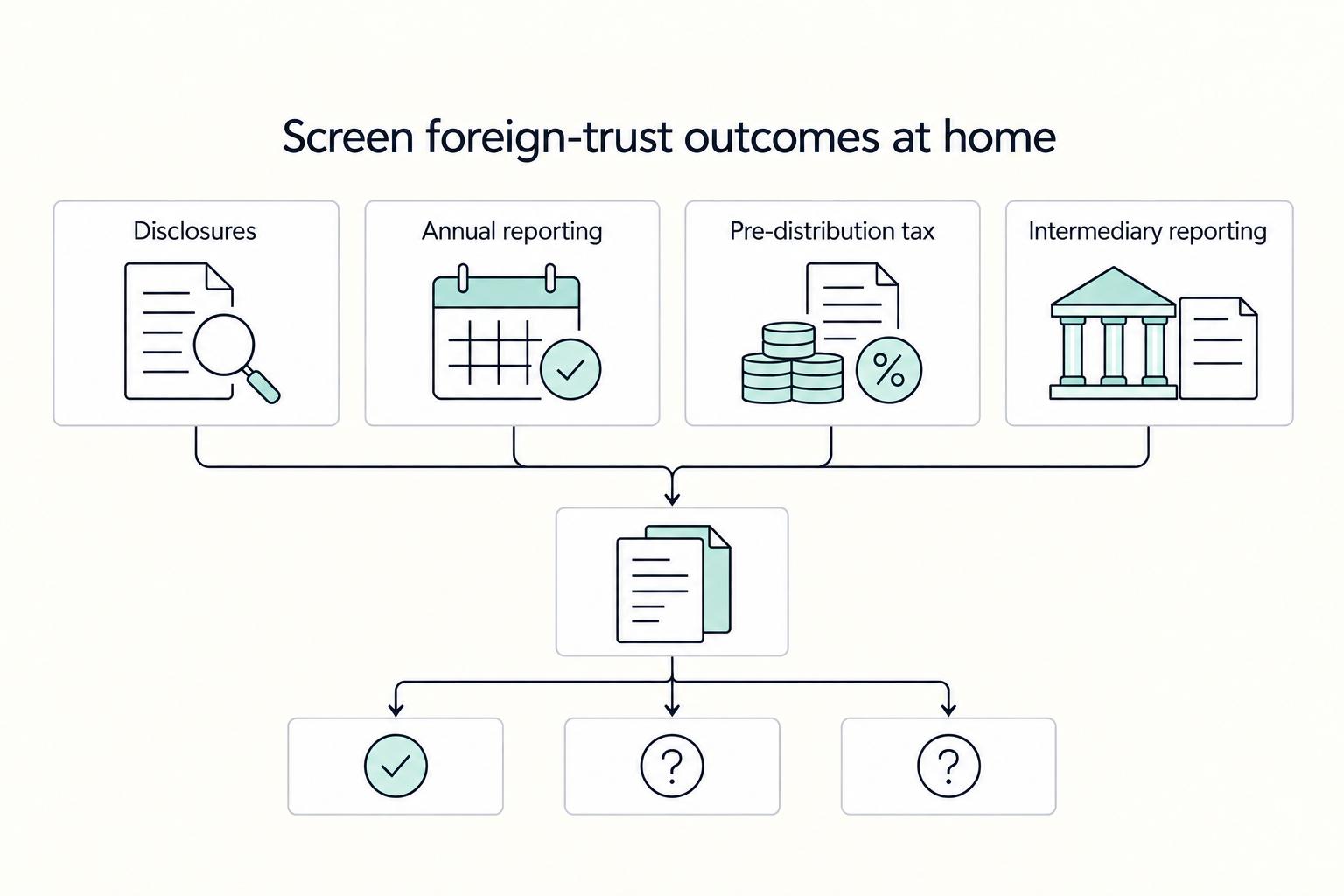
A valid offshore company does not automatically determine your personal tax result. Cross-border passive income - interest, dividends, and capital gains - is a known enforcement risk, and foreign passive income generally does not have the same broad third-party reporting that exists in domestic contexts.
| Issue | What to clarify | Article note |
|---|---|---|
| Disclosures | required ownership and foreign-entity disclosures | The answer depends on where you are tax resident. |
| Annual reporting | annual information reporting obligations | Get clear answers before first revenue lands. |
| Pre-distribution taxation | whether any income can be taxed to you before distributions | For U.S. persons, common concepts include Subpart F income and GILTI. |
| Foreign intermediary reporting | FATCA information requirements where foreign financial intermediaries are involved | Missing required information can lead to withholding. |
Because the answer depends on where you are tax resident, get clear answers from your home-country adviser before first revenue lands on required ownership and foreign-entity disclosures, annual information reporting obligations, and whether any income can be taxed to you before distributions.
For U.S. persons, common concepts include Subpart F income and GILTI. Where foreign financial intermediaries are involved, FATCA information requirements can matter too, and missing required information can lead to withholding.
Budget the structure honestly#
Do not price this off a single setup quote. Budget it in three buckets.
| Cost bucket | What it covers | Timing |
|---|---|---|
| Setup | formation support, initial registrations, first-year setup coordination | one-time or front-loaded |
| Recurring obligations | annual maintenance, filings, accounting or tax work, required ongoing support | annual |
| Variable provider costs | banking support, certifications or legalization, complex bookkeeping, cross-border opinions, remediation | as needed |
The real question is whether the structure still makes sense after all three buckets are included, especially if incomplete records create extra variable work.
Keep the structure defensible every quarter#
Quarterly discipline matters more than a single clean filing season. If records drift, cleanup is usually heavier than steady maintenance.
Treat compliance as a recurring cadence:
- reconcile contracts, invoices, receipts, payroll, related-party flows, and approvals
- run pre-deadline data validation so reporting logic stands up to auditor scrutiny
- document any tax-policy elections and apply them consistently across filings and disclosures
- keep a live due-diligence pack ready for banks, payment providers, auditors, and tax authorities
Assume the burden of proof can get heavier under tougher enforcement approaches. Thin or inconsistent records are usually where avoidable problems begin. Long-term durability comes from steady evidence, not clever structuring.
For that issue, see How to Use a Nominee Director in an Offshore Company Without Losing Control.
Is a Labuan Structure Right for Your Solo Business?#
Use this as a strict go or no-go screen. Proceed only if you pass all three tests. If one clearly fails, pause and price a simpler structure first.
| Test | Good fit | Poor fit |
|---|---|---|
| Commercial fit | Stable profit, predictable invoicing, and enough margin to absorb the current annual compliance cost range, once verified through official or licensed-provider sources, without strain | Uneven income or thin margins where ongoing upkeep erodes the expected benefit |
| Client fit | Your buyers expect a formal corporate counterparty, structured onboarding, and stronger compliance documentation | Your buyers are comfortable contracting an individual and rarely require formal entity-level checks |
| Commitment fit | You are planning multi-year operations and can maintain records, approvals, and recurring obligations consistently | You are testing a short-term setup or want minimal ongoing admin discipline |
Commercial fit#
Pass only after you replace assumptions with verified numbers. That means [current first-year setup cost], [current recurring annual cost], and [current home-country tax outcome or effective rate range after adviser review].
Use official Labuan IBFC materials as a checkpoint, including the online Market Report 2023 and its 56 Performance Indicators, and confirm current requirements in writing with your provider. If the model works only under best-case assumptions, treat that as a fail. The report describes recovery as somewhat fragile and links downside risk to conflict spillovers and inflation pressure, so your downside case needs to hold.
Client fit#
Pass when the entity clearly improves how you win and keep work. That usually shows up in procurement workflows, formal counterparty checks, and contract requirements that are easier to satisfy as a company.
Fail if the structure adds process without improving revenue quality. Review your last 10 clients and note how many asked for company registration details or formal compliance documents. If that number is near zero, do not assume the structure creates value on its own.
Commitment fit#
Pass if you are willing to run this as a long-term operating setup, not a short experiment. The Labuan IBFC Strategic Roadmap 2022-2026 supports using a multi-year planning lens.
Fail if your real plan is temporary income parking or rapid jurisdiction switching. That is where recordkeeping and reporting discipline can break down, and those gaps remain your responsibility even when providers handle administration.
Before moving ahead, ask your home-country tax adviser to model your personal reporting outcome. Then ask your Labuan provider to confirm current substance, filing, and cost requirements in writing. Compliance accountability still sits with you.
If you are comparing alternatives, see A Guide to Mauritius as an Offshore Jurisdiction for African Businesses.
Before you decide, map your home-country exposure and residency assumptions in one place with the tax residency tracker.
Conclusion: Make Your Move with Confidence#
Choosing a Labuan structure is a risk-management decision, not a rate-chasing exercise. You are deciding whether this company will be easier to defend, operate, and sustain than your alternatives.
That means treating tax and positioning as verification items, not selling points. Before you rely on any upside, keep current Labuan tax treatment and regulatory framing pending verification against current primary materials and with qualified advisers. The excerpts used here are historical, so current-year treatment must be verified directly.
You should also confirm the compliance path before you incorporate. Labuan FSA publicly lists areas such as Regulatory Reporting and Forms, which points to an ongoing filing environment, not a one-time setup. If you cannot map the filing path, required records, and responsible support, you are not yet assessing the real operating burden.
For a business of one, the decision is straightforward: strategic fit, operational burden, and home-country tax exposure all have to align. If the structure does not materially improve your commercial position, liability posture, or day-to-day operations, the extra administration may not be worth it.
Keep one principle clear: any benefit is conditional on ongoing governance and documentation discipline. If records, approvals, correspondence, and recurring filings slip, the structure becomes harder to defend.
Validate eligibility, confirm cross-border tax impact with qualified advisers, then decide whether to proceed or defer.
For a related treaty analysis, see A Deep Dive into the US-Switzerland Tax Treaty for Financial Consultants.
If you move forward and need compliant, traceable money operations for global clients, review how that workflow fits in the docs.
Frequently Asked Questions
What is the tax rate for a Labuan company?
Treat tax as a verification item, not a headline assumption. For trading activity, confirm the current rate and conditions with the official source or your licensed provider; for pure investment holding, confirm the current treatment and conditions the same way. Before you incorporate, get written confirmation from your licensed provider on your activity category and the filing, audit, and election requirements that apply.
Is Labuan a tax haven?
Use a compliance lens instead of a label. Labuan IBFC materials reference Labuan FSA, and setup and maintenance still involve obligations such as annual return filing and maintaining records that show financial position. The practical question is whether you can run the structure cleanly year after year.
Can you set up a Labuan company as a solo consultant or freelancer?
Potentially, but treat eligibility as a case-by-case verification item. Resident-secretary rules also matter: only an approved officer of a Labuan trust company (or its wholly owned subsidiary) may be appointed as a resident secretary, and if multiple secretaries are appointed, at least one must be resident. If entity credentials do not change your client outcomes, the extra upkeep may not be worth it.
What do substance requirements mean in practice?
Exact economic-substance thresholds are a verification item — confirm the current official tests before you act. You should be ready to maintain records that show your financial position.
Do you still pay tax in your home country?
Home-country tax or reporting exposure does not necessarily disappear when you use a Labuan company. Treat home-country tax, reporting, and any CFC analysis as separate items to verify with your home-country adviser before setup.
When is Labuan a poor fit for a solo business?
Labuan can be a poor fit if you do not want recurring admin obligations or if your model conflicts with stated operating limits (for example, no cash transactions in Labuan IBFC, and Labuan investment banks cannot accept deposits). If you are unlikely to maintain annual returns, required records, and any applicable account-filing path, compliance risk rises. If you are still deciding between a simple setup and a company, start with Sole Proprietorship vs. LLC: The Definitive Guide for Global Freelancers.
Try a related tool
Researched and edited by the Gruv editorial team. Gruv builds cross-border billing, payouts, and finance-operations software for global businesses.
Sources
Includes 1 external source outside the trusted-domain allowlist.
- ato.gov.au/businesses-and-organisations/international-t...trusted
- irs.gov/forms-pubs/about-form-5471trusted
- irs.gov/statistics/soi-tax-stats-controlled-foreign-...trusted
- labuanfsa.gov.my/clients/asset_120A5FB8-61B6-45E8-93F0-3F79F8...trusted
- labuanfsa.gov.my/areas-of-business/labuan-structures/labuan-c...trusted
- sec.gov/Archives/edgar/data/1991605/0000950123240009...trusted
- gov.uk/government/publications/overseas-companies-i...external
Educational content only. Not legal, tax, or financial advice.
Related Posts

Sole Proprietorship vs LLC for Global Freelancers in 2026
For most freelancers in 2026, the practical default is still simple: use the simplest structure you can run cleanly, then formalize when risk actually rises. If your work is still in validation mode and the downside is contained, a sole proprietorship is often the practical starting point. When contract exposure, delivery stakes, or dispute risk starts climbing, forming an LLC deserves earlier attention.

How to Write a Professional Bio That Attracts Clients
If you want to know **how to write a freelance bio** that is client-focused, write for scan speed, not autobiography. Clients often read your headline before they open your portfolio, and first impressions can form in less than seven seconds. Your opening should show fit, proof, and a clear next step fast.
Planning Your Move With the Malaysia Digital Nomad Visa (DE Rantau)
Treat this as a verification-first playbook, not a travel pitch. If you cannot confirm current rules from official Malaysian sources, the best move is to pause before planning anything else.