
Quick Answer
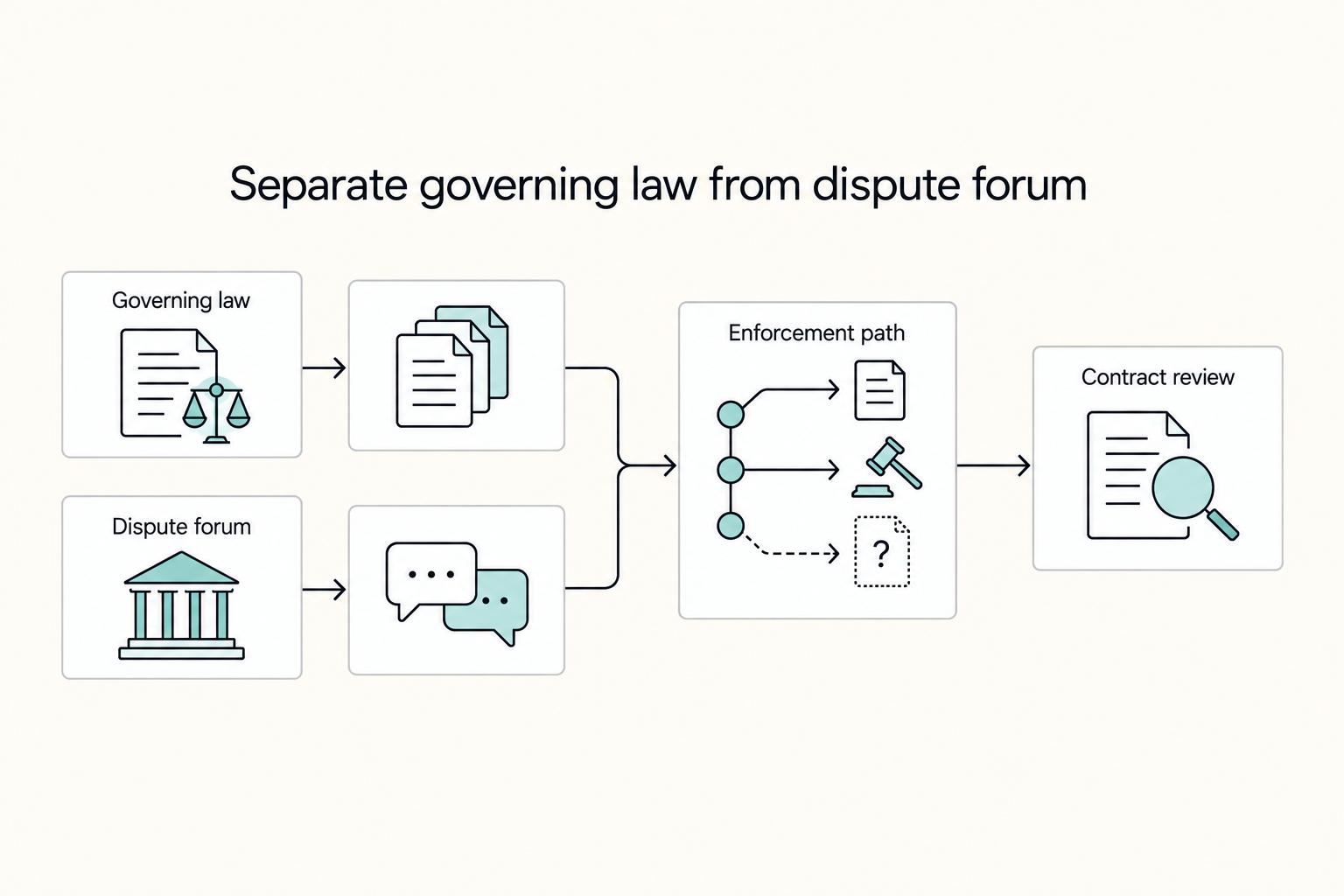
Freelancers should usually align governing law and jurisdiction, then choose the forum based on the main risk in the deal. If payment collection matters most, look first to where the client's assets are and confirm the enforcement path. Keep the clauses consistent across the agreement, SOW, and attached terms, and make ownership, license, and assignment language explicit for IP.
What choice of law and jurisdiction clauses determine#
Treat these two clauses as core risk controls before you sign, not fine print. In cross-border work, they determine which legal rules apply, where disputes are heard, and how predictable enforcement may be if things go wrong.
In plain language, choice of law tells you which legal rulebook governs the contract. Jurisdiction tells you which court has authority to hear the case and issue orders. If the contract names a specific court, that is usually a forum selection clause or choice of court agreement.
These are negotiated business terms, not background boilerplate. Your choices affect predictability, enforceability, and the practical burden of any dispute. Under the EU's Rome I Regulation, parties can choose the law governing their contract, and that choice should be express or clearly demonstrated in the contract. In international civil and commercial matters, the HCCH 2005 Choice of Court Convention is designed to make exclusive choice-of-court agreements effective. It can also provide greater certainty, but its core scope excludes consumer and employment contracts. First, confirm what kind of contract you are signing. Then confirm the clause structure fits it.
This article focuses on three practical risks these clauses can help you manage:
- Payment risk, by planning where a dispute outcome may need to be recognized or enforced across borders.
- Scope risk, by choosing a legal framework that supports the written deal you actually negotiated.
- IP risk, by making sure ownership, license, and deliverable terms are interpreted under the law and forum you selected.
One red flag is a mismatch: one place named for governing law and another for the courts. That can reduce predictability and make disputes harder to manage. Also check whether the contract sends disputes to arbitration instead of court, because arbitration follows a different recognition-and-enforcement framework. Related: Digital Nomad Pre-Travel Checklist for Long-Stay Moves.
The Twin Pillars of Contract Control#
Start with this baseline: jurisdiction decides where a dispute is heard, and choice of law decides which legal rules interpret the contract. They are separate clauses, and one does not automatically determine the other.
A jurisdiction clause, also called a forum selection or choice of court clause, identifies the court for disputes. A choice of law clause, also called a governing law clause, identifies the law that applies. A contract can mix them, but that mix should be intentional and clearly drafted.
In many international commercial contracts, you can negotiate both clauses because party autonomy is widely accepted. But that flexibility is not unlimited. Enforceability can vary by forum, contract type, and mandatory local rules. If you do not clearly choose governing law, default conflict-of-law rules may apply (for example, under Rome I in the EU, rules can turn on contract type).
What goes wrong when clauses are weak or missing#
When these clauses are weak, disputes can turn procedural before they turn substantive. Before anyone gets to payment, scope, or delivery, the parties may be arguing about forum, applicable law, or whether the dispute language even works. That uncertainty can delay resolution and complicate early case handling.
A common problem is messy drafting: court language in one clause, different law language in another, plus mediation or arbitration language with no clear sequence.
When alignment is the default, and when to depart from it#
For many freelance commercial contracts that use court litigation, aligning forum and governing law is the practical default. It can reduce procedural friction and make the dispute path easier to predict.
Depart from alignment when the dispute design is deliberate, such as a layered structure with mediation before arbitration or court proceedings. If you do that, make the sequence, forum or seat, and enforcement path explicit so the clauses do not compete with each other.
| Setup | Likely friction | Practical outcome for a freelancer |
|---|---|---|
| Aligned clauses (court and governing law in the same place) | Lower | More predictable dispute path and fewer threshold arguments |
| Mismatched clauses (court in one place, law of another) | Higher | More room for preliminary disputes on applicable law and slower early progress |
| Missing or vague clauses | Often high, sometimes variable | Default rules may control, and timing and control over dispute handling drop |
Before signing, run three checks:
- Confirm the contract separately states both forum and governing law.
- Confirm the same clause logic appears across the master agreement, SOW, and incorporated terms.
- If mediation or arbitration is included, confirm the sequence is explicit and does not conflict with court language.
You might also find this useful: A guide to the 'Common Law' vs. 'Civil Law' systems for international contracts.
Shield #1: How to Guarantee You Get Paid Across Borders#
Jurisdiction is a payment and enforcement decision, not a housekeeping clause. Once you know your forum and governing-law approach, pick the forum based on your main objective. That might be a faster path to collection, stronger claim deterrence, or a neutral option both sides will accept.
Pick the court by your main objective#
Use this filter before you negotiate venue:
- If your main goal is collection, start with where the client's assets are.
A judgment from that location is usually a more direct path to local enforcement than a judgment that must first be recognized elsewhere.
- If your main goal is deterrence, consider starting with your own court.
This can raise the practical burden for a client that is considering a claim against you.
- If your main goal is deal closure, consider a neutral forum only after mapping enforcement.
Neutrality can help negotiations, but it does not by itself put you closer to assets held in another country.
That offense-versus-defense split matters. The forum that is best for litigation posture is not always the forum that is best for recovery speed.
Know the enforcement path before you trade venue#
Ask, "Where can this judgment actually be enforced?" not just, "Where can I sue?" If you win in one country and the assets are in another, recovery is usually a two-step process: recognition first, then enforcement.
| Route | Instrument | Notes |
|---|---|---|
| EU to EU judgments | Brussels I Recast (Regulation 1215/2012) | Judgments are recognized across EU Member States without special procedure, and enforceable judgments can be enforced without a declaration of enforceability. |
| Exclusive choice-of-court route | HCCH 2005 | Applies to international civil and commercial matters with an exclusive choice of court agreement and is aimed at making those agreements effective across Contracting States; excludes consumer and employment contracts. |
| General foreign-judgment route | HCCH 2019 | Covers recognition and enforcement of civil and commercial judgments, but coverage depends on whether the relevant states are Contracting Parties. |
Under HCCH 2019 terminology, the country where you seek recognition or enforcement is the requested State. Procedure there is governed by that state's law unless the Convention says otherwise. So even when a convention helps, local process still controls collection mechanics.
Before you sign, check which route applies:
- EU to EU judgments: Under Brussels I Recast (Regulation 1215/2012), judgments are recognized across EU Member States without special procedure, and enforceable judgments can be enforced without a declaration of enforceability.
- Exclusive choice-of-court route: HCCH 2005 applies to international civil and commercial matters with an exclusive choice of court agreement and is aimed at making those agreements effective across Contracting States.
- General foreign-judgment route: HCCH 2019 covers recognition and enforcement of civil and commercial judgments, but coverage still depends on whether the relevant states are Contracting Parties.
If you plan to rely on HCCH 2005, make the court clause exclusive and confirm treaty coverage for both the court state and the likely enforcement state. Do not rely on memory; check the status tables. HCCH 2005 also excludes consumer and employment contracts.
Neutral forums can help negotiations, with a collection tradeoff#
A neutral forum can help move a deal forward when neither side accepts the other's home court. But if assets are elsewhere, you may still need separate recognition and enforcement steps after judgment. Treat neutrality as a negotiation compromise, not a collection shortcut.
| Your priority | Best forum starting point | Path to recovery | Procedural burden | Likely leverage |
|---|---|---|---|---|
| Collect from client assets | Court tied to asset location | Often a more direct local enforcement path | Often lower when court and assets are in the same place | Can increase payment pressure |
| Deter claims against you | Your local court | Can improve defensive posture; collection abroad may still add steps | Often higher for the client; collection can be more complex for you | Can increase deterrence |
| Reach neutral ground | Neutral forum both sides will accept | May require later recognition or enforcement where assets sit | Can be medium to high when assets are elsewhere | Can improve deal acceptability, with weaker pure collection leverage |
Common mistakes are not verifying where the contracting entity's assets are, and using non-exclusive or inconsistent dispute clauses across the master agreement, SOW, and attached terms.
What to propose in redlines#
If collection is your main risk, ask for an exclusive choice-of-court clause in courts connected to the client's assets or main operating entity. Name the court clearly and avoid vague wording. Keep governing law aligned with that forum unless you have a specific reason to split them. Also confirm the exact contracting entity and likely enforcement location.
Before you sign, verify whether Brussels I Recast, HCCH 2005, or HCCH 2019 actually supports your enforcement plan. If not, plan for a separate foreign recognition and enforcement step.
We covered this in detail in International Freelance Contract Clauses for Payment and Dispute Control.
Shield #2: How to Prevent Endless "Scope Creep"#
Scope-creep disputes can become interpretation disputes, so clarity and consistency in your written scope matter before you sign. If the scope is vague, outcomes are harder to forecast.
Use this pre-signing test:
- Legal clarity: Can a neutral reader see what is included, excluded, and priced from the SOW alone?
- Interpretation predictability: If wording is contested, is the likely interpretation clear or uncertain?
- Leverage balance: If wording is fuzzy, who gains from that uncertainty?
Then use three plain-language interpretation checks in your own process:
- Text-first reading: Start with the actual SOW wording, not assumptions from calls or sales language.
- Ambiguity check: If a clause reasonably supports two readings, treat it as unresolved risk and rewrite it.
- Written scope amendment: When scope, timing, or price changes, record the change in writing so it is explicit and approved.
Courts do not all reason the same way. Some approaches track prior decisions more closely, while others give more weight to current social needs. That is one reason less ambiguity and better records matter.
Before you sign, run a quick scoping exercise and needs analysis. Then confirm the same scope appears across your SOW, proposal, pricing, and key emails.
| Scope-creep dispute | If scope language is explicit | If scope language is ambiguous |
|---|---|---|
| Assumed deliverables | Deliverables and exclusions are easier to verify against the SOW | Scope wording may be read differently by each side |
| Revision expansion | Revision limits are easier to compare against what was agreed | The baseline can support more than one reading |
| Timeline extensions | New deadlines can be captured as a defined scope change | Delay-related changes can remain unresolved unless documented |
When a client requests extra work, use this script: "Happy to do that. It sits outside the current SOW, so I'll send a scope amendment with deliverable, timeline, and fee updates." Before starting, confirm what changed, what moves, and who approved it.
For related background, read What is the 'Berne Convention' for International Copyright?.
Shield #3: How to Protect Your Greatest Asset - Your IP#
Your IP is a core business asset, so the contract should state exactly who owns what and how rights move. In cross-border deals, it often comes down to drafting discipline.
For IP, your choice of law sets the legal system that governs contractual obligations. In practice, that can affect how ownership terms are interpreted, whether specific transfer structures are recognized, and what formalities make a transfer valid.
Start with the ownership mechanism, not assumptions#
Do not rely on "they paid, so they own it." In both U.S. and UK copyright frameworks, authorship is the default starting point unless a valid mechanism changes that. UK guidance says freelancers under a contract for services usually retain copyright unless contract terms change it.
| Mechanism | What it does | Requirement or effect |
|---|---|---|
| Work made for hire (U.S.) | Specific U.S. statutory path | Defined conditions, including signed writing for certain commissioned works. |
| Assignment | Transfer or sale of ownership rights | In U.S. and UK law, assignment is ineffective unless in writing and signed. |
| License | Permission to use IP under agreed terms | Ownership stays with you. |
Use the right mechanism on purpose:
- Work made for hire (U.S.): a specific U.S. statutory path with defined conditions, including signed writing for certain commissioned works.
- Assignment: transfer or sale of ownership rights. In U.S. and UK law, assignment is ineffective unless in writing and signed.
- License: permission to use IP under agreed terms while ownership stays with you.
If the clause calls for a full transfer, draft assignment terms clearly. If the client only needs use rights, draft a license clearly. Do not assume labels alone will solve ownership across jurisdictions.
Pick the commercial outcome first#
Decide the commercial model before debating law or forum.
| Your deal position | What the client gets | Contract concept |
|---|---|---|
| Client needs full ownership | Ownership of defined deliverables | Assignment of specified deliverables, with pre-existing materials carved out |
| You retain reusable rights | Use rights only | License with defined scope of use while you retain ownership |
| Shared or limited-use model | Narrow rights | Limited license plus explicit retained rights in your tools, templates, and methods |
At minimum, define ownership for pre-existing materials, project deliverables, and modified or derivative outputs. That can be where cross-border disputes begin.
Choose law and forum with IP-specific criteria#
For IP clauses, use concrete criteria, not prestige labels:
- Predictability of interpretation: pick a law that supports predictable contract outcomes.
- Moral-rights handling: Berne recognizes moral rights independently of economic rights; treatment differs by jurisdiction, including waiver rules.
- Transfer enforceability: confirm your transfer structure meets local formalities, for example signed writing where required.
- Dispute enforceability: choose a forum or arbitration path with realistic recognition and enforcement routes for outcomes.
If you split governing law and forum, do it intentionally.
Cross-border checklist for digital nomads#
If you do not effectively choose governing law, default conflict rules can connect the contract to the characteristic performer's habitual residence. That is why mobile freelancers need tighter drafting.
- Align governing law and dispute forum unless you have a clear reason not to.
- State how temporary work location is intended to interact with the chosen law or forum, while recognizing that mandatory local rules may still apply.
- Add a local-law carveout placeholder after legal verification: "Except to the extent any non-waivable local law or overriding mandatory rule applies."
- List pre-existing IP and retained rights in writing.
- Verify signatures and exhibits before work starts.
Red flag: if the contract says the client owns "everything" but does not define deliverables or distinguish assignment from license, pause and rewrite before delivery starts.
For a step-by-step walkthrough, see How a US Freelancer Should Draft a Governing Law Clause with an Asian Client.
Your 60-Second Contract Red Flag Checklist#
Use this as a pre-signing screen for three process risks: unresolved wording, unclear approvals, and weak documentation. It is not a legal validity test by itself. If the clause is unclear, treat it as unresolved and get written clarification before you sign.
| Red flag | Why to pause | Action |
|---|---|---|
| Dispute wording is still changing | Draft language may change before final approval. | Ask which version is current, who can approve final text, and when that approval is expected. |
| No written feedback loop on redlines | Without written feedback, key points can stay unresolved. | Request written feedback and a response timeline, ideally within one week. |
| Final approval path is unclear | Recommendations may be considered but not accepted before final approval. | Confirm the approval path in writing and sign only against finalized text. |
Treat dispute wording as provisional until it is fully approved in the signed contract. Keep all edits in writing, request written feedback on your redlines, ideally within one week, and rely on the final executed text, not verbal assurances.
- Dispute wording is still changing
Decision test: Is the language still moving across emails, chats, or draft versions? Why to pause: Draft language may change before final approval. Action: Ask which version is current, who can approve final text, and when that approval is expected.
- No written feedback loop on redlines
Decision test: Did you submit edits but receive no written response or timeline? Why to pause: Without written feedback, key points can stay unresolved. Action: Request written feedback and a response timeline, ideally within one week.
- Final approval path is unclear
Decision test: Is it unclear whether proposed wording can actually be adopted in final form? Why to pause: Recommendations may be considered but not accepted before final approval. Action: Confirm the approval path in writing and sign only against finalized text.
Fallback options you can propose#
If the other side rejects your first request, move to a fallback that still protects clarity and execution discipline.
| Fallback option | When it is reasonable | Tradeoff you accept |
|---|---|---|
| Written issue log | You need each open clause and owner tracked before signature | More coordination overhead during negotiation |
| Time-boxed review window | You can proceed if written feedback arrives by a clear deadline | Signing may slip if responses miss the window |
| Legal escalation checkpoint | Material wording remains unresolved after business review | More legal effort and a longer cycle |
Drafting template and client script#
Use this as a customizable placeholder for legal review, not a final legal answer:
"Before signature, please confirm the final approved dispute-language version in writing, identify the approver, and respond to the attached redlines by your proposed review deadline. I will rely on the executed contract text as controlling."
You can send this to the client:
"I want to keep this moving, and I need the dispute clause to be clear and workable in the final signed version. Can you confirm the final approver, the current draft to review, and a written response timeline for the redlines?"
If written clarification does not arrive, or terms keep changing informally, treat that as an unresolved contract risk and escalate before signing.
If you want a deeper dive, read Germany Freelance Visa: A Step-by-Step Application Guide.
Want a cleaner draft before negotiation? Start with the freelance contract generator and then tailor governing law and jurisdiction with counsel.
Conclusion: Align law and forum, confirm enforcement, confirm IP ownership#
Treat these clauses as risk controls, not boilerplate. When you review a draft, ask what each clause lets you do if the deal goes wrong.
Keep the three shields straight. A key payment-risk shield is forum choice. It affects where you may need to bring a claim and can affect how realistic enforcement is where assets are located. Your scope shield is governing law. It gives you a more predictable rulebook for interpreting the SOW, change requests, and acceptance terms. Your IP shield is separate. It depends on explicit ownership and assignment language.
Do not assume one clause does another clause's job. A court clause does not, by itself, choose governing law, and dispute clauses are not a substitute for explicit copyright transfer language. If the draft says the client "owns everything" but does not clearly state what is assigned, when transfer happens, and who signs, treat that as a drafting gap. In U.S. and UK rules, copyright assignment must be in writing and signed, and a short "work made for hire" line alone is not a complete cross-border ownership plan.
Before you sign, run this quick check:
- If governing law and court are split, ask for the business reason in writing and decide whether the extra complexity is worth it.
- If the forum is exclusive, confirm you can realistically pursue or defend a case there and that enforcement is plausible where assets are located.
- If the contract includes deliverables, confirm who owns background IP, who owns final work product, and when transfer occurs.
- If the signature version changed, recheck the exact dispute and IP wording before execution.
Final check: align governing law and forum where possible, confirm a realistic enforcement path, and confirm who owns what IP after delivery. That is standard professional parity, not friction. If clause language is ambiguous, internally inconsistent, or mismatched, pause and get legal review before signing.
This pairs well with our guide on A deep dive into the 'force majeure' clause when your client is in a politically unstable region.
If you want to run invoicing and cross-border payouts in one workflow with clear status tracking, see Gruv for freelancers.
Frequently Asked Questions
What is the difference between governing law and jurisdiction?
Governing law tells you which legal rules apply to the contract. Jurisdiction tells you which court has authority to hear the case. If the contract picks one place's law and another place's court, ask for the business reason in writing because that can increase cost and complexity.
Should governing law and jurisdiction be the same?
Often, yes. Aligning them usually makes interpretation cleaner and reduces procedural friction. A split is not automatically invalid, but it should be a deliberate exception with a documented reason.
What is the best jurisdiction for an international contract?
There is no universal best jurisdiction. Choose based on your main goal: collection, defense burden, neutrality, or interpretation predictability. The best forum is the one that fits your actual risk profile and enforcement path.
How do I enforce a freelance contract internationally?
Start by locating the other side's assets and checking whether your selected route can realistically reach them. If you are using an exclusive choice-of-court clause, HCCH 2005 can support recognition and enforcement in covered international civil or commercial cases, subject to scope limits. If the contract uses arbitration instead of court litigation, the New York Convention is a key cross-border baseline, and local law and treaty applicability still matter.
What happens if my contract has no governing law or jurisdiction clause?
The contract is not automatically void, but predictability drops. Default conflict-of-law rules may decide the governing law, and forum disputes can become an early fight before the core dispute is heard. That usually means more uncertainty, more process, and more cost.
Can I choose a court where neither I nor my client is based?
Yes, you can choose a court where neither side is based. Before agreeing, confirm whether the clause is exclusive or non-exclusive and whether there is a realistic enforcement path to the other side's assets. Neutrality can help negotiations, but it is not a collection shortcut.
What does “exclusive jurisdiction” mean, and why should I care?
An exclusive choice-of-court clause means the named court is intended to be the only court for covered disputes. In covered convention cases, choice-of-court agreements are generally treated as exclusive unless the parties state otherwise, and non-chosen courts are generally expected to suspend or dismiss, subject to exceptions. In the final signed contract, confirm the wording says exclusive or non-exclusive.
What is the main red flag in a mismatched clause?
The main problem is usually not automatic invalidity. The bigger risk is higher complexity, higher cost, and less predictable handling when one court applies another place's law. Ask for a written explanation and decide whether the tradeoff is worth it.
What should I confirm before I sign?
Confirm the contract names both governing law and the court or forum. Align them unless you have a written reason for a split, and state whether jurisdiction is exclusive or non-exclusive. Check that the forum has a realistic enforcement path to the other side's assets, that any arbitration language is clear, and that the final executed contract contains the exact dispute wording you approved.
Watch
Choice of Law vs Jurisdiction Explained
Try a related tool
Researched and edited by the Gruv editorial team. Gruv builds cross-border billing, payouts, and finance-operations software for global businesses.
Sources
- 2017-2021.state.gov/wp-content/uploads/2019/05/2016-Digest-Unite...trusted
- copyright.gov/circs/circ30.pdftrusted
- courts.ca.gov/sites/default/files/courts/default/2024-12/f...trusted
- eur-lex.europa.eu/EN/legal-content/summary/contractual-obligat...trusted
- eur-lex.europa.eu/legal-content/EN/TXT/HTMLtrusted
- federalregister.gov/documents/2024/10/29/2024-24582/provisions-p...trusted
- hhs.texas.gov/sites/default/files/documents/pcs-procuremen...trusted
- law.cornell.edu/wex/governing_lawtrusted
Educational content only. Not legal, tax, or financial advice.
Related Posts

Germany Freelance Visa Application Path for Freiberufler and Gewerbe
Choose your track before you collect documents. That first decision determines what your file needs to prove and which label should appear everywhere: `Freiberufler` for liberal-profession services, or `Selbständiger/Gewerbetreibender` for business and trade activity.

Write Jurisdiction and Choice of Law Clauses You Can Enforce
Treat this clause package as an enforcement tool, not boilerplate. If governing law, court authority, and filing location do not fit how the deal actually works, you can end up fighting about procedure before you ever reach the unpaid invoice, IP misuse, or scope breach.

Digital Nomad Pre-Travel Checklist for Long-Stay Moves
Set your departure dates first. Long-term travel planning breaks down when timing stays vague. Vague timing usually turns into rushed paperwork, rushed bookings, or unresolved home obligations.