
Quick Answer
Start by confirming that VITEM XIV matches your work model, then run the brazil digital nomad visa process as a sequence, not a checklist: verify your consular post rules, align contracts and financial proof, and pre-plan Federal Police registration. Keep a rolling 12-month day count so your stay timeline and tax risk stay connected. If you are a U.S. filer, model Form 2555 and foreign tax credit scenarios before locking travel dates.
Relocating to Brazil for remote work is not a casual lifestyle move. It is a planning exercise that touches immigration, tax exposure, documentation, and the basic admin you need to function once you arrive. This guide breaks the process into three phases: due diligence, application, and on-the-ground setup. The goal is simple: make a clear go or no-go decision early, file a clean application, and land with a workable first-90-days plan.
Phase 1: Pre-Application Strategic Due Diligence (The Go/No-Go Decision)#
Before you apply, make one hard call: proceed only if eligibility, tax exposure, and documentation are all solid. If one fails, delay and fix it or use a different visa route.
Confirm that VITEM XIV is actually your lane#
Start here, because the rest only works if the visa fits your actual work model. VITEM XIV is for remote work done without a Brazilian employment relationship. If you plan to work for a Brazilian company, even remotely, this is not the right path.
Use this quick fit check:
- Work model: remote work without a Brazilian employment relationship
- Legal basis: Resolução Normativa nº 45
- Duration: initial stay up to 1 year, with potential renewal for another one year in Brazil
- In-country filing option: if already in Brazil, residence can be requested through MigranteWeb
Then check the requirements of your specific consular post before you commit. Official checklists are not identical. One post shows US$ 1,500.00 monthly or US$ 18,000.00 in funds, while another asks for $2,000.00 average income. Treat that as a real planning risk, not a small variation.
Model the tax residency trigger before you book dates#
For most people, the real risk is not the visa label but how long they stay, so track every day against the prior 12 months, not the calendar year.
| Rule point | Threshold or condition | Article note |
|---|---|---|
| Rolling presence test | Up to 183 days, consecutive or not, within a 12-month period | Track every day against the prior 12 months, not the calendar year |
| Residency trigger | More than 183 days within 12 months | Foreign-source income can become part of Brazilian taxable income in this context |
| Counting pivot | If you do not reach 184 days in that window | Guidance indicates a new count can start from the next entry |
| After Saída Definitiva do País | Taxation is limited to Brazil-source income | Foreign income is no longer declared in Brazil unless residency is triggered again |
In practice, watch three points: up to 183 days within 12 months, more than 183 days as the trigger, and whether you ever hit 184 days in that rolling window.
If residency is triggered, foreign-source income can become part of Brazilian taxable income in this context. Receita Federal guidance on carnê-leão includes taxable income from foreign sources. If you previously completed Saída Definitiva do País, guidance says taxation is limited to Brazil-source income. Foreign income is no longer declared in Brazil unless residency is triggered again.
For tax budgeting, do not rely on old summaries. Confirm current rates, bands, thresholds, and filing cutoffs from official tax guidance or qualified source records before using them in your plan. For a deeper residency breakdown, read A Guide to Tax Residency in Brazil for Digital Nomads.
For U.S. citizens, compare FEIE and FTC on paper#
Do not guess here. U.S. citizens remain taxable by the IRS on worldwide income while abroad, so the better option depends on your numbers and your expected stay pattern.
| Criteria | FEIE | FTC |
|---|---|---|
| Basic mechanism | Excludes qualifying foreign earned income via Form 2555 | Credits foreign taxes paid against U.S. tax |
| Qualification fit | Requires qualification test(s), including 330 full days in 12 consecutive months (physical presence route) | Depends on creditable foreign tax paid |
| Often more useful when | You qualify under Form 2555 and want to exclude qualifying foreign earned income | You paid creditable foreign tax and need double-tax relief |
| Key limitation | If income is excluded, you cannot claim FTC on that excluded income | Excess credits can carry to other years, including forward up to 10 tax years |
| Admin burden | Residency/day-count proof | Foreign-tax documentation and category matching |
A practical screen helps. If you expect a short stay that avoids Brazilian residency, FEIE may be relevant if you qualify. If you expect Brazilian residency and local tax, FTC may become more relevant. Run both scenarios. If you are not a U.S. taxpayer, do the equivalent treaty or credit check under your home-country rules with local advice.
Build a document set that can survive scrutiny#
A strong file is not one perfect document. It is whether the whole pack tells one consistent story.
- Required core proof: work or service contract showing digital-nomad activity
- Financial proof: income/funds evidence that meets your exact consular post checklist
- If self-employed: include signed client contracts and bank inflows that align with those contracts
- Consistency check: names, entities, dates, currencies, and payment timing should align across all documents
- Risk flags to pre-check: mismatched client names, weak monthly averages, signs of Brazilian employment, or preparing for one post's threshold and filing at another
Before you move on, read the pack as an outsider would. If the story is not obvious on a first pass, fix it now.
Make the call#
This is the point where you decide whether to spend more time and money. Use this pre-application decision framework:
- Proceed now: high eligibility confidence, day-count plan matches your tax risk tolerance, and documentation is already post-specific and coherent.
- Delay and fix: unresolved day-count plan, undecided FEIE/FTC position, or financial documentation that needs explanation to hold up.
- Choose a different route: you plan to work for a Brazilian company, or your intended stay pattern creates tax exposure you are not ready to manage.
That gives you a real go-or-no-go outcome before Phase 2 turns more effort into sunk cost. If you want a deeper dive, read The 2026 Global Digital Nomad Visa Index: 50+ Countries Compared. Before you submit anything, map your stay pattern and trigger points with the Tax Residency Tracker.
Phase 2: Assemble a Complete, Post-Specific VITEM XIV Package#
Here, the job is straightforward: submit a complete, post-specific VITEM XIV package the first time. Delays often happen because applicants build to a generic checklist instead of the exact rules of the post they will use.
Build the file around the exact post you will use#
Build from your consulate's current checklist and submission flow, then match it exactly. Posts differ on income thresholds, criminal-record recency windows, upload requirements, and apostille or legalization expectations. At least one post requires all uploads, including a signed RER, before you can schedule an appointment.
| Document | Purpose | Issuer or source | Format/authentication | Timing dependency |
|---|---|---|---|---|
| Passport + visa form + signed RER | Identity and formal visa request | Passport authority; RER generated from visa form flow | Print and sign the RER; bring originals where required; verify upload/signature rules at your post | Finalize after all identity fields are confirmed. |
| Criminal record certificate | Required background-check evidence under RN 45/2021 | Country-of-origin authority (for example, federal police/FBI-equivalent) | Some posts require apostille/legalization (and sometimes translation) | Confirm the current validity window with your consulate. |
| Work or service contract | Digital-nomad eligibility and foreign work relationship | Foreign employer (or foreign client, if accepted by your post) | Keep entity names, dates, role, and compensation consistent with financial records | Use the most current signed version at filing. |
| Financial proof | Means to live in Brazil | Bank, payroll provider, or financial institution | Show account-holder identity and accessible funds clearly | Confirm the current financial-proof threshold with your consulate. |
| Remote-work declaration and/or employer letter | Ability to perform work remotely | Applicant; employer if requested by the post | Some posts ask for employer letterhead/signature; notarization/legalization can vary by post | Draft after contract details are final so wording matches exactly. |
The key point is sequencing. If one document changes, check whether it changes the rest of the file before you submit.
Draft the remote-work declaration so it cannot be misread#
Keep this statement short, factual, and aligned with the rest of your file. Use this fill-ready framework:
| Element | Required content | Article note |
|---|---|---|
| Identity details | Full legal name, nationality, passport number, and current address | Listed in the fill-ready framework |
| Employer or client relationship | Foreign employer identity, or foreign-client relationship | Use foreign-client wording only if your post accepts that route |
| Remote-work statement | Clear statement that you perform professional activities remotely | Keep aligned with the rest of your file |
| Brazil employment statement | Clear statement that there is no employment relationship in Brazil | Do not describe Brazilian hiring, Brazilian payroll, or office-based work in Brazil |
| Signature | Signature and date | Listed in the fill-ready framework |
| Employer letter | Employer letter on company letterhead with signature | If your post requires it |
Those are the points you want a reviewer to see immediately.
The wording boundary matters. Say that you perform professional activities remotely for a foreign employer, and use foreign-client wording only if your post accepts that route. Do not describe Brazilian hiring, Brazilian payroll, or office-based work in Brazil. Before filing, confirm whether your post requires a simple signature, notarization, apostille, or legalization.
Choose the filing path that matches your constraints#
Once the file is taking shape, choose the route that fits your location and timing. The right path is the one you can execute cleanly.
| Path | Speed/timing fit | Process complexity | Document burden | Legal risk profile | When to involve counsel |
|---|---|---|---|---|---|
| Consular visa abroad | Better when you can absorb consular lead time before travel | Multi-step consular flow (form, uploads, appointment) | High, and often strict about sequence (for some posts, uploads + signed RER before scheduling) | Lower operational ambiguity if your file is clean and post rules are followed exactly | Use counsel if your documents are inconsistent, your status history is complicated, or the post requests discretionary extras |
| In-country residence via MigranteWeb 2.0 | Better when you are already in Brazil and local timing is the constraint | Higher procedural complexity through Justice Ministry residence workflow | High, with the same need for exact consistency and authority-aware preparation | Higher if your timeline is tight or documentation has gaps | Use counsel when timing is tight, facts are complex, or your packet has irregularities |
Note: some posts explicitly require in-person visa processing and do not process by mail, so verify that before choosing your route.
Run a hard QA pass before submission#
Before you submit, assume the reviewer will compare your documents line by line.
- Check identity-data consistency across your passport, form, RER, criminal record, and required civil-status fields. At least one post requires parents' names exactly as in the birth certificate and warns inconsistent data can block completion.
- Check financial-proof clarity against your post's exact standard. If the rule is monthly income, make the average obvious; if balance-based, make accessible funds obvious. Confirm the current threshold from the consular checklist before filing.
- Check final completeness against the actual submission sequence: required uploads complete, signed RER included, originals prepared for appointment, and no "bring later" gaps where uploads are mandatory.
For a step-by-step walkthrough, see Digital Nomad Visa Guide for 2026 Moves.
Phase 3: The First 90 Days Operations Manual (Post-Arrival Execution)#
After arrival, sequence matters. Handle legal setup first, financial setup second, and day-to-day operations third. If you entered on a temporary visa (VITEM XIV), register with the Federal Police within 90 days after entry. If your residence authorization was granted inside Brazil, the registration window can be 30 days from Diário Oficial publication. Confirm which case applies, then act.
Legal setup first#
Your first job is to keep your identity and registration record clean from day one.
| Item | What it is | Article note |
|---|---|---|
| CRNM | Physical immigrant ID card | Valid across Brazil |
| RNM | Unique alphanumeric migration number linked to your registration | Printed on the CRNM |
| CPF | Taxpayer registry identifier | Managed by Receita Federal |
Keep the three straight: the CRNM is the physical card, the RNM is the number printed on it, and the CPF is your taxpayer registry identifier with Receita Federal.
Use this task flow:
- Book early: complete the Federal Police online step, then schedule, then attend in person at the assigned unit.
- Prepare documents in the required format: bring paper originals/copies as required; do not rely on files on your phone for official visa or immigration procedures.
- Validate foreign-document formalities: foreign documents generally must be legalized and translated; even apostilled documents usually need sworn translation in Brazil.
- Pay applicable fees and keep proof: Federal Police guidance cites R$ 204,77 for CRNM issuance when applicable.
- Keep submission proof and track pickup: save appointment confirmation, protocol/receipt, and payment proof; check CRNM readiness before returning to collect it. Current pickup follow-up method pending Federal Police verification.
- Confirm deadline basis before you let the appointment window slip: before relying on the 90-day or 30-day registration window, verify the current deadline basis against Federal Police guidance or the residence-authorization publication record.
Common failure points#
Common issues include:
- Name, passport number, or parent-name mismatches across passport, visa record, translations, and forms
- Foreign documents that are apostilled but not sworn-translated when required
- Arriving with files only on a phone when printed/original documents are required
- Missing payment proof, missing protocol receipts, or missing required originals at check-in
Financial setup second#
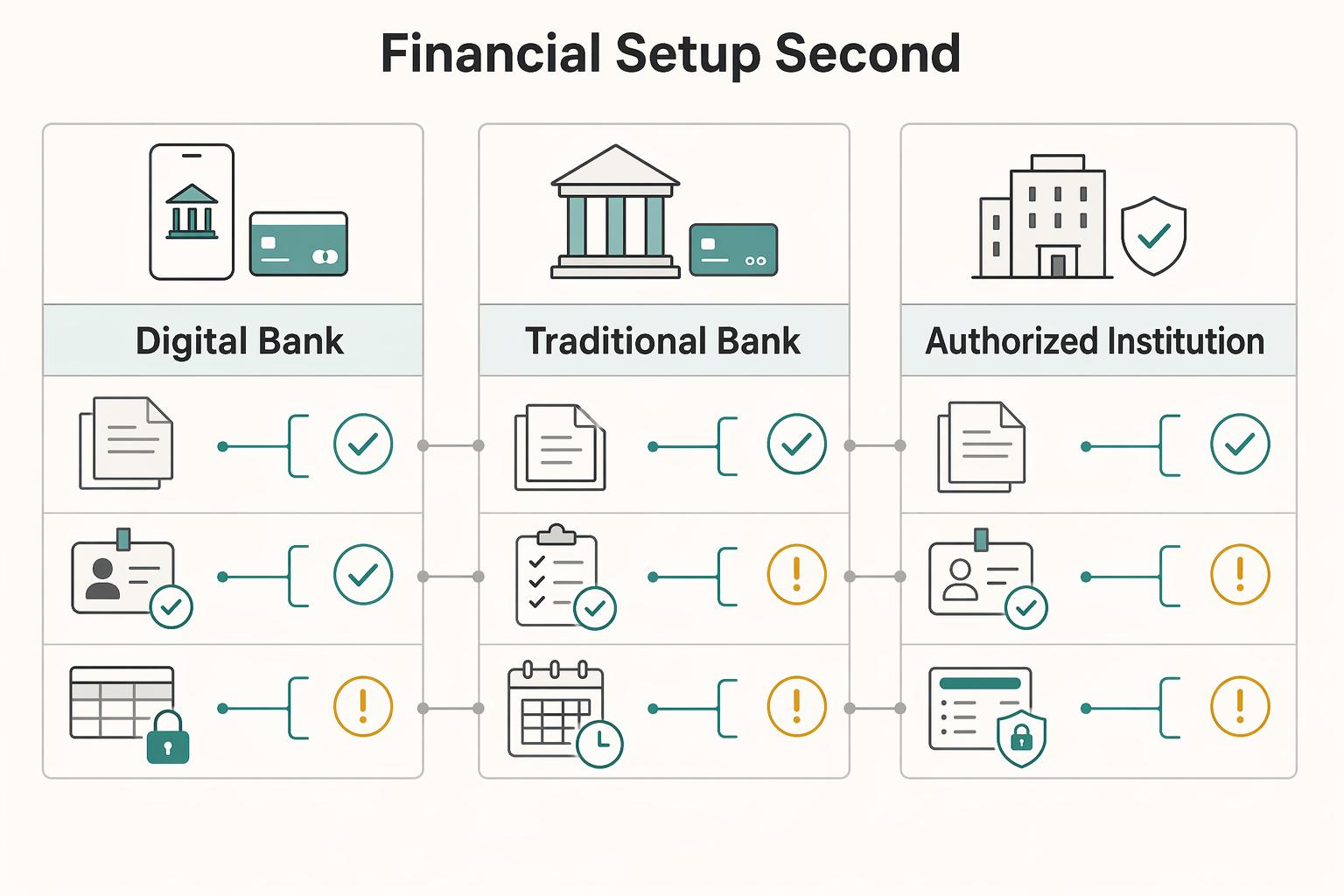
Once registration is underway and your CPF path is clear, set up your payment rails. Pix is Brazil's instant payment system, so compare account options by onboarding requirements and transfer practicality, not marketing.
| Option | Onboarding friction | Required documents (institution-defined) | Payment rails | Foreign-transfer practicality | Decision trigger |
|---|---|---|---|---|---|
| Digital bank | Varies by institution and account policy | Institution-defined (often identity/CPF plus requested supporting records) | Product-dependent; may include Pix and local transfers | You may still need a separate authorized FX provider for foreign-currency flows | Choose if app-based onboarding matches your document set |
| Traditional bank | Varies by institution; branch steps may be part of process | Institution-defined compliance documents | Product-dependent; may include Pix and local transfers | Compare FX availability, fees, and VET disclosure before use | Choose if you want branch support for document review |
| Authorized FX institution | Discretionary onboarding (no guaranteed acceptance) | Documentation requested for the specific transfer/account product | Product-dependent | Required lane for compliant inbound/outbound foreign-currency transfers; providers must disclose VET (rate, IOF, fees) | Choose when you need regular cross-border transfers |
Do not assume approval is automatic. Institutions are not obligated to open or maintain these accounts.
Operational setup third#
With immigration and money movement under control, stabilize the basics before the 90-day mark.
- Healthcare: request a Cartão SUS at a local UBS; SUS access is available in Brazil regardless of migration status.
- Housing/admin: keep your name and address formatting consistent across lease, bank, CPF, and Federal Police records to reduce mismatch delays.
- Professional network: set up at least one reliable local channel, such as coworking, professional community, or vetted service referrals, so you can quickly solve document, housing, and admin issues.
Escalate to licensed support when any of these triggers appear:
- You cannot confirm whether your registration deadline is the 90-day or 30-day scenario
- Federal Police flags legalization/translation or document-consistency issues
- Your stay may approach 183 days in 12 months and immigration planning starts overlapping with tax-residency risk (review A Guide to Tax Residency in Brazil for Digital Nomads before that threshold)
Related: Hungary's White Card for Digital Nomads: A Complete Guide.
Brazil Isn't Just a Destination; It's a Strategic Decision#
The cleanest way to think about this move is as a go-or-no-go decision. Proceed only when your visa fit, tax plan, document file, and first-weeks operations are all ready at the same time.
Start with visa fit. VITEM XIV is for remote work you perform in Brazil for a foreign employer, without a Brazilian employment link. If your plan includes working for a Brazilian company, this is the wrong route. The required proof set matters, and the consular authority can still request additional documents. So the real standard is a complete, route-specific file, not just hitting the published US$ 1,500 monthly or US$ 18,000 funds thresholds.
Then lock your post-arrival registration plan. If you hold a temporary visa, register with the Federal Police within 90 days after entry. If you received residence authorization, the window is 30 days after publication. Missing the deadline can lead to penalties. A practical readiness check is simple: have a dated appointment plan, a complete registration document set, and a live fee check for CRNM issuance when applicable. That includes confirming whether R$204,77 (code 140120) still applies on the Federal Police page.
| Requirement area | Why it matters | Your proof of readiness | If missing, do this next |
|---|---|---|---|
| Visa status | Confirms you are using the correct legal route | Your VITEM XIV route matches your work facts and current post checklist | Re-check your consulate's live requirements and confirm no Brazilian employment link |
| Registration documents | Required for RNM/CRNM after arrival | Appointment plan, complete document pack, current fee confirmation | Review the Federal Police page and build your post-arrival file now |
| Tax-residency tracking | Helps you monitor exposure early | Entry/exit log with a rolling 12-month day count (including the 183-day marker) | Start day tracking and review A Guide to Tax Residency in Brazil for Digital Nomads |
| Banking setup | Banks define their own onboarding documents | Written checklist from each target bank plus your ID/CPF plan | Ask each bank which foreigner documents they currently accept |
Your next move:
- Ready to proceed if every item above is verified, dated, and matched to your route.
- Delay and fix gaps if any step still relies on assumptions, especially consular requirements, Federal Police timing, tax-day tracking, or bank document fit.
- Before you submit or book, re-check the live rules on your consulate's VITEM XIV page, the Federal Police registration page, and current tax-status guidance.
You might also find this useful: A Guide to Greece's Digital Nomad Visa.
If you want a final pre-submission cross-check, use the Digital Nomad Visa Cheatsheet to confirm your timeline and document sequence.
Frequently Asked Questions
How is Brazil’s tax-residency timing calculated?
This depends on your time in Brazil and your full fact pattern, and this section does not set tax-residency thresholds. Track every entry and exit date, then review A Guide to Tax Residency in Brazil for Digital Nomads and confirm your position with a qualified tax adviser.
How can you prove income as a freelancer or contractor?
Use a consistent evidence pack for foreign remote work, including the required declaration that you can perform your activities remotely. Documentation varies by application route, so confirm the route-specific checklist before filing.
Will you pay tax in both Brazil and your home country?
There is no case-specific tax outcome that can be stated in general. Your result depends on your countries and your personal facts, so use the tax-residency section for planning context and get country-pair tax advice if you expect a longer stay.
What is the CRNM and what do you do after arrival?
For CRNM-related steps, post-arrival Federal Police registration is a key checkpoint, and required documents are part of that process. Confirm your exact post-arrival requirements early and prepare the route-specific documents before your appointment.
Can you open a Brazilian bank account as a nomad?
Account-opening eligibility and document rules are not settled here. Check directly with each institution for its current onboarding checklist and compliance requirements.
Should you apply at a consulate or from inside Brazil?
Brazil provides two application routes under Normative Resolution No. 45: apply while abroad or apply when already in Brazil, and the required documents vary by route. The right choice depends on your current location, nationality-based visa position, and stay plan. Decide only after confirming eligibility and checklist fit for the route you actually intend to use.
Try a related tool
Researched and edited by the Gruv editorial team. Gruv builds cross-border billing, payouts, and finance-operations software for global businesses.
Sources
Includes 4 external sources outside the trusted-domain allowlist.
- irs.gov/individuals/international-taxpayers/foreign-...trusted
- irs.gov/individuals/international-taxpayers/foreign-...trusted
- portaldeimigracao.mj.gov.br/pt/nav-guiada/rn-45trusted
- citizenremote.com/visas/brazil-digital-nomad-visaexternal
- gov.br/mre/pt-br/consulado-lisboa/servicos-consular...external
- gov.br/mre/pt-br/embaixada-helsinque/consular-servi...external
- leglobal.law/countries/brazil/brazil-remote-work-faqexternal
Educational content only. Not legal, tax, or financial advice.
Related Posts

The 2026 Global Digital Nomad Visa Index for 50+ Countries
Start with legal fit, not lifestyle filters. The practical order is simple: choose a route you can actually document, then decide where you want to live. That single change cuts a lot of wasted comparison work and stops you from falling in love with places that were never a real filing option.

Hungary White Card Guide for Digital Nomads: Eligibility, Documents, Fees, and Timeline
Treat this like an audit, not a hope-and-pray submission. Your job is to decide whether your real-world setup fits the permit logic, pick the right filing route, then build one evidence pack that stays coherent even if someone reviews it line by line.

A Guide to Tax Residency in Brazil for Digital Nomads
**Stop treating Brazil tax residency as a guess and run it as a monthly decision system with written rules, clear triggers, and conservative defaults.** If you run a business-of-one in South America, you do not need a risky tax hack. You need a repeatable check that turns legal triggers into actions. Build the ledger and checklist once, then keep the review short and consistent so your tax position stays aligned with how you actually live and work. A practical system starts with triggers you can verify, not opinions you can debate.